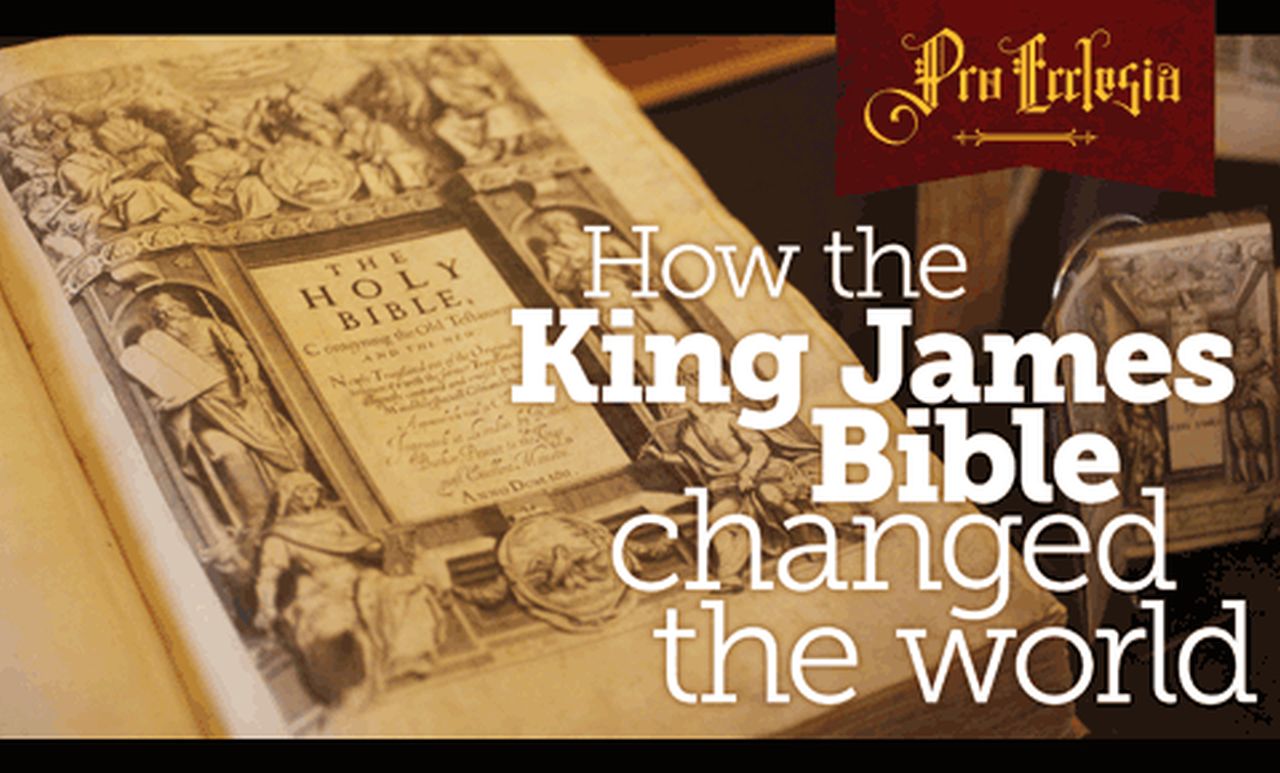
At the Hampton Court Conference, convened by King James I in 1603, John Reynolds, the head of the Puritan Church in England, proposed a new English translation of the Scriptures that would unite the churches and the people of England. Reynold’s goal was one universal authority or standard for all English-speaking Christians. There was division and strife between the churches and the people over the two primary English translations of the time the Bishops’ Bible and the Geneva translation. The Bishops’ Bible, published in 1568 by leaders in the Church of England by the authority of Queen Elizabeth, was the official Bible for usage in the churches. The Geneva Bible, produced in 1560 by exiled Protestant leaders in Geneva, Switzerland, had been adopted and embraced as the beloved Bible of the common people. Although both translations were made from the same textual foundation the Textus Receptus Greek and the Masoretic Text of the Hebrew in many places the English renderings differed, resulting in strife and confusion between pulpit and pew. King James received Reynold’s proposal gladly, and was anxious for work on a new English Bible translation to begin.
A list of the names of fifty-four men was forwarded to the king, who approved the proposed list of translators submitted by the Dean of Westminster and the Regius Professor of Hebrew at Oxford and Cambridge Universities.
The next three years were set aside by the select group of translators for time in private research, prayer, fasting and preparation for the task that lay ahead. The King James translation team was comprised of fifty-four godly men, and arguably the most scholarly men ever assembled for any similar endeavor.
The company met together in 1607 to commence work on the translation and divided themselves into six committees: two met at Oxford, two at Cambridge, and two at Westminster Abbey. The whole of the Bible was distributed in six portions among the various committees: John Reynolds and Miles Smith chaired the committee responsible for the Books of Isaiah through Malachi; Bishop George Abbott oversaw the committee working on the Gospels, Acts and the Book of Revelation; Edward Lively headed the committee which translated I Chronicles through the Song of Solomon;
John Bois’ company worked on the translation of the Apocryphal books; Genesis through II Kings were assigned to Lancelot Andrewes and his group; and the New Testament Epistles were translated by a committee led by Dr. William Bedwell.
The conditions for translation work for a project of the magnitude of the entire English Bible were ideal in the early seventeenth century in England. The translators operated with the blessing and the financial aid of the king himself. All of the scholarship and resources of Cambridge University, Oxford University and Westminster Abbey were at the translators’ disposal. An invitation was extended to “all principal learned men of the kingdom” to participate as consultants or advisors. Historians concur that during this era the English language had “ripened to its full perfection” (from Alexander McClure’s The Translators Revived). McClure also stated that “the study of Greek, and of the oriental languages, and of rabbinical lore, had been carried to a greater extent in England than ever before or since.” The character and credentials of the translators were impeccable. Lancelot Andrewes, while a young student at Cambridge, learned a new language each year during Easter break. After several years, he had mastered most of the languages of Europe. Andrewes spoke Latin, Greek, Hebrew, Chaldee, Syriac, Arabic and at least fifteen other languages. It was said of him that he could have been “interpreter general” at the Tower of Babel! He was also reputed to have spent an average of five hours each day in prayer. Among the Christians of his day he was known as “the star of preachers.” It was said that “those who stole his sermons could never steal his preaching.” Andrewes had the privilege of being selected, from among all the preachers in the land, to deliver the annual Christmas Day sermon for the royal family, beginning with Queen Elizabeth and continuing for many years during the reign of King James.
William Bedwell produced translations of the Scriptures into Hebrew, Syriac, Chaldee and Arabic. He produced a Persian dictionary and a three-volume Arabic lexicon. He was a master of the Semitic languages, which shed much light on Hebrew words and phrases, most importantly those Hebrew words and phrases that found their way into the Greek language of the New Testament.
John Bois read through the Hebrew Bible by age five, and by age six was writing Hebrew legibly. He was often found studying Greek at the Cambridge library from four a.m. until 8 p.m. (sixteen hours a day!). Bois tutored many of his fellow students at the University in Greek, and his class was also attended by many of his Greek professors! John Bois served as pastor of St. John’s Church before, during, and after his work as Bible translator. He preached without notes, but not without much prayer and study. He had the entire Greek New Testament committed to memory. He practiced fasting twice a week, and often gave to help the poor until he had no more to give himself. Among Bois’ writings was a commentary in Latin on the Gospels and Acts. Even after his retirement, he spent eight hours a day in study, mostly reading and correcting the ancient authors.
Dr. Miles Smith was known as “a walking library.” He was called by his contemporaries “an incomparable theologist.” He had studied all of the writings of the Latin and Greek church fathers, and was as well versed in Arabic, Chaldee and Syriac as he was in English. It was said of Smith that he “had Hebrew at his fingers’ ends.” He was chosen by the other translators to write the Preface to the King James Bible, The Translators to the Reader. Concerning his fellow translators, he wrote: “There were many chosen who were greater in other men’s eyes than their own, and who sought the truth rather than their own praise.” Miles Smith served as the final editor on the King James translation, perusing the entire text of the Bible before it went to press in 1611.
At age 23, John Reynolds was made a Greek lecturer at Corpus Christi College. He gave himself to the study of the Scriptures in the original languages, and was an “able and successful preacher of God’s Word.” He had read all the Greek and Latin fathers, and all the records of the ancient church. He was known as “a living library” and “a third university” (Oxford, Cambridge, and John Reynolds!). These are a few observations of Reynolds contemporaries: “As to virtue, integrity, piety, and sanctity of life, he was so eminent and conspicuous, that to name Reynolds is to commend virtue itself.” “He alone was a well-furnished library, full of all faculties, all studies, and all learning. The memory and reading of that man were near to a miracle.” “He was most excellent in all tongues useful or ornamental to a divine. He was so well skilled in all arts and sciences, as if he had spent his whole life in each of them.”
Of the fifty-four translators, four were college presidents, six were bishops, five were deans, thirty held PhD’s, thirty-nine held Masters degrees, there were forty-one university professors, thirteen were masters of the Hebrew language, and ten had mastered Greek. Every man involved in the King James Bible translation believed in the verbal inspiration of the Scriptures, all believed in the deity of our Lord Jesus Christ, and all were men of prayer. Many were not only Biblical scholars and master linguists, but also God-called, Spirit-filled preachers. Yet the translators considered themselves “poor instruments to make God s holy truth to be yet more and more known unto the people.”
A look at some of the statements of the translators themselves reveals the depth of their convictions concerning the eternal Word of God. They spoke of the Scriptures as “that inestimable treasure which excelleth all the riches of the earth.” They acknowledged the Bible as being “so full and so perfect,” “a fountain of most pure water, springing up into everlasting life.” They believed “the original (Scriptures were) from heaven, not earth; the author being God, not men; the penmen, such as were sanctified from the womb and endued with a principal portion of God’s Spirit.” They referred to the Bible as “God’s Word,” “God s Truth,” “God’s testimony,” “the Word of salvation.” Study of the Scriptures brought “light of understanding, stableness of persuasion, repentance from dead works, newness of life, holiness, peace, joy in the Holy Ghost, fellowship with the saints, participation of the heavenly nature, fruition of an inheritance immortal, undefiled, and that shall never fade away.” From the translators Epistle Dedicatory, the dedication letter of their Bible translation to King James I:
“Among all our joys, there was not one that more filled our hearts, than the blessed continuance of the preaching of God s sacred Word among us.”
Some closing comments from The Translators to the Reader: Gentle Reader, we commend thee to God, and to the Spirit of His grace. He removeth the scales from our eyes, the veil from our hearts, opening our wits that we may understand His Word, enlarging our hearts, yea correcting our affections, that we may love it above gold and silver, yea that we may love it to the end. Ye are brought unto fountains of living water which ye digged not. Others have labored, and you may enter into their labors; O receive not so great things in vain, O despise not so great salvation! It is a fearful thing to fall into the hands of the living God; but a blessed thing it is, and will bring us to everlasting blsessedness in the end, when God speaketh unto us, to hearken; when He setteth His Word before us, to read it; when He stretcheth out His hand and calleth, to answer, Here am I, here we are to do thy will O God.”
In the final analysis, the translators of the King James Bible believed that what they had spent nearly seven years of their lives producing was an “exact translation of the holy Scriptures into the English tongue.”
Bible Bashed! King James Bible Bashing. CS Lewis Idolatry!
Persecuted for Believing God is Not Confused about His Real Word! ————————— BREAKING: The violent bashing continues…. NIV defenders attacking me because I believe God preserved His Word in the King James Bible – just as He promised (Psalms 12:6-7). Recently, an enraged “pastor” messaged me seeking to argue Bible versions… which he brought up, not me. He initiated the conversation and got real frustrated when I simply, kindly asked him to explain why Matthew 17:21 is removed, why Romans 8:1 is chopped in half, and why the BLOOD of Jesus was removed from Colossians 1:14. He didn’t like […]
THE KING JAMES BIBLE TRANSLATORS
by David W. Daniels Question: Who were the translators of the King James Bible? Answer: God brought together over 54 of the finest Bible translators English has ever known, to translate the King James Bible. Researching the Translators For twenty years (the late 1830s to the late 1850s) researcher Alexander McClure pored over records to learn all he could about who translated the King James Bible. His resulting book, Translators Revived: Biographical Notes on the King James Version Translators, stands as a monument to these dedicated Christian men. It may be read online at www.books.google.com. I highly recommend it. A Few Short Examples Here are […]
“And say to Archippus, Take heed to the ministry which thou hast received in the Lord, that thou fulfil it.” Colossians 4:17
MINISTRY which pleases God is simply helping people know and grow in Christ for themselves – by the cross life and getting into HIS Word for themselves so they can follow HIM, not you! True ministry fosters in the hearers faith in God, not the preacher or local church organization! Read 1 Corinthians 2:1-5; 2 Corinthians 1:9; 3:5; 4:5.
Your communications and ministry are fed and fueled by your personal daily study and knowledge of God’s Word (Proverbs 22:17-21; 2 Timothy 2:15).
Ephesians 4:1-14
“I therefore, the prisoner of the Lord, beseech you that ye walk worthy of the vocation wherewith ye are called, 2 With all lowliness and meekness, with longsuffering, forbearing one another in love; 3 Endeavouring to keep the unity of the Spirit in the bond of peace. 4 There is one body, and one Spirit, even as ye are called in one hope of your calling; 5 One Lord, one faith, one baptism, 6 One God and Father of all, who is above all, and through all, and in you all. 7 But unto every one of us is given grace according to the measure of the gift of Christ. 8 Wherefore he saith, When he ascended up on high, he led captivity captive, and gave gifts unto men. 9 (Now that he ascended, what is it but that he also descended first into the lower parts of the earth? 10 He that descended is the same also that ascended up far above all heavens, that he might fill all things.) 11 And he gave some, apostles; and some, prophets; and some, evangelists; and some, pastors and teachers; 12 For the perfecting (equipping, maturing) of the saints, for the work of the ministry, for the edifying of the body of Christ: 13 Till we all come in the unity of the faith, and of the knowledge of the Son of God, unto a perfect man, unto the measure of the stature of the fulness of Christ: 14 That we henceforth be no more children, tossed to and fro, and carried about with every wind of doctrine, by the sleight of men, and cunning craftiness, whereby they lie in wait to deceive;” Ephesians 4:1-14
“Reformed Theology“, is just a fancy way of saying ‘We know better than Paul, the old testament prophets, even David! And the very apostles who walked with Jesus must be unlearned men or liars.’ Nay, I will not say such a thing of my LORD and Saviour, Christ Jesus. Let God be true, and >every< man a liar.” Jonathan Crane It’s “ungodly men” who mislead the gullible with the eternal security heresy, and the heretical doctrines and system of calvinism. Jude warned us of just that, as did the prophets (Jude 3-4; Jeremiah 23:17, etc.). Then Jude reminds us of […]
Out of the Mouth of Babes - "What is Love?" Hilarious. Revealing. [podcast]
What these precious children say will have you laughing and perhaps crying. Our LORD Jesus, the greatest Servant says: “Greater love hath no man than this, that a man lay down his life for his friends.” John 15:13 This “greater love” of our Creator, Jesus Christ, was busy blessing each of us in our mother’s womb. Reading 1 Corinthians 13 today will refresh your heart and mind on the divine importance placed upon LOVE. Share. Recently it occurred to me…. That the younger the child, the less corrupted they are by this world and the closer they are to […]
The LORD’s Vision to His Servant Isaiah and how it Relates to each of Us When the LORD revealed Himself more fully to the man Isaiah, the response of Isaiah is something we should behold and be taught by, learn from. “Then said I, Woe is me! for I am undone; because I am a man of unclean lips, and I dwell in the midst of a people of unclean lips: for mine eyes have seen the King, the LORD of hosts. 6 Then flew one of the seraphims unto me, having a live coal in his hand, which […]
God Himself personally sends a “strong delusion” to all who do not love His truth so that they WILL believe lies. He greases their pole to hell. That’s how personally He takes it when people call Him a liar by not believing His Word.
“Even him, whose coming is after the working of Satan with all power and signs and lying wonders, 10 and with all deceivableness of unrighteousness in them that perish; because they received not the love of the truth, that they might be saved. 11 And for this cause God shall send them strong delusion, that they should believe a lie: 12 that they all might be damned who believed not the truth, but had pleasure in unrighteousness.” 2 Thessalonians 2:9-12
“Beware lest any man spoil you through philosophy and vain deceit, after the tradition of men, after the rudiments of the world, and not after Christ.” Colossians 2:8
Notice “of God” and “NOT of God”
“He that is OF GOD heareth God’s words: ye therefore hear them not, because ye are NOT OF GOD.” John 8:47
How do We Know Who is "of God" and Who is "Not of God"? [podcast]
Scripture vs Subjectivity/Human Reasoning “Beware lest any man spoil you through philosophy and vain deceit, after the tradition of men, after the rudiments of the world, and not after Christ.” Colossians 2:8 There are many people pretending to be representing Christ. Many pretend to speak for God but how do we know who is truly “of God” and who is “not of God”? Jesus gave us the answer to this important question because He desires His people to be protected by proper discernment. He has warned us repeatedly to “Beware of false prophets, which come to you in sheep’s clothing, but […]
Return and Discern [podcast]
THE LORD IS DOING A WORK TODAY IN THE HEARTS OF HIS PEOPLE – BLESSING US TO BE POOR IN SPIRIT, HUNGERING FOR MORE OF HIM, AND PURE IN HEART (Matthew 5:3, 6, 8 ). It’s all in spite of our own failings and sin and because of His great mercies which are renewed every morning – GREAT is His faithfulness (Lamentation 3:22-23). Discernment is only granted by God when we truly repent which means we lay down our lives in this fleeting world and follow Jesus for real (2 Corinthians 3:16-18). WHEN we earnestly seek the face of the […]
The Essential Doctrine of Repentance
The Biblical Statement on the Essential Doctrine and Necessity of Repentance – in Life and in the Dispensing of the Original Gospel Message. Though nearly never heard in today’s apostate modern church world, according to Christ’s unchanging original Gospel, repentance is an absolute necessity. Karen Cochran observes: “It doesn’t seem the word repent is part of the Christian’s vocabulary! In the modern church, it’s all about God accepting you the way you are without any requirements to repent and die to self.” Note that in modern churches, “Christian” radio, media, books, the word “repent” is rarely if ever heard. Yet […]
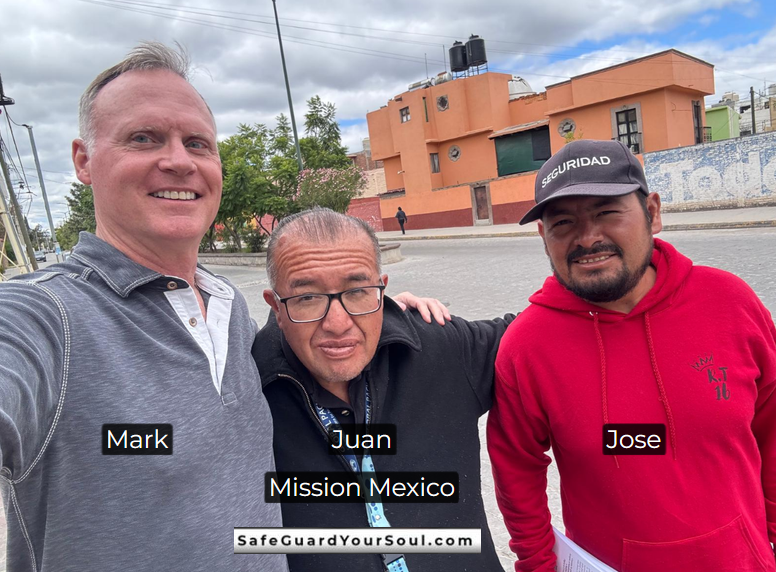
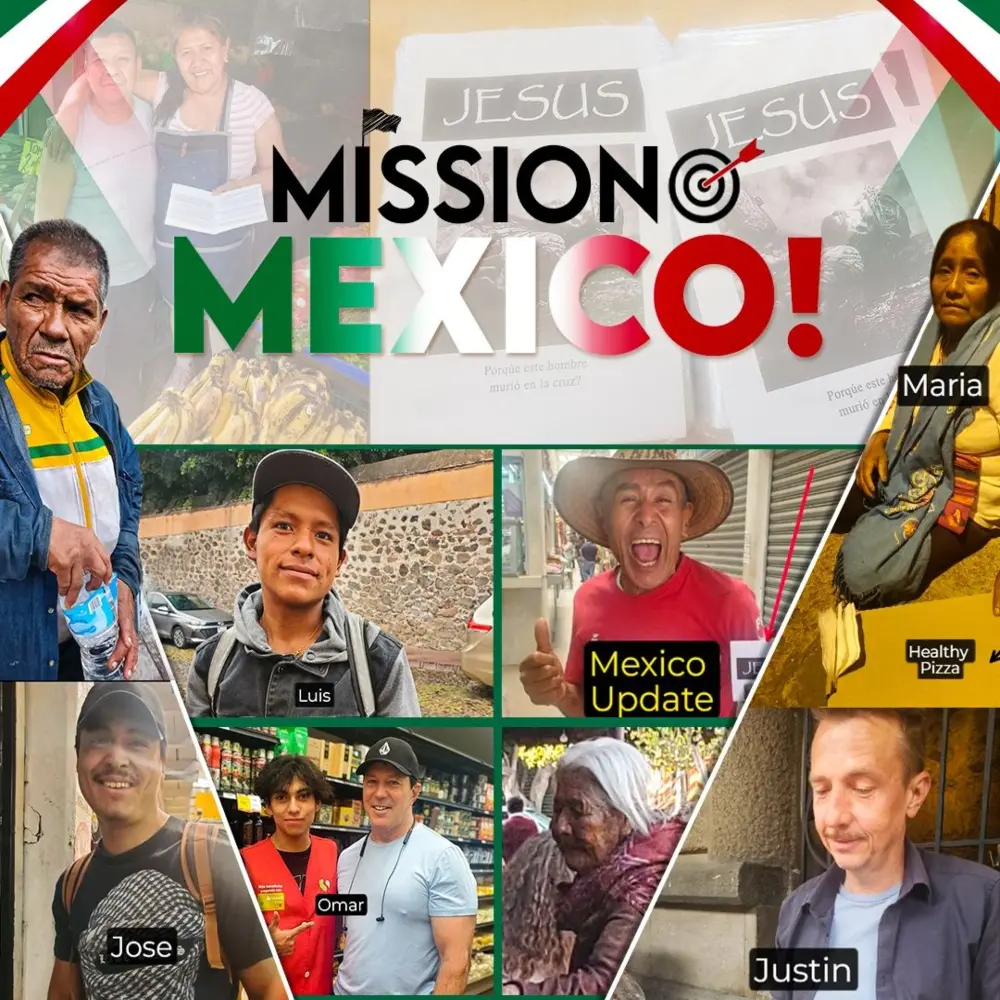
THIS MORNING: Brother Mark brought brother Juan to meet our new brother Jose Patron!
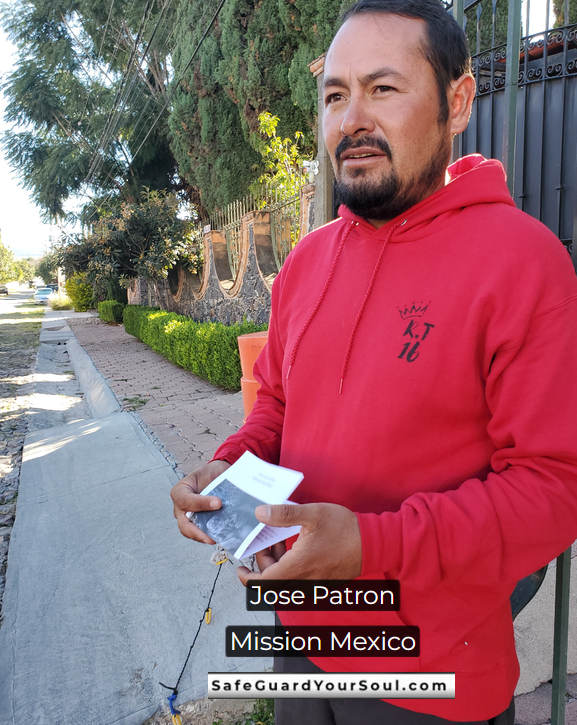
Jose was given a stack of JESUS tracts after he said he wanted to evangelize.
Brother Juan passes by where Jose works for work daily and so that connection and fellowship is being put in place.
“WE are labourers TOGETHER with God” (1 Corinthians 3:9) – and what God has us doing is supporting His beloved “labourers” who are “few”! (Matthew 9:35-38)
A FEW DAYS AGO: Sister Maria called for more JESUS tracts. She ran out as she is distributing hundreds per day. So our dear sister, thanks to you who are praying and supply…. was given a new jacket to keep her warm (pictured), food and drink to bring home for her living quarters, a fresh supply of JESUS tracts, some cash (Mexican pesos), and some Scripture that she as usual read out loud and devoured as I brought them up on my cell phone from the Spanish Bible (Reina Valera). God is good saints. May He be glorified in all you are doing to see the beloved people of Mexico reached with His bless-ed Gospel! You are refreshing His beloved saints.
LORD willing, I will be meeting again with our dear brother Juan this week to refresh him in fellowship etc.
“Pure religion and undefiled before God and the Father is this, To visit the fatherless and widows in their affliction, and to keep himself unspotted from the world.” James 1:27
Mexico: The Land where the Gospel of Jesus is Freely Received
“Freely ye have received, freely give.” Matthew 10:8
As we truly follow Jesus He makes us fishers of men.
“And Jesus said unto them, Come ye after me, and I will make you to become fishers of men.” Mark 1:17
This was the sweetest couple ever as you can tell by the picture. They were overjoyed to receive the preaching of our LORD’s Gospel and were told how to be saved – repentance and faith in Christ, and showed the prayer on the back, etc. They were directed to the prayer on the back and exhorted to pray in repentance and faith and receive eternal life. When asked they said they’d welcome your prayers for them.
On the streets today in Mexico ministering our LORD Jesus’ Gospel to many. As usual the name of Jesus was preached in Christ’s love and it was readily, eagerly received by most who thanked us for giving them the Gospel. SMH. It’s no even fair!
A man name Jose was ministered to, received the Word, and prayed in repentance and faith to be saved! Would you like to lift our new brother in Christ in prayer? Jose Patron is his name and we are connected and he’s already been given more Scripture and added to the Spanish WA group.
Jose just sent me a voice recording saying Thank you to Mark and I for ministering Jesus’ Gospel to him and that he wants to do the same thing we are doing, minister to others our LORD’s Gospel.
“So mightily grew the word of God and prevailed.” Acts 19:20
“The food looks healthy. Just this morning I was thinking that it is unfathomable, in my mind, to comprehend what the Lord is doing in Mexico. I watched the video of Mark passing out Jesus tracts and everyone was so receptive. That stuck in my mind, because I recently watched a video of a man preaching the gospel on a train. Zero response! Everyone kept looking at their phones and never once looked up. This is the true state of America. We have need of nothing and especially not Jesus. Rev 3:17. As opposed to the precious people of Mexico who know they are poor in spirit and are in need of the Lord to save them. They know something is missing in their lives. When Mark was passing out those Jesus tracts people were very happy and joyful to receive them, here they are rejecting the Savior.” Karen Cochran
We went to a colonia, to a street where no one was outside at the moment, Brother Mark said “God sent us this way for a reason, for someone.” 30 seconds later we came upon Jose! Boom.
Then came the Gospel explosion!
Upon ministering Christ’s Gospel to him, Jose Patron excitedly shared with brother Mark and I about how God had saved him from dying. He simply needed the opportunity to repent and be saved – and that’s exactly what JESUS did. Thank you for lifting our beloved brother Jose in prayer.
Jose just sent me a voice recording saying Thank you to Mark and I for ministering Jesus’ Gospel to him and that he wants to do the same thing we are doing, minister to others our LORD’s Gospel.
“So mightily grew the word of God and prevailed.” Acts 19:20
Gospel blessings abounded on the streets in Mexico ministering our LORD Jesus’ Gospel to many. As always the name of Jesus was preached in Christ’s love and it was readily, eagerly received by most who thanked us for giving them the Gospel.
It’s no even fair to have the privilege to minister to the beloved Mexicans! SMH.
A man name Jose was ministered to. He received the Word, and prayed in repentance and faith to be saved! Would you like to lift our new brother in Christ in prayer? Jose Patron is his name and we are connected and he’s already been given more Scripture and added to the Spanish WA group.
Jose just sent me a voice recording saying Thank you to Mark and I for ministering Jesus’ Gospel to him and that he wants to do the same thing we are doing, minister to others our LORD’s Gospel.
Thank you for lifting the salvation of the people of Mexico in your prayers. | Mexico Mission
“I love this brother! May God continue to provide and increase his fruit in the lives of the disciples in Mexico, in the Philippines, in Pakistan, in Kenya, in all his earth for his glory! Amen.
I was reading Psalm 8 and John 10. Beautiful beyond understanding is God’s love poured out in Christ Jesus toward us who hear his voice!
Much love to the body of Christ in Mexico and throughout the whole world. Jesus is coming!
“EVERY person you meet, or stand next to in line, is an opportunity to share the Good News. Do not miss the opportunity to bring another into the Kingdom.
I thank God everyday that this happened to me 5 years ago.” Targeted Christian Girl, RN
Let us be blessed to preach Christ’s Gospel this day.
Upon having the Gospel of Jesus preached to her, beloved Laura informed me that she is a born again saint!!! After fellowshipping she took a stash of JESUS tracts. Would you like to pray for sister Laura?
After receiving the ministry of God’s Word, Antonio was asked if he wanted you to lift him in prayer. He eagerly accepted and is glad you will pause to lift his life to the LORD in prayer. | Mexico Mission
ON THE TOPIC OF MEXICO
The Mexican people never handed their country over to the government so that the government can take it away the government cannot take it away because
Historically and presently the Mexican people find a way to circumvent the government. They never let the government have control and therefore the government can’t take their freedom away – because the people recognize their freedom coming from God.
The tax money of the people is a large way that the government controls the people they are empowered by the riches of the people through taxes in order to control and exploit them endlessly. Your tax money fuels your slavery….
Mexican people have a very healthy dis-trust for government. This is unlike many Americans. Many Americans it seems, haven’t learned that the promises candidates make before an election, will nearly never carry them out when elected. It seems the “We’re going to release the epstein files” was a mere ruse to cover those secret files. “It’s all a big club, and you’re not in it.” George Carlin
Thank you for praying for this man, Juan. He received ministry today and is in need of being saved.