“Let none of you imagine evil against his brother in your heart.” Zechariah 7:10
Get gone the guile. Crucify it.
“Put on therefore, as the elect of God, holy and beloved, bowels of mercies, kindness, humbleness of mind, meekness, longsuffering; 13 Forbearing one another, and forgiving one another, if any man have a quarrel against any: even as Christ forgave you, so also do ye. 14 And above all these things put on charity, which is the bond of perfectness.” Colossians 3:12-14
The divine command to “love one another” appears 13 times in God’s word.
“Greater love hath no man than this, that a man lay down his life for his friends.” John 15:13
When God’s people walk in God’s love, they are not nit picking or busybodying the lives of others. Never. No, rather they are realizing the potential of their own wicked hearts and the great and sheer mercy of God in saving them (Psalms 103:10; Romans 7:18, 24; 1 Peter 4:15). Whew!
Have you needed, do you presently need, and will you need future mercy? Yes.
Memorize:
“And be ye kind one to another, tenderhearted, forgiving one another, even as God for Christ’s sake hath forgiven you.” Ephesians 4:32
Love and Liberty in things Not Essential to Salvation – Things that don’t jeopardize the eternal soul.
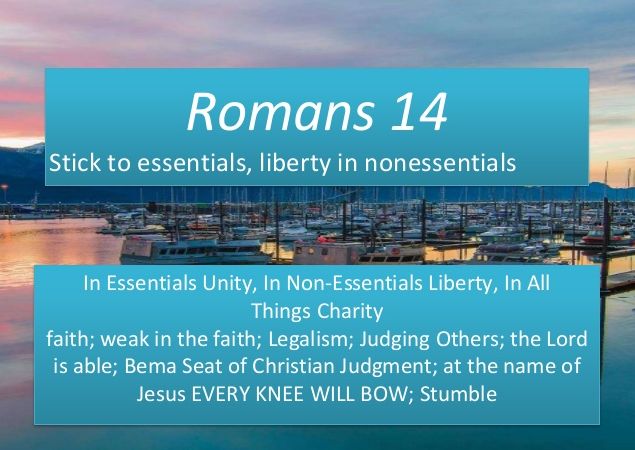
God gives each of His saints liberty in NON-essentials, that is, in things not clearly stated as being sin. Read Romans 14 prayerfully, carefully.
The decisions other believers make concerning NON-essentials is none of your business. Read Romans 14 and obey God.
Concerning this important chapter, the Believer’s Bible Commentary notes:
“Romans 14:1-23
In Relation to Other Believers (14:1-15:13)
14:1 Romans 14:1-15:13 deals with important principles to guide God’s people in dealing with matters of secondary importance. These are the things that so often cause conflict among believers, but such conflict is quite unnecessary, as we shall see. A weak Christian is one who has unfounded scruples over matters of secondary importance. In this context, he was often a converted Jew who still had scruples about eating nonkosher foods or working on Saturday. The first principle is this: a weak Christian should be received into the local fellowship, but not with the idea of engaging him in disputes about his ultra scrupulousness. Christians can have happy fellowship without agreeing on nonessentials.”
Issues arise among believers concerning non-essentials. Just what are the essentials of the faith? And therefore what things are non-essential to believers?
Love is the essential concerning non-essentials. Love doesn’t judge another saint concerning things not essential to his salvation which is in Christ (1 Corinthians 13; 1 Peter 4:7-8; 1 John 4:7-8, etc.).
God gives each and every believer individual liberty in the non essentials according to Romans 14. This are part of the in-house order of God’s people.
Never destroy the work God has and is doing in someone’s life for something not essential to salvation.
Read the Galatians 5:19-21 list of soul damning sins so that when you are thinking of addressing another believer on something, you make sure it’s that such as issue is named on this list of sins.
What kind of food someone eats is not on that list. The day of the week a believer chooses to gather with other believers in fellowship is not on that list. Who a believer chooses to marry (age, race, etc.), as long as they are a true believer, is not on that list. How one chooses to spend his money, is not on that list. etc.
One writer notes:
“And whether you are a ‘Lord’s day’ observer (Sunday) like Ignatius of Antioch, or a ‘Sabbath’ observer (Saturday) like his very close friend, Polycarp, as Paul the apostle would say ‘Let each be fully convinced in his own mind.’ These two men had NO contentions whatsoever between one another. In fact, Polycarp called Ignatius ‘Ignatius the BLESSED.’ Perfect harmony between brothers in Christ.”
The way an individual believer chooses to operate with his God-given personal liberty in non-essentials is up to him and no one else. Yet, he must not condemn others in his heart or otherwise for seeing and practicing their own God-given liberty as they see fit. See Roman 14. Being a “busybody” is condemned in Scripture (1 Peter 4:15).
God’s Word makes it clear that only a “fool” will meddle, interject themselves into the affairs of others unnecessarily.
“It is an honour for a man to cease from strife: but every fool will be meddling.” Proverbs 20:3
This is a biblical truth, component, not tended to enough. In order to “grow up into him in all things, which is the head, even Christ”, we must cease being condescending towards other saints concerning things that are none of our business (Ephesians 4:15).
“For the kingdom of God is not meat and drink (non-essentials); but righteousness, and peace, and joy in the Holy Ghost. … For meat (any non-essential) destroy not the work of God. All things indeed are pure; but it is evil for that man who eateth with offence.” Romans 14:17, 20
“It is good neither to eat flesh, nor to drink wine, nor any thing whereby thy brother stumbleth, or is offended, or is made weak.” Romans 14:21
Concerning judging other believers on NON-essentials, the apostle Paul forewarns:
“But why dost thou judge thy brother (on NON-essentials)? or why dost thou set at nought thy brother? for we shall all stand before the judgment seat of Christ.” Romans 14:10
Do you know what Scripture reveals of essentials and non-essentials?
It frustrates the grace and work of God when we infringe upon the individual liberty He gave each and every individual saint in non-essentials.
Among authentic disciples (not counterfeits nor wolves), we must never judge each other’s servant/serving. And, we must admit to/realize just how imperfect our own serving is…..
“Who art thou that judgest another man’s servant? to his own master he standeth or falleth. Yea, he shall be holden up: for God is able to make him stand.” Romans 14:4
If you dare take this self-righteous stance to judge other Christians for non-essentials, then you have some things to explain: Unless you are reading the Bible and praying 24 hours per day every day, then you have need to explain just why that’s not sin.
The point in this matter that Paul makes is that what we eat or drink has nothing to do with our salvation and is a matter of individual liberty. So, we have and we give liberty to other believers in non-essentials.
To eat or not to eat is the God-granted decision of the individual disciple. Neither eating or not eating certain foods has anything to do with one’s place with the LORD. The person who doesn’t eat has no better relationship with Christ than the person who chooses to eat that pork, drink that coke, or otherwise.
Speaking of NON-essentials to the faith….
“Him that is weak in the faith receive ye, but not to doubtful disputations.” Romans 14:1
“By thought and prayer and the study of God’s Word, conscience becomes educated and strengthened, and ceases to worry as to whether we should be vegetarian or not; whether we should observe saints’ days, or adopt a specific method of observing the Sabbath. Some people are constantly wondering and questioning about such things, as though their eternal salvation depended on minute observances.” FB Meyer
ON THE MATTER OF WHAT IS SIN IN GOD’S EYES AND WHAT IS A NON-ESSENTIAL
Recently, a dear brother in Christ began sharing with me how he’s being told by some self-righteous novices that he’s going to hell because he on occasion watches a football game. Here’s my reply to him:
I’ve been attacked by these pharisees too in the past. They are delusional, totally self-righteous. Ask them this: “So, is playing a GAME of cards going to send someone to hell? yes or no?” Force them to answer. Ask: “Where does God’s Word tell us that playing a game of cards is a soul damning sin? Chapter and verses please? Be the one asking the questions. Then ask them this: “Okay, so if my son or nephew are participating in a sporting event like say, they are playing in a football game, please show me in the Bible exactly what sin I am committing by attending the game. Waiting…..
So, in other words, a game is a game, so where do we draw the line? right? We draw the line where GOD draws the line in His Word. If something is not directly or principally listed as a sin, it’s not a sin. It’s a non-essential and totally an individual choice for the believer as he/she works out their salvation with fear and trembling before the LORD (Romans 14). Such liberties are not to be judged by other believers which would be being a busybody.
“But let none of you suffer as a murderer, or as a thief, or as an evildoer, or as a BUSYBODY in other men’s matters.” 1 Peter 4:15
If something isn’t listed at least categorically on the list of 17 soul damning sins in Galatians 5:19-21, it is not a sin and is a NON-essential. Rebuke and then point these self-righteous devils to Romans 14 and insist they read it. Personally, I hit and run with these self-righteous devils, for they are the same ilk as the hell bound religious devils Jesus dealt with and told they are going to hell three times in Matthew 23.
COMMON OBJECTION:
“But wait, James 4:4 says that if any man love this world, he’s the enemy of Christ.”
REPLY:
When James speaks of loving the world, he is not speaking about the liberties God gives to each individual believer in this life, otherwise James would be contradicting Paul, and we know that’s not possible. James is speaking of the 3 things Jesus specifically defines as loving this world in Mark 4:17-19: 1. the cares of this world, 2. the deceitfulness of riches, and 3. the lusts of other things. Not the use but the LUST of other things.
“And the cares of this world, and the deceitfulness of riches, and the lusts of other things entering in, choke the word, and it becometh unfruitful.” Mark 4:19
If you define anything other than Bible reading, praying, praise, and fellowship as a sin, you better stop all things like shopping, paying rent, walking down the street, going to work, driving a vehicle, getting something to eat at a restaurant, etc. – because in your conscience, your calculating, mis-guided mind, all those things are sin.
The neutral things of this world are NOT sin. The misuse of them is. Listen to what Christ’s apostle Paul wrote about this world as pertains to married people:
“But this I say, brethren, the time is short: it remaineth, that both they that have wives be as though they had none; 30 And they that weep, as though they wept not; and they that rejoice, as though they rejoiced not; and they that buy, as though they possessed not; 31 And they that use this world, as not abusing it: for the fashion of this world passeth away (is temporal). 32 But I would have you without carefulness. He that is unmarried careth for the things that belong to the Lord, how he may please the Lord: 33 But he that is married careth for the things that are of the world, how he may please his wife.” 1 Corinthians 7:29-33
It’s the abuse of the temporal things of this world Paul addresses and not the simple use of them.
Perhaps we’ve all got a bunch of legalism still in us due to the bad example and teachings we’ve heard and our own lack of knowledge of God’s Word on this topic…. we are not yet experiencing Christ’s liberty…. not liberty to sin but rather His joy and love in all things….
In this post, we are addressing and citing those who are sinfully judging other believers for things not essential to salvation – never specifically mentioned as sin…. Read Romans 14:4-5 again please.
Romans 14 is the chapter that is all about non essentials and personal liberty given to each individual believer by the LORD. Get familiar with it friend so we don’t judge other believers on non-essential issues that are none of our business.
PLEASE read Romans 14 every morning this week prayerfully. We must grow up into Christ in all things saints. Learn about essentials and non-essentials. Never argue or in any way hinder God’s work in one of His children concerning a NON-essential. That’s one of the main truths in Romans 14. Please share this truth with other believers.
No where in Scripture do we see that a certain end time view (pre, post, etc.) is essential to our salvation – other than knowing Jesus is coming back. Food and drink are also not essential to our salvation (Romans 14; Mark 7:20-23). Such is never mentioned as a soul-damning sin or as a Gospel imperative. God wants us to mature and not judge other saints for things that are non-essential – not necessary/essential to our salvation. IF you don’t see something identified as a soul-damning sin or essential foundational truth of the Gospel, you may want to refrain from despising in your hearts another believer. This doesn’t negate exhortation or admonishment when needed but we are never to judge another true Christian for observing Saturday or Sunday being that that has nothing at all to do with salvation (Romans 14; Colossians 2:14-19).
Unwarranted intrusion. In part perhaps “intruding” can mean going to places we are not sure of, such as citing someone for something you don’t like while the Bible never says that such a thing is sin. Such non-essentials must be kept in mind to be the God-given individual liberties of each believer, as that individual does so according to his own conscience. We are instructed not to judge another believer on something that is not an essential – something not specifically named as a sin in God’s Word. If something cannot be ascertained as a sin, a disciple of Jesus should not be cited, confronted about such. Instead, perhaps we should mind our own business and allow other members of Christ’s body to exercise themselves as they see fit in non-essentials to salvation. Get to know Romans 14.
“Let no man beguile you of your reward in a voluntary humility and worshipping of angels, intruding into those things which he hath not seen, vainly puffed up by his fleshly mind, 19 And not holding the Head, from which all the body by joints and bands having nourishment ministered, and knit together, increaseth with the increase of God.” Colossians 2:18-19
Many times, when we become hyper-critical of others, it’s because there’s a deficiency in our own lives. Many times, when called upon to servant-lead, we wonder why others don’t desire to follow. On this note and namely concerning when we are called to lead, Oswald Chambers writes:
“If you are in a position of authority and people are not obeying you, the greatest heart searching you can have is realization that the blame does not lie with them but with you; there is a leakage going on spiritually. Get right with God yourself, and every other one will get in touch with God through you.” Oswald Chambers, God’s Workmanship, p. 328
Open God’s Word (KJV) and study Romans 14-15 today prayerfully.
Concerning “meat and drink” which represents non-essentials to salvation, Christ’s apostle warns: “Who art thou that judgest another man’s servant? to his own master he standeth or falleth. Yea, he shall be holden up: for God is able to make him stand. 5 One man esteemeth one day above another: another esteemeth every day alike. Let every man be fully persuaded in his own mind.” (Romans 14:4-5)
It’s wrong if we impose upon other saints our own personal convictions on non-essential issues – in those things are not essential to salvation. Not one Scripture says watching a family clean movie is a sin or playing a card game or watching a soccer game or going out to eat….. Those who say such things are novices and adding to God’s Word and imposing your own conscience convictions concerning non-essential on others. Obviously you have no clue what Paul taught in Romans 14 and 1 Corinthians 10 on Christian liberties.
If Jesus is teaching YOU personally to stay away from all these things, do it – BUT DON’T IMPOSE SUCH ON OTHERS unless it’s clearly taught in Scripture. Paul says “Why is my conscience judged of another man’s conscience?” ….
1 Corinthians 10:29-32: “Conscience, I say, not thine own, but of the other: for why is my liberty judged of another man’s conscience? 30 For if I by grace be a partaker, why am I evil spoken of for that for which I give thanks? 31 Whether therefore ye eat, or drink, or whatsoever ye do, do all to the glory of God. 32 Give none offence, neither to the Jews, nor to the Gentiles, nor to the church of God:”
It is wise to take a day weekly to worship and rest, reflecting upon the goodness of our LORD. However, this is not essential to salvation. The New Testament Scriptures tell us not to judge one of God’s children if they choose a different day of the week than we do (Romans 14 and Colossians 2:14-17). The point made here is to not condemn another blood-washed saint for something that God gave them personal liberty to choose and that doesn’t affect their relationship with Him. We are saved by faith in the blood of the only Savior and not by what day we observe or don’t observe or our end time view or what type food we choose to eat.
Consider that we are to worship the ONE who makes ALL days whom we are blessed to worship in spirit and in truth every day (John 4:23-24). No certain day is more special to the LORD than is the other days of the week (Galatians 4:9-11). Yet, if a believer chooses to count a certain day as a day of particular rest and worship, they are not to be condemned for such and neither are those who don’t agree. To walk in Christian maturity, this truth is a must.
Personally, this disciple loves Hebrew 13:9. This truth has helped me much, that is, to grow in divine grace. Asking the LORD to multiply His blessed grace in my life which has taken away nit-picking, critical, “evil eye” which Jesus says is a sin (Mark 7:20-23; Hebrews 13:9; 2 Peter 1:2; 3:18).
It seems obvious that our LORD’s rebuke applies to those, to us, if we have unresolved sin, a lack of victory over sin in our own lives and yet are pointing out the sins or supposed sins of others. In addressing hypocritical judgment, Jesus calls us hypocrites in such a case, in need of repentance ourselves.
“Judge not, that ye be not judged. 2 For with what judgment ye judge, ye shall be judged: and with what measure ye mete, it shall be measured to you again. 3 And why beholdest thou the mote that is in thy brother’s eye, but considerest not the beam that is in thine own eye? 4 Or how wilt thou say to thy brother, Let me pull out the mote out of thine eye; and, behold, a beam is in thine own eye? 5 Thou hypocrite, first cast out the beam out of thine own eye; and then shalt thou see clearly to cast out the mote out of thy brother’s eye.” Matthew 7:1-5
Praying this verse, taking it before our LORD, has had a great impact on my needy heart.
“Be not carried about with divers and strange doctrines. For it is a good thing that the heart be established with grace; not with meats, which have not profited them that have been occupied therein.” Hebrews 13:9
God’s Word informs us that the LORD Jesus wants His beloved people to “grow up”:
“But speaking the truth in love, may grow up into him in all things, which is the head, even Christ.” Ephesians 4:15
Some unfortunately dis-fellowship other believers for whom Jesus died due to a differing view on the end times. Ones view of the end times or some other non-essential does not affect their salvation. We have no divine license to cut off any of Christ’s children for things not essential to our salvation. If we do such, perhaps Christ will cut us off.
We are to receive them as Christ has. Romans 15:7 says “Wherefore receive ye one another, as Christ also received us to the glory of God.” “For meat (a non-essential) destroy not the work of God. All things indeed are pure; but it is evil for that man who eateth with offence.” (Romans 14:20) Paul wrote in Romans 14:4: “Who art thou that judgest another man’s servant? to his own master he standeth or falleth. Yea, he shall be holden up: for God is able to make him stand.”
To those of you who have or are being judged for a non-essential, this Word is for you:
“Who shall lay any thing to the charge of God’s elect? It is God that justifieth. 34 Who is he that condemneth? It is Christ that died, yea rather, that is risen again, who is even at the right hand of God, who also maketh intercession for us.” Romans 8:33-34
Your verdict comes from God alone:
“Let my sentence (verdict) come forth from thy presence; let thine eyes behold the things that are equal.” Psalms 17:2
“One Body in Christ”
“So we, being many, are one body in Christ, and every one members one of another.” Romans 12:5
Saints, this is not a message about “peace at any price.” No, this is an in-house message from God’s Word concerning Christ’s body – His true, remnant saints who are born again and abiding in Christ via His Word. As such, we are to dwell together in unity as His body, which is made up of “many members.” (1 Corinthians 12:12)
“For as the body is one, and hath many members, and all the members of that one body, being many, are one body: so also is Christ.” 1 Corinthians 12:12
“But now are they many members, yet but one body.” 1 Corinthians 12:20
“The Unity of the Spirit”
“Endeavouring (working diligently) to keep the unity of the Spirit in the bond of peace.” Ephesians 4:3
—– Those who are not working hard to keep “the unity of the Spirit in the bond of peace” amidst Christ’s true, fruit-bearing remnant, are out of God’s will (Ephesians 4:3).
Listen to His Words in Psalms 133:
“Behold, how good and how pleasant it is for brethren to dwell together in unity! 2 It is like the precious ointment upon the head, that ran down upon the beard, even Aaron’s beard: that went down to the skirts of his garments; 3 As the dew of Hermon, and as the dew that descended upon the mountains of Zion: for there the Lord commanded the blessing, even life for evermore.” Psalms 133:1-3
IT IS truly a blessing to see how God’s true children are walking in His love and “endeavoring (working diligently) to keep the unity of the Spirit in the bond of peace.” (Ephesians 4:3) This is beautiful in the sight of our Savior. He is watching exactly how we treat others which is how we are treating Him (Matthew 25:40-46). In these final days, as Jesus promised, the “love of MANY” is waxing “cold.” (Matthew 24:10-13) In light of this and so much more that He told us, you must remember that love, “shall cover the multitude of sins.” (1 Peter 4:8)
“But the end of all things is at hand: be ye therefore sober, and watch unto prayer. 8 And above all things have fervent charity among yourselves: for charity shall cover the multitude of sins.” 1 Peter 4:7-8
Concerning Unbelievers – Those not Yet Saved
Tattoos, length of hair, length of skirt, has NOTHING to do with salvation. It’s a NON-essential (Romans 14). And, these women aren’t even saved so what’s that matter anyway? “The LORD looketh on the heart.” 1 Sam 16:7 …. It’s time to cease attempting to scale the fish that aren’t yet in the boat…. AND, once they are in Christ’s boat, HE will scale/clean them up. The hell bound self-righteous religionists in our midst haven’t even led themselves to Christ by true repentance and so have no clue or chance to leader another sinner to the Savior.
There is order in the house of God and one of the instructional orders, is to never judge another saint for something not named as a sin – something God grants personal liberty in. Do you know Romans 14? If not, why not? We Can “STUDY TO BE QUIET” “And that ye study (work hard) to be quiet, and to do your own business, and to work with your own hands, as we commanded you; 12 That ye may walk honestly toward them that are without, and that ye may have lack of nothing.” 1 Thessalonians 4:11-12 EVER have a […]
13 Times the Bible Commands Us to "Love One Another"
“Love One Another” “A new commandment I give unto you, That ye LOVE ONE ANOTHER; as I have loved you, that ye also LOVE ONE ANOTHER.” John 13:34 “This is my commandment, That ye LOVE ONE ANOTHER, as I have loved you.” John 15:12 “These things I command you, that ye LOVE ONE ANOTHER.” John 15:17 “Owe no man any thing, but to LOVE ONE ANOTHER: for he that loveth another hath fulfilled the law.” Romans 13:8 “But as touching brotherly love ye need not that I write unto you: for ye yourselves are taught of God to LOVE ONE […]
The Cardinal Characteristic of Knowing God [podcast]
It’s one thing to know the Bible. It’s another thing to know the God of the Bible. “Ye shall walk after the LORD your God, and fear him, and keep his commandments, and obey his voice, and ye shall serve him, and cleave unto him.” Deuteronomy 13:4 This is why He created you – to know Him. “And this is life eternal (the whole purpose for it), that they might know thee the only true God, and Jesus Christ, whom thou hast sent.” John 17:3 The disciple has nothing more important today than to obey God in choosing to worship, […]
TORAH Keepers Slammed
The only value in Torah is that it pointed to, it prefigured the coming Messiah – Jesus Christ. TORAH KEEPING ANTICHRISTS EXPOSED! Christ’s apostle Paul warned Titus and us of many judaizer devils! Nothing has changed! Expose them! NOTHING is more antichrist than rebels who pretend to keep the whole law or even attempt to (for righteousness) – instead of truly repenting and receiving the only One who ever perfectly kept the law and then nailed it to the cross! Jesus Christ! (Colossians 2:14-19) Galatians! Those still seeking to earn their own salvation via law keeping are outside of Christ’s […]
Forbid Him Not [podcast]
“Who art thou that judgest another man’s servant? to his own master he standeth or falleth. Yea, he shall be holden up: for God is able to make him stand.” Romans 14:4 IN their early days, it was pride in the disciples that caused them to question and seek to get Jesus to shut down other ministries. They were judging another man’s servant as Paul puts it (Romans 14:4). Jesus replied and shut them down by forbidding sectarianism. Watch this: “And John answered and said, Master, we saw one casting out devils in thy name; and we forbad him, […]
“And say to Archippus, Take heed to the ministry which thou hast received in the Lord, that thou fulfil it.” Colossians 4:17
MINISTRY which pleases God is simply helping people know and grow in Christ for themselves – by the cross life and getting into HIS Word for themselves so they can follow HIM, not you! True ministry fosters in the hearers faith in God, not the preacher or local church organization! Read 1 Corinthians 2:1-5; 2 Corinthians 1:9; 3:5; 4:5.
Your communications and ministry are fed and fueled by your personal daily study and knowledge of God’s Word (Proverbs 22:17-21; 2 Timothy 2:15).
Ephesians 4:1-14
“I therefore, the prisoner of the Lord, beseech you that ye walk worthy of the vocation wherewith ye are called, 2 With all lowliness and meekness, with longsuffering, forbearing one another in love; 3 Endeavouring to keep the unity of the Spirit in the bond of peace. 4 There is one body, and one Spirit, even as ye are called in one hope of your calling; 5 One Lord, one faith, one baptism, 6 One God and Father of all, who is above all, and through all, and in you all. 7 But unto every one of us is given grace according to the measure of the gift of Christ. 8 Wherefore he saith, When he ascended up on high, he led captivity captive, and gave gifts unto men. 9 (Now that he ascended, what is it but that he also descended first into the lower parts of the earth? 10 He that descended is the same also that ascended up far above all heavens, that he might fill all things.) 11 And he gave some, apostles; and some, prophets; and some, evangelists; and some, pastors and teachers; 12 For the perfecting (equipping, maturing) of the saints, for the work of the ministry, for the edifying of the body of Christ: 13 Till we all come in the unity of the faith, and of the knowledge of the Son of God, unto a perfect man, unto the measure of the stature of the fulness of Christ: 14 That we henceforth be no more children, tossed to and fro, and carried about with every wind of doctrine, by the sleight of men, and cunning craftiness, whereby they lie in wait to deceive;” Ephesians 4:1-14
“Reformed Theology“, is just a fancy way of saying ‘We know better than Paul, the old testament prophets, even David! And the very apostles who walked with Jesus must be unlearned men or liars.’ Nay, I will not say such a thing of my LORD and Saviour, Christ Jesus. Let God be true, and >every< man a liar.” Jonathan Crane It’s “ungodly men” who mislead the gullible with the eternal security heresy, and the heretical doctrines and system of calvinism. Jude warned us of just that, as did the prophets (Jude 3-4; Jeremiah 23:17, etc.). Then Jude reminds us of […]
Out of the Mouth of Babes - "What is Love?" Hilarious. Revealing. [podcast]
What these precious children say will have you laughing and perhaps crying. Our LORD Jesus, the greatest Servant says: “Greater love hath no man than this, that a man lay down his life for his friends.” John 15:13 This “greater love” of our Creator, Jesus Christ, was busy blessing each of us in our mother’s womb. Reading 1 Corinthians 13 today will refresh your heart and mind on the divine importance placed upon LOVE. Share. Recently it occurred to me…. That the younger the child, the less corrupted they are by this world and the closer they are to […]
The LORD’s Vision to His Servant Isaiah and how it Relates to each of Us When the LORD revealed Himself more fully to the man Isaiah, the response of Isaiah is something we should behold and be taught by, learn from. “Then said I, Woe is me! for I am undone; because I am a man of unclean lips, and I dwell in the midst of a people of unclean lips: for mine eyes have seen the King, the LORD of hosts. 6 Then flew one of the seraphims unto me, having a live coal in his hand, which […]
God Himself personally sends a “strong delusion” to all who do not love His truth so that they WILL believe lies. He greases their pole to hell. That’s how personally He takes it when people call Him a liar by not believing His Word.
“Even him, whose coming is after the working of Satan with all power and signs and lying wonders, 10 and with all deceivableness of unrighteousness in them that perish; because they received not the love of the truth, that they might be saved. 11 And for this cause God shall send them strong delusion, that they should believe a lie: 12 that they all might be damned who believed not the truth, but had pleasure in unrighteousness.” 2 Thessalonians 2:9-12
“Beware lest any man spoil you through philosophy and vain deceit, after the tradition of men, after the rudiments of the world, and not after Christ.” Colossians 2:8
Notice “of God” and “NOT of God”
“He that is OF GOD heareth God’s words: ye therefore hear them not, because ye are NOT OF GOD.” John 8:47
How do We Know Who is "of God" and Who is "Not of God"? [podcast]
Scripture vs Subjectivity/Human Reasoning “Beware lest any man spoil you through philosophy and vain deceit, after the tradition of men, after the rudiments of the world, and not after Christ.” Colossians 2:8 There are many people pretending to be representing Christ. Many pretend to speak for God but how do we know who is truly “of God” and who is “not of God”? Jesus gave us the answer to this important question because He desires His people to be protected by proper discernment. He has warned us repeatedly to “Beware of false prophets, which come to you in sheep’s clothing, but […]
Return and Discern [podcast]
THE LORD IS DOING A WORK TODAY IN THE HEARTS OF HIS PEOPLE – BLESSING US TO BE POOR IN SPIRIT, HUNGERING FOR MORE OF HIM, AND PURE IN HEART (Matthew 5:3, 6, 8 ). It’s all in spite of our own failings and sin and because of His great mercies which are renewed every morning – GREAT is His faithfulness (Lamentation 3:22-23). Discernment is only granted by God when we truly repent which means we lay down our lives in this fleeting world and follow Jesus for real (2 Corinthians 3:16-18). WHEN we earnestly seek the face of the […]
The Essential Doctrine of Repentance
The Biblical Statement on the Essential Doctrine and Necessity of Repentance – in Life and in the Dispensing of the Original Gospel Message. Though nearly never heard in today’s apostate modern church world, according to Christ’s unchanging original Gospel, repentance is an absolute necessity. Karen Cochran observes: “It doesn’t seem the word repent is part of the Christian’s vocabulary! In the modern church, it’s all about God accepting you the way you are without any requirements to repent and die to self.” Note that in modern churches, “Christian” radio, media, books, the word “repent” is rarely if ever heard. Yet […]
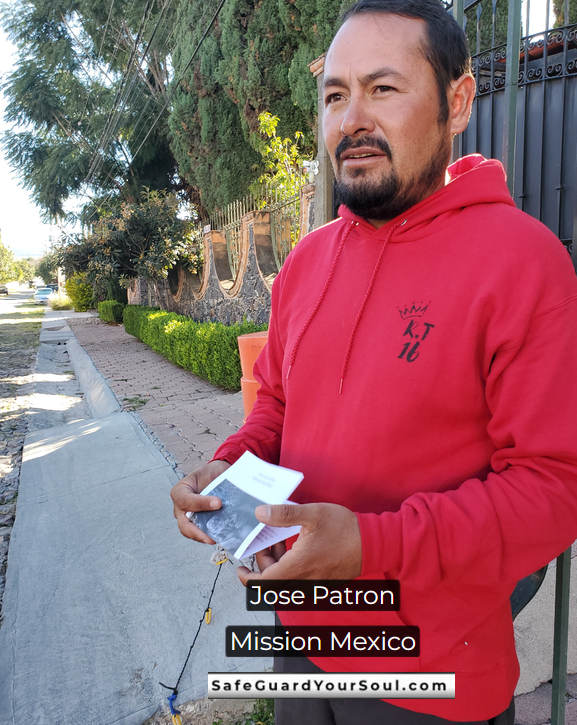
THIS MORNING: Brother Mark brought brother Juan to meet our new brother Jose Patron!
Jose was given a stack of JESUS tracts after he said he wanted to evangelize.
Brother Juan passes by where Jose works for work daily and so that connection and fellowship is being put in place.
“WE are labourers TOGETHER with God” (1 Corinthians 3:9) – and what God has us doing is supporting His beloved “labourers” who are “few”! (Matthew 9:35-38)
A FEW DAYS AGO: Sister Maria called for more JESUS tracts. She ran out as she is distributing hundreds per day. So our dear sister, thanks to you who are praying and supply…. was given a new jacket to keep her warm (pictured), food and drink to bring home for her living quarters, a fresh supply of JESUS tracts, some cash (Mexican pesos), and some Scripture that she as usual read out loud and devoured as I brought them up on my cell phone from the Spanish Bible (Reina Valera). God is good saints. May He be glorified in all you are doing to see the beloved people of Mexico reached with His bless-ed Gospel! You are refreshing His beloved saints.
LORD willing, I will be meeting again with our dear brother Juan this week to refresh him in fellowship etc.
“Pure religion and undefiled before God and the Father is this, To visit the fatherless and widows in their affliction, and to keep himself unspotted from the world.” James 1:27
Mexico: The Land where the Gospel of Jesus is Freely Received
“Freely ye have received, freely give.” Matthew 10:8
As we truly follow Jesus He makes us fishers of men.
“And Jesus said unto them, Come ye after me, and I will make you to become fishers of men.” Mark 1:17
This was the sweetest couple ever as you can tell by the picture. They were overjoyed to receive the preaching of our LORD’s Gospel and were told how to be saved – repentance and faith in Christ, and showed the prayer on the back, etc. They were directed to the prayer on the back and exhorted to pray in repentance and faith and receive eternal life. When asked they said they’d welcome your prayers for them.
On the streets today in Mexico ministering our LORD Jesus’ Gospel to many. As usual the name of Jesus was preached in Christ’s love and it was readily, eagerly received by most who thanked us for giving them the Gospel. SMH. It’s no even fair!
A man name Jose was ministered to, received the Word, and prayed in repentance and faith to be saved! Would you like to lift our new brother in Christ in prayer? Jose Patron is his name and we are connected and he’s already been given more Scripture and added to the Spanish WA group.
Jose just sent me a voice recording saying Thank you to Mark and I for ministering Jesus’ Gospel to him and that he wants to do the same thing we are doing, minister to others our LORD’s Gospel.
“So mightily grew the word of God and prevailed.” Acts 19:20
“The food looks healthy. Just this morning I was thinking that it is unfathomable, in my mind, to comprehend what the Lord is doing in Mexico. I watched the video of Mark passing out Jesus tracts and everyone was so receptive. That stuck in my mind, because I recently watched a video of a man preaching the gospel on a train. Zero response! Everyone kept looking at their phones and never once looked up. This is the true state of America. We have need of nothing and especially not Jesus. Rev 3:17. As opposed to the precious people of Mexico who know they are poor in spirit and are in need of the Lord to save them. They know something is missing in their lives. When Mark was passing out those Jesus tracts people were very happy and joyful to receive them, here they are rejecting the Savior.” Karen Cochran
We went to a colonia, to a street where no one was outside at the moment, Brother Mark said “God sent us this way for a reason, for someone.” 30 seconds later we came upon Jose! Boom.
Then came the Gospel explosion!
Upon ministering Christ’s Gospel to him, Jose Patron excitedly shared with brother Mark and I about how God had saved him from dying. He simply needed the opportunity to repent and be saved – and that’s exactly what JESUS did. Thank you for lifting our beloved brother Jose in prayer.
Jose just sent me a voice recording saying Thank you to Mark and I for ministering Jesus’ Gospel to him and that he wants to do the same thing we are doing, minister to others our LORD’s Gospel.
“So mightily grew the word of God and prevailed.” Acts 19:20
Gospel blessings abounded on the streets in Mexico ministering our LORD Jesus’ Gospel to many. As always the name of Jesus was preached in Christ’s love and it was readily, eagerly received by most who thanked us for giving them the Gospel.
It’s no even fair to have the privilege to minister to the beloved Mexicans! SMH.
A man name Jose was ministered to. He received the Word, and prayed in repentance and faith to be saved! Would you like to lift our new brother in Christ in prayer? Jose Patron is his name and we are connected and he’s already been given more Scripture and added to the Spanish WA group.
Jose just sent me a voice recording saying Thank you to Mark and I for ministering Jesus’ Gospel to him and that he wants to do the same thing we are doing, minister to others our LORD’s Gospel.
Thank you for lifting the salvation of the people of Mexico in your prayers. | Mexico Mission
“I love this brother! May God continue to provide and increase his fruit in the lives of the disciples in Mexico, in the Philippines, in Pakistan, in Kenya, in all his earth for his glory! Amen.
I was reading Psalm 8 and John 10. Beautiful beyond understanding is God’s love poured out in Christ Jesus toward us who hear his voice!
Much love to the body of Christ in Mexico and throughout the whole world. Jesus is coming!
“EVERY person you meet, or stand next to in line, is an opportunity to share the Good News. Do not miss the opportunity to bring another into the Kingdom.
I thank God everyday that this happened to me 5 years ago.” Targeted Christian Girl, RN
Let us be blessed to preach Christ’s Gospel this day.
Upon having the Gospel of Jesus preached to her, beloved Laura informed me that she is a born again saint!!! After fellowshipping she took a stash of JESUS tracts. Would you like to pray for sister Laura?
After receiving the ministry of God’s Word, Antonio was asked if he wanted you to lift him in prayer. He eagerly accepted and is glad you will pause to lift his life to the LORD in prayer. | Mexico Mission
ON THE TOPIC OF MEXICO
The Mexican people never handed their country over to the government so that the government can take it away the government cannot take it away because
Historically and presently the Mexican people find a way to circumvent the government. They never let the government have control and therefore the government can’t take their freedom away – because the people recognize their freedom coming from God.
The tax money of the people is a large way that the government controls the people they are empowered by the riches of the people through taxes in order to control and exploit them endlessly. Your tax money fuels your slavery….
Mexican people have a very healthy dis-trust for government. This is unlike many Americans. Many Americans it seems, haven’t learned that the promises candidates make before an election, will nearly never carry them out when elected. It seems the “We’re going to release the epstein files” was a mere ruse to cover those secret files. “It’s all a big club, and you’re not in it.” George Carlin
Thank you for praying for this man, Juan. He received ministry today and is in need of being saved.