
sgys banner books

LIST OF CATHOLIC HERESIES
And HUMAN TRADITIONS

ADOPTED and PERPETUATED by the ROMAN CATHOLIC CHURCH IN THE COURSE OF 1600 YEARS

(Compiled by Rev. Stephen L. Testa)

“And ye shall know the truth, and the truth shall
make you free.”
 —Jesus in John 8:32
Notice: These dates are in many cases approximate. Many of these heresies had been current in the Church years before, but only when they were officially adopted by a Church council and proclaimed by the pope as dogma of faith, did they become binding on Catholics.

And doctrine to be true must conform to the Word of God. “To the law and to the testimony; if they speak not according to this word, it is because there is no light in them.” (Isaiah 8:20)

At the Reformation in the 16th Century these heresies were repudiated as having no part in the Religion of Jesus as taught in the New Testament.
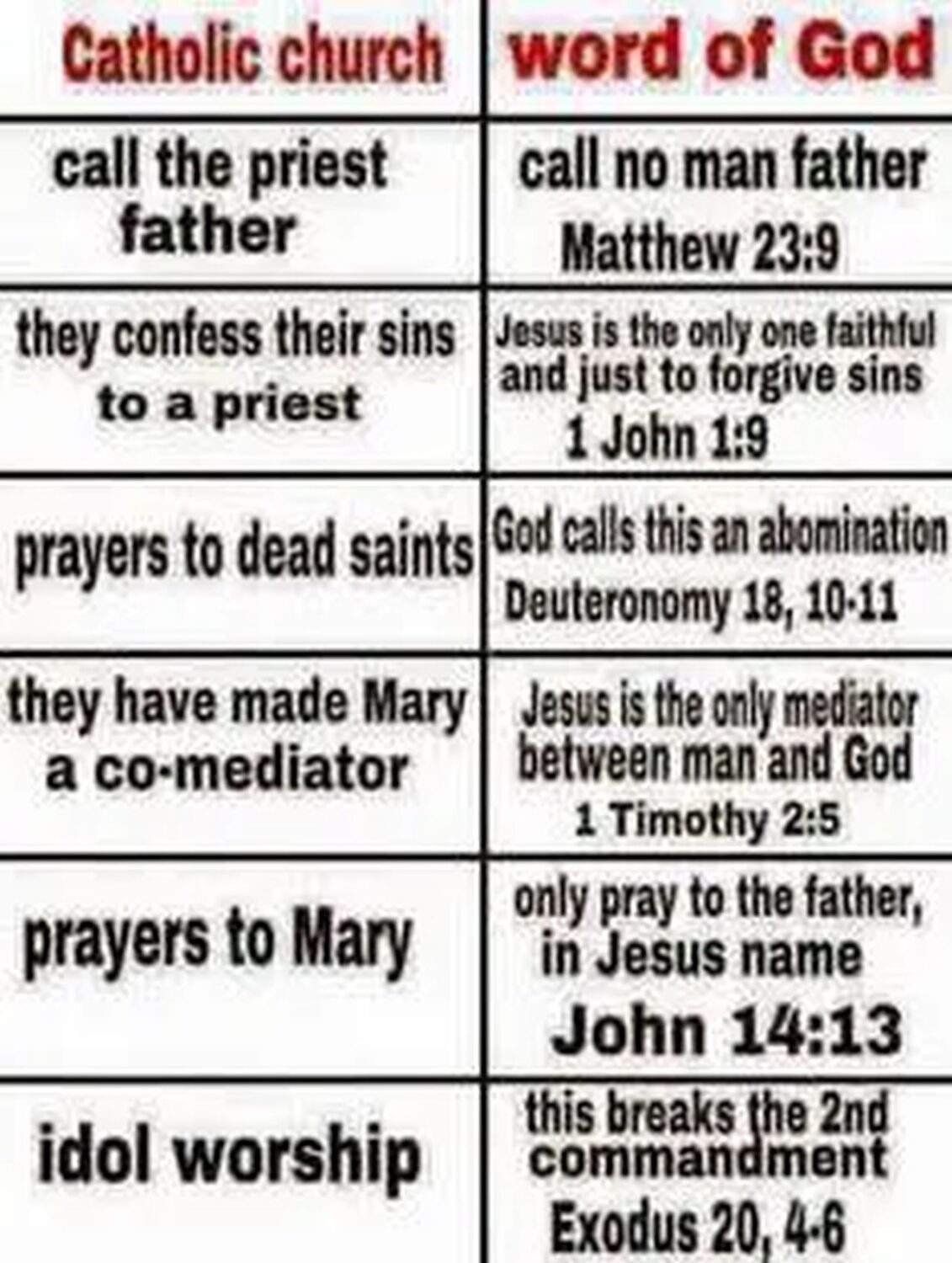
Heresy Date
OF ALL THE HUMAN TRADITIONS taught and practiced by the Roman Catholic Church, which are contrary to the Bible, the most ancient are the prayers for the dead and the sign of the Cross. Both began 300 years after Christ. 310
Wax Candles introduced in church 320
Veneration of angels and dead saints 375
The Mass, as a daily celebration, adopted 394
The worship of Mary, the mother of Jesus, and the use of the term, “Mother of God”, as applied to her, originated in the Council of Ephesus 431
Priests began to dress differently from the laity 500
Extreme Unction 526
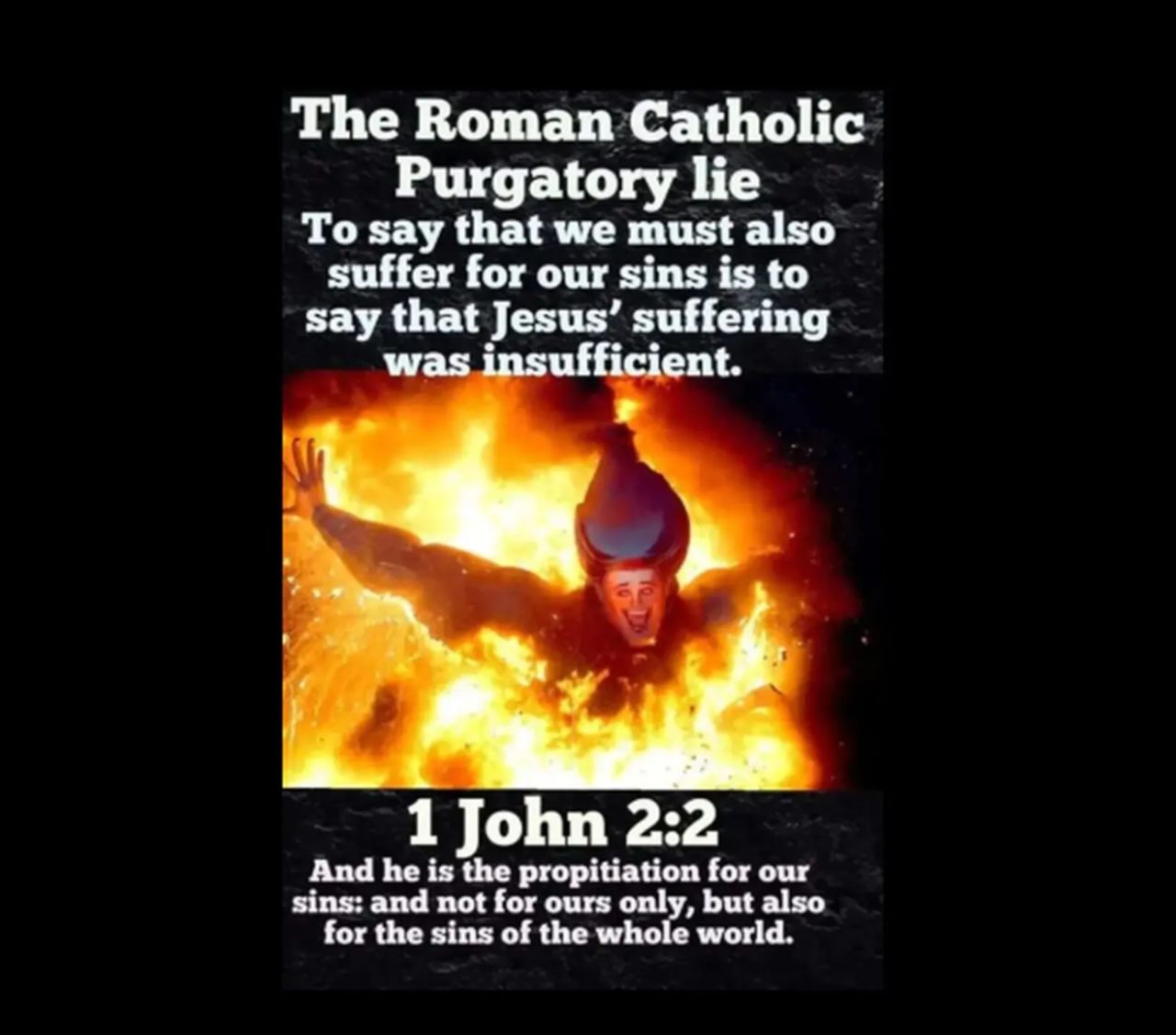
The doctrine of Purgatory was first established by Gregory the Great 593
The Latin language, as the language of prayer and worship in churches, was also imposed by Pope Gregory I. 600 years after Christ
The Word of God forbids praying and teaching in an unknown tongue. (1st Corinthians 14:9).
600
The Bible teaches that we pray to God alone. In the primitive church never were prayers directed to Mary, or to dead saints. This practice began in the Roman Church.
(Matthew 11:28; Luke 1:46; Acts 10:25-26; 14:14-18)
600
The Papacy is of pagan origin. The title of pope or universal bishop, was first given to the bishop of Rome by the wicked emperor Phocas.
This he did to spite Bishop Ciriacus of Constantinople, who had justly excommunicated him for his having caused the assassination of his predecessor emperor Mauritius. Gregory 1, then bishop of Rome, refused the title, but his successor, Boniface III, first assumed title “pope.”
Jesus did not appoint Peter to the headship of the apostles and forbade any such notion. (Luke 22:24-26; Ephesians 1:22-23; Colossians 1:18; 1st Corinthians 3:11).
Note: Nor is there any mention in Scripture, nor in history, that Peter ever was in Rome, much less that he was pope there for 25 years; Clement, 3rd bishop of Rome, remarks that “there is no real 1st century evidence that Peter ever was in Rome.”
610
The kissing of the Pope’s feet
It had been a pagan custom to kiss the feet of emperors. The Word of God forbids such practices. (Read Acts 10:25-26; Revelation 19:10; 22:9).
709
The Temporal power of the Popes
When Pepin, the usurper of the throne of France, descended into Italy, called by Pope Stephen II, to war against the Italian Lombards, he defeated them and gave the city of Rome and surrounding territory to the pope. Jesus expressly forbade such a thing, and He himself refused worldly kingship. (Read Matthew 4:8-9; 20:25-26; John 18:38).
750
Worship of the cross, images and relics was authorized
This was by order of Dowager Empress Irene of Constantinople, who first caused to pluck the eyes of her own son, Constantine VI, and then called a church council at the request of Hadrian I, pope of Rome at that time.
Such practice is called simply IDOLATRY in the Bible, and is severely condemned. (Read Exodus 20:4; 3:17; Deuteronomy 27:15; Psalm 115).
788
Holy Water, mixed with a pinch of salt and blessed by the priest, was authorized 850
The veneration of St. Joseph began 890
The baptism of bells was instituted by Pope John XIV 965
Canonization of dead saints, first by Pope John XV
Every believer and follower of Christ is called saint in the Bible. (Read Romans 1:7; 1st Colossians 1:2).
995
Fasting on Fridays and during Lent were imposed
Imposed by popes said to be interested in the commerce of fish. (Bull, or permit to eat meat), some authorities say, began in the year 700. This is against the plain teaching of the Bible. (Read Matthew 15:10; 1st Corinthians 10:25; 1st Timothy 4:1-3).
998
The Mass was developed gradually as a sacrifice; attendance made obligatory in the 11th century.
The Bible teaches that the sacrifice of Christ was offered once and for all, and is not to be repeated, but only commemorated in the Lord’s Supper. (Read Hebrews 7:27; 9:26-28; 10:10-14).
The celibacy of the priesthood was decreed by Pope Hildebrand, Boniface VII
Jesus imposed no such rule, nor did any of the apostles. On the contrary, St. Peter was a married man, and St. Paul says that bishops were to have wife and children. (Read 1st Timothy 3:2,5, and 12; Matthew 8:14-15).
1079
The Rosary, or prayer beads was introduced by Peter the Hermit, in the year 1090. Copied from Hindus and Mohammedans
The counting of prayers is a pagan practice and is expressly condemned by Christ. (Matthew 6:5-13).
1090
The Inquisition of heretics was instituted by the Council of Verona in the year 1184. Jesus never taught the use of force to spread His religion 1184
The sale of Indulgences, commonly regarded as a purchase of forgiveness and a permit to indulge in sin.
Christianity, as taught in the Bible, condemns such a traffic and it was the protest against this traffic that brought on the Protestant Reformation in the 16th century.
1190
The dogma of Transubstantiation was decreed by Pope Innocent III, in the year
By this doctrine the priest pretends to perform a daily miracle by changing a wafer into the body of Christ, and then he pretends to eat Him alive in the presence of his people during Mass. The Bible condemns such absurdities; for the Lord’s Supper is simply a memorial of the sacrifice of Christ. The spiritual presence of Christ is implied in the Lord’s Supper. (Read Luke 22:19-20; John 6:35; 1st Corinthians 11:26).
1215
Confession of sin to the priest at least once a year was instituted by Pope Innocent III., in the Lateran Council
The Bible commands us to confess our sins direct to God. (Read Psalm 51:1-10; Luke 7:48; 15:21; 1st John 1:8-9).
1215
The adoration of the wafer (Host), was decreed by Pope Honorius
So the Roman Church worships a God made by human hands. This is plain idolatry and absolutely contrary to the spirit of the Gospel. (Read John 4:24).
1220
The Bible forbidden to laymen and placed in the Index of forbidden books by the Council of Valencia
Jesus commanded that the Scriptures should be read by all. (John 5:39; 1st Timothy 3:15-17).
1229
The Scapular was invented by Simon Stock, an English monk
It is a piece of brown cloth, with the picture of the Virgin and supposed to contain supernatural virtue to protect from all dangers those who wear it on naked skin. This is fetishism.
1287
The Roman Church forbade the cup to the laity, by instituting the communion of one kind in the Council of Constance
The Bible commands us to celebrate the Lord’s Supper with unleavened bread and the fruit of the vine. (Read Matthew 26:27; 1st Corinthians 11:26-29).
1414
The doctrine of Purgatory was proclaimed as a dogma of faith by Council of Florence
There is not one word in the Bible that would teach the purgatory of priests. The blood of Jesus Christ cleanseth us from all sins. (Read 1st John 1:7-9; 2:1-2; John 5:24; Romans 8:1).
1439
The doctrine of 7 Sacraments affirmed
The Bible says that Christ instituted only two ordinances, Baptism and the Lord’s Supper. (Read Matthew 28:19-20; 26:26-28).
1439
The Ave Maria, part of the last
It was completed 50 years afterward and finally approved by Pope Sixtus V, at the end of the 16th century.
1508
The Council of Trent, held in the year 1545, declared that Tradition is of equal authority with the Bible
By tradition is meant human teachings. The Pharisees believed the same way, and Jesus bitterly condemned them, for by teaching human tradition, they nullified the commandments of God. (Read Mark 7:7-13; Colossians 2:8; Revelation 22:18).
1545
The apocryphal books were added to the Bible also by the Council of Trent
These books were not recognized as canonical by the Jewish Church. (See Revelation 22:8-9).
1546
The Creed of Pope Pius IV was imposed as the official creed 1560 years after Christ and the apostles
True Christians retain the Holy Scriptures as their creed. Hence their creed is 1500 years older than the creed of Roman Catholics. (Read Galatians 1:8).
1560
The Immaculate Conception of the Virgin Mary was proclaimed by Pope Pius IX
The Bible states that all men, with the sole exception of Christ, are sinners. Mary herself had need of a Savior. (Read Romans 3:23; 5:12; Psalm 51:5; Luke 1:30,46,47).
1834
In the year 1870 after Christ, Pope Pius IX proclaimed the dogma of Papal Infallibility
This is a blasphemy and the sign of the apostasy and of the antichrist predicted by St. Paul. (Read 2nd Thessalonians 2:2-12; Revelation 17:1-9; 13:5-8,18).
Many Bible students see the number of the beast (Rev. 13:18), 666 in the Roman letters of the Pope’s title: “VICARIVS FILII DEI.” — V-5, I-1; C-100, I-1; V-S, I-1; L-50, I-1; I-1; D-500, I-l — Total, 666.
1870
Pope Plus X, in the year 1907, condemned together with “Modernism”, all the discoveries of modern science which are not approved by the Church
Pius IX had done the same thing in the Syllabus of 1864.
1907
In the year 1930 Pius XI, condemned the Public Schools 1930
In the year 1931 the same pope Pius XI, reaffirmed the doctrine that Mary is “the Mother of God”
This doctrine was first invented by the Council of Ephesus in the year 431. This is a heresy contrary by Mary’s own words. (Read Luke 1:46-49; John 2: l-5).
1931
In the year 1950 the last dogma was proclaimed by Pope Pius XII, the Assumption of the Virgin Mary 1950

CONCLUSION

What will be the next invention? The Roman Church says it never changes; yet, it has done nothing else but invent new doctrines which are contrary to the Bible, and has practiced rites and ceremonies taken from paganism. One scholar has found that 75% of the rites and ceremonies of the Roman Church are of pagan origin.

Note: Cardinal Newman, in his book, “The Development of the Christian Religion,” admits that … “Temples, incense, oil lamps, votive offerings, holy water, holidays and season of devotions, processions, blessing of fields, sacerdotal vestments, the tonsure (of priests and monks and nuns), images … are all of pagan origin…” (Page 359).

HERESIES are those doctrines and practices which are contrary to the Bible. They are also called “human traditions” or “doctrines of men”. Both Peter and Paul predicted and warned that in the later times “false teachers” would rise within the Church and bring in “damnable heresies” and “doctrines of devils”. (Read 2nd Peter 2:1-3, and 1st Timothy 3:2-5). Jesus rebuked the Pharisees, for they transgressed the commandments of God by keeping their traditions. “in vain,” He said, “they worship me by keeping for doctrines the commandments of men” (Matthew 15:3,9).

The real heretics therefore, are the Roman Catholics and the true orthodox are the Evangelical Christians.

BRETHREN! The Word of God commands us to get out of Babylon, saying: “Come out of her, my people, that ye be not partakers of her sins, and that ye receive not of her plagues.” (Revelation 18:4). All true Christians will remain faithful to the religion of Christ as taught in the Bible, and heed the warning of the Apostle Paul, who said: “But though we, or an angel from heaven, preach any other Gospel unto you than that which we have preached unto you, let him be accursed.” (Galatians 1:8).

Catholic Church Exposed

Support | STORE | Podcasts | The Catholic church“MYSTERY, BABYLON THE GREAT, THE MOTHER OF HARLOTS AND ABOMINATIONS OF THE EARTH” [podcast] | Did Mary Die for Our Sins? [podcast] | SATAN IN THE VATICAN | The Chosen and Jonathan Roumie Exposed [podcast]Peace with God

Join Us

We saved a place for you to receive our weekly newsletter.

Please wait...

Thank you for signing up!

Click to comment

Leave a Reply

Your email address will not be published. Required fields are marked *


The reCAPTCHA verification period has expired. Please reload the page.

Apostasy

Richard Foster Exposed

Wait, WHAT, WHO are Christ’s disciples to celebrate?

“But God forbid that I should glory, save in the cross of our Lord Jesus Christ, by whom the world is crucified unto me, and I unto the world.” Galatians 6:14

A Biblically based commentary on current issues that impact you

Richard Foster—Celebration of Deception

by Bob DeWaay

Christianity Today ran a glowing cover story about Evangelicalism’s recent embrace of medieval Roman Catholic mysticism entitled The Future lies in the Past.1 The article traced the beginning of the movement as follows: “The movement seems to have exploded in a 24-month period in 1977-1978, which saw the publication of Richard Foster’s bestselling Celebration of Discipline: The Path to Spiritual Growth and Robert Webber’s Common Roots: A Call to Evangelical Maturity.”2

The article views Foster as one who continues to guide the movement: “From Dallas Willard, Richard Foster, and living practicing monks and nuns, they [those going back to Roman Catholic mysticism] must learn both the strengths and the limits of the historical ascetic disciplines.”3 So Foster was instrumental in starting a movement that is still growing 30-plus years later.

The irony about this particular CIC regarding Foster’s 1978 book is that in 1978 I myself was living in a Christian community committed to practicing much of what he promotes in Celebration of Discipline (even though we had not learned it from him directly). So I am not criticizing a practice about which I know nothing (or one in which I have no experience). I am criticizing a practice I foolishly allowed to deceive me for a significant portion of my early Christian life. When it comes to being deceived by mysticism, I have had abundant involvement. The only way I escaped it was through discovering and adopting the Reformation principle of sola scriptura.

In this article I will show that Foster’s “journey inward” is unbiblical and dangerous. I will show that most of the spiritual disciplines that he calls “means of grace” are no means of grace at all—but a means of putting oneself under spiritual deception.

The Journey Inward

The Bible nowhere describes an inward journey to explore the realm of the spirit. God chose to reveal the truth about spiritual reality through His ordained, Spirit-inspired, biblical writers. What is spiritual and not revealed by God is of the occult and, therefore, forbidden. We have discussed this in many articles and have produced DVD seminars on the topic. But the concept of sola scriptura is totally lost on mystics such as Richard Foster. They, like the enthusiasts that Calvin and Luther warned against, believe they can gain valid and useful knowledge of spiritual things through direct, personal inspiration.

Foster describes the idea of the disciplines that are the topic of his book: “The classical Disciplines of the spiritual life call us to move beyond surface living into the depths. They invite us to explore the inner caverns of the spiritual realm.”4 So Foster has conceptually repudiated sola scriptura on page one to replace it with a journey inward to explore the realm of spirits. Something must have been seriously amiss in evangelicalism already in 1978 to render this book a bestseller! It ought to have been repudiated on the spot. In a footnote to that statement Foster writes, “In one form or another all of the devotional masters have affirmed the necessity of the Disciplines” (Foster: 1). The devotional “masters,” by the way, are mostly Roman Catholics who never were committed to the principle of sola scriptura. It is not surprising that they looked for spirituality through experimentation. But as an “inner light” Quaker, Foster never was committed to sola scriptura either.

Forgetting that the Bible forbids divination, Foster explains what he is after:

[W]e must be willing to go down into the recreating silences, into the inner world of contemplation. In their writings, all of the masters of meditation strive to awaken us to the fact that the universe is much larger than we know, that there are vast unexplored inner regions that are just as real as the physical world we know so well. . . . They call us to the adventure, to be pioneers in this frontier of the Spirit. (Foster: 13)

Realizing that his readers would likely take this as an endorsement of Eastern religions, he makes a disclaimer that it is not Transcendental Meditation (TM) or something of that ilk: “Eastern meditation is an attempt to empty the mind; Christian meditation is an attempt to empty the mind in order to fill it” (Foster: 15). But what Foster wishes us to fill our minds with are personal revelations from the spirit realm that we naively are to think are the voice of God. This sort of meditation is not meditating on what God has said, but uses a technique to explore the spirit world. In other words, it is divination.

What we learn about the spirit realm either is revealed by God (once for all in Scripture) or gleaned by man-made techniques. That distinction is the difference between Christianity and paganism. Only Bible believers know what God has said about Himself and what He wishes to reveal about the unseen spirit world. Foster’s material continues to be popular because we live in an age where being spiritual pioneers on a journey into the unseen realm of the spirits is the essence of popular piety. It is the spirituality of secular talk shows.

To fully understand the degree of Foster’s deception, he even calls these techniques to the inner journey “means of grace”: “They [the Disciplines] are God’s means of grace” (Foster: 6). As with all who teach spiritual disciplines, there are no boundaries to these false “means.” For example, consider this recommended practice: “After you have gained some proficiency in centering down, add a five- to ten-minute meditation on some aspect of the creation. Choose something in the created order: tree, plant, bird, leaf, cloud, and each day ponder it carefully and prayerfully” (Foster 25). This after he had just taught breathing exercises (a means of “centering down”). Then he makes a startling claim: “We should not bypass this means of God’s grace” (Foster: 25). And there we have it: meditating of a leaf can be a means of grace!

Foster’s journey inward is to discover a spirit world that is available for any who search for it: “How then do we come to believe in a world of the spirit? Is it by blind faith? Not at all. The inner reality of the spiritual world is available to all who are willing to search for it” (Foster: 18). He claims that this spiritual search is analogous to scientific experimentation. Never mind that every pagan culture that has existed has believed in the “spiritual world.”

Spirituality of the Imagination

The Bible does not have anything good so say about the imagination. For example: “Thus says the Lord of hosts, ‘Do not listen to the words of the prophets who are prophesying to you. They are leading you into futility; They speak a vision of their own imagination, Not from the mouth of the Lord'” (Jeremiah 23:16). A search of the KJV for “imagination” yields 14 verses, and in each case it is a bad thing. According to the Bible, the imagination is where people go when they do not want to listen to God.

However, for Foster the imagination is central: “The inner world of meditation is most easily entered through the door of the imagination. We fail today to appreciate its tremendous power. The imagination is stronger than conceptual thought and stronger than the will” (Foster: 22). Some of the authorities he cites on this point are C. G. Jung, Ignatius of Loyola, and Morton Kelsey. Jung is famous for his concept of the collective unconscious, and Kelsey was an Episcopal priest committed to Jungian principles. Kelsey wrote many books promoting mysticism. The advice Foster gleans from these teachers is that we must learn to think in images and take our dreams to be a possible doorway into the spirit world. Foster claims that dreams are something we already have and can help us develop the use of the imagination. He says, “Keeping a journal of our dreams is a way of taking them seriously” (Foster: 23).

There is, Foster warns, a danger to this process: “At the same time [that we ask for dreams to be God speaking to us], it is wise to pray a prayer of protection, since to open ourselves to spiritual influence can be dangerous as well as profitable” (Foster: 23). I would say that is asking God to protect us as we use various techniques to go where He does not want us to go (into the world of the spirits to gain information). The danger he warns of is far greater than Foster imagines. Those who take the journey inward will be deceived—every time! We are not equipped to gain spiritual information from that realm. That is why God speaks to us through His ordained mediators (the inspired Biblical writers); otherwise we would be fishing in the dark in a medium we are not suited for.

Foster teaches his readers to use their imaginations to experience Biblical stories with the five physical senses. Here is what he claims will happen:

As you enter the story, not as a passive observer but as an active participant, remember that since Jesus lives in the Eternal Now and is not bound by time, this event in the past is a living present-tense experience for Him. Hence, you can actually encounter the living Christ in the event, be addressed by His voice and be touched by His healing power. It can be more than an exercise of the imagination; it can be a genuine confrontation. Jesus Christ will actually come to you. (Foster: 26)

Showing that Foster’s ideas are still influential in our day, Greg Boyd cites some of Foster’s words here to support what he calls “cataphatic prayer” which uses the imagination and images as a means to contact God and gain spiritual information.5 Those who endorse this practice assume they are not being deceived by spirits, but I cannot see on what grounds.

Foster prescribes a practice using one’s imagination that mimics astral projection to the degree that he actually includes a footnote disclaimer stating that it is not astral projection (Foster 28). It begins by telling his readers to imagine themselves going out into nature into a beautiful place (Boyd describes how he practices this, as well as its results6). After enjoying the sights and smells (in your imagination) these are the next steps:

In your imagination allow your spiritual body, shining with light, to rise out of your physical body. Look back so that you can see yourself lying in the grass and reassure your body that you will return momentarily. Imagine your spiritual self, alive and vibrant, rising up through the clouds and into the stratosphere. . . Go deeper and deeper into outer space until there is nothing except the warm presence of the eternal Creator. Rest in His presence. Listen quietly, anticipating the unanticipated. Note carefully any instruction given. With time and experience you will be able to distinguish readily between mere human thought that may bubble up to the conscious mind and the True Spirit which inwardly moves upon the heart. (Foster: 27, 28)

I must ask how one knows whether “True Spirit” is not a deceiving one? Mysticism’s fatal flaw is that it naively assumes that Christians having subjective religious experiences must therefore be having Christian experiences that are truly from God—even if the experiences were provoked through unbiblical practices similar to those used by pagans.

Mental Alchemy

Foster’s approach to prayer is laced with mysticism as well. He claims that prayer needs to be learned from people who have the right experiences and are “masters” who know what they are doing. Foster does not teach ordinary prayer, whereby we bring our needs and requests to the Lord and know that He hears us (because He promised that He does). Here is why he thinks such prayer fails:

Often people will pray and pray with all the faith in the world, but nothing happens. Naturally, they were not contacting the channel. We begin praying for others by first centering down and listening to the quiet thunder of the Lord of hosts. Attuning ourselves to divine breathings is spiritual work, but without it our praying is vain repetition (Mt. 6:7). Listening to the Lord is the first thing, the second thing, and the third thing necessary for successful intercession. (Foster: 34)

Of course this means we have to become mystics if we want to pray.

He teaches that we first must hear personal revelations from God, using meditation techniques such as he teaches, before we pray. He says: “The beginning point, then, in learning to pray for others is to listen for guidance . . . This inner “yes” is the divine authorization for you to pray for the person or situation” (Foster: 35). No! Foster is wrong! The only authorization we need to pray is the Biblical command to pray—not personal revelations.

For Foster, meditation (mystical style) is necessary but not sufficient. He also brings the imagination into the process: “As with meditation, the imagination is a powerful tool in the work of prayer” (Foster: 36). He credits Agnes Sanford7 for helping him see the value of using the imagination in praying. Foster writes, “Imagination opens the door to faith. If we can ‘see’ in our mind’s eye a shattered marriage whole or a sick person well, it is only a short step to believing it will be so” (Foster: 36). Sanford got her ideas from Theosophy, New Thought, Jung, and Emmet Fox. These ideas, echoed by Foster, come from the unbiblical “mind over matter” thinking of that era. That kind of thinking uses creative visualization to change reality or channel spiritual power. Foster suggests, “Imagine the light of Christ flowing through your hands and healing every emotional trauma and hurt feeling your child experienced that day” (Foster: 39).

In his 1985 book, The Seduction of Christianity, Dave Hunt labeled creative visualization such as what Foster promotes, “mental alchemy.”8 Hunt warned the church that Foster promoted such mental alchemy in Celebration of Discipline, and as we have shown, he, in fact, does. So how is it that 24 years after Hunt’s warning Foster is more popular than ever with Evangelicals? The answer is end times deception. Now, a huge movement that claims to be a reformation promoting Foster, Willard and their versions of mysticism does exist (i.e., The Emergent Church). Things have gotten so very much worse.

Spiritual Directors

Once mysticism and the supposed need to gain personal revelations from God are embraced, there arises a need for new “masters” who are better at navigating the spirit world. Pagan societies have always had such persons. They are called “shamans.” Eastern religion calls them “gurus.” Deceived Christians call them “spiritual directors.” Foster explains, “In the Middle Ages not even the greatest saints attempted the depths of the inward journey without the help of a spiritual director” (Foster: 159). The problem, according to Foster, is that the churches (in 1978) lacked “living masters”:

No doubt part of the surge of interest in Eastern meditation is because the churches have abrogated the field. How depressing for a university student, seeking to know the Christian teaching on meditation, to discover that there are so few living masters of contemplative prayer and that nearly all of the serious writings on the subject are seven or more centuries old. No wonder he or she turns to Zen, Yoga, or TM. (Foster: 14)

Foster’s dream has come true. Today people can even practice Yoga in a Christian church. We have Christian TM; it is called contemplative prayer. Yes, Eastern religion has come right into the church, and Foster has helped usher it in.

But what about “living masters” or spiritual directors? In 1972 Morton Kelsey lamented their lack: “Indeed I would suggest that everyone who is serious about relating to the spiritual realm find himself a spiritual director, if there were more men trained and experienced in this way.”9 That “problem” has been solved in a huge way. Evangelical theology schools are now offering masters degrees in “spiritual formation” in order to equip people to be “spiritual directors.” Here is what Biola University says about its program: “This degree is designed to equip men and women for the ministry of spiritual direction, discipleship, formation and soul care in the local church and for further academic training in spiritual formation.”10 Spiritual Directors International will help you find a spiritual director regardless of your religion.11 Richard Foster’s own Renovare, which purports to “encourage renewal in the Christian church,” has a list of spiritual direction programs.12

Foster explains the purpose of the spiritual director: “He is the means of God to open the path to the inward teaching of the Holy Spirit” (Foster: 160). Apparently, in a full-blown rejection of sola scriptura where the Holy Spirit’s teaching is mediated to the church through the Biblical writers only, we need mediators for personal revelations beyond scripture.

Foster explains how spiritual directors lead: “He leads only by the force of his own personal holiness” (Foster: 160). In Roman Catholicism the Pope is called “his holiness” and in Tibetan Buddhism the Dalai Lama is called “his holiness” but now evangelicals are developing a class of people who evidently deserve the title. How exactly are we to judge when someone has gained “personal holiness” sufficient to be a spiritual director and mediate spirituality to others? Foster says, “Though the director has obviously advanced further into the inner depths, the two [master and disciple] are together learning and growing in the realm of the Spirit” (Foster: 160). Foster cites Roman Catholic mystic Thomas Merton about how this works: “The spiritual director was something of a ‘spiritual father who begot the perfect life in the soul of his disciple by his instructions first of all, but also by his prayer, his sanctity and his example. He was . . . a kind of ‘sacrament’ of the Lord’s presence in the ecclesiastical community” (Foster: 161).

End Times Delusion

When it comes to end times deception, Foster is on the cutting edge of embracing it. Consider what he wrote: “In our day heaven and earth are on tiptoe waiting for the emerging of a Spirit-led, Spirit-intoxicated, Spirit-empowered people. . . . Individuals can be found here and there whose hearts burn with divine fire” (Foster: 150). Such inclinations have led to massive deception. They smack of the Latter Rain deception, now embodied in such false teachers as Rick Joyner and Mike Bickle. They are elitist. They are in line with the beliefs of the Emergent Church as well. He also says: “Our century has yet to see the breaking forth of the apostolic church of the Spirit” (Foster: 150). Now we have the New Apostolic Reformation claiming to be just that. Foster’s ideas now embody the massive apostasy and end times deception that characterize our age.

Foster’s teachings have taken the church as far away from the Reformation principle of sola scriptura as the Roman Catholic Church ever was. The only thing left is for them to bring us all the way back to Rome. Christianity Today praises Foster for pointing us in that direction.

In early 2008 I wrote a CIC article about how abandoning the principle of sola scriptura would lead evangelicals back to Rome.13 It was partly a response to the CT article praising mysticism. The response I received was rather unexpected. I was contacted by former evangelicals who had rejected sola scriptura and had gone back to Rome! They wanted to debate me about sola scriptura. Sadly, my point was proven. As a response to their misguided challenge our church hosted a seminar on sola scriptura, called Faith at Risk 4.14 In the seminar Gary Gilley and I defended the scriptures as the sole authority for the church.

The aforementioned CT article discusses a new monasticism, former evangelical leaders converting to Roman Catholicism, and mystical practices like lectio divina—and they call all of it a good and hopeful thing. Chris Armstrong, the author of the article, concluded, “That they [evangelicals] are receiving good guidance on this road from wise teachers [Foster and Willard] is reason to believe that Christ is guiding the process. And that they are meeting and learning from fellow Christians in the other two great confessions, Roman Catholicism and Eastern Orthodox, is reason to rejoice in the power of love.”15

Who is left to defend the principles of the Reformation? One would think Reformed theologians are, but they aren’t doing their job. In the last CIC article we mentioned Reformed theologian Donald Whitney who wrote: “Richard Foster’s Celebration of Discipline has been the most popular book on the subject of the Spiritual Disciplines in the last half of the twentieth century. The great contribution of this work is the reminder that the Spiritual Disciplines, which many see as restrictive and binding, are actually means to spiritual freedom.”16 That from a teacher in a Reformed seminary?

If a book that teaches Christian TM, Christian astral projection and mental alchemy by means of the imagination is a “great contribution,” then something is seriously wrong here. The delusion is so widespread that I see no other explanation for it than the end time deception predicted by Paul: “But the Spirit explicitly says that in later times some will fall away from the faith, paying attention to deceitful spirits and doctrines of demons,” (1Timothy 4:1). Another passage warns: “For the time will come when they will not endure sound doctrine; but wanting to have their ears tickled, they will accumulate for themselves teachers in accordance to their own desires, and will turn away their ears from the truth and will turn aside to myths” (2Timothy 4:3, 4).

That time now is here. We are accountable to God for what we believe and practice. Those who wish to persevere in the faith in this age of delusion must base their beliefs and practices only on the truths found in Scripture. Foster’s journey into the world of the spirits will deceive all who enter it.

Issue 112 – May / June 2009

End Notes

    1. Chris Armstrong, “The Future lies in the Past” in Christianity Today, February 2008.
    2. Ibid. 24.
    3. Ibid. 29.
    4. Richard Foster, Celebration of Discipline: The Path to Spiritual Growth (New York: Harper & Row, 1978) 1. All subsequent citations from this book will be bracketed within the text in this fashion: (Foster: 1).
    5. Greg Boyd, Seeing is Believing, (Grand Rapids: Baker, 2004). Boyd cites Foster to prove that the Lord will actually come to us through our use of “imaginative meditation.” I deal with this issue more fully in CIC issue 83 July/August, 2003: HTTP://CICMINISTRY.ORG/COMMENTARY/ISSUE83.HTM
    6. Ibid. 111-125.
    7. I write about Sanford’s inner healing theories in CIC Issue 96: HTTP://CICMINISTRY.ORG/COMMENTARY/ISSUE96.HTM
    8. Dave Hunt and T. A. McMahon, The Seduction of Christianity (Eugene: Harvest House, 1985) 138.
    9. Morton Kelsey, Encounter With God, (Bethany Fellowship: Minneapolis, 1972) 179.
    10. http://www.biola.edu/spiritualformation/programs/ SEE PDF
    11. HTTP://WWW.SDIWORLD.ORG
    12. HTTP://WWW.RENOVARE.ORG/JOURNEY_TRAINING_DIRECTION.HTM
    13. CIC Issue 105; March/April 2008: HTTP://CICMINISTRY.ORG/COMMENTARY/ISSUE105.HTM
    14. Watch this seminar HERE
    15. Armstrong, Future
    16. DONALD S. WHITNEY, SPIRITUAL DISCIPLINES FOR THE CHRISTIAN LIFE (COLORADO SPRINGS: NAVPRESS, 1991) 23.

Support | STORE | Podcasts | Jail/Prison MinistryMexico Mission here | All Ministry Updates | More on Assurance hereBecause You Care Page | The Greatest of these is CharityBe Ready in the Morning [podcast]The Sure Mercies of David [podcast]That Repentance and Remission of Sins should be Preached [podcast]At His Feet | Knowing God | The Cross Life | 100’s of Christ-centered Scripture-rich PodcastsChristology = the Study of Christ

Join Us

We saved a place for you to receive our weekly newsletter.

Please wait...

Thank you for signing up!

Continue Reading

Apostasy

GOD’S GRACE “IN THIS PRESENT WORLD” TITUS 2:12 [podcast]


Excerpt from the book Lie of the Ages

LOTS OF FRAUDS WHO CLAIM TO BE SAVED BY GRACE YET DEFEND INSTEAD OF ADMITTING, REPENTING, CALLING OUT AND CONFESSING SIN. “Grace” that isn’t leading you to live godly in this present world, denying ungodliness instead of living in it, is NOT saving grace. You are lost if this is the phony “grace” you have.

“For the grace of God that bringeth salvation hath appeared to all men, Teaching us that, denying ungodliness and worldly lusts, we should live soberly, righteously, and godly, in this present world.” Titus 2:11-12 

YES God’s grace in Christ is certainly amazing and yet, the evangelical, calvinistic worlds have grossly emphasized and perpetrate a perverted view of God’s grace…. Fulfilling the prophecy of Jude 3-4. God says these are “ungodly men” who we are to “earnestly contend” against! (Jude 3-4)

It’s only the sin-justifying, grace-perverting frauds who hate personal accountability and obedience as the manifestation, the fruit of true worship and love for God (Titus 2:11-12; Jude 4).

IF you love God, truly, you will obey Him. Those who do not obey Christ, don’t love Him (John 14:15; 1 John 2:3-6, etc.).

Hell is full of people who got saved, then made excuses for their Christ-denying cross-less life on earth (Matthew 7:21; Titus 1:16).

This is how true grace manifests IF someone is saved by it….. otherwise they have either never been saved or have since fallen away from saving grace (Luke 8:13; Galatians 5:4; 2 Peter 2:20-22, etc.).

“For if after they have escaped the pollutions of the world through the knowledge of the Lord and Saviour Jesus Christ, they are again entangled therein, and overcome, the latter end is worse with them than the beginning. 21 For it had been better for them not to have known the way of righteousness, than, after they have known it, to turn from the holy commandment delivered unto them.” 2 Peter 2:20-21

Dear OSAS fairytale believer: Grace is given to overcome sin and not to justify it.

This “so great salvation” (Heb. 2:3) that “hath appeared to all men” was wrought for us by the grace and life blood of the Son of God (Lev. 17:11; Rom. 3:23-26). We were down and out “having no hope” and “when we were yet without strength, in due time Christ died for the ungodly.” (Rom. 5:6; Eph. 2:12)  We were “without strength!” – In other words we had no ability in and of ourselves to get back to the one true God we were separated from due to our own sin (Isa. 59:1-2; Rom. 5:12). Yet, “while we were yet sinners, Christ died for us.” (Rom. 5:8) He saved us to be made progressively more free and to please and serve Him with joy in the Holy Ghost. He is our Salvation and enabler in all things. We truly CAN do “all things through Christ which strengtheneth” us! (Phil. 4:13)

Whenever God commands something, He also provides the grace for it to manifest in your life – as you are submitted and therefore obedient to Him (James 4:6-10; 1 Peter 4:10-11). His grace, divine enablement, operational power, is always sufficient to bring His perfect will to pass in our lives and to bring us through any and all difficulties, grueling seasons we may find ourselves in! (2 Corinthians 9:8; 12:9-10; 1 Peter 5:10) 

No gift could possibly be so “great.” See Hebrews 2:3. It is to Jesus Christ the LORD of all lords that we as vile and depraved sinners, owe all thanksgiving and have the immeasurable, grand and blessed privilege to worship. There is no fathoming the magnitude of the blessing, of the grace and mercy of our God poured out to us through “the blood of his cross.” (Rom. 11:33; 1 Cor. 2:9; Col. 1:20; Tit. 3:5-6) His grace truly is amazing and yet He is holy and righteous and will not permit sin into His presence.

“By him (Christ) therefore let us offer the sacrifice of praise to God continually, that is, the fruit of our lips giving thanks to his name.” Hebrews 13:15

Seems to me that in “grace” circles grace itself is deified instead of the One who alone granted that grace?

“For the law was given by Moses, but grace and truth came by Jesus Christ.” John 1:17

My identity, my salvation is first and foremost in CHRIST JESUS Himself and not in the grace He brought and provided via His death on the cross! First things first! Keeping the main thing the main thing! (1 Corinthians 2:2; Galatians 2:20; 6:14; Hebrews 2:9)

The apostle Paul, the divinely inspired grace teacher, stated here in our theme verse (please re-read Titus 2:11-12 above) that when God’s grace is genuinely at work in a person, that person is being taught and learning certain things. Let’s go to the divine source, God’s Word, to discover what these things are:

According to Titus 2:11-12, just what does God’s grace teach one who possesses it?

  • To “deny ungodliness…in this present world”
  • To “deny…worldly lusts…in this present world”
  • To “live soberly…in this present world”
  • To “live…righteously…in this present world”
  • To live “godly, in this present world”

If a person claims to be saved (secure for Heaven) and yet is not “denying ungodliness” and “worldly lusts…living soberly, righteously, and godly, in this present world,” he is simply deluded. See also Matthew 7:21; Titus 1:16; James 1:22; 4:4 and 1 John 2:3-6.

If you don’t mind, I am nominating Titus 2:11-12 as that place in Scripture believers think of when they think of the grace of God. Do you think that saints and/or those who claim to be saints might take on a whole new level of responsibility if such were the case?

The person who currently possesses and is living in the grace of God can be assured of eternal life (Heb. 12:14). One can know or verify whether or not he truly possesses the grace of God by reading closely this enlightening theme passage of Titus 2:11-12. The authentically saved person is presently abiding in Christ’s grace – “Denying ungodliness and worldly lusts” and living “soberly, righteously, and godly, in this present world (life).”  

If these things are not manifesting in our lives, be sure that we are not presently living in the grace of God and should immediately repent before the LORD (James 4:6). In verse 11 of Titus 2, the Word states that it is “the grace of God that bringeth salvation.” And then Holy Writ reveals how those who truly and currently possess this essential grace live their lives – “in this present world.” 

“‘For whom ye yield yourselves, servants to obey, his servants ye are to whom ye obey.’ (Rom. 6:16)  If we are compelled, therefore, to yield ourselves servants to sin, and be subject to Satan’s power, insomuch that we cannot help but obey him, and really have no choice in the matter, then our free agency, our volition, is destroyed; and to make matters worse, the devil has more power than God. Satan can make us disobey God, but alas, God cannot make us disobey Satan. The devil compels us to be sinners, but God cannot compel us to be righteous. What kind of doctrine is this?” –Howard W. Sweeten

In America, the vast majority of those who are called evangelicals do not even realize that this Titus 2 text exists. The masses have never had this text pointed out to them and expounded upon by their leaders. What is it these leaders are afraid their audiences will discover if they unveil this text? Some leaders just simply do not teach the Word (2 Tim. 4:2-4). This alone makes them false. For the Calvinistic leader I must ask: What are they hiding? What are they afraid people might find out? Why are other Bible passages on grace spotlighted and not Titus 2? Why is this Bible passage purposely neglected and avoided? What are our leaders afraid will be revealed to the people they communicate to? Do these leaders fear that the divine truth revealed in Titus 2 will contradict what they are teaching? Do they fear offending people by communicating what the evidences (fruit) of true grace and salvation are?

Unrepentant rebels who claim to be saved lack the discernment and ability to rightly divide the word of God because they refuse to turn their hearts over to the LORD – 2 Corinthians 3:14-16; 2 Thessalonians 2:9-12. OSAS dupes reject the mountains of Scripture that teach a conditional eternal security because they simply do not want to repent and lay down their lives in this sinful world.

Speaking of “A Foreign Grace,” David Servant, in his book The Great Gospel Deception, says:

“It is not only the fruit of people’s deeds that mark them as false teachers, but also the fruit of their words. If they teach what is contrary to essential New Testament doctrine, they are false teachers.

Of course, no teacher in the church is going to stand up and declare that he is teaching what is contrary to the New Testament. Rather, he will neglect certain important scriptures and twist others to persuade his constituency that he is teaching the truth. This is being done today by many very popular and influential teachers who teach about a grace that is foreign to the Bible. The grace they proclaim is not the true grace that leads to holiness…

How is it possible that people who denied the only Master and Lord, Jesus Christ, could have ‘crept in unnoticed’? The answer is that they were not standing in front of congregations declaring, ‘I deny Jesus Christ.’ Rather, they were denying Jesus Christ through their false teaching about grace, turning it into licentiousness.

Their message could be summarized as follows: ‘Isn’t God’s grace wonderful? Because our salvation stems from His grace and not from our meritorious works, holiness is not essential for salvation. Because of God’s wonderful grace, all who believe in Jesus are saved, even if they continue practicing sin.’” p. 230, 231

As David Servant points out, the false teacher is not going to stand up and announce that he is a wolf. It is the individual believer’s responsibility to discern leaders by the fruit of their teaching. What is not taught (left out of the message) can be more deadly than what is taught. What we don’t know can kill us. “My people are destroyed for lack of knowledge.” (Hos. 4:6) To be able to discern one must study the Word diligently and be exercised therein (2 Tim. 2:15; 3:16; Heb. 5:11-14).  This gross lack of knowledge among some who claim to know the LORD is also an indication that many have not diligently studied the Word of God for themselves, but rather have relied upon their leaders to tell them what God has said. Consequently, so very many have been deluded with a false gospel.

Saints of the LORD, let us allow Jesus Christ to become important enough to our hearts to learn for ourselves what He has stated to us in His Word. Is the LORD truly your first love? Are you actively and fervently memorizing Scripture – His very words? Let me encourage you to do so from the Authorized Version (KJV). See Proverbs 4:4 and Psalms 119. Index cards are a great way to do such.

“In This Present World” Holiness Now Or Then?

If we do not possess His grace “in this present world,” evidenced by our denial of ungodliness and holy living here and now, then how can we deceive ourselves into thinking we are truly His? If not now, the then (eternity) is surely eternal damnation. According to God’s Word, without holiness, no person will be with Jesus Christ in eternity (Matt. 5:8; Heb. 12:14; Rev. 21:8, 27). Think with me for a moment of how many people who are at this very instant, residents of the domain of the damned – hell. What is their unalterable and horrible future? These eternal souls will shortly be cast into the lake or ocean of fire (Rev. 20:11-15). Why? These people were given the choice and willfully and deliberately chose in their brief earthly life to make something else more important than the LORD and doing His will (Exod. 20:3; Matt. 7:21; Eph. 5:3-6; 1 Jn. 5:21). Pretty simple, yet the consequence is forever fixed – They have reached the point of no return. Hell’s eternal occupants who have gone before us to damnation will, after a million years of excruciating and conscious torment, have not one less second to spend there.

Is it worth it? Is living apart from life-giving fellowship with Jesus in this short life worth eternity in torment? Is justifying instead of crucifying the sins of the body worth spending eternity in the prison of fire? Jesus told us we must abruptly cut off the hand and pluck out the eye that causes us to offend the one true and holy God with our sin, that we might be in Heaven (Mk. 9:42-50). Ready or not – Jesus is Coming!

The Fruit of True Grace: Grace that is not taught with responsibility and the fear of the LORD is not Biblical grace at all. Be not deceived! (Tit. 2:11-14) According to Titus 2:11-12, true grace produces a specific fruit. God’s grace is active. When it truly abides in a person, it has specific earmarks of its possession while “grace” without this fruit is shown to be no saving grace at all. This is a sham that so many today have been taught. It is the bill of goods that is being sold from pulpits across America every week.

Comprehensive grace includes the fear of God which alters the lifestyle and causes the recipient to live a holy life. The adherent is led into intimate fellowship with Christ and from living in habitual sin that would disqualify him from the prize of eternal life. The good news is that there is the precious blood of the Savior available at the “throne of grace” to grant us all a fresh start! This believer, who is less than the least of all saints, has had enormous reason to rejoice in that he has fallen short so many times, only to be drawn back in by the LORD to receive mercy and grace afresh! This priceless grace, purchased with the blood of Christ, is available at all times to those who are born again. We therefore have no excuse to have any sin remaining on our account (Heb. 4:14-16; 1 Jn. 1:7, 9). We are blessed to have EVERY sin washed away in His holy blood as we simply go before His precious throne of grace and cry out in repentance and receive His priceless mercy which we do not deserve yet was merited by Christ’s blood. This truth makes me want to shout for joy!

What a rich blessing it is that God’s grace empowers the believer to fulfill what its Author demands. Through the apostle Paul the Holy Ghost tells us that “sin shall not have dominion over you: for ye are not under the law, but under grace.” (Rom. 6:14)

PRAYER: LORD Jesus thank You for Your saving grace which enables me to experience relationship with You and live completely pleasing in Your holy sight in all things. Right this moment I denounce all dissimulation and self-deception, lies, and excuses. LORD I beg You to make my heart pure LORD Jesus! Thank You that sin shall not have dominion over my life as I obey You in the daily crucified life, as I remain in fellowship with You, forsaking all thoughts and deeds that offend You. Your grace is sufficient to bring about Your perfect will which is holiness. In the name of Jesus, amen.   

Lie of the Ages (the book)

No honest Bible student reads the whole of Scripture and comes out with the idea that he’s OSAS. No, such a doctrine is taught by men who lure in their un-repentant prey with ear-tickling promises. “For when they speak great swelling words of vanity, they allure through the lusts of the flesh, through much wantonness, those that were clean escaped from them who live in error.” (2 Peter 2:18) Instead of preaching the original Gospel message by calling their audiences to repentance and live a holy, cross-bearing life, they assure them in their sins, just like the false prophets Jeremiah cited (Jeremiah 23:17). This is exactly why those wolves who teach this lie of the ages have such lucrative “church” businesses. They’ve gotten rich peddling Satan’s first lie and are fulfilling prophecy as they lead many to damnation (Genesis 2:17; 3:4).

“Preach the word; be instant in season, out of season; reprove, rebuke, exhort with all longsuffering and doctrine. 3 For the time will come when they will not endure sound doctrine; but after their own lusts shall they heap to themselves teachers, having itching ears; 4 And they shall turn away their ears from the truth, and shall be turned unto fables.” 2 Timothy 4:2-4

The OSAS believer is vested in his own flesh which he serves instead of Christ and so he doesn’t care how many Scriptures contradict the lie he loves – because he refuses to truly repent and bring forth fruit consistent with that authentic repentance. Instead of overcoming all sin he wallows in it, justifying that which God condemns because he’s self-deceived with this antinomian (lawless) lie.

Support | STORE | Podcasts | Eternal Security/OSASAccounted Worthy to Escape [podcast] |Sealed?The Return of Christ | SupportLie of the Ages [podcast]10 Questions about Eternal SecurityIs Salvation Eternal?The Damning Myth of Unconditional Eternal Security [podcast]The Essential of Fearing God | The KING is Coming [podcast] | Lie of the Ages (Blockbuster book exposing OSAS and calvinism)

Join Us

We saved a place for you to receive our weekly newsletter.

Please wait...

Thank you for signing up!

Continue Reading

Abiding

The Book of 2 Peter Narrated [podcast]


Chapter 1

Simon Peter, a servant and an apostle of Jesus Christ, to them that have obtained like precious faith with us through the righteousness of God and our Saviour Jesus Christ: Grace and peace be multiplied unto you through the knowledge of God, and of Jesus our Lord, according as his divine power hath given unto us all things that pertain unto life and godliness, through the knowledge of him that hath called us to glory and virtue: whereby are given unto us exceeding great and precious promises: that by these ye might be partakers of the divine nature, having escaped the corruption that is in the world through lust.

And beside this, giving all diligence, add to your faith virtue; and to virtue knowledge; and to knowledge temperance; and to temperance patience; and to patience godliness; and to godliness brotherly kindness; and to brotherly kindness charity. For if these things be in you, and abound, they make you that ye shall neither be barren nor unfruitful in the knowledge of our Lord Jesus Christ. But he that lacketh these things is blind, and cannot see afar off, and hath forgotten that he was purged from his old sins. 10 Wherefore the rather, brethren, give diligence to make your calling and election sure: for if ye do these things, ye shall never fall: 11 for so an entrance shall be ministered unto you abundantly into the everlasting kingdom of our Lord and Saviour Jesus Christ.

12 Wherefore I will not be negligent to put you always in remembrance of these things, though ye know them, and be established in the present truth. 13 Yea, I think it meet, as long as I am in this tabernacle, to stir you up by putting you in remembrance; 14 knowing that shortly I must put off this my tabernacle, even as our Lord Jesus Christ hath shewed me. 15 Moreover I will endeavour that ye may be able after my decease to have these things always in remembrance. 16 For we have not followed cunningly devised fables, when we made known unto you the power and coming of our Lord Jesus Christ, but were eyewitnesses of his majesty. 17 For he received from God the Father honour and glory, when there came such a voice to him from the excellent glory, This is my beloved Son, in whom I am well pleased. 18 And this voice which came from heaven we heard, when we were with him in the holy mount. 19 We have also a more sure word of prophecy; whereunto ye do well that ye take heed, as unto a light that shineth in a dark place, until the day dawn, and the day star arise in your hearts: 20 knowing this first, that no prophecy of the scripture is of any private interpretation. 21 For the prophecy came not in old time by the will of man: but holy men of God spake as they were moved by the Holy Ghost

Chapter 2

But there were false prophets also among the people, even as there shall be false teachers among you, who privily shall bring in damnable heresies, even denying the Lord that bought them, and bring upon themselves swift destruction. And many shall follow their pernicious ways; by reason of whom the way of truth shall be evil spoken of. And through covetousness shall they with feigned words make merchandise of you: whose judgment now of a long time lingereth not, and their damnation slumbereth not. For if God spared not the angels that sinned, but cast them down to hell, and delivered them into chains of darkness, to be reserved unto judgment; and spared not the old world, but saved Noah the eighth person, a preacher of righteousness, bringing in the flood upon the world of the ungodly; and turning the cities of Sodom and Gomorrha into ashes condemned them with an overthrow, making them an ensample unto those that after should live ungodly; and delivered just Lot, vexed with the filthy conversation of the wicked: (for that righteous man dwelling among them, in seeing and hearing, vexed his righteous soul from day to day with their unlawful deeds;) the Lord knoweth how to deliver the godly out of temptations, and to reserve the unjust unto the day of judgment to be punished: 10 but chiefly them that walk after the flesh in the lust of uncleanness, and despise government. Presumptuous are they, selfwilled, they are not afraid to speak evil of dignities. 11 Whereas angels, which are greater in power and might, bring not railing accusation against them before the Lord. 12 But these, as natural brute beasts, made to be taken and destroyed, speak evil of the things that they understand not; and shall utterly perish in their own corruption; 13 and shall receive the reward of unrighteousness, as they that count it pleasure to riot in the day time. Spots they are and blemishes, sporting themselves with their own deceivings while they feast with you; 14 having eyes full of adultery, and that cannot cease from sin; beguiling unstable souls: an heart they have exercised with covetous practices; cursed children: 15 which have forsaken the right way, and are gone astray, following the way of Balaam the son of Bosor, who loved the wages of unrighteousness; 16 but was rebuked for his iniquity: the dumb ass speaking with man’s voice forbad the madness of the prophet.

17 These are wells without water, clouds that are carried with a tempest; to whom the mist of darkness is reserved for ever. 18 For when they speak great swelling words of vanity, they allure through the lusts of the flesh, through much wantonness, those that were clean escaped from them who live in error. 19 While they promise them liberty, they themselves are the servants of corruption: for of whom a man is overcome, of the same is he brought in bondage. 20 For if after they have escaped the pollutions of the world through the knowledge of the Lord and Saviour Jesus Christ, they are again entangled therein, and overcome, the latter end is worse with them than the beginning. 21 For it had been better for them not to have known the way of righteousness, than, after they have known it, to turn from the holy commandment delivered unto them. 22 But it is happened unto them according to the true proverb, The dog is turned to his own vomit again; and the sow that was washed to her wallowing in the mire.

Chapter 3

This second epistle, beloved, I now write unto you; in both which I stir up your pure minds by way of remembrance: that ye may be mindful of the words which were spoken before by the holy prophets, and of the commandment of us the apostles of the Lord and Saviour: knowing this first, that there shall come in the last days scoffers, walking after their own lusts, and saying, Where is the promise of his coming? for since the fathers fell asleep, all things continue as they were from the beginning of the creation. For this they willingly are ignorant of, that by the word of God the heavens were of old, and the earth standing out of the water and in the water: whereby the world that then was, being overflowed with water, perished: but the heavens and the earth, which are now, by the same word are kept in store, reserved unto fire against the day of judgment and perdition of ungodly men.

But, beloved, be not ignorant of this one thing, that one day is with the Lord as a thousand years, and a thousand years as one day. The Lord is not slack concerning his promise, as some men count slackness; but is longsuffering to us-ward, not willing that any should perish, but that all should come to repentance. 10 But the day of the Lord will come as a thief in the night; in the which the heavens shall pass away with a great noise, and the elements shall melt with fervent heat, the earth also and the works that are therein shall be burned up.

11 Seeing then that all these things shall be dissolved, what manner of persons ought ye to be in all holy conversation and godliness, 12 looking for and hasting unto the coming of the day of God, wherein the heavens being on fire shall be dissolved, and the elements shall melt with fervent heat? 13 Nevertheless we, according to his promise, look for new heavens and a new earth, wherein dwelleth righteousness.

14 Wherefore, beloved, seeing that ye look for such things, be diligent that ye may be found of him in peace, without spot, and blameless. 15 And account that the longsuffering of our Lord is salvation; even as our beloved brother Paul also according to the wisdom given unto him hath written unto you; 16 as also in all his epistles, speaking in them of these things; in which are some things hard to be understood, which they that are unlearned and unstable wrest, as they do also the other scriptures, unto their own destruction. 17 Ye therefore, beloved, seeing ye know these things before, beware lest ye also, being led away with the error of the wicked, fall from your own stedfastness. 18 But grow in grace, and in the knowledge of our Lord and Saviour Jesus Christ. To him be glory both now and for ever. Amen.

Bible Books Narrated | 100’s of Christ-centered Podcasts | Support

Going deeper begins with a foundational knowledge of the book of origins – the book of Genesis. In fact, a sound, solid biblical foundation begins with knowing and understanding the book of Genesis. What is the Book of Genesis about summary? The Book of Genesis, the first book of the Hebrew Bible and the Christian Old Testament, is an essential component of the foundation to be built in the life of every disciple of Christ.

Bible – Word of God | Bible School Modules (free) | Hundreds of Scripture-Rich edifying audios here.

Support | STORE | Podcasts | Jail/Prison MinistryMexico Mission here | 100’s of Christ-centered Podcasts | Bible Books Narrated | Bible Study Helps | The Book of James Narrated [podcast] | The Book of Revelation Narrated [podcast]Colossians Overview [podcast]

Join Us

We saved a place for you to receive our weekly newsletter.

Please wait...

Thank you for signing up!

Continue Reading

Categories

donate button round
sgys-books01

Trending