






 by David Servant
Chapter four of a book by David S. Kirkwood titled The Disciple-Making Minister
Here is great question to ask ourselves: How did the early church succeed so well at making disciples without any church buildings, professionally-trained clergy, Bible schools and seminaries, hymnals and overhead projectors, wireless microphones and tape duplicators, Sunday school curriculums and youth ministries, worship teams and choirs, computers and copy machines, Christian radio and TV stations, hundreds of thousands of Christian book titles and even personally-owned Bibles? They didn’t need any of those things to make disciples, and neither did Jesus. And because none of those things were essential then, none are essential now.
When people first hear of house churches, they often mistakenly imagine that the only difference between house churches and institutional churches is their size and their relative abilities to provide “ministry.” People sometimes conclude that the house church cannot offer the quality of ministry provided by churches with buildings. But if one defines “ministry” as that which contributes to the making of disciples, helping them become like Christ and equipping them for service, then institutional churches have no advantage, and as I pointed out in the previous chapter, they may well be disadvantaged. Certainly house churches cannot provide the quantity of multi-faceted activities of institutional churches, but they can excel at providing true ministry.
Some people reject house churches as being true churches, simply because they lack an actual church building. Had those folks lived at any time during the first three hundred years of the church, they would have rejected every single church in the world as being a real church. The fact is that Jesus declared, “For where two or three have gathered together in My name, there I am in their midst” (Matt. 18:20). Jesus said nothing about where believers must gather. And even if there are only two believers, He promised to be present if they gather in His name. What Christ’s disciples often do in restaurants, sharing a meal and exchanging truth, teaching and admonishing one another, is actually closer to the New Testament model of church gatherings than what often happens in many church buildings on Sunday mornings.
In the previous chapter, I enumerated some of the advantages that house churches have over institutional churches. I’d like to begin this chapter enumerating a few more reasons why the house church model is a very valid biblical alternative that can be quite effective in accomplishing the goal of making disciples. First, however, let me state at the outset that my purpose is not to attack institutional churches or their pastors. There are multitudes of godly and sincere pastors of institutional churches who are doing everything they can within their structures to please the Lord. I minister to thousands of institutional pastors every year, and I love and appreciate them very much. They are among the finest people in the world. And it is because I know how incredibly difficult their jobs are that I want to present an alternative that will help them suffer fewer casualties and be more effective and happy at the same time. The house church model is one that is biblical and that potentially lends itself to the effective making of disciples and expansion of God’s kingdom. I have little doubt that the large majority of institutional pastors would be much happier, more effective and more fulfilled if they ministered in a house church setting.
 I was an institutional pastor for more than twenty years and did my best then with what I knew. But it was after spending several months visiting many churches on Sunday mornings that I had my first glimpse of what it is like to attend church as a mere “layperson.” It was an eye-opener, and I began to understand why so many people are so unenthusiastic about attending church. Like almost everyone except the pastor, I would sit there politely waiting for the service to be over. When it was, at least then I could interact with others as a participant rather than as a bored spectator. That experience was one of several catalysts that started me thinking about a better alternative, and I began my research on the house church model. I was amazed to discover that millions of house churches exist all over the world, and concluded that house churches have some definite advantages over institutional churches.
Most of the pastors who read this book are not overseeing house churches, but institutional churches. I know that much of what I’ve written might be initially difficult for them to swallow as it may seem so radical at first. But I ask that they give themselves some time to contemplate what I have to say, and I don’t expect them to embrace everything overnight. It is for pastors I have written, motivated by love for them and their churches.
The Only Kind of Church in the Bible
First, and foremost, institutional churches that meet in special buildings are unknown to the New Testament, whereas house churches were clearly the norm in the early church:
And when he realized this, he went to the house of Mary, the mother of John who was also called Mark, where many were gathered together and were praying (Acts 12:12; emphasis added).
…how I did not shrink from declaring to you anything that was profitable, and teaching you publicly [but not in church buildings, obviously] and from house to house…(Acts 20:20; emphasis added)
Greet Prisca and Aquila….Also greet the church that is in their house (Rom. 16:3-5; emphasis added; see also Romans 16:14-15 for mention of two other probable house churches in Rome).
The churches of Asia greet you. Aquila and Prisca greet you heartily in the Lord, with the church that is in their house (1 Cor. 16:19; emphasis added).
Greet the brethren who are in Laodicea and also Nympha and the church that is in her house (Col. 4:15; emphasis added).
And to Apphia our sister, and to Archippus our fellow soldier, and to the church in your house… (Philemon 1:2; emphasis added).
 It has been argued that the only reason the early church didn’t build church buildings is because the church was still in her infancy. But that infancy lasted through quite a few decades of recorded New Testament history (and more than two centuries after it). So if the building of church buildings is a sign of the church’s maturity, the church of the apostles of which we read in the book of Acts didn’t ever mature.
I suggest that the reason none of the apostles ever built a church building is because such a thing, at bare minimum, would have been considered outside of God’s will, since Jesus left no such example or instruction. He made disciples without special buildings, and He told His disciples to make disciples. They would have not seen any need for special buildings. It is just that simple. When Jesus told His disciples to go into all the world and make disciples, His disciples did not think to themselves, “What Jesus wants us to do is to build buildings and give sermons to people there once a week.”
Additionally, building special buildings may even have been considered a direct violation of Christ’s commandment to not lay up treasures on the earth, wasting money on something that was entirely unnecessary, and robbing God’s kingdom of resources that could be used for transformational ministry.
Biblical Stewardship
This leads to the second advantage that house churches have over institutional churches: The house church model promotes godly stewardship of its members’ resources, which is certainly an extremely important aspect of discipleship. [ 1 ] No money is wasted on church buildings, owning, renting, repairing, expanding, remodeling, heating or cooling them. Consequently, what would have been wasted on buildings can be used to feed and clothe the poor, spread the gospel, and make disciples, just like it did in the book of Acts. Think of the good that could have been done for God’s kingdom if the billions of dollars spent on church buildings had been used for spreading the gospel and serving the poor! It is almost unimaginable.
Moreover, house churches that consist of no more than twenty people could actually be overseen by “tent-making” (that is, “non-paid”) elders/pastors/overseers, a real possibility when there are a number of mature believers in a house church. Such churches would require virtually no money at all to operate.
Of course, the Bible seems to indicate that elders/pastors/overseers should be paid in proportion to their labor, so those who devote their full time to ministry should make their full living from it (see 1 Tim. 5:17-18). Ten wage earners in a house church who tithe can support one pastor at their average standard of living. Five tithers in a house church can free up a pastor to devote half his workweek to his ministry.
Following the house church model, money that would be used on buildings is freed to support pastors, and so institutional pastors should not think that the proliferation of house churches threatens their job security. Rather, it could mean that many other men and women could realize the desire God has placed in their hearts to serve Him in vocational ministry. [ 2 ] That in turn, would help accomplish the goal of making disciples. Moreover, a house church with twenty wage earners could potentially give one half of its income to mission outreach and the poor. [ 3 ]
If an institutional church transitioned to a network of house churches, the people who might lose their paying jobs would be church administrative and program support staff and perhaps some staff members with specialty ministries (for example, child and youth ministers in larger churches) who would be unwilling to trade ministries that have little biblical basis for ministries that do. House churches don’t need child and youth ministers because parents are given that responsibility in the Bible, and people in house churches generally strive to follow the Bible rather than the norms of cultural Christianity. Christian youth who don’t have Christian parents can be incorporated into house churches and discipled just as they are incorporated into institutional churches. Does anyone wonder why there are no “youth pastors” or “children’s pastors” mentioned in the New Testament? Such ministries didn’t exist for the first 1900 years of Christianity. Why are they suddenly essential now, and primarily in wealthy western countries? [ 4 ]
Finally, in poorer nations in particular, pastors often find it impossible to rent or own church buildings without being subsidized by Western Christians. The undesirable consequences of this dependency are manifold. The fact is, however, that for 300 years the problem didn’t exist in Christianity. If you are pastor in a developing nation whose congregation can’t afford your own church building, you don’t need to flatter some visiting American in hopes of striking gold. God has already solved your problem. You really don’t need a church building to successfully make disciples. Follow the biblical model.
The End of Fragmented Families
Another advantage that house churches have is this: they excel at discipling children and teens. One of the great falsehoods perpetrated by institutional churches today (especially large ones in United States) is that they provide wonderful ministries to children and youth. Yet they hide the fact that the large majority of the children who experience years of fun attending their exciting children and youth ministries never return to church again upon “leaving the nest.” (Ask any youth pastor for the statistics.. he should know them.)
Additionally, churches that have youth pastors and children’s pastors continually promote the falsehood to parents that they are either incapable or not responsible for their children’s spiritual training. Again, “We’ll take care of your children’s spiritual training. We’re the trained professionals.”
The system as it stands breeds failure, because it creates a cycle of ever-increasing compromise. It begins with parents who are looking for churches that their kids enjoy. If teenager Johnny says on the ride home that he had fun in church, the parents are thrilled, because they equate Johnny’s enjoying church with Johnny’s being interesting in spiritual things. They are often dead wrong.
Success-driven senior pastors want their churches to grow, and so youth and children’s pastors often leave staff meetings feeling pressure to create “relevant” programs that kids think are fun. (“Relevant” is always secondary to “fun,” and “relevant” doesn’t necessarily mean, “Lead kids to repent, believe, and obey Jesus’ commandments.”) If the kids can be sold the program, naïve’ parents will return (with their money), and the church will grow.
The success of youth groups in particular is measured by attendance numbers. Youth pastors find themselves doing whatever it takes to pack them in, and that too often means compromising genuine spirituality. Pity the poor youth pastor who hears reports that parents are murmuring to the senior pastor that their kids are complaining about his boring or condemning messages.
But what a blessing youth pastors could be in the body of Christ if they became house church leaders. They normally already have great relational skills and possess young zeal and no lack of energy. Many of them are only youth pastors because that is the required first step for them to gradually acquire the super-human skills required to survive being senior pastors. Most are more than capable of pastoring a house church. What they’ve been doing in their youth group could well be closer to the biblical model of a church than what has been going on in the main sanctuary of the church! The same could be said of children’s pastors, who might be miles ahead of most senior pastors in being able to serve in house churches where everyone, including children, sits in one small circle, all participating and even enjoying some food together.
Children and teens are naturally better discipled in house churches, as they experience true Christian community and have opportunities to participate, ask questions, and relate to people of other ages, all as part of a Christian family. In institutional churches they are continually exposed to a big show and “fun” learning, experience very little if any true community, are often made very aware of pervasive hypocrisy, and just as in school, only learn to relate to their peers.
But in a gathering of all ages, what about babies who cry or little children who become restless?
They should always be enjoyed, and practical steps can be taken to handle them when they pose problems. They can, for example, be taken to another room to be entertained, or given crayons and paper to color on the floor. In the community of a house church, the babies and children are not problems who are dropped off at the nursery staffed by a stranger. They are loved by everyone in their extended family. A baby who starts to cry in an institutional church is often a disturbance to the formality of the service and an embarrassment to the parents who may feel the disapproving stares of strangers. A baby who starts to cry in a house church is surrounded by his family, and no one minds the reminder that a little gift from God is in their midst, a person they’ve all held in their arms.
Parents whose children are uncontrolled can be gently taught by other parents what they need to know. Again, believers have genuine, caring relationships. They aren’t gossiping about one another as is so often the case in an institutional church. They know and love each other.
Happy Pastors
Having pastored churches for two decades, having spoken to tens of thousands of pastors around the world, and having many pastors as personal friends, I think I can say that I know something about the demands of pastoring a modern church. Like every pastor of an institutional church, I have experienced the “dark side” of the ministry. It can be very dark at times. In fact, “brutal” might be a better word to describe it.
The expectations that most pastors encounter naturally create incredible stresses that sometimes even ruin their relationships within their own families. Pastors are discouraged for many reasons. They must be politicians, judges, employers, psychologists, activity directors, building contractors, marriage counselors, public speakers, managers, mind readers and administrators. They often find themselves in fierce competition with other pastors to gain a larger slice of the body of Christ. They have little time for personal spiritual disciplines. Many feel trapped in their vocation and are underpaid. Their congregations are their customers and their employers. Sometimes those employers and customers can make life very difficult.
By comparison, the house church pastor has it easy. First, if he leads an exemplary life of a true disciple and teaches uncompromised obedience to Jesus’ commandments, few goats will have an interest in being part of his group. In fact, just meeting in houses is probably enough to keep many goats away. So he’ll mostly have sheep to pastor.
Second, he can love and disciple all his sheep on a personal basis, because he only has twelve to twenty adults to oversee. He can enjoy real closeness with them, as he is like the father of a family. He can give them the time they deserve. I remember when I was an institutional pastor, I often felt alone. I couldn’t get close with anyone with my congregation, lest others resent me for not including them in my close circle of friends or become jealous of those within that circle. I longed for genuine closeness with other believers, but wouldn’t risk the potential price of gaining true friends.
In the close-knit family of a house church, the members naturally help keep the pastor accountable, as he is their close friend, not an actor on a stage.
The house church pastor can spend time developing leaders of future house churches, so when the time comes to multiply, leaders are ready. He doesn’t have to watch his most promising future leaders take their gifts from the church to a Bible school in another place.
He may well have time to develop other ministry outside his local congregation. Perhaps he could minister in prisons, personal care homes or be involved in one-on-one evangelism to refugees or businesspeople. Depending on his experience, he could conceivably devote some of his time to planting other house churches, or mentoring younger house church pastors who have been raised up under his ministry.
He feels no pressure to be a Sunday-morning performer. He never needs to prepare a three-point sermon on a Saturday night, wondering how he can possibly satisfy so many people who are at so many different levels of spiritual growth. [ 5 ] He can delight in watching the Holy Spirit use everyone at the gatherings and encourage them to use their gifts. He can be absent from meetings and everything works well even without him.
He has no building to distract him and no employees to manage.
He has no reason to compete with other local pastors.
There is no “church board” that exists to make his life miserable and through which political infighting becomes common.
In short, he can be what he is called to be by God, and not what is imposed on him by cultural Christianity. He is not the lead actor, the president of a company, or the center of the hub. He is a disciple maker, an equipper of the saints.
Happy Sheep
Everything about true, biblical house churches is what true believers desire and enjoy.
All true believers long for genuine relationships with other believers, because God’s love has been shed abroad in their hearts. Such relationships are part and parcel of house churches. It is what the Bible refers to as fellowship, genuine sharing of one’s life with other brothers and sisters. House churches create an environment where believers can do what believers are supposed to do, which is found in the many New Testament “one another” passages. In the house church setting, believers can exhort, encourage, edify, comfort, teach, serve and pray for one another. They can provoke each other to love and good works, confess their sins to each other, bear one another’s burdens, and admonish one another with psalms, hymns and spiritual songs. They can weep with those who weep and rejoice with those who rejoice. Such things don’t occur very often during the Sunday morning meetings of institutional churches where believers sit and watch. As one house church member told me, “When someone is sick within our body, I don’t take a meal to a stranger’s house because I signed up for the ‘meal ministry.’ I naturally take a meal to someone I know and love.”
True believers enjoy interaction and involvement with each other. Passively sitting and listening to irrelevant or redundant sermons year after year insults their intelligence and spirituality. Rather, they prefer having an opportunity to share the personal insights they gain concerning God and His Word, and house churches provide that opportunity. Following a biblical model rather than a cultural one, each person ”has a psalm, has a teaching, has a revelation, has a tongue, has an interpretation” (1 Cor. 14:26). In house churches, no one is lost in the crowd or excluded by a church clique.
True believers desire to be used by God in service. In a house church, there is opportunity for everyone to be used to bless others, and responsibilities are shared among all, so that no one experiences the burnout that is common among committed members of institutional churches. At the minimum, everyone can bring food to share for the common meal, what Scripture seems to refer to as the “love feast” (Jude 1:12). For many house churches, that meal follows the example of the original Lord’s Supper, which was part of an actual Passover meal. The Lord’s Supper is not, as a little boy referred to it in a previous institutional church I pastored, “God’s holy snack.” The idea of eating a small wafer and drinking a little juice among strangers during a few seconds of a church service is utterly foreign to the Bible and to biblical house churches. The sacramental meaning of Communion is enhanced manifold during a shared meal among disciples who love each other.
In a house church, worship is simple, sincere and participatory, not a performance. True believers love to worship God in spirit and truth.
Doctrinal Balance and Toleration
In the casual and open forums of small church gatherings, all teaching can be scrutinized by anyone who can read. Brothers and sisters who know and love each other are inclined to respectfully consider viewpoints that differ from theirs, and even if the group doesn’t reach a consensus, love, not doctrine, still binds them together. Any teaching by any person in the group, including elders/pastors/overseers, is subject to loving examination by anyone else, because the Teacher indwells every member (see 1 John 2:27). The built-in checks and balances of a biblical model help prevent it from becoming doctrinally derailed.
This is quite a contrast from the norm in modern institutional churches, where church doctrine is established from the start and not to be challenged. Consequently, bad doctrines endure indefinitely, and doctrine becomes the litmus test of acceptance. For this same reason, one point in a single sermon can result in the immediate exodus of dissenters, who all jump ship to temporarily find some “like-minded believers.” They know there is no sense in even talking to the pastor about their doctrinal disagreement. Even if he was persuaded to change his viewpoint, he would have to keep it hidden from many in the church as well as from those of higher rank within his denomination. Doctrinal differences within institutional churches produce pastors who are some of the most skilled politicians in the world, orators who speak in vague generalities and avoid anything that could result in controversy, leading everyone to think he is in their camp.
A Modern Trend
Interestingly, more and more institutional churches are developing small group structures within their institutional models, recognizing their value in discipleship. Some churches go even further, basing their core structure on small groups, considering them to be the most important aspect of their ministry. Larger “celebratory meetings” are secondary in importance to the small groups (at least in theory).
These are steps in the right direction, and God blesses such steps, as His blessing upon us is proportionate to the degree that we line up with His will. Indeed, “cell churches” are better structured than standard institutional churches to facilitate disciple making. They stand halfway between the institutional church model and the house church model, combining elements of both.
How do modern institutional churches with small groups compare with ancient and modern house churches? There are some differences.
For example, small groups within institutional churches unfortunately sometimes serve to promote much that is wrong within institutional churches, especially when the real motive for starting small group ministry is to build the senior pastor’s church kingdom. He consequently uses people for his own ends, and small groups fit that plan nicely. When this occurs, small group leaders are selected for their tested loyalty to the mother church, and they can’t be too gifted or charismatic, lest the devil fill their heads with ideas that they can make it on their own. This kind of policy hinders the effectiveness of small groups and, just like in any other institutional church, drives off the truly called and aspiring leaders to Bible schools and seminaries, robbing the church of true gifts, and taking such people to a place where they will be lecture-taught rather than on-the-job discipled.
Small groups in institutional churches often evolve into little more than fellowship groups. Disciple-making really doesn’t occur. Since people are supposedly being spiritually fed on Sunday mornings, small groups sometimes focus on other things besides God’s Word, not wanting a repeat of Sunday mornings.
Small groups in institutional churches are often organized by a staff member of the church, rather than birthed by the Spirit. They become one more program among many other church programs. People are put together based on ages, social status, background, interests, marital status or geographical location. Goats are often mixed with sheep. All of this fleshly organization does not help believers learn to love each other in spite of their differences. Remember that many of the early churches were a mixture of Jews and Gentiles. They regularly shared meals together, something forbidden by Jewish tradition. What a learning experience their meetings must have been! What opportunities to walk in love! What testimonies of the power of the gospel! So why do we think we must divide everyone into homogeneous groups to insure success of small groups?
Institutional churches with small groups still have the Sunday morning performance, where spectators watch the pros perform. Small groups are never permitted to meet when there are “real” church services, indicating to all that it is really the institutional services that are most important. Because of that message, many, if not the majority, of Sunday morning attendees will not get involved with a small group even if encouraged to do so, seeing them as optional. They are satisfied that they are attending the most important weekly service. So the small group concept may be promoted as being somewhat significant, but not nearly as significant as the Sunday institutional service. The best opportunity for real fellowship, discipleship and spiritual growth is effectively downplayed. The wrong message is sent. The institutional service is still king.
More Differences
Institutional churches with small groups are still structured like a corporation pyramid, where everyone knows his place in the hierarchy. The people at the top may call themselves “servant leaders,” but they often are more like chief executive officers who are responsible to make executive decisions. The larger the church, the more distant the pastor is from the members of his flock. If he is a true pastor and you can get him to admit the truth in an unguarded moment, he will usually tell you he was happier when he pastored a smaller flock.
Similarly, institutional churches with small groups still promote the clergy-laity division. Small group leaders are always in a subordinate class to the paid professionals. Bible study lessons are often passed down or approved by clergy, since small group leaders can’t be trusted with too much authority. Small groups are not permitted to practice the Lord’s Supper, or baptize. These sacred duties are reserved for the elite class with the titles and diplomas. Those who are called to vocational ministry within the body must go to a Bible school or seminary to be qualified for “real” ministry to join the elite group.
Small groups within institutional churches are sometimes nothing more than mini-church services, lasting no longer than 60 to 90 minutes, where one gifted person leads worship and another gifted person gives the approved teaching. There is little room for the Spirit to use others, distribute gifts, or develop ministers.
People are often not seriously committed to small groups in institutional churches, attending sporadically, and groups are sometimes designed to be temporary, and so the depth of community is lesser than in house churches.
Small groups in institutional churches ordinarily meet during the week so as not to crowd the weekend with another church meeting. Consequently, a midweek small group is normally time-limited to no longer than two hours for those who can attend, and prohibitive for those who have school-age children or who must travel any significant distance.
Even when institutional churches promote small group ministry, there is still a building on which to waste money. In fact, if the small group program adds people to the church, even more money ends up being wasted on building programs. Additionally, organized small groups within institutional churches often require at least one additional paid staff person. That means more money for another church program.
Perhaps worst of all, pastors of institutional churches with small groups are often extremely limited in their personal disciple making. They are so busy with their many responsibilities and find little time for one-on-one discipleship. About the closest they can get is discipling the small group leaders, but even that is often limited to a once-a-month meeting.
All of this is to say that house churches, in my opinion, are more biblical and effective in making and multiplying disciples and disciple-makers. I realize, however, that my opinion is not going to quickly change hundreds of years of church tradition. So I urge institutional pastors to dosomething in the direction of moving their churches to a more biblical model of disciple-making. [ 6 ] They could consider personally discipling future leaders or initiating small group ministry. They could hold an “early-church Sunday” when the church building would be closed and everyone would share a meal in homes and attempt to meet like Christians did for the first three centuries. Pastors who have small groups within their churches could consider releasing some of those small groups to form house churches and see what happens. If small groups are healthy and lead by God-called pastors/elders/overseers, they should be able to operate on their own. They don’t need the mother church any more than any non-affiliated young church needs that mother church. Why not set them free? [ 7 ] The member’s money that is going to the mother church could support the pastor of the house church.
Does my endorsement of house churches mean that there is nothing good to say about institutional churches? Absolutely not. To the degree that disciples who obey Christ are being made in institutional churches, they are to be commended. Their practices and structure, however, can sometimes be more of hindrance than a help to reaching the goal Christ has set before us, and they are often pastor killers.
What Happens at a House Church Gathering?
Not every house church needs to be structured the same, and there is room for a lot of variation. Every house church should reflect its own cultural and social nuances—one reason why house churches can be very effective in evangelism, especially in countries that have no Christian cultural tradition. House church members don’t invite their neighbors to a church building that appears completely foreign to them where they would be involved in rituals that are completely foreign to them—major obstacles to conversions. Rather, they invite their neighbors to a meal with their friends.
The common meal is generally a major component of a house church meeting. For many house churches, that meal includes or is the Lord’s Supper, and each individual house church can decide how to best bring out its spiritual significance. As previously mentioned, the originalLord’s Supper began as an actual Passover meal that was packed with spiritual significance by itself. Celebrating the Lord’s Supper as a meal or part of a meal is the apparent pattern followed when the early believers gathered. We read of the early Christians:
And they were continually devoting themselves to the apostles’ teaching and to fellowship, to the breaking of bread and to prayer….And day by day continuing with one mind in the temple, and breaking bread from house to house, they were taking their meals together with gladness and sincerity of heart (Acts 2:42, 46; emphasis added).
The early Christians were literally taking loaves of bread, breaking them, and sharing them together, something that was done at practically every meal in their culture. Could that breaking of bread during a meal have had some spiritual significance to the early Christians? The Bible doesn’t say for certain. However, William Barclay writes in his book, The Lord’s Supper, “It is not in doubt that the Lord’s Supper began as a family meal or a meal of friends in a private house….The idea of a tiny piece of bread and a sip of wine bears no relation at all to the Lord’s Supper as it originally was….The Lord’s Supper was originally a family meal in a household of friends.” It is amazing that every modern biblical scholar agrees with Barclay, yet the church still follows its tradition rather than God’s Word on this issue!
Jesus commanded His disciples to teach their disciples to obey all that He had commanded them, so when He commanded them to eat bread and drink wine together in remembrance of Him, they would have taught their disciples to do the same. Could that have been done at common meals? It certainly seems as if it was when we read some of Paul’s words to the Corinthians believers:
Therefore when you meet together [and he is not talking about meeting in church buildings, because there were none] it is not to eat the Lord’s Supper, for in your eating each one takes his own supper first; and one is hungry and another is drunk (1 Cor. 11:20-21; emphasis added).
How would such words make any sense if Paul was speaking about the Lord’s Supper as it is practiced in modern churches? Have you ever heard of the problem of anyone in a modern church service taking his own supper first, and one being hungry while another one is drunk in conjunction with the Lord’s Supper? Such words would only make sense if the Lord’s Supper was done in conjunction with a real meal. Paul continues:
What! Do you not have houses in which to eat and drink? Or do you despise the church of God [remember, Paul was not writing about a church building, but a gathering of people, the church of God], and shame those who have nothing? What shall I say to you? Shall I praise you? In this I will not praise you (1 Cor. 11:22).
How would people be shamed who had nothing if what was being done was not in the context of an actual meal? Paul was pointing out the fact that some of the Corinthian believers who arrived earliest at their gatherings ate their own meal without waiting for the others to arrive. When some arrived who were perhaps so poor that they brought no food to share at the common meal, they were not only left hungry, but also shamed because it was so obvious they had brought nothing.
Immediately after this, Paul wrote more about the Lord’s Supper, a sacrament that he “received from the Lord” (1 Cor. 11:23), and he recounted what happened at the first Lord’s Supper (see 1 Cor. 11:24-25). He then warned the Corinthians against partaking of the Lord’s Supper in an unworthy manner, stating that if they didn’t judge themselves, they could actually eat and drink judgment upon themselves in the form of weakness, sickness and even premature death (see 1 Cor. 11:26-32).
He then concluded,
So then, my brethren, when you come together to eat, wait for one another. If anyone is hungry, let him eat at home, so that you may not come together for judgment (1 Cor. 11:33-34).
Contextually, the offense being committed at the Lord’s Supper was inconsideration of other believers. Paul again warned that those who were eating their own supper first at what was supposed to be a shared, common meal, were in danger of being judged (or disciplined) by God. The solution was simple. If one was so hungry that he couldn’t wait for the others, he should eat something before he came to the gathering. And those who arrived earliest should wait for those who arrived later for the meal, a meal that apparently included or was the Lord’s Supper.
When we look at the entire passage, it seems clear Paul was saying that if it was the Lord’s Supper that was being eaten, it would be done in a way that it was pleasing to the Lord, reflecting love and consideration for each other.
In any case, it is crystal clear that the early church practiced the Lord’s Supper as part of a common meal in homes without an officiating clergy. Why don’t we?
Bread and Wine
The nature of the elements of the Lord’s Supper are not the most important thing. If we must strive for perfect imitation of the original Lord’s Supper, we would have to know the exact ingredients of the bread and the exact kind of grapes from which the original wine was made. (Some of the church fathers during the first few centuries strictly prescribed that the wine had to be diluted with water, otherwise the Eucharist was being practiced improperly.)
Bread and wine were some of the most common elements of the ancient Jewish meals. Jesus gave profound significance to two things that were incredibly common, foods that practically everyone consumed each day. Had He visited another culture at a different time in history, the first Lord’s Supper may have consisted of cheese and goat’s milk, or rice cakes and pineapple juice. So any food and drink could potentially represent His body and blood at a common meal shared among His disciples. The important thing is the spiritual significance. Let us not neglect the spirit of the law while succeeding at keeping the letter of it!
It is not necessary that common meals be deathly solemn. The early Christians, as we already read, broke “bread from house to house…taking their meals together with gladness and sincerity of heart” (Acts 2:46; emphasis added). Seriousness, however, is certainly appropriate during that portion of the meal when Jesus’ sacrifice is remembered and the elements are consumed. Self-examination is always appropriate before eating the Lord’s Supper, as indicated by Paul’s solemn words of warning to the Corinthian believers in 1 Corinthians 11:17-34. Any transgression of Christ’s commandment to love one another is an invitation to God’s discipline. Any and all strife and division should be resolved before the meal. Every believer should examine himself, and confess any sins, which would be the equivalent of “judging yourself,” to use Paul’s words.
The Spirit Manifested Through the Body
The common meal could occur before or after a meeting in which worship, teachings and spiritual gifts are shared. It is up to each individual house church to determine its format, and formats can vary from gathering to gathering of the same house church.
It is very clear from Scripture that the early church gatherings were quite different from modern institutional church services. In particular, 1 Corinthians 11-14 gives us an abundance of insight into what happened when the early Christians gathered, and there isn’t any reason to think that the same format cannot and should not be followed today. It is also clear that what occurred in the early church gatherings described by Paul could only have happened in small group settings. What Paul described could not have occurred logistically in a large meeting.
I will be the first to admit that I don’t understand all that Paul wrote within those four chapters of 1 Corinthians. However, it seems obvious that the most outstanding characteristic of the gatherings described in 1 Corinthians 11-14 was the Holy Spirit’s presence among them and His manifestation through members of the body. He gave gifts to individuals for the edification of the entire body.
Paul lists at least nine spiritual gifts: prophecy, tongues, interpretation of tongues, the word of knowledge, the word of wisdom, discerning of spirits, gifts of healings, faith, and working of miracles. He does not state that all of these gifts were manifested at every gathering, but certainly implies the possibility of their operation and seems to summarize some of the more common manifestations of the Spirit in 1 Corinthians 14:26:
What is the outcome then, brethren? When you assemble, each one has a psalm, has a teaching, has a revelation, has a tongue, has an interpretation. Let all things be done for edification.
Let’s consider all five of these common manifestations, and in a later chapter more thoroughly consider the nine gifts of the Spirit listed in 1 Corinthians 12:8-10.
First on the list is the psalm. Spirit-given psalms are mentioned by Paul in two of his other letters to churches, underscoring their place in Christian gatherings.
And do not get drunk with wine, for that is dissipation, but be filled with the Spirit, speaking to one another in psalms and hymns and spiritual songs, singing and making melody with your heart to the Lord (Eph. 5:18-19).
Let the word of Christ richly dwell within you, with all wisdom teaching and admonishing one another with psalms and hymns and spiritual songs, singing with thankfulness in your hearts to God (Col. 3:16).
The difference between psalms, hymns and spiritual songs is unclear, but the primary point is that all are based on Christ’s words, are Spirit-inspired, and should be sung by believers to teach and admonish one another. Certainly many of the hymns and choruses that believers have sung throughout church history would fall into one of those categories. Unfortunately, too many modern hymns and choruses lack biblical depth, indicating they were not Spirit-given, and because they are so shallow, have no real value to teach and admonish believers. Nevertheless, believers who gather in house churches should expect that the Spirit will not only inspire individual members to lead well-known Christian songs, old and new, but will also give special songs to some of the members that can be utilized for the common edification. Indeed, how special it is for churches to have their own Spirit-given songs!
Teaching
Second on Paul’s list is teaching. This again indicates that anyone might share a Spirit-inspired teaching at a gathering. Of course, every teaching would be judged to see if it lined up with the apostles’ teaching (as everyone was devoted to that: see Acts 2:42) and we should do the same today. But note that there is no indication here or anywhere in the New Testament that the same person gave a sermon every week when local churches met, dominating the gathering.
There were, in Jerusalem, larger gatherings at the Temple at which the apostles taught. We know that elders were also given teaching responsibility in churches, and that some people are called to a teaching ministry. Paul did a lot of teaching, publicly and from house to house (see Acts 20:20). In the small gatherings of believers, however, the Holy Spirit might use others to teach besides apostles, elders or teachers.
When it comes to teaching, it would seem that we would be greatly advantaged over the early church to be able to bring personal copies of the Bible with us to our gatherings. On the other hand, perhaps our easy access to the Bible has helped us elevate doctrine above loving God with all our hearts and loving our neighbors as ourselves, robbing us of the very life that God’s Word was meant to impart. We have been doctrinalized to death. Many small group Bible studies are every bit as irrelevant and boring as Sunday morning sermons. A good rule to follow in regard to house church teachings is this: If the older children aren’t hiding their boredom, the adults are probably hiding theirs. Kids are great truth barometers.
Revelation
Third, Paul lists “revelation.” That could mean anything that is revealed by God to some member of the body. For example, Paul specifically mentions how an unbeliever might visit a Christian gathering and have “the secrets of heart…disclosed” by means of gifts of prophecy. The result is that he would be “convicted” and “called to account” and “will fall on his face and worship God, declaring that God is certainly among you” (1 Corinthians 14:24-25).
Here we once again see that the real presence of the Holy Spirit was an expected feature of church gatherings, and that supernatural things would occur because of His presence. The early Christians really believed Jesus’ promise that, “Where two or three have gathered together in My name, there I am in their midst” (Matt. 18:20). If Jesus Himself was in their midst, miracles could happen. They literally “worshipped in the Spirit of God” (Phil. 3:3).
In any case, prophecy, which I will say more about shortly, might contain revelation about people’s hearts. But revelation could be given about other things and by other means, such as through dreams or visions (see Acts 2:17).
Tongues and Interpretation
Fourth, Paul listed two gifts that work together, tongues and the interpretation of tongues. In Corinth, there was an overabundance and abuse of speaking in tongues. Namely, people were speaking in tongues during the church gatherings and there was no interpretation, so no one knew what was being said. We might wonder how the Corinthians could be blamed, as it would seem the fault of the Holy Spirit for giving people the gift of tongues without giving anyone the gift of interpretation. There is a very satisfactory answer to that question which I will address in a later chapter. In any case, Paul did not forbid speaking in tongues (as do many institutional churches). Rather, he forbade the forbidding of speaking in tongues, and declared this was the Lord’s commandment (see 1 Corinthians 14:37-39)! [ 8 ] It was a gift that, when used properly, could edify the body and affirm God’s supernatural presence in their midst. It was God speaking through people, reminding them of His truth and His will.
Paul did make a strong case in chapter 14 for the superiority of prophecy over non-interpreted tongues-speaking. He strongly encouraged the Corinthians to desire to prophesy, and this indicates that gifts of the Spirit are more likely to be manifested among those who desire them. Similarly, Paul admonished the Thessalonian believers, “Do not quench the Spirit; do not despise prophetic utterances” (1 Thes. 5:19). This indicates that believers can “quench” or “put out the fire of” the Spirit by harboring a wrong attitude towards the gift of prophecy. That is, no doubt, why the gift of prophecy is so rarely manifested among most believers today.
How to Start
House churches are birthed by the Holy Spirit through the ministry of a house-church planter or an elder/pastor/overseer who is given a vision for a house church by God. Keep in mind that a biblical elder/pastor/overseer may be what the institutional church refers to as a mature layperson. No house church planter needs a formal ministry education.
Once the vision for a house church is given by the Spirit to the founder, he needs to seek the Lord regarding others who might join him. The Lord will bring him in contact with people with a similar vision, confirming his leading. Or he may be led to receptive unbelievers whom he can lead to Christ and then disciple in a house church.
Those who are just beginning a house church adventure should anticipate that it will take time for the members to feel comfortable with each other and learn to relate and flow with the Spirit. It will be trial and error along the way. The concepts of every-member participation, biblical servant leadership, equipping elders, the Holy Spirit’s leading and gifts, a common meal, and a casual yet spiritual atmosphere are quite foreign to those who are only familiar with institutional church services. Thus the application of grace and patience is wise as a new house church is birthed. The initial format may be more a home Bible study, with one person leading worship, another sharing a prepared teaching, and then closing with an opportunity for corporate prayer, fellowship and a meal. However, as the biblical format for house churches is studied by the group, the elder/pastor/overseer should encourage the members to strive for God’s best. Then, enjoy the ride!
House church meetings can circulate from one member’s house to another each week, or one person can open his home each week. Some house churches occasionally move to scenic outdoor spots when the weather is nice. The meeting time and place does not have to be Sunday morning, but anytime that best works for the members. Finally, it is best to start small, with no more than twelve people.
How to Transition from Institution to House Church
Most likely, the majority of pastors who are reading this are working within the structures of institutional churches, and perhaps you, dear reader, are one of them. If I’ve touched a chord within you that longs for the kind of church I’ve been describing, then you are already wondering how you can make the transition. Let me encourage you to take your time. Start by teaching only biblical truth and doing whatever you can within the framework of your existing structure to make disciples who obey Jesus’ commandments. True disciples are much more likely to want to make the transition to a biblical church structure as they understand it. Goats and religious people are much more likely to resist any such transitions.
Second, study what Scripture says on the subject and teach your congregation about house church structures and their inherent blessings. You could eventually cancel your midweek or Sunday evening church service to begin weekly cell meetings in homes overseen by mature believers. Encourage everyone to attend. Increasingly pattern those meetings to follow the format of the biblical model of house churches as closely as possible. Then, allow time for the people to begin to fully enjoy the blessings of their small group.
Once most everyone is enjoying the home meetings, you might announce that a certain Sunday in the next month is going to be “Early Church Sunday.” That Sunday, the church building will be closed and everyone will go to homes to meet just like the early church did, enjoying a full meals together, the Lord’s Supper, fellowship, prayer, worship, shard teaching and spiritual gifts. If it is a success, you could start having such meetings one Sunday of every month, then eventually two Sundays, and then three Sundays. Eventually, you could release every group to be an independent house church, free to grow and multiply, and perhaps come together for larger meetings once every couple of months.
This whole transition process I’ve described could take from one to two years.
Or, if you want to go even more cautiously, you could begin just one home gathering with a few of your most interested members that you lead yourself. (Again, house churches don’t have to meet on Sunday mornings.) It could be presented as an experiment and would certainly be a learning experience for all.
If it succeeds, then appoint an overseer and release the group to become an independent church that would only join the institutional Sunday service once per month. That way the new church would still be a part of the mother church, and would not be viewed so negatively by those still within the institutional congregation. That could also help influence others within the church to consider being part of another house church being planted by the institutional church.
If the first group grows, prayerfully divide it so that both groups have good leaders and sufficient gifts within their members. Both groups could meet together in a larger celebration on agreed-upon occasions, perhaps once a month or once every three months.
Regardless of the path you take, keep your eye on the goal even through the disappointments, of which there will likely be a few. House churches consist of people, and people cause problems. Don’t give up.
It is highly unlikely that everyone in your entire institutional church congregation will make such a transition, so you would have to decide at what point you will personally begin to devote yourself completely to a house church or group of house churches, leaving the institution behind. That will be a significant day for you!
The Ideal Church
Could a pastor of a house church actually be more successful in God’s eyes than a pastor of a mega-church with a huge building and thousands in attendance every Sunday? Yes, if he is multiplying obedient disciples and disciple-makers, following Jesus’ model, as opposed to simply gathering goats once a week to watch a concert and listen to an entertaining speech sanctified by a few out-of-context scriptures.
A pastor who determines to follow the house church model will never have a large congregation of his own. In the long run, however, he will have much lasting fruit, as his disciples make disciples. Many pastors of “small” congregations of 40 or 50 people who are striving for more might need to adjust their thinking. Their churches might already be too large. Perhaps they should stop praying for a bigger building and start praying about who should be appointed to lead two new house churches. (Please, when that happens, don’t give your new denomination a name and yourself the title of “bishop”!)
We need to eradicate the thinking that bigger is better when it comes to church. If we were to judge purely on a biblical basis, single congregations consisting of hundreds of undiscipled spectators who meet in special buildings would be considered quite strange. If any of the original apostles visited modern institutional churches, they would be scratching their heads!
Footnotes:
1. See “Jesus on Money” under Biblical Topics on the home page of Stewardship.
2. Although it may sound radical, the only real reason that church buildings are needed is because of the lack of leaders who would oversee smaller house churches, which is the result of poor discipleship of potential leaders within institutional churches. Could it be that pastors of large institutional churches are actually guilty of robbing God-called pastors within their congregations of their rightful ministries? Yes.
3. This one-to-ten or -twenty ratio should not be considered pastoral overkill in light of Jesus’ biblical model of discipling twelve men and Moses’ delegated judges over ten people (See Exodus 18:25). Most institutional pastors oversee many more people than they can effectively disciple on their own.
4. We might also question why there are no “senior pastors,” “associate pastors” or “assistant pastors” mentioned in Scripture. Again, these titles that seem so essential in the modern church because of its structure were unnecessary in the early church because of its structure. House churches of twenty people don’t need senior, associate and assistant pastors.
5. Many pastors never become good orators, even though they are God-called, caring servants of Christ. In fact, is it being too harsh to say that many sermons by pastors are boring, or at least boring at times? What one church-critic refers to as “the thousand-yard stare” is very common among the pew sitters. But those same pastors who are boring orators are often very good conversationalists, and people rarely become bored while they are engaged in conversation with one another. That is why the interactive teaching at house churches is usually always interesting. Time flies during such times, as contrasted with the many covert glances at wristwatches during church sermons. House church pastors don’t have to worry about being boring.
6. One of my favorite definitions of the word insanity is this: Doing the same thing repeatedly and hoping for different results. Pastors can teach for years about every member’s responsibility to be involved in disciple-making, but unless they do something to change formats or structures, people will continue to come to church to sit, listen and go home. Pastor, if you continue to do what has not changed people in the past, it will not change people in the future. Change what you are doing!
7. Of course, the primary reason that many pastors are adverse to this idea is because they are actually building their own kingdoms, not God’s kingdom.
8. I am aware, of course, that there are those who relegate all supernatural manifestations of the Spirit to the first century, at which time they supposedly ceased. Thus, we have no reason to seek what the early church experienced, and speaking in tongues is no longer valid. I have little sympathy with such people who are like modern-day Sadducees. As one who has on several occasions praised God in Japanese according to Japanese speakers who heard me, and having never learned Japanese, I know these gifts have not ceased to be given by the Holy Spirit. I also wonder why these Sadducees maintain the Holy Spirit still calls, convicts and regenerates sinners, but deny the Spirit’s work beyond those miracles. This kind of “theology” is the product of human unbelief and disobedience, has no scriptural support, and actually works against Christ’s goal. It is direct disobedience to Christ according to what Paul wrote in 1 Corinthians 14:37.
The book ‘The Disciple-Making Minister’ can be found on Amazon.
Sign up here to begin receiving the Moments with My Master email sent out to edify the saints of the LORD in this late hour.
STORE | Support | The Return of Christ | Stewardship | Jesus Sat Over Against The Treasury [podcast] | 10 Clues Your Love for God has Waxed Cold [podcast] | Where to Give and Where Not to Give | Fruit Abounding to Your Account! | Parable of the Talents [podcast] | Proving Jesus Matters [podcast] | Money, Material Wealth, and Riches | Rusted Gold and Fire Untold [podcast]
Apostasy
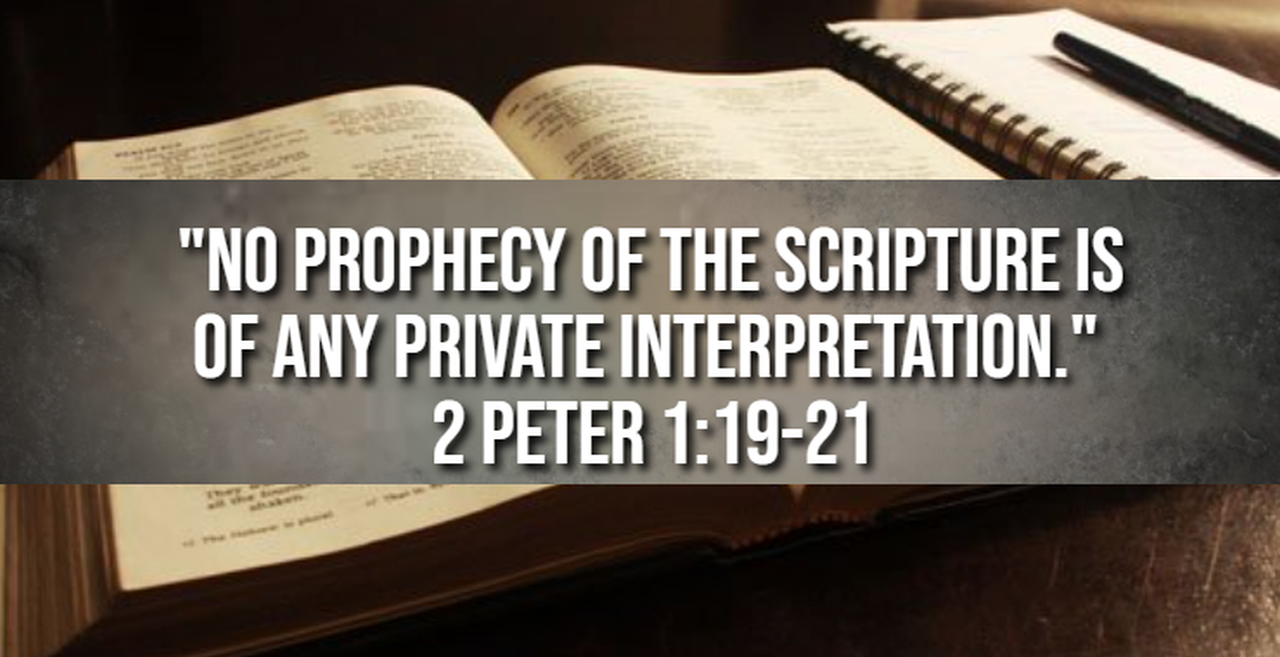
Beware of “Private Interpretation” [podcast]
NO MAN GAVE THE TRUTH AND NO MAN CONTROLS IT
ANY person who doesn’t uphold God’s Word as final divine authority on all matters of faith, is 100% “NOT of God” according to the Son of God (John 8:47).
“Let God be true and EVERY man a liar.” Romans 3:4
Is God or are mere men confused?
“For God is not the author of confusion, but of peace, as in all churches of the saints.” 1 Corinthians 14:33
Beware of those who violate, who speak contradictory to other parts of God’s Word in order to sell you on their “revelation.” Known truth, biblically stated truth must never be contradicted. The LORD is not confused and so we conclude that anyone upholding what they believe to be truth that contradicts known biblical truth, is confused at best. Beware of what the Holy Spirit calls “private interpretation.” (2 Peter 1:19-21) More in a moment on this.
Many seek to use commentaries, historians and the like to paint the picture, the outcome they desire because they do not love the LORD and therefore His truth. If God wanted us to have more it’d be in His Word…. I am not opposed to background information but that’s not divinely inspired Holy Scripture and many people try to change the outcome of biblical truth by using extra-biblical sources. Beware. They attempt to create a path to an unbiblical conclusion because they are “not valiant for the truth.” (Jeremiah 9:3)
It’s convoluted theology to speak against, contrary to the whole of the Word of God which among other things says “ALL scripture is given by inspiration of God.” (2 Timothy 3:16) Ignoring known, clearly stated Bible truth to perpetrate a certain view is bearing false witness against the LORD, is confusion, and is violence against the Holy Scriptures and the picture painted by the WHOLE of God’s Word. This is also a refusal to rightly divide the Word of truth but instead a deliberate, subjective ignoring of divine truth in order to perpetrate an agenda (1 Corinthians 2:13; 2 Timothy 2:15).
Many today interpret the Bible for their own self-serving purpose or liking, based on being predisposed to certain traditions, philosophies, and clichés. This is exactly what Jesus cited the false religionists of His day for doing (Mark 7:6-9).
God gave His Word to us and will reveal Himself and His will to each of His saints as they seek Him, studying His words thoroughly, diligently, daily.
“Search the scriptures; for in them ye think ye have eternal life: and they are they which testify of me. 40 And ye will not come to me, that ye might have life.” John 5:39-40
God gave us the Holy Scriptures to reveal to us who He is and yet, the individual must come to Jesus personally to know Him and understand His Precepts, His kingdom truths. Like the religionists Jesus is addressing above, many who think they know God are not known of God at all because they refuse to truly repent and seek His holy face.
Exactly as Jesus warned, there are “many false prophets” today to accommodate counterfeits, tares (Matthew 7:15; 24:11).
 Many times we hear men stand up to speak, claiming they’ve been studying a topic in the Bible extensively – and insinuating that on the basis of THEIR study, you should just buy wholesale everything they’re about the say. There are “many deceivers” operating today (2 John 7-11). Out of the pride of their hearts we hear men preface their message this way, boasting of their study, to set up and snare the unlearned, the gullible when in reality many of them have simply borrowed the errors of other men. Yet we must judge all that is taught against our own personal, diligent study of the whole of God’s Word and never buy the subjective claims of mere men. This is the very reason so many are deceived today. Following man’s supposed revelation, interpretations, instead of getting God’s revelation for ourselves, firsthand, is the recipe to be deceived. There are no shortcuts to personally, thoroughly studying the whole counsel of God’s Word for ourselves. | The Importance of Personal, Organic Bible Study
This scenario often plays out when someone is teaching on the end times, claiming or insinuating that they have come up with special revelation. At times they will claim to definitely know and have figured out who the antichrist is, the specifics and timing of end time events, and secrets about these last days. Yet, at least some of those things they claim to have special knowledge of are not specifically, expressly written in the Bible. Beware of the “private interpretation” of mere men.
“We have also a more sure word of prophecy; whereunto ye do well that ye take heed, as unto a light that shineth in a dark place, until the day dawn, and the day star arise in your hearts: 20 Knowing this first, that no prophecy of the scripture is of any private interpretation. 21 For the prophecy came not in old time by the will of man: but holy men of God spake as they were moved by the Holy Ghost.” 2 Peter 1:19-21
God’s Word, the words of God recorded in Holy Writ, were inspired by the Holy Spirit and were not written from any mere man’s “private interpretation”, nor are the words of God to be twisted and done violence to by anyone today for their own “private interpretation” to promulgate their own view, doctrine, or agenda.
Notice in this passage above that through Peter, the Holy Spirit puts the personal responsibility upon the individual disciple to “take heed” to the Word of God, to study it daily, diligently as the revelation of Christ and His will rises in our hearts, dawns on us – “ye do well that ye take heed, as unto a light that shineth in a dark place, until the day dawn, and the day star arise in your hearts.”
God expects His people to study thoroughly and to know His Word for themselves.
“Study to shew thyself approved unto God, a workman that needeth not to be ashamed, rightly dividing the word of truth.” 2 Timothy 2:15
No man controls the truth nor does he control the interpretation of divine truth which is self-evident and to be first and foremost studied and understood by individual disciples. Yes, God calls elders out to teach HIS Word, to let God’s Word dwell richly among His people, and yet the LORD alone teaches the individual believers heart His truth (Colossians 3:16). This is the individual priesthood of each and every blood bought saint of Christ. Jesus saves the individual sinner first and foremost who is then and only then an individual member of His one body (Ephesians 4; 1 Corinthians 12).
“But ye have an unction from the Holy One, and ye know all things. 21 I have not written unto you because ye know not the truth, but because ye know it, and that no lie is of the truth. …26 These things have I written unto you concerning them that seduce you. 27 But the anointing which ye have received of him abideth in you, and ye need not that any man teach you: but as the same anointing teacheth you of all things, and is truth, and is no lie, and even as it hath taught you, ye shall abide in him.” 1 John 2:20-27
Ultimately, and most importantly, God teaches each and every one of His individual saints – “My sheep hear my voice, and I know them, and they follow me:” (John 10:27)
Those who aren’t objective with the whole counsel of Scripture clearly prove their hearts are not honest, not authentic, and sincere before the LORD (Luke 8:15; John 7:16; 2 Corinthians 2:17; 2 Peter 3:16, etc.).
Beware of Being a “Back it Up” Bubba
Personally studying God’s Word from Genesis to Revelation, organically, is ultra-important. | The Importance of Personal, Organic Bible Study
To “back up” a belief with Scripture seems to really mean: “I believe ABC doctrine and I’m hell bent on finding Bible verses to prove it!” In other words someone like this doesn’t really care what the whole of Scripture teaches as much as they care to hold on to some pet doctrine (it’s usually something to justify their sin such as the falsehood of eternal security).
Some put forth their subjective beliefs and defend those beliefs by saying “I can back everything up with scripture.” Satan can too as we see him do when tempting Jesus (Luke 4). The devil used Scripture out of context as many today do. Are we merely backing up what WE say and what WE currently believe with Scripture or are we simply reading and diligently studying the whole counsel of Holy Scripture and letting GOD speak for Himself as we “compare spiritual things (Scripture, known truth) with spiritual things”? (1 Corinthians 2:13; 2 Timothy 2:15) Big difference. Think about that. Men and devils can deceitfully make the Bible say anything THEY want it to say but that doesn’t make it biblically sound and true. We must beware of our own tendency to espouse and hold on to philosophies, notions, and doctrines that do not line up with the whole counsel of God’s Word and we must be corrected (2 Timothy 3:16-17).
“All scripture is given by inspiration of God, and is profitable for doctrine, for reproof, for correction, for instruction in righteousness: 17 That the man of God may be perfect, throughly furnished unto all good works.” 2 Timothy 3:16-17
The disciple of Jesus, without exception, will be ever more rooted and grounded in the final divine authority of the written Word of God.
Jesus told us exactly who is “of God” and who is “NOT of God.”
“He that is OF GOD heareth God’s words: ye therefore hear them not, because ye are NOT OF GOD.” John 8:47
ALL who are “of God” uphold His Word as final divine authority, with no exception.
When discussing any matter, specifically spiritually, the main issue is what God’s Word says, which is His “truth” and when one is valiant for His truth, such a man will not rely on anything except God’s Word (Jeremiah 9:3; John 17:17). God says we can be CERTAIN about what He says concerning any topic revealed in His Word – “Have not I written to thee excellent things in counsels and knowledge, 21 That I might make thee KNOW the CERTAINTY of the words of truth; that thou mightest answer the words of truth to them that send unto thee?” (Proverbs 22:20-21)
We must honestly examine our own selves to see WHY we believe WHAT we currently believe. Discernment, “rightly dividing the word of truth” seem to be concretely connected to searching the Scriptures as we see with the Bereans who tested Paul and all that he taught, right? (2 Timothy 2:15; Acts 17:10-11) Lots of people who talk about discernment trust their own subjective discernment instead of letting the written WORD be their two edged sword of discernment (Hebrews 4:12). Many believe they are discerning correctly and yet aren’t daily, diligently being grounded in the written Word, which God will never contradict (2 Timothy 3:16-17; 2 Peter 1:19-21).
The Berean Saints are a Great Example to us Today
“And the brethren immediately sent away Paul and Silas by night unto Berea: who coming thither went into the synagogue of the Jews. 11 These were more noble than those in Thessalonica, in that they received the word with all readiness of mind, and searched the scriptures daily, whether those things were so.” Acts 17:10-11
May the reader be exhorted to become intimately familiar with the above passage, noticing that the Bereans didn’t even take Christ’s apostle Paul at his word. No, they “searched the scriptures daily” for themselves to see “whether those thing were so” that Paul was preaching.
As was the case with the Berean disciples who listened to Paul preach, God intends for us to partake in, to hear preaching and yet, all must be cross examined against our own personal searching of His Word for ourselves (2 Timothy 2:15; 3:16-17). On that note, do you remember when the LORD Jesus spoke to the woman at the well and how when He revealed Himself to her as the Messiah she ran out and told everyone? Yet, those men didn’t fully embrace Christ till they personally went to see Him for themselves.
“The woman then left her waterpot, and went her way into the city, and saith to the men, 29 Come, see a man, which told me all things that ever I did: is not this the Christ? 30 Then they went out of the city, and came unto him. … 42 And said unto the woman, Now we believe, not because of thy saying: for we have heard him ourselves, and know that this is indeed the Christ, the Saviour of the world.” Acts 4:28-30, 42
No Greek or Hebrew is needed and is certainly not the main rule of interpretation. We must take God’s preserved Word for what it clearly states in our own language, as we compile, compound, put together Scripture with Scripture (Isaiah 28:16; 1 Corinthians 2:13). This is the method of priority in apprehending truth, the highest, stated rule of interpreting truth. A thorough gathering of all Scripture pertaining to the given study, is essential.
“TAUGHT OF GOD”
“It is written in the prophets, And they shall be all TAUGHT OF GOD. Every man therefore that hath heard, and hath learned of the Father, cometh unto me.” John 6:45
“But as touching brotherly love ye need not that I write unto you: for ye yourselves are TAUGHT OF GOD to love one another.” 1 Thessalonians 4:9
The LORD alone is “the truth”, gave us His truth – His written Word – and presides over it, teaching it to His people (John 14:6; Psalms 146:6, etc.). His written Word is final divine authority and taught by Him to His people in abiding relationship (John 14:26; 16:13-14).
Beware of “Private Interpretation”
Being crucified with Christ means one is emptied of self, self-will, self-agenda, and abandoned to God’s will. This means that such a person searches out and embraces the biblical truth, no matter where it leads. He never bends the truth to try to fit a tradition or doctrine but rather reject any previous believed notion when the Word says differently (Romans 3:4; 2 Timothy 2:15; 3:15-17, etc.).
Those who engage in the sinful activity of privately interpreting Scripture, do so because …
- They themselves are un-repentant, not denying self, taking up the cross, and following Jesus (Luke 9:23-24; 2 Timothy 4:2-4)
- They refuse to let God be true and every man a liar – beginning with their own wicked hearts (Romans 3:4)
- They value tradition about divine truth (Mark 7:6-9)
- They do no hold God’s Word as final divine authority though they claim to (John 8:47)
- They refuse to be honest with the whole counsel of Holy Scripture (2 Timothy 2:15; 3:15-17)
Beware of those who seek to control the interpretation of God’s Word – those who impose their own notions and doctrine onto God’s truth. There are many who read things into Scripture which are not in the Scriptures. Let’s read again our central passage:
“We have also a more sure word of prophecy; whereunto ye do well that ye take heed, as unto a light that shineth in a dark place, until the day dawn, and the day star arise in your hearts: 20 Knowing this first, that NO PROPHECY OF THE SCRIPTURE IS OF ANY PRIVATE INTERPRETATION. 21 For the prophecy came not in old time by the will of man: but holy men of God spake as they were moved by the Holy Ghost.” 2 Peter 1:19-21
“Private interpretation” seems to point to the agenda and act of self application based on tradition or preconceived notions. Not allowing God to speak for Himself via a thorough study of the whole counsel of His written Word. Application or interpretation based on self desires or that which conforms to some extra-biblical notion or doctrine of men.
Here’s the Greek word for “private”
G2398
ἴδιος
idios
id’-ee-os
Of uncertain affinity; pertaining to self, that is, one’s own (agenda); by implication private or separate: – X his acquaintance, when they were alone, apart, aside, due, his (own, proper, several), home, (her, our, thine, your) own (business), private (-ly), proper, severally, their (own).
Greek word for “interpretation”
G1955
ἐπίλυσις
epilusis
ep-il’-oo-sis
From G1956; explanation, that is, application: – interpretation.
Total KJV occurrences: 1
Not only did the Holy Ghost give us God’s written Word, but also it’s the Holy Ghost that teaches individual saints. Here’s how:
“Which things also we speak, not in the words which man’s wisdom teacheth, but which THE HOLY GHOST TEACHETH; comparing spiritual things with spiritual.” 1 Corinthians 2:13
Believers are “taught of God” as they study and collate Scripture. This is never to be infringed upon or controlled by elders. That’s one reason for the plurality of elders in the local expressions, the gatherings of Christ’s body. There’s safety in a plurality of elders who should thereby be held accountable and rebuked when needed (Titus 1:5, etc.).
As Christ’s saints continue “stedfastly in the apostles’ doctrine and fellowship, and in breaking of bread, and in prayers”, they compare, put together, collate line upon line, Bible verse upon Bible verse, in ordain to be “taught of God” His truth (Acts 2:42; Colossians 3:16).
“Reprove, rebuke, exhort with all longsuffering and doctrine”
RED FLAG: When you witness a man, an elder, who dodges or doesn’t want certain BIBLE verses read, due to that truth contradicting his tradition/heresy, you know you have a man who is in need of repentance (Mark 7:6-9). Such a man’s heart is not captive to the Word of God. He has his own evil agenda. Such a wolf will seek to impose his doctrine of men and devils on others and must be rebuked.
“Against an elder receive not an accusation, but before two or three witnesses. 20 Them that sin rebuke before all, that others also may fear.” 1 Timothy 5:19-20
“Preach the word; be instant in season, out of season; reprove, rebuke, exhort with all longsuffering and doctrine.” 2 Timothy 4:2
The root reason people choose the lie of OSAS is that they simply refuse to truly repent and lay down their lives in this fleeting world. So they are willing to wax over and avoid mountains of biblical truths and warnings. They have their own agenda they hold in reserve. They are not given over to Christ. They believed and were saved and yet didn’t continue in the truth – which Jesus says is essential.
Many times, the ones who cry “context, context, context” are those taking God’s Word out of context in order to perpetrate their heresy. They don’t want the real context because though they pose as Christians, they are not men of truth and so don’t honestly follow the Word of God honestly, no matter where it may lead. They don’t like the context of Holy Scripture – because it simply doesn’t say what they want it to say. They have a predetermined outcome, a doctrinal goal they want to reach and are willing to bait and switch, do acrobats, and ignore Scripture that doesn’t agree with their heresy. These are not honest people. Their goal is to reach their predetermined conclusion.
The Bible reveals that un-repentant people migrate to false teachers, false doctrines (2 Timothy 4:3-4).
“For the time will come when they will not endure sound doctrine; but after their own lusts shall they heap to themselves teachers, having itching ears; 4 And they shall turn away their ears from the truth, and shall be turned unto fables.” 2 Timothy 4:3-4
Counterfeits invent ways to excuse themselves from accountability to Scripture. Though they regularly and selectively refer to and read the Old Testament Scriptures, when you quote or read them Holy Scripture from the Old Testament to expose OSAS, they will scream “but that’s Old Testament!” Nice try. But “ALL scripture” is given to New Testament saints and we are told that we are taught by those very Scriptures (2 Timothy 3:17; Romans 15;4; 1 Corinthians 10:11). Also, this same truth as is taught in the passage below, is also taught and confirmed all over the New Testament and from Genesis to Revelation.
“Say unto them, As I live, saith the Lord GOD, I have no pleasure in the death of the wicked; but that the wicked turn from his way and live: turn ye, turn ye from your evil ways; for why will ye die, O house of Israel? 12 Therefore, thou son of man, say unto the children of thy people, The righteousness of the righteous shall not deliver him in the day of his transgression: as for the wickedness of the wicked, he shall not fall thereby in the day that he turneth from his wickedness; neither shall the righteous be able to live for his righteousness in the day that he sinneth. 13 When I shall say to the righteous, that he shall surely live; if he trust to his own righteousness, and commit iniquity, all his righteousnesses shall not be remembered; but for his iniquity that he hath committed, he shall die for it.” Ezekiel 33:11-13
Eternal Security is a Lie from Hell.
The Ultimate Teacher is Divine
“But the Comforter, which is the Holy Ghost, whom the Father will send in my name, he shall teach you all things, and bring all things to your remembrance, whatsoever I have said unto you.” John 14:26
“Howbeit when he, the Spirit of truth, is come, he will guide you into all truth: for he shall not speak of himself; but whatsoever he shall hear, that shall he speak: and he will shew you things to come. 14 He shall glorify me: for he shall receive of mine, and shall shew it unto you.” John 16:13-14
GOD alone “keepeth truth”, is the Divine Source and Steward of His Truth
“…the LORD his God: 6 Which made heaven, and earth, the sea, and all that therein is: which keepeth truth for ever:” Psalms 146:6
Notice the Hebrew word for “keepeth” here….
H8104
שָׁמַר
shâmar
shaw-mar’
A primitive root; properly to hedge about (as with thorns), that is, guard; generally to protect, attend to, etc.: – beware, be circumspect, take heed (to self), keep (-er, self), mark, look narrowly, observe, preserve, regard, reserve, save (self), sure, (that lay) wait (for), watch (-man).
Total KJV occurrences: 468
Support | STORE | Podcasts | Jail/Prison Ministry | Mexico Mission here | All Ministry Updates | Making Peace with God | It is Finished! | Discipleship | The Gospel Centers Upon Christ’s Blood | Christology | The Gospel: What is It? | H.O.T. Bible Study [podcast]

Abiding
Cons and Crooks who Do Not Preach the Cross [podcast]
“For the preaching of the cross is to them that perish foolishness; but unto us which are saved it is the power of God.” 1 Corinthians 1:18
Those who do not preach the cross prove that they believe the cross is “foolishness.”
The know that many will leave if they were to preach the crucified life. And they are in it for the money, the acceptance of mere men, not Christ. Make no mistake, the Holy Ghost through Paul warned us specifically about this generation of counterfeits, these “evil men and seducers” who “wax worse and worse.” (2 Timothy 3:13) They’ve raised up a generation of self-love counterfeits who have a mere “form of godliness” and are “denying the power (authority of Jesus) thereof: from such turn away.” (2 Timothy 3:1-13)
The con men who commandeer today’s apostate church world want you “in church” so they get paid and yet where did the apostle Paul or any of the apostles instruct anyone to go find a good church or “attend church every Sunday”? Chapters and verses please
Why is lack of attending a local fellowship listed as a sin in the New Testament canon?
What qualifies a man to be an elder? certainly not seminary which are wolf factories invaded by the jesuits in 50’s and 60’s. All seminarians are vatican indoctrinated. The first they the jesuits did was replace the real Bible, the KJB with fake vatican corrupted new version “bibles.”
In His Great Commission command, did Jesus ever command “Go ye into all the world and find a church and be a fruitless, lukewarm, good church member?” OR …. Go teach and preach my Word? (Matthew 28:18-20; Mark 16:15)
In the early days of the Gospel, when persecution hit Jerusalem, God’s Word records this: “Therefore they that were scattered abroad went every where preaching the word.” (Acts 8:4) This clearly reveals that they were equipped by the apostles “for the work of the ministry, for the edifying of the body of Christ:” (Ephesians 4:11-12) Jesus and apostles never trained anyone to become good church members or attenders.
IF YOU ARE ARGUING TO PUSH THE IDEA THAT ALL DISCIPLES OF JESUS MUST GO TO A SUPPOSED “OFFICIAL” CHURCH BUILDING ON SUNDAY MORNINGS AND YET YOUR OWN PASTOR ISN’T CONSTANTLY PREACHING THE CRUCIFIED LIFE AS AN ABSOLUTE ORIGINAL GOSPEL ESSENTIAL….. THIS IS CLEAR PROOF YOU ARE SITTING UNDER WOLVES AND NOW DEFENDING THEM AND WILL BE JUDGED WITH THEM (2 John 9-11).
Isn’t it interesting that those who push the “go to church” agenda are the ones who stand to profit from such? Are you being made merchandise of? (2 Peter 2:1-3)
Christ’s true disciples do what HE did – direct you to the cross, the crucified life – and not some apostate modern church run by a fake pastor, using a fake “bible”, and preaching a fake “Jesus.” WHAT did Jesus teach was necessary to follow Him – going to church or taking up the cross, living the crucified life, daily?
“And he said to them all, If any man will come after me, let him deny himself, and take up his cross daily, and follow me. 24 For whosoever will save his life shall lose it: but whosoever will lose his life for my sake, the same shall save it.” Luke 9:23-24
“Many try to crucify their flesh in their own strength. This is impossible. It takes a complete and total surrender to Jesus first. Then the Holy Spirit will show you all the ways you are not like God. Then it is not a struggle. You let Jesus have control. Your job is to obey and take your flesh to the cross to be nailed there. Dead and buried. This is how the fruits of the Spirit are born in us! If we are saved by the blood of Jesus, we will not let sin reign in our mortal bodies. We now have the power of Christ to resist sin. It should never have dominion over us. We are now servants of righteousness and holiness. We are to walk in the newness of life that we have in Christ. Do not serve sin! Serve Jesus!” Karen Cochran
Is the cross, the crucified daily life essential to following Jesus? Yes or no?
“And whosoever doth not bear his cross, and come after me, cannot be my disciple.” Luke 14:27
 Memorize Galatians 2:20 today. Meditate upon and live it daily.
“But those mine enemies, which would not that I should reign over them, bring hither, and slay them before me.” Luke 19:27
“Behold, the days come, saith the Lord GOD, that I will send a famine in the land, not a famine of bread, nor a thirst for water, but of hearing the words of the LORD:” Amos 8:11
Fellowship with other saints is vital and yet we have to navigate these times of apostasy.
MESSAGE RECEIVED:
“Not forsaking the assembling of ourselves together” is a Biblical command (Hebrews 10:24-25). It was also demonstrated and practiced in the early church (Acts 4:31, Acts 11:26, Acts 15:25, Acts 20:7, Romans 12:3-8, 1 Corinthians 11:17-34, 1 Corinthians 14:23-26, 1 Corinthians 16:1-2) . Missionaries may not always be able to attend the local church that sent them out but their heart is there and a big part of the mission should be establishing new local churches, like Paul did. All believers should desire to meet with fellow like minded Scriptural believers for fellowship, labor, and worship together unto God. Those without a body mentality are self centered.”
REPLY:
As Jesus commanded, the earliest followers of Jesus cross-walked with Jesus “daily” and fellowshipped “daily.” (Luke 9:23-24; Acts 2:46; 5:42). Today we have people who are impressed with themselves for meeting weekly in a setting that is called “church” that is not even biblical. Churchianity vs Christianity.
Acts 2:42 – “And they continued stedfastly in the apostles’ doctrine and fellowship, and in breaking of bread, and in prayers.” This is the true model of simple, Christ-centered fellowship. Regrettably the bureaucracy mob of wolves infiltrated long ago. Most local “churches” are commandeered by seminarian wolves (Ezekiel 22:25-27). In the first decades after Christ was raised from the dead, the apostle Paul wept bitterly over the hoards of wolves who would come and make a busine$$ out of the church, who would devour the sheep of Christ, for whom He came and died (Acts 20:20-32). Jesus had already cleansed the temple in divine fury over this very thing (Matthew 21; John 2). They the apostle Peter warned us of those who would “make merchandise of you.” (2 Peter 2:1-3)
“Evil men and seducers shall wax worse and worse.” 2 Timothy 3:13
 Missionaries and others who are truly born again and find Biblical fellowship even daily, instead of weekly, are no less assembling than those who meet in a designated building once weekly.
We still do not see Jesus or the apostles operating rigidly or perhaps much at all with a regimented Sunday morning meeting, nor their insistence that all Christians the world over do such. It was more of a lifestyle, not a Sunday morning visit to a country club as is mostly what we see today. Telling new Christians to go “find a church” in their area is a dangerous proposition especially in this late hour where Jesus promised, foretold that “MANY false prophets shall arise and shall deceive MANY.” (Matthew 24:11) Most “church” organizations are 501(C)(3) which alone means they sold out to the state, rejecting the rulership of the Savior…. and now the state dictates what, when, and where they can preach. The covid scamdemic exposed this – how over 90% of these state owned “churches” are utterly false. Those wolves took orders from the State, not the Savior who commands us to fellowship and if they have true fellowship, why didn’t they continue? They are compromised.
WHAT fruit has the modern church produced? Can we count on more than 1 hand the amount of people we know who are ardent church members (unbiblical) who are also in the Word daily, deny self and taking up the cross daily, and who are evangelizing. There are very few. Jesus says His people are a “little flock.” (Luke 12:32) The modern church wolves who pretend to represent Christ have produced a generation of counterfeits.
WHO did God tell us are His?
“And they that are Christ’s have crucified the flesh with the affections and lusts.” Galatians 5:24
When’s the last time you heard, outside of a “church” building. a faithful church goer laud and celebrate Jesus Christ, testifying of His precious blood and glorious resurrection? Churchianity isn’t Christianity. So many counterfeit modern church goers brag about and are proud of their church and pastor and yet few if any of those same people testify from their own mouths and lives the glories of the bless-ed nail scarred risen Savior. They are not upholding Christ, the Head (Colossians 2:18-19).
Many modern church assemblies do not equal true Bible fellowship, assembling which will always exalt Jesus Christ, not the elders, the organization, or the church.
YOUR PRAYER: Holy Father I come to You now in the name of Jesus, knowing what you said my life should be and yet not knowing how this is to come about. Please increase my faith. I love You LORD. Here and now I turn to You in repentance, asking You to forgive my many sins of not being thankful to You, of selfishness, self-idolatry, rebellion, and unbelief. Please wash me clean, afresh, in the precious blood of my LORD Jesus. Change me dear LORD. Conform me to the image of Christ. Please fill me with Your Holy Ghost and use me to win the lost and help Your people as we eagerly anticipate Your soon return. In Jesus’ name. Amen.
Each of us is blessed with good ministries we are surrounded by. They feed us and they are winning souls (street preachers, God called Bible teachers, etc). Please pray for and support them saints (Galatians 6:6; Philippians 1:19, etc.). This way we are all, each member of Christ’s body, participating in the Great Commission mandate He gave us – and is coming back to take account of the stewardship of our lives – time, talent, treasure, etc. (Ephesians 4:11-16, etc.). Let’s roll saints. Jesus is coming.
Support | STORE | Podcasts | Jail/Prison Ministry | Mexico Mission here | All Ministry Updates | THE BLOOD OF JESUS | Blood Atonement | PEACE with GOD | Christology (the study of Christ) | Christ Crucified | Was Jesus the “One and Only Son”? [podcast] | The Remission of Sins | | Prayer | Making Peace with God – Before it’s too late | The Return of Christ



Apostasy
Doubt Casting Wolves Exposed

Beware of this New Fad of Uncertainty
“Lest Satan should get an advantage of us: for we are not ignorant of his devices.” 2 Corinthians 2:11
Satan was the first to cast doubt on God’s Word, on what God had said. This led to the fall of mankind. It seems to be the first play in his playbook – in order to deceive mankind.
“Now the serpent was more subtil than any beast of the field which the LORD God had made. And he said unto the woman, Yea, hath God said, Ye shall not eat of every tree of the garden?” Genesis 3:1
Beware: Satan is the very father of all lies and the one who casts doubt upon the Word of his arch-enemy – the LORD. Did you notice that in the above verse, God’s Word describes our enemy as the creature that is “more subtil than any beast”? Then it shows us just exactly who he operates as we see this “subtil … beast” cast a question mark on the LORD and what He stated to the man and woman just previously (Genesis 2:17).
To “endure to the end,” we must be aware of this significant tripping tool, this pitfall of the enemy of all souls (2 Corinthians 2:11).
There are many ways and vehicles through which Satan casts doubt on what God has said in His Word – what He has spoken to us, mankind. In this message, we are merely touching on a few of those ways, in hopes of assisting the reader of being aware of the way our enemy works.
It has actually become fashionable to question the Almighty in the things He has non-negotiably stated to us in His Word. Is this not a fulfillment of many prophetic Scriptures warning us of apostasy?
“Woe unto them that call evil good, and good evil; that put darkness for light, and light for darkness; that put bitter for sweet, and sweet for bitter! 21 Woe unto them that are wise in their own eyes, and prudent in their own sight!” Isaiah 5:20-21
Satan is in the Seminaries
Casting doubt on God’s Word is an ancient tactic of Satan and we must be aware of it and on guard against it. There are no boundaries to it – where ever the enemy works, this tactic will be seen and it’s most “subtil.” In fact, the place we think this evil scheming to be least likely to be found is the very place it can be most prevalently found – Bible colleges and seminaries! Personally, I have attended two Bible colleges and have dialogued with hundreds of seminarians. It doesn’t take long at all to see just where their faith and trust is and how they have allowed themselves to have “an evil heart of unbelief,” refusing to take God at His very Word (Hebrews 3:12-14). Rather, they are “subverted” as they have been taught not to believe God for what He says in His Word (Titus 3:9-11). Instead, they have systems in place to cast doubt upon the Most High which is treason and betrayal of Christ! See Satan’s Seminaries!
Doubt-Casting in the Margins of Perverted Versions of the English Bible
Have you ever noticed that in the margin of the new, corrupt versions of the English Bible, where the godless translators have rebelliously and brazenly removed portions of Holy Scripture, they have a note casting doubt on whether or not that portion they removed should have been there in God’s Word in the first place? The lie in the margin is that “many earlier manuscripts didn’t contain this portion of Scripture.” This is an outright lie. Satan is busy people (1 Peter 5:8). Jesus warned us that the enemy has come to steal, kill, and destroy and that “Satan cometh immediately, and taketh away the word.” (Mark 4:15; John 10:10)
Of a new diabolical fad that is arising, Jim Clark notes:
“It seems that the latest apostate fad is ‘uncertainty’, also referred to as the certainty vs. assurance debate. They say that you can only have ‘assurance’ (something less than 100% certainty — like it’s something that you can scientifically measure) and only omniscient God has certainty. This is eisegesis (opposite of exegesis) — inserting human philosophy into Scripture. 1 John 5:13 says ‘These things have I written unto you that believe on the name of the Son of God; that ye may KNOW that ye have eternal life, and that ye may believe on the name of the Son of God.’ KJV”
In the divine economy and the heart of every true disciple of Jesus, salvation is a definitive certainty. Jesus made it certain because His blessed miracle of salvation in the hearts of men is certain. How can the most powerful experience (regeneration) in this life happen to a person and they not know it? The Son of God says:
Those who are truly saved, KNOW they are truly saved. Any person who is only 99% “sure” they are saved, is not saved. Huh?! Yes! Read these words of Holy Scripture:
“Verily, verily, I say unto you, He that heareth my word, and believeth on him that sent me, HATH everlasting life, and shall not come into condemnation; but is passed from death unto life.” John 5:24
“Verily, verily, I say unto you, He that believeth on me hath everlasting life.” John 6:47
1 John 3:14 says: “We KNOW that we have passed from death unto life, because we love the brethren. He that loveth not his brother abideth in death.”
This doubt is purely diabolical. Satan has not changed and that he is limited to the same tricks he had in the beginning (1 Corinthians 10:13). In the Garden of creation he cast doubt on God’s Word when he said to the woman: “Yea, hath God said?” (Genesis 3:1)
Of these doubt-casters, a brother named Preston notes:
“I think this stems from a philosophy embraced by many Calvinists. Christian Existentialism was started by Soren Kierkegaard and is where we get the idea of “blind leap of faith”. That is, the more obscure a belief can be the more “faith” one must exhibit or have to believe in it. This is a satanically-inspired, man-made philosophy and is not of God. God has given us overwhelming evidence not only of his existence, but also salvation as well. These men are preachers of confusion and are enamored with their so called intellect. In fact they are nothing more than fools!”
“Being b orn again, not of corruptible seed, but of incorruptible, by the word of God, which liveth and abideth for ever.” 1 Peter 1:23
Beware of the wolf who would cast doubt on the “certainty” of knowing God (Proverbs 22:17-21). Along with the divine Person of the Holy Spirit who indwells every believer, His “words of truth” are His “incorruptible” seed and make evident within every true born again and abiding saint that he is saved!
“For as many as are led by the Spirit of God, they are the sons of God. 15 For ye have not received the spirit of bondage again to fear; but ye have received the Spirit of adoption, whereby we cry, Abba, Father. 16 The Spirit itself beareth witness with our spirit, that we are the children of God.” Romans 8:14-16
Among other evils, this doubt that Satan’s ministers are introducing and casting, stifles witnessing and fulfilling the Great Commission our LORD gave us (2 Corinthians 11:12-15).
“Bow down thine ear, and hear the words of the wise, and apply thine heart unto my knowledge. 18 For it is a pleasant thing if thou keep them within thee; they shall withal be fitted in thy lips. 19 That thy trust may be in the Lord, I have made known to thee this day, even to thee. 20 Have not I written to thee excellent things in counsels and knowledge, 21 That I might make thee know the CERTAINTY of the words of truth; that thou mightest answer the words of truth to them that send unto thee?” Proverbs 22:17-21
Now that these smooth talking animalistic wolves have enormous masses of gullible audiences following their cultic personalities, they are beginning to cast doubt on the salvation of their constituents. Beware and be rooted and grounded in Christ!
“As ye have therefore received Christ Jesus the Lord, so walk ye in him: 7 Rooted and built up in him, and stablished in the faith, as ye have been taught, abounding therein with thanksgiving. 8 Beware lest any man spoil you through philosophy and vain deceit, after the tradition of men, after the rudiments of the world, and not after Christ.” Colossians 2:6-8
Seek, love, and obey Jesus Christ and cease following men! Repent of this idolatry and spiritual adultery!
The LORD’s holy truth is divine, eternal, and non-negotiable, amen. “FOREVER O LORD, they word is settled in heaven.” Psalms 119:89
Concerning Satan’s process through the modern church of deceiving and damning the souls of millions, one commenter writes:
“Those of us who keep our nose in the crack of the Holy Word of God and ignore the imaginations of men will be glad we did! Whew, denominations and their doctrines have killed more people than Hitler could have imagined! No denominations, no politics, no electorate process, no opinions in Heaven! God IS. That is enough to know!”
“Cease ye from man, whose breath is in his nostrils: for wherein is he to be accounted of?” Isaiah 2:22
Remedy for the sins of lies and doubt:
- Repent/surrender afresh
- Cling to Christ
- Repent of spiritual idolatry and adultery
- Denounce your human idols – all of them (Ezek. 14:3)
- Stop trusting mere men
- Get into God’s Word with reckless abandon
- Memorize Scripture by writing them on index cards – KJB
Sign up for free email devotional HERE... The Moments with My Master email devotional is sent out for the edification of the body of Christ.
Feedback:
“Excellent word! Sharing! I must admit I have been caught in Satan’s trap on this one in my life! But got right back up again, repented and know that I am His!” Darlene T.
Support | STORE | Podcasts | Jail/Prison Ministry | Mexico Mission here | All Ministry Updates | Christology | Be Ready in the Morning [podcast] | Fresh Start with God | Making Peace with God | 100’s of Christ-Centered, Scripture-Rich Podcasts | Rooted and Grounded in Christ







Ridiculous King James Bible Corrections

Darwin’s Demise: What they don’t want You to know about Charles Darwin! [podcast]

Beware of “Private Interpretation” [podcast]

The Benefits of Knowing and Delighting in the LORD [podcast]

Cons and Crooks who Do Not Preach the Cross [podcast]

NET New English Translation Fake “bible” Exposed

Doubt Casting Wolves Exposed

Thank You for Declaring that the Mexican People Matter to Jesus! Mission Mexico Part 50

John Wesley on Calvinism, Once Saved Always Saved, and Conditional Security

Arrogant Bible Correctors Rebuked

In a Small Prison Cell, Justin was about to Commit Suicide … [podcast]

“A Land Flowing with Milk and Honey” [podcast]

Nicolaitan Nightmare [podcast]

A PLACE CALLED HELL [podcast]

Following the Faith of Abraham [podcast]
John Wesley on Calvinism, Once Saved Always Saved, and Conditional Security

Why Did God Give Us His Word? [podcast]
Beware of “Private Interpretation” [podcast]

Beware of the Hebrew Roots Judaizing Snakes! [podcast]

The Highest Form of His Creation

The Flesh will Never be Reformed it Must be Crucified [podcast]

The High Treason of False Leaders [podcast]

Direction in God’s Word? [podcast]

Can and Will God Use You? [podcast]
A PLACE CALLED HELL [podcast]
Arrogant Bible Correctors Rebuked
Nicolaitan Nightmare [podcast]

The Daily Cross in Prayer [podcast]
Doubt Casting Wolves Exposed
Ridiculous King James Bible Corrections
Ridiculous King James Bible Corrections
Darwin’s Demise: What they don’t want You to know about Charles Darwin! [podcast]
Beware of “Private Interpretation” [podcast]


 America2 years ago
The Drugging of America: The Pharmakeia Sorcery Deception [podcast]
- Articles3 years ago
Children being Rescued in Tunnels: Happening Now – UPDATE!
- Articles9 years ago
Self-Examination in Preparation for the Lord’s Return
- Apostasy3 years ago
SHOCKING List of False Prophets Most Believe are True