

sgys banner books

Giving the first of our time, treasure, and talents is the stated will of God. – “But seek ye FIRST the kingdom of God, and his righteousness; and all these things shall be added unto you.” (Matthew 6:33)

Giving Under the New Testament

Clarity and Questions Answered

  • Does the Bible teach New Testament believers to tithe?
  • What does the LORD say concerning our worship in giving?
  • Did Jesus teach tithing?
  • Will God curse me if I don’t tithe?
  • Will tithing make me wealthy or debt-free?
  • If tithing is not commanded under the New Testament, how should I worship Christ with the blessings He is bringing into my life?
  • If Christians aren’t supposed to tithe then why is it taught in the church?
  • How can I make sure I am giving to New Testament ministry?

There are many now who are exposing the fraud of modern wolves who have coercively placed New Testament Christians under the Old Testament tithing laws God gave to the Jews. The New Testament Scriptures never teach that New Testament believers have to tithe. Believers under the New Covenant can tithe if they wish, but there’s no instruction in the New Covenant to do such. Having learned that tithing is not required, many are left hanging, not knowing how to worship Jesus Christ with their giving. Those who are exposing the exploitation of God’s people by wolves who have told them they will be cursed if they don’t tithe, must teach what Scriptures does teach about giving. Regrettably, it seems that few are learning and teaching what the New Testament teaches concerning giving/distribution. Biblical balance is what we seek as we study the whole counsel of God’s Word (2 Timothy 2:15; 3:15-17).

So, we have a whole lot of unlearned people going around touting that we are not under the law of tithing, and that’s valid. And yet, where are those who are learning and teaching what the New Testament Scriptures teach about giving? Our giving is to be part of our worship to our LORD, the Giver of all good things (James 1:17). That part is the same under both testaments. Someone is being honored with our money and that should be the LORD Himself who alone gives us that ability to have health and to get wealth (Deuteronomy 8:1-18).

“When I stand before God at the end of my life, I would hope that I would not have a single bit of talent (or treasure) left and could say, I used everything You gave me.” Erma Bombeck

The New Testament Scripture have much to say about giving – first our lives and then our provisions (2 Corinthians 8:5). The fact that there is no law of tithing under the New Covenant is no license to ignore the instructions of the One who bled to save us. He taught us not to hoard but rather to be generous in our giving. In fact, the apostle Paul expresses the divine incentive in our giving when he penned these words:

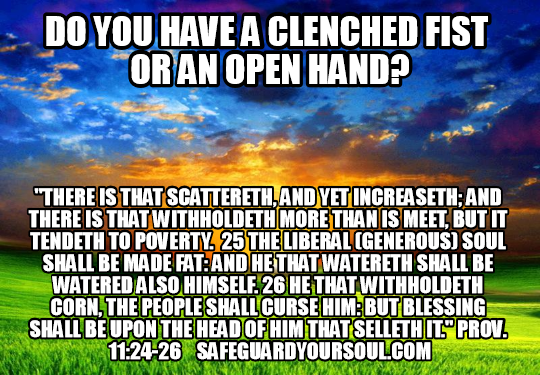
“But this I say, He which soweth sparingly shall reap also sparingly; and he which soweth bountifully shall reap also bountifully. Every man according as he purposeth in his heart, so let him give; not grudgingly, or of necessity: for God loveth a cheerful giver. And God is able to make all grace abound toward you; that ye, always having all sufficiency in all things, may abound to every good work: (As it is written, He hath dispersed abroad; he hath given to the poor: his righteousness remaineth for ever. 10 Now he that ministereth seed to the sower both minister bread for your food, and multiply your seed sown, and increase the fruits of your righteousness;)11 Being enriched in every thing to all bountifulness, which causeth through us thanksgiving to God.”  2 Corinthians 9:6-11
“The  fruits of our righteousness” are “increased” when we give. Jesus taught this also when He instructed us where to lay up treasure:

“Lay not up for yourselves treasures upon earth, where moth and rust doth corrupt, and where thieves break through and steal: 20 But lay up for yourselves treasures in heaven, where neither moth nor rust doth corrupt, and where thieves do not break through nor steal: 21 For where your treasure is, there will your heart be also.” Matthew 6:19-21

“Cast thy bread upon the waters”

“Cast thy bread upon the waters: for thou shalt find it after many days. 2  Give a portion to seven, and also to eight; for thou knowest not what evil shall be upon the earth.” Ecclesiastes 11:1-2

Of this passage, one commentator writes:

“Ecclesiastes 11:1
a    [Cast thy bread upon the waters: for thou shalt find it after many days] This is universally taken to mean that blessings will be returned to one who is generous and hospitable (Ecc_11:1). In Ecc_11:2 one is advised to give a portion of his bread to seven or eight (figurative of several), for no one knows when he will need bread from another for himself.”

Of Ecclesiastes 11:1 John Wesley wrote:

“The waters – Freely and liberally bestow it upon the waters; upon those poor creatures, on whom it may seem to be as utterly lost, as the seed which a man casts into the sea or river. Find it – It shall certainly be restored to thee, either by God or men. This is added to prevent an objection, and to quicken us to the duty enjoyned. After – The return may be slow, but it is sure, and will be so much the more plentiful.”

Of this passage, Adam Clarke wrote:

“Cast thy bread upon the waters – An allusion to the sowing of rice; which was sown upon muddy ground, or ground covered with water, and trodden in by the feet of cattle: it thus took root, and grew, and was found after many days in a plentiful harvest. Give alms to the poor, and it will be as seed sown in good ground. God will cause thee afterwards to receive it with abundant increase. The Targum understands it of giving bread to poor sailors. The Vulgate and my old Bible have the same idea. Send thi brede upon men passing waters.”

THE WAY A PERSON SPENDS THEIR MONEY IS A DIRECTION REFLECTION OF THE PRIORITIES OF THEIR HEART (Matthew 6:21).

Doesn’t the fact that some do not choose to generously support the LORD’s work reveal their disdain for Him who gave them life?

There is much to be missed out on if we don’t learn and do what the LORD taught us concerning giving under the New Testament. From the above passage we see that not only will God reward eternally those who give now, but also that our heart affections will follow our giving into His kingdom.

There is an abundance of teaching on giving in the New Testament. The LORD is not at all silent on this matter. It is a different program than the tithing program He gave to the Jews and yet there are New Testament teachings which find their beginnings as elements that were modeled in the program to Israel. The apostle Paul specifically ties them together (1 Corinthians 9:8-10, 13-14). There is a series of insightful passages revealing the charitable disposition and giving among the earliest believers (Acts 2:44-45; 4:32-35).  These are given to us by the LORD to be examples to all believers under the New Covenant. There is an abundance of doctrine on giving in the New Testament Scriptures. Here’s a sampling:

Summary of what the New Testament Teaches on Giving

  • 16 of Jesus’ 38 parables involve stewardship (Matthew 25:14-46; Mark 12:41-44; Luke 12:13-47; 16:1-31, etc.)
  • Each and every one of us shall be judged by how we gave or did not give (Matthew 25:14-46)
  • That God looks at the percentage we give out of what we have and the heart with which we give (Mark 12:41-44; 2 Corinthians 9:7)
  • Giving (of self and substance) and how it shall be given back to those who give (Luke 6:29-38)
  • As Christ’s body, having all things common, that is, by abandoning our lives in this world, liquidating, and sharing as every believer has need (Acts 2:44-45; 4:32-35)
  • Giving so that distribution can be made among all believers and so the LORD’s workers can be provided for (Acts 6:1-4)
  • Provision for those whom the LORD has called out to worship and serve Him (feed and equip His sheep) full-time may be sustained (1 Corinthians 9:1-14)
  • Gathering and giving that which is being given by the individual members of Christ’s body (1 Corinthians 16: 1-3)
  • “Equality” among believers (2 Corinthians 8)
  • We shall all be rewarded according as we gave generously or otherwise (Matthew 25:14-46; 2 Corinthians 9:6-11)
  • Divinely incentivized giving. Those who give sparingly reap sparingly and those who give generously will reap abundance (2 Corinthians 9:6-11)
  • The believers at Philippi helped Paul by providing for him in the Gospel work. Those who gave were given a special promise (v19; Philippians 4:10-19)
  • The New Testament teaches giving so that “double honour” provision may be given to those whom the LORD has called out to labor in the word and in doctrine (1 Timothy 5:17-18)

Also, remember that those who still tithe (by faith and clear conscience) are not sinning by doing so, no less than those who observe a certain day of the week to worship and rest (by faith and clear conscience).

The fact that New Testament believers are not under tithing laws does not mean that God will not bless those who give in a disciplined, organized, generous manner. It also does not negate the fact that the LORD will bring us into judgment for our giving or lack thereof. He’s actually watching exactly how we are stewarding what He has given us (Mark 12:41-44).

We must conclude that the LORD is not glorified when we give to causes that do not directly connect with what is taught in His Word. For example: New Testament disciples are to give to that which is clearly fulfilling the New Testament purposes Jesus set forth, namely teaching and preaching His Word (Matthew 28:18-20; Mark 16:15-20). It should be noted that not one penny was collected among the earliest believers to build or sustain/maintain a physical building and perhaps such is the greatest hindrance to the Gospel program Jesus instituted in His Great commission command which still stands today till He returns. Also, giving to false teachers is bidding God speed to them and makes us as guilty and condemned as they are before God (2 John 7-11).

New Testament Christians are not only to give but also to make sure their giving is according to God’s Word. The following is a partial list of things that will work against us and not be rewarded:

  • Giving to physical building projects (new or renovation)
  • Paying to maintain a physical building, especially in a wasteful manner)
  • Giving to contribute to wasteful, man-centered projects or causes or maintenance of temporal things that only stifle the going forth of the Gospel
  • Humanitarian “missions” that don’t include the clear preaching and teaching of God’s Word
  • Giving the already over paid pastor wolf an expensive watch for his birthday or sending him on a lavish vacation
  • The SPCA or any animal (beast) cause
  • Breast cancer causes, etc. (the wicked Susan G. Komen Foundation gives money to Planned Parenthood to murder babies)
  •  Entertainment that poses as ministry
  • Children’s church that does not teach God’s Word

The early disciples of Jesus are our example and they didn’t huddle, hunker down, or hide but instead they “went every where preaching the word.” (Acts 8:4) A personal study of the book of Acts will begin to reveal a vast difference between authentic New Testament Christianity and the self-serving apostate modern church and the hireling wolves who make merchandise of the biblically illiterate (2 Peter 2:1-3).

It does not matter how deeply passionate someone feels about what cause they give to. If a cause isn’t clearly fulfilling a New Testament purpose it’s wasteful and sinful to further that cause. The only thing that matters is whether or not their giving is clearly reconcilable with the Great Commission to teach God’s Word to His people and to preach His Word to the lost (Matthew 28:18-20; Mark 16:15-20; Acts, etc.). All New Testament giving should in one way or another go to provide for those preaching and teaching His Word, tending to the sheep of Christ, winning lost souls, and providing for believers in need.

If it’s not fulfilling the clearly stated New Testament purpose, it’s not glorifying God and is wasted resources for which we shall give account. If giving to a cause is not funding the feeding of Christ’s sheep and declaration of His truth, it’s not New Testament giving.

“The Lord Loveth a cheerful giver.” 2 Corinthians 9:7

This message is not to discourage the believer from tithing. It is NOT a sin to tithe and it’s not required, especially under the coercive way under the New Testament. It’s important to realize that Christ’s New Testament saints are not forced, commanded, or instructed to tithe under the New Testament.  This makes you free to give out of a heart of cheerfulness (hilarity) which the LORD says He delights in (2 Corinthians 9:7). Actually, it’s a good idea in organizing ones finances. Firstfruits” giving is a great way to worship the LORD with our finances and assures that He alone is put first (Proverbs 3:9-10; Matthew 6:33, etc.).

Are you taking care of your own business and not “the Father’s business”? (Luke 2:49) If so, unlike Christ, you are all about yourself, your own self-serving business and not “the Father’s business.” The LORD created and saved you to be about His business first and foremost. How do we think that’s going to work out for you if you don’t repent and begin putting the LORD first in your life and finances? Diminishing returns.

Is tithing essential to salvation? No! Will God still keep His promises to bless those who give? Yes (2 Corinthians 1:20).

If we do not take control of our money, our money will continue to have control over us. There’s no better way to take control and begin to steward all the resources God brings into your possession than by making the decision to give the LORD the very first portion of all that you are blessed to bring in.

Taking care of the things of God’s kingdom is seeking first His kingdom.

Ye looked for much, and, lo it came to little; and when ye brought it home, I did blow upon it. Why? saith the Lord of hosts. Because of mine house that is waste, and ye run every man unto his own house.” Haggai 1:9

“Honour the Lord with thy substance, and with the firstfruits of all thine increase: 10 So shall thy barns be filled with plenty, and thy presses shall burst out with new wine.” Proverbs 3:9-10

New Testament Distribution (audio) | Is Your Local Church Fulfilling a New Testament Purpose? | Much More on Stewardship and Giving Here.

Do you want to get deeper into God’s Word? If so, send a reply requesting the Moments with My Master email that is sent out to edify Christ’s body.

FEEDBACK:

“The problem with tithing is that we are to cheerfully give without being instructed to tithe. The Spirit of God should direct us to give even more than a 10% of our money or goods or whatever. We are led of the Spirit of God not the Law. All tithing has done is keep these preachers who don’t preach the truth in all their expensive cars and homes, and planes and so forth. I love to give. I don’t believe like the preachers teach to tithe or else. I’m not talking about you brother, but many others. Be Blessed.” David Pace

Support | STORE | PodcastsThe Return of ChristStewardshipWhere to Give and Where Not to Give | Fruit Abounding to Your Account! | Consider Your Ways [podcast] | Consider and Build [podcast] | Holes in Your Money Bags? [podcast] | Dollar DialogueJesus Sat Over Against The Treasury [podcast] | Escaping Sodom!Waste | Stewardship | Giving

Join Us

We saved a place for you to receive our weekly newsletter.

Please wait...

Thank you for signing up!

Dollar Dialogue [podcast]

Holes in Your Money Bags? [podcast]

Grace vs Holiness [podcast]

Un-Biblical Local Church Structures [podcast]

Click to comment

Leave a Reply

Your email address will not be published. Required fields are marked *


The reCAPTCHA verification period has expired. Please reload the page.

Abiding

The Song of Moses: God’s Favor upon His People [podcast]


“And Moses spake in the ears of all the congregation of Israel the words of this song, until they were ended.” Deuteronomy 31:30

Everything we read of the children of Israel was pointing to Christ and to His perfect salvation He would later come and accomplish and bestow upon His beloved people, the body of Christ which is “the Israel of God.” (Galatians 6:16)  And so this song is written to us (Romans 15:4;  Corinthians 10:11).

At the end of his days, at the end of the 5 books he penned, God gives us through Moses a summation of His salvation work among His beloved people.

“He found him in a desert land, and in the waste howling wilderness; he led him about, he instructed him, he kept him as the apple of his eye. 11 As an eagle stirreth up her nest, fluttereth over her young, spreadeth abroad her wings, taketh them, beareth them on her wings: 12 So the LORD alone did lead him, and there was no strange god with him. 13  He made him ride on the high places of the earth, that he might eat the increase of the fields; and he made him to suck honey out of the rock, and oil out of the flinty rock;  14  Butter of kine, and milk of sheep, with fat of lambs, and rams of the breed of Bashan, and goats, with the fat of kidneys of wheat; and thou didst drink the pure blood of the grape.” Deuteronomy 32:10-14

“32:10-14 The birth and childhood of the nation of Israel are described in verse 10. After the Exodus from Egypt, God guided, instructed, and preserved His people with the love of a mother eagle (v. 11). There was no foreign god who had a part in Israel’s preservation. Why then should the nation turn to idolatry and ascribe the goodness of Jehovah to another? Beginning in verse 13, the song is prophetic. He brought them into the blessings of the Promised Land.” Believer’s Bible Commentary

“Deuteronomy 32:10
a    [He found him in a desert land …] The sevenfold preservation of Israel:
1.    God found (literally, sustained) him in the wilderness (Deu_32:10).
2.    He led him around (Deu_32:10-12).
3.    He instructed him (Deu_32:10).
4.    He kept him as the apple (pupil) of His eye.
5.    He preserved him from idolatry (Deu_32:12).
6.    He exalted him among the nations (Deu_32:13).
7.    He gave him material prosperity (Deu_32:13-14).
b    [apple of his eye] Hebrew: ’iyshown (H380), the dark pupil of the eye; the hole, gate, or door of the eye (Psa_17:8; Pro_7:2)” Dake

“Deuteronomy 31:30-32:14
MOSES’ SONG: THE LORD’S FAVOR UPON ISRAEL
The song of Moses, like the fabled song of the swan, was his last and sweetest. It is probably the noblest ode in the whole compass of the Bible, and is the source from which subsequent singers derived suggestions for their noblest outbursts. The marginal references prove how deeply it dyed the national sentiment.

It excels in the names and designations of the Almighty. He is the Rock: Deu_31:4; Deu_31:15; Deu_31:18; Deu_31:30; Jehovah: Deu_31:6; Father: Deu_31:6; the Most High: Deu_31:8; God: El, the strong, Deu_31:15, etc. What a study are the names of God, scattered through the Bible! Each was coined to meet some need of the human soul. What the rocks of the desert are to its shifting sands God is amid the changes of this mortal existence.

This earlier part of the song is very tender. We are God’s portion; the apple of His eye; as young eaglets, whom the mother-bird is carefully teaching to fly, the favored recipients of God’s richest gifts, Deu_31:13, etc.” FB Meyer

Notice the descriptive language, the metaphors—how the LORD illustrates how He loves, protects, and provides for His people. In Scripture, the LORD uses imagery to communicate truth.

“Moses’ song and what our LORD reveals in this message, is such a beautiful picture of God finding us in our hopeless, miserable, and lost state. He pulls us out of the miry clay and gives us His supply of grace. He then clothes us with His righteousness, seating us in heavenly places in Christ and surrounding us with His care and protection. God’s love and goodness to us.” Karen Cochran

“He that dwelleth in the secret place of the most High

shall abide under the shadow of the Almighty. 2 I will

say of the LORD, He is my refuge and my fortress: my

God; in him will I trust. 3 Surely he shall deliver thee

from the snare of the fowler, and from the noisome

pestilence. 4 He shall cover thee with his feathers,

and under his wings shalt thou trust: his truth shall

be thy shield and buckler.” Psalms 91:1-4

Read Psalm 91 often so this truth permeates you. Here the LORD uses the imagery of His “winged fowl” creation (Genesis 1:21). GOD made this very creature/bird for the express purpose of showing us how much He loves us and how He comforts, cares and provides for, guides, and protects His own (Psalms 91:1).

“The Song of Moses is recorded in Deuteronomy 32 of the King James Version (KJV), spanning verses 1 through 43. It is a prophetic poem given by Moses to the children of Israel just before his death, serving as a witness and a reminder of God’s faithfulness and Israel’s potential turning away.”

Prayer: Father, please grant that I know and understand You more and more. I love You LORD. In Jesus’ name. Amen.

Support | STORE | Podcasts | Jail/Prison MinistryMexico Mission here | All Ministry UpdatesBecause You Care Page | Bible/Word of GodThe Greatest of these is CharityBe Ready in the Morning [podcast]The Sure Mercies of David [podcast]That Repentance and Remission of Sins should be Preached [podcast]At His Feet | Prepared to be Used of God Grace and Truth Bible School [modules] | 7 Study Guides to a Greater Foundation in Christ | Knowing God | The Cross Life | Christology = the Study of Christ

Join Us

We saved a place for you to receive our weekly newsletter.

Please wait...

Thank you for signing up!

Continue Reading

Articles

Jesus in Every Book of the Bible

First and foremost, God’s Word was written to reveal Christ.

The Bible is said to be “The only Book where the divine Author is present every time you read it.”

He’s divinely encoded and present on every page of His Word.

“And he said unto them, These are the words which I spake unto you, while I was yet with you, that all things must be fulfilled, which were written in the law of Moses, and in the prophets, and in the psalms, concerning me.” Luke 24:44 

Every book of the Bible is about the LORD Jesus, who is the central theme, the sacred substance of all of Holy Scripture. If we miss Him, we miss everything, we miss the grand subject and revelation of God’s Word.

“Search the scriptures; for in them ye think ye have eternal life: and they are they which testify of me. 40 And ye will not come to me, that ye might have life.” John 5:39-40

This makes it clear that we can “search the scriptures,” we can know them, and yet not know the Author.

They knew the Word of God but did not know the God of the Word. They made the choice not to “come to” Jesus thorugh His Word. They made it about themselves, not Jesus.

The Bible is one Book from one divine Author. The divisions are there to help us navigator His Word. – Old and New Testaments, chapters, verses, etc.

“Open thou mine eyes, that I may behold wondrous things out of thy law.” Psalms 119:18

The supreme and most important “wondrous” thing we are to behold in Holy Writ, is Jesus Christ.

Amen. Jesus Christ is King of all kings, LORD of all lords.

“Behold, he cometh with clouds; and every eye shall see him, and they also which pierced him: and all kindreds of the earth shall wail because of him. Even so, Amen. 8 I am Alpha and Omega, the beginning and the ending, saith the Lord, which is, and which was, and which is to come, the Almighty.” Revelation 1:7-8

Jesus is present in every book of the Bible, from Genesis to Revelation. Here’s a breakdown of how He is revealed in each book:

Old Testament Canon:

  • Genesis: Jesus is the seed of the woman (Gen 3:15) and the promised redeemer descended from the line of Judah (Genesis 22:17-18).
  • Exodus: Jesus is the Passover Lamb (Exodus 12:1-13).
  • Leviticus: Jesus is the Great High Priest (Leviticus 8:1-36; Hebrews 4:14).
  • Numbers: Jesus is the Rock (Numbers 20:2-13).
  • Deuteronomy: Jesus is the Bread of Life (Deuteronomy 8:3).
  • Joshua: Jesus is the Captain of the Lord’s host (Joshua 5:13-15).
  • Judges: Jesus is the Judge of Israel (Judges 2:11-15).
  • Ruth: Jesus is the Kinsman-Redeemer (Ruth 3:9-13).
  • 1 Samuel: Jesus is the King of Israel (1 Samuel 16:13).
  • 2 Samuel: Jesus is the Son of David (2 Samuel 7:12-13).
  • 1 Kings: Jesus is the King of Israel (1 Kings 1:30-40).
  • 2 Kings: Jesus is the King of Israel (2 Kings 17:13-15).
  • 1 Chronicles: Jesus is the King of Israel (1 Chronicles 17:11-15).
  • 2 Chronicles: Jesus is the King of Israel (2 Chronicles 6:16).
  • Ezra: Jesus is the Rebuilder of the Temple (Ezra 5:2-5).
  • Nehemiah: Jesus is the Rebuilder of the Walls of Jerusalem (Nehemiah 6:15-16).
  • Esther: Jesus is Mordecai (Esther 2:5-7).
  • Job: Jesus is the Ever-Living Redeemer (Job 19:25-27).
  • Psalms: Jesus is the Shepherd (Psalm 23:1-4).
  • Proverbs: Jesus is Wisdom (Proverbs 8:22-31).
  • Ecclesiastes: Jesus is the Teacher (Ecclesiastes 12:13-14).
  • Song of Solomon: Jesus is the Bridegroom (Song of Solomon 1:2-4).
  • Isaiah: Jesus is the Messiah (Isaiah 53:1-12).
  • Jeremiah: Jesus is the Righteous Branch (Jeremiah 23:5-6).
  • Lamentations: Jesus is the Suffering Servant (Lamentations 3:22-24).
  • Ezekiel: Jesus is the Shepherd (Ezekiel 34:11-16).
  • Daniel: Jesus is the Son of Man (Daniel 7:13-14).
  • Hosea: Jesus is the Husband (Hosea 2:16-20).
  • Joel: Jesus is the Day of the Lord (Joel 2:28-32).
  • Amos: Jesus is the Shepherd (Amos 5:24-27).
  • Obadiah: Jesus is the Redeemer (Obadiah 1:21).
  • Jonah: Jesus is the Savior (Jonah 2:9-10).
  • Micah: Jesus is the Ruler (Micah 5:2-5).
  • Nahum: Jesus is the Judge (Nahum 1:2-8).
  • Habakkuk: Jesus is the Righteous One (Habakkuk 1:13).
  • Zephaniah: Jesus is the Righteous Branch (Zephaniah 3:14-17).
  • Haggai: Jesus is the Desire of All Nations (Haggai 2:7).
  • Zechariah: Jesus is the Branch (Zechariah 3:8).
  • Malachi: Jesus is the Messenger (Malachi 3:1).

New Testament Canon:

  • Matthew: Jesus is the Messiah (Matthew 1:1-25).
  • Mark: Jesus is the Son of God (Mark 1:1-11).
  • Luke: Jesus is the Savior (Luke 2:11).
  • John: Jesus is the eternal, the divine Word of God (John 1:1-14).
  • Acts: Jesus is the Resurrected Lord (Acts 1:1-11).
  • Romans: Jesus is the Righteousness of God (Romans 3:21-26).
  • 1 Corinthians: Jesus is the Wisdom of God (1 Corinthians 1:18-25).
  • 2 Corinthians: Jesus is the Great Comforter, Consoler, grace-giver, sufficiency of/to His people (2 Corinthians 1:1; 12).
  • Galatians: Jesus is the Redeemer, liberty giver (Galatians 3:13-14).
  • Ephesians: Jesus is the Head of the Church (Ephesians 1:20-23).
  • Philippians: Jesus is the God of Peace (Philippians 4:7-9).
  • Colossians: Jesus is the Creator and Sustainer of all life (Colossians 1:15-17).
  • 1 Thessalonians: Jesus is the Coming King (1 Thessalonians 4:13-18).
  • 2 Thessalonians: Jesus is the Coming Judge and King (2 Thessalonians 2:1-12).
  • 1 Timothy: Jesus is the High Priest (1 Timothy 2:5-6).
  • 2 Timothy: Jesus is the Faithful One, Rewarder (2 Timothy 2:13).
  • Titus: Jesus is the Savior, the Blessed Hope (Titus 1:3-4).
  • Philemon: Jesus is the Ransom (Philemon 1:8-9).
  • Hebrews: Jesus is the Great High Priest (Hebrews 4:14; 5:1-10).
  • James: Jesus is the Righteous One, Giver of wisdom (James 1:1-18).
  • 1 Peter: Jesus is the Shepherd, Rock (1 Peter 2:25).
  • 2 Peter: Jesus is the Lord, Day Star (2 Peter 1:1-21).
  • 1 John: Jesus is the Son of God, Light, Advocate, Truth (1 John 1:1-14).
  • 2 John: Jesus is the Savior, Truth (2 John 1:1-13).
  • 3 John: Jesus is the Savior, Way (3 John 1:1-15).
  • Jude: Jesus is the Savior (Jude 1:1-25).
  • Revelation: Jesus is the Lamb of God, King of kings (Revelation 1:1-20).

Jesus is present in every book of the Bible, from Genesis to Revelation, as the seed of the woman, the Passover Lamb, the High Priest, the Rock, the Judge, the King, the Redeemer, the Shepherd, the Husband, the Savior, and more.

Jesus Christ is King. – “Behold, he cometh with clouds; and every eye shall see him, and they also which pierced him: and all kindreds of the earth shall wail because of him. Even so, Amen. 8 I am Alpha and Omega, the beginning and the ending, saith the Lord, which is, and which was, and which is to come, the Almighty.” Revelation 1:7-8

Support | STORE | Podcasts | ChristologyBe Ready in the Morning [podcast]Fresh Start with God | Making Peace with God | 100’s of Christ-Centered, Scripture-Rich Podcasts | Rooted and Grounded in Christ 

Continue Reading

Articles

Redemption Through Christ’s Sacrifice [podcast]


The Glories
of the
Scarlet Thread

(Few things could be this important to your spiritual life)

Of the scarlet of redemption, one writer notes:

“The Wonder of Redemption: The blood is the power of redemption and you will see this as we follow through the Bible from the beginning to the end of God’s revelation of Himself to man as recorded in the Bible.”

“Giving thanks unto the Father, which hath made us meet to be partakers of the inheritance of the saints in light: 13 Who hath delivered us from the power of darkness, and hath translated us into the kingdom of his dear Son: 14 In whom we have redemption through his blood, even the forgiveness of sins:” Colossians 1:12-14

The great apostle of Jesus declared the Gospel to us:

“Christ died for our sins according to the scriptures; 4 And that he was buried, and that he rose again the third day according to the scriptures:” 1 Corinthians 15:3-4 

The Fall of Man

The Good News is so good due to the very bad news of our fall.

“Wherefore, as by one man (Adam) sin entered into the world, and death by sin; and so death passed upon all men, for that all have sinned: … Therefore as by the offence of one (Adam) judgment came upon all men to condemnation; even so by the righteousness of one the free gift came upon all men unto justification of life.” Romans 5:12, 18

When the man and woman whom God had created chose to sin against Him, He separated them from His presence. They attempted to cover their nakedness by sewing fig leaves together and girding them around their waists (Genesis 2:7). This was man’s attempt to cover his own sin and shame.

“The aprons of fig leaves speak of man’s attempt to save himself by a bloodless religion of good works.” William MacDonald

God did not honor the fig leaves so He shed the blood of animals to make them “coats of skins, and clothed them” (Genesis 3:21). Because He had already foretold that His Son would be sent to redeem the fallen race (Genesis 3:15), God chose to depict the sacrifice that the coming Redeemer would make by the sacrifice of innocent animals. The atonement for the man and woman by the sacrifice of these animals pointed to the prophesied Savior who would later come and personally shed His blood to atone for the sins of His creation which had been contaminated by sin.

“And I sought for a man among them, that should make up the hedge, and stand in the gap before me for the land, that I should not destroy it: but I found none.” Ezekiel 22:30

This Scripture above speaks to the utter need and absolute divine exclusivity and uniqueness of Christ.

From the cradle of creation through the dispensation of the Mosaic law, in Christ’s redemptive blood on Calvary’s cross, and throughout eternity future, we see that in the Creator’s economy it is blood that quenches the fire of His holy vengeance.

“And almost all things are by the law purged with blood; and without shedding of blood is NO remission.” Hebrews 9:22

God obviously instructed Adam and Eve to sacrifice animals to continue to cover their sin because their son Abel brought “the firstlings of his flock” at the time of sacrifice (Genesis 4:4).

The blood sacrifice that Abel offered to God was accepted because it demonstrated faith in the coming Redeemer.

When Israel was in bondage God informed the nation that each family was to shed the blood of an unblemished lamb and place the blood upon their doorposts before He delivered them from Egypt (Exodus 12). He said that this blood would save them from His wrath. The unblemished lamb was a type of the spotless Lamb of God which was to come to be slain (1 Peter 1:19), saving those who would receive Him, from the wrath of God (Romans 5:9).

Not Just Any Blood

“But when the fulness of the time was come, God sent forth his Son, made of a woman, made under the law, To redeem…” Galatians 4:4-5

Sin separated men from their holy Maker and God (Isaiah 59:2). Under the law God instructed the nation of Israel to approach Him by the sacrifice of animals. The sins of the people were atoned for by the blood of animals because this demonstrated faith in the prophesied and coming Redeemer (Leviticus 16:34, 17:11). In Leviticus 16 there is a twofold typology of Christ found. Aaron, the priest of Israel, was to take two goats to atone for the sins of the people (Lev. 16:8-10). One of these two goats was used as a “sin offering” and the other for a “scapegoat.” The “sin offering” goat that was sacrificed was a type of Christ who would later shed His blood, “offering Himself without spot to God” (Hebrews 9:14). His blood, which was depicted here in the blood of the animal, was to be the ultimate price for atonement (at-one-ment) that the Father required for the removal of the sins of the fallen race. The word “scapegoat” here literally means the goat of departure. Concerning this live goat of departure, the LORD instructed Aaron to lay both hands upon him and confess all the sins and iniquities of Israel upon him and then send him away into the wilderness (Leviticus 16:20-22). This goat, the scapegoat, was a type of Christ in that it would carry the sins of God’s people away from them. It would separate them from sin so that their sin wouldn’t separate them from God. This is a type of Christ in that He was to come and shed His perfect blood to “take away the sin of the world” (John 1:29).

Jesus cried: “Why hast thou forsaken me?” (Psalms 22:1; Matthew 27:46)

“It was the human body which God had given Him. It was the sacrifice that cried-the Lamb about to die! The Son of Man knew Himself forsaken. God dumped that vast, filthy, slimy mass of human sin on the soul of the Savior-and then backed away.” A.W. Tozer.

“Wow! All that filth was ours! Jesus was our ultimate sacrifice! And Isaiah says in 53:10 that it ‘pleased the Lord to bruise Him.’ This was God’s divine plan that Jesus would be the sacrifice for our sins so we could have redemption and reconciliation with God. We cannot understand the depths of this kind of love for us! All we can do is praise Jesus! And love Him with all our heart, soul, and mind (Matthew 22:37), and obey and follow Him all the days of our lives! All praise to You Jesus for loving us this much!” Karen Cochran

Discover the age-old falsehood responsible for the ruin of millions since the dawn of creation. Are you being deceived? What is the LIE of the Ages? Find out in this revolutionary new book.

This prophetic pattern continued to cover the sins of His people from the time of the fall until the One whom these sacrifices foreshadowed appeared (Hebrews 10). Those in Israel who truly loved the LORD fervently anticipated the arrival of the prophesied Messiah a Lamb of God. About 4,000 years after man had fallen, a prophet named John the Baptist, saw Jesus approaching and declared “Behold, the Lamb of God, which taketh away the sin of the world” (John 1:29). It was the fullness of time and the Father had sent the promised Redeemer into the earth to “take away the sin of the world.” The sacrifices that once atoned for Israel would now be superseded by the one sacrifice of God’s only begotten Son (Hebrews 10:1-23). His pure and spotless blood would now be shed to remove the sins of the world. The Lamb which was slain before the foundation of the world (in the mind of God) was now manifest in the flesh to redeem mankind from his sinful and separated state (Revelation 13:8; John 1:14). He became the “propitiation” (atoning sacrifice) for our sins (1 John 2:2).

Just before He went to His ordained altar, the cross, to be offered up for the sin of the world, Jesus said;

“For this is my blood of the new testament, which is shed for many for the remission of sins.” Matthew 26:28

As is clearly announced in the God-breathed New Testament records, redemption, remission, and the forgiveness of sins comes only from the blood of Jesus, the one and only Redeemer of men (Ephesians 1:7).

“In whom we have redemption through his blood, the forgiveness of sins, according to the riches of his grace.” Ephesians 1:7

THE ULTIMATE AND FINAL SACRIFICE

He who knew no sin became the atoning sacrifice for the sins of the world (2 Corinthians 5:21).

“When Jesus therefore had received the vinegar, he said, It is finished: and he bowed his head, and gave up the ghost.” John 19:30

It was out of the riches of His mercy and grace that our sins have been remitted by the one sacrifice of Jesus Christ, the Lamb of God. Note the finality of language He uses to convince you of this in the following passage:

“But this man, after he had offered one sacrifice for sins for ever, sat down on the right hand of God…For by one offering he hath perfected for ever them that are sanctified…. And their sins and iniquities will I remember no more. Now where remission of these is, there is no more offering for sin. Having therefore, brethren, boldness to enter into the holiest by the blood of Jesus, By a new and living way, which he hath consecrated for us, through the veil, that is to say, his flesh; And having an high priest over the house of God; Let us draw near with a true heart in full assurance of faith…” Hebrews 10:12-22

Not only does the blood of Jesus take away/remove the sins of the one who personally receives Him, but also the guilt that is always coupled with sin (Hebrews 9:14; 1 John 1:9). What great salvation!

“And from Jesus Christ, who is the faithful witness, and the first-begotten of the dead, and the prince of the kings of the earth. Unto him that loved us, and washed us from our sins in his own blood.” Revelation 1:5

His blessed sinless divine blood is available to those who will simply “Come” to Him as He invites them to do … before and in order to be saved AND afterward, that fount is always available during this season …. (Matthew 11:28-30; Hebrews 4:14-16)! Anyone else thankful and happy about “the precious blood of Christ, as of a lamb without blemish and without spot” today? (1 Peter 1:18-19)

For a topical study of deeper proportions on this subject, see The Blood of Jesus.

Where is YOUR Christology friend? What know thee of Christ? Have you sought and studied Him? Go here: Christology (the study of Christ)

If you will be planted deep into Christ, your Christology, your study of, your personal knowledge of Christ must be deep, not shallow (Colossians 2:6-10).

If you truly desire to know more about how to really know the LORD, go here:  Born Again: What is It?

Sign up for free email devotional HERE… The Moments with My Master email devotional is sent out for the edification of the body of Christ.

PEACE with GOD

Feedback:

“Amen! Words cannot express our thanks in what our Lord Jesus has done on the Cross for us, His suffering. We thank You Lord for all you have done, though we are undeserving, we thank you so much. Otherwise I would be lost, on my way to hell w/out your salvation.” Paula L.

Support | STORE | Podcasts | ChristologyBe Ready in the Morning [podcast]Fresh Start with God | Making Peace with God | 100’s of Christ-Centered, Scripture-Rich Podcasts | Rooted and Grounded in Christ 

Join Us

We saved a place for you to receive our weekly newsletter.

Please wait...

Thank you for signing up!

Continue Reading

Categories

donate button round
sgys-books01

Trending