Calvinism’s Origins and Historical Roots [podcast]





Calvinism’s Origins and Historical Roots
How did Calvinism Come about? Where did John Calvin derive his teachings, doctrines which many hold to today?
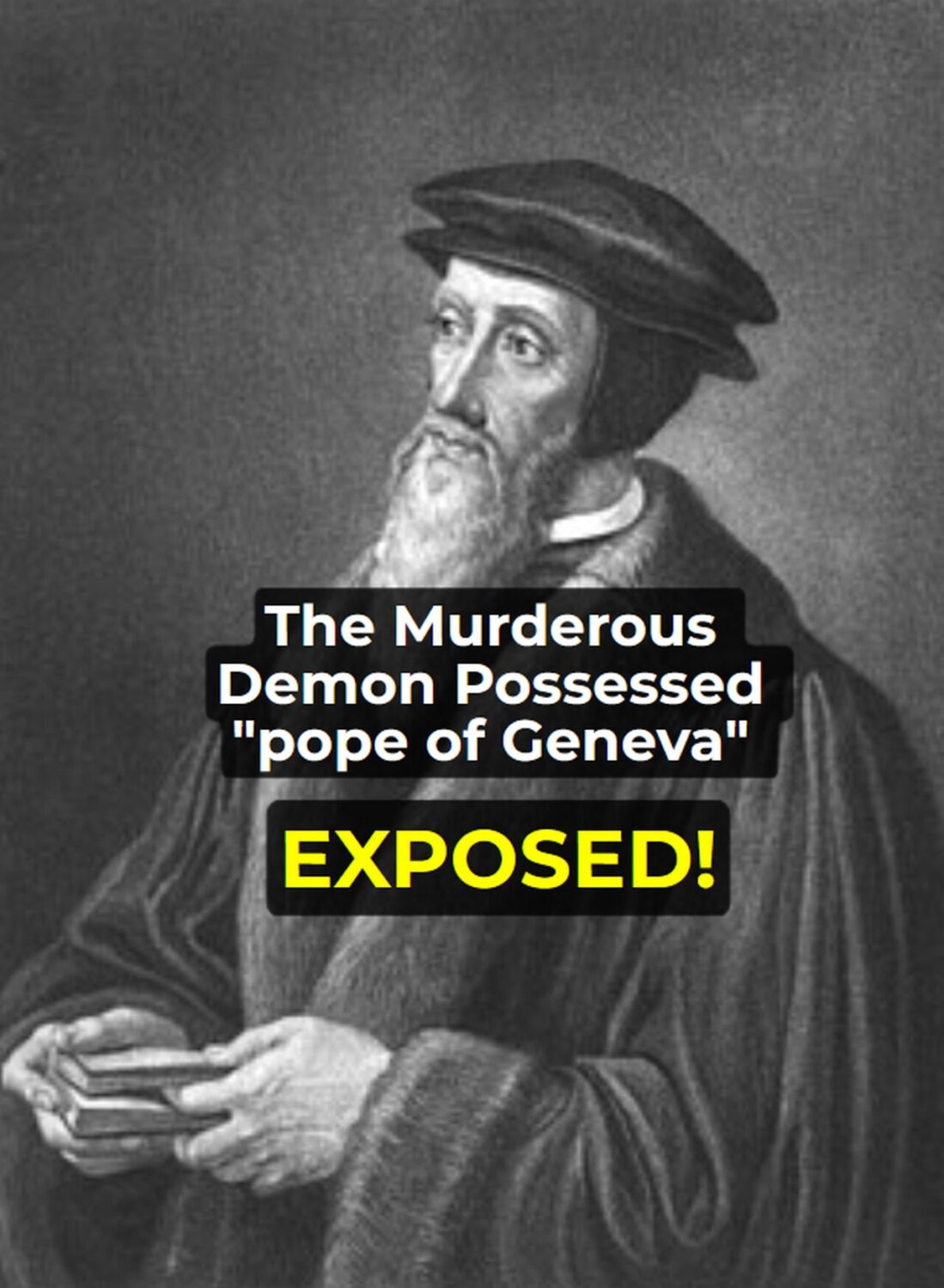
False Doctrines of the “Pope” of Geneva
Total Depravity, Unconditional Election, Limited Atonement, Irresistible Grace, and Perseverance of the Saints.
HERE’S WHERE THE TULIP, THE 5 SOLAS, THE 5 POINTS OF CALVINISM CAME FROM. IT’S A CURSED ROOT AND THAT’S WHY CALVINISM CAN BRING FORTH NOTHING EXCEPT CURSED FRUIT (Matthew 12:33).
Calvinism was cursed from the beginning, at the root. Calvinism is “another gospel,” a false gospel, and a totally heretical system of theology spawned from an “accursed” demon-possessed wolf who murdered over 60 men and women for disagreeing with his lies (Galatians 1:6-9).
Was John Calvin the worst wolf in church history?
Demon possessed maniac John Calvin wrote the following:
“Chapter Four – Unbiblical Beliefs and Failures of John Calvin
Calvin on the Bible: In 1536 Calvin wrote: “The Bible is a knotty, difficult text, whose interpretation demands extensive knowledge. If brought into contact with it unceremoniously, many minds are upset and seized with confusion. The Bible is too old a text in too new a world.”23
God willed that man sin. Calvin wrote “God, in a secret and marvellous way, justly wills, the things which men unjustly do.” . . . “Although God and the devil will the same thing: they do so in an utterly different manner.”24 He said that God did not will that all men be saved saying, “. . .that few receive the Gospel; we must fully conclude, that the cause is the will of God; and that the outward sound of that Gospel strikes the ear in vain, until God is pleased to touch, by it, the heart within.”24
Calvinism is not only not “biblical Christianity”, it is a gross attack on the original Gospel of Jesus Christ and the character of a loving and just God. The origins of the cult of calvinism are disturbing to put it lightly. Its roots are cursed. It is “another gospel” and so all who espouse and promulgate it are “accursed.” (Galatians 1:6-9).
 The following is from Kent Rieske
Everything One must first study the man, John Calvin, in order to understand the theology that has come to be called Calvinism. Here’s some facts you should know about this demonic fraud: Calvin was born July 10, 1509, in Picardy at Noyon, France, to devout Roman Catholic parents as Jean Chauvin and died at Geneva, May 27, 1564, at age 54. The family name, spelled in many ways, was Cauvin, latinized according to the custom of the age as Calvinus. John is commonly called Maître Jean C. Maître Jean C. is French for Master John C. His mother, Jeanne Le Franc, born in the Roman Catholic Diocese of Cambrai, is mentioned as “beautiful and devout.” She took her little son to various shrines and brought him up a good Catholic. John was baptized in the Roman Catholic Church as an infant. On the father’s side, his ancestors were seafaring men. His grandfather settled at Pont l’Evêque near Paris and had two sons who became locksmiths. The third, Gerard, became procurator at Noyon and had four sons and two daughters. John Calvin’s father, Gerard, an attorney, had purchased the freedom of the City of Noyon where he practiced civil and canon law. Gerard’s four sons were made clerics and held benefices at a tender age. John was given one when a boy of twelve. He became Curé of Saint-Martin de Marteville in the Vermandois in 1527 and of Pont l’Eveque in 1529. Three of the boys attended the local Collège des Capettes, and there John proved himself an apt scholar.
Calvin’s formal education was complete in 1527 when he was eighteen. According to the Catholics, he drifted from his Roman Catholic faith to become a humanist and a reformer. The “sudden conversion” to a spiritual life in 1529 could possibly be interpreted as his becoming saved, but throughout his life he counted on his Roman Catholic infant baptism as the basis of his regeneration.
Theological Seminaries Are Centers for Higher Brainwashing.
 John Calvin studied the voluminous writings of Saint Augustine, the Roman Catholic Bishop of Hippo (354-430 AD), much more so than those of Martin Luther, his contemporary. Calvin is continually praising Augustine’s work with numerous references and quotations. Augustine was greatly influenced by the Gnostics, an early Christian sect, whose doctrine was heretical. Gnostics believed that mankind was wholly evil, and some sects even renounced marriage and procreation. They also believed in two gods, one evil and one good. Their teachings are believed to have influenced Saint Augustine in the development of his theology of the “total depravity” of mankind and his concept of God. For nine years Saint Augustine adhered to Manichaeism, a Persian dualistic philosophy proclaimed by Mani (216-276? AD) in southern Babylonia (Iraq) that taught a doctrine of “total depravity” and the claim that they were the “elect.” Augustine could not advance in his Manichaeism religion because of his sinful lifestyle. He had a reputation as a “womanizer” and a fornicator.
Manichaeism – Wikipedia Encyclopedia
Manichaeism – Catholic Encyclopedia
Manichaeism – MSN Encarta Encyclopedia

Augustine then turned to skepticism and was attracted to the philosophy of Neoplatonism. He blended these beliefs with his later Gnostic and Christian teachings. Augustine’s prolific writings were more strongly biased by his previously-obtained theology than on his detailed study of the Christian Scriptures. He used Christian Scripture out of context when words or phrases could be adapted to match his theology. Augustine’s teachings were in turn passed on to John Calvin through his extensive study of Augustine’s writings, the most popular being his book, Confessions. It is very easy to follow the trail of John Calvin’s theology from the pagan religion of Mani in Babylonia to Saint Augustine and into his own writings in France and Geneva that distort the Word of God. Calvin’s false doctrine came directly from Augustine.
Calvin’s Book Supersedes the Bible
Calvin’s famous letter to King Francis I was dated August 23, 1535. It served as a prologue to his book, Institutes of the Christian Religion, the first edition of which was written in March 1536, not in French but in Latin. Calvin’s apology for lecturing the king was displayed as placards posted all over the realm denouncing the Protestants as rebels. King Francis I did not read these pages, but if he had done so he would have discovered in them a plea not for toleration, which Calvin utterly scorned, but for doing away with Catholicism in favor of the new gospel. “There could be only one true Church; therefore, kings ought to make an utter end of popery,” said the young theologian. The second edition of Calvin’s Institutes was written in 1539; the first French translation in 1541; the final in Latin, as revised by its author, in 1559; but that in common use, dated 1560, has additions by his disciples.
We know little of Calvin’s previous activities, but because of a war between King Charles V and King Francis I, he settled his family affairs and reached Bale by way of Geneva in July, 1536. He persuaded two of his brothers and two sisters to accept the Reformed views he had adopted and took them with him. At Geneva the Swiss preacher, Fare, then looking for help with his propaganda, besought Calvin with such vehemence to stay and teach his theologies that, as Calvin himself relates, he was terrified into submission. As a student, reclusive and new to public responsibilities, he may well have hesitated before plunging into the troubled waters of Geneva, then at their stormiest period.
Calvin had not introduced the legislative articles of Geneva; however, it was mainly by his influence that in January, 1537, the articles were approved which insisted on communion four times a year, set spies on delinquents, established a moral censorship, and punished the unruly with excommunication. There was to be a children’s catechism, which he drew up. The articles caused a dispute, and the city became divided into “jurants” who swore an oath to the articles and “nonjurors” who would not accept them. Questions had arisen with Berne concerning the points of major dispute, but Calvin made the claim in Lausanne for the freedom of Geneva. Discourse ensued in Geneva, where the opposition became more obstinate. In 1538 the council exiled Farel, Calvin, and the blind evangelist, Couraud from Geneva.
Calvin complained of his poverty and ill health, but these did not prevent him from marrying Idelette de Bure, the widow of an Anabaptist whom he had converted. Nothing more is known of this lady except that she bore him a son who died almost at birth in 1542, and that her own death took place in 1549.
Calvin’s Reign of Terror
After some negotiation, Ami Perrin, commissioner for Geneva, persuaded Calvin to return. He did so, though unwillingly, on September 13, 1541. His entry was modest. Geneva was a church-city-state of 15,000 people, and the church constitution now recognized “pastors, doctors, elders and deacons,” but the supreme power was given to the magistrate, John Calvin. In November 1552, the Council declared Calvin’s Institutes of the Christian Religion to be a “holy doctrine which no man might speak against.” Thus the State issued dogmatic decrees, the force of which had been anticipated earlier, as when Jacques Gruet, a known opponent of Calvin, was arrested, tortured for a month and beheaded on July 26, 1547, for placing a letter in Calvin’s pulpit calling him a hypocrite. Gruet’s book was later found and burned along with his house while his wife was thrown out into the street to watch. Gruet’s death was more highly criticized by far than the banishment of Castellio or the penalties inflicted on Bolsec — moderate men opposed to extreme views in discipline and doctrine, who fell under suspicion as reactionary. Calvin did not shrink from his self-appointed task. Within five years fifty-eight sentences of death and seventy-six of exile, besides numerous committals of the most eminent citizens to prison, took place in Geneva. The iron yoke could not be shaken off. In 1555, under Ami Perrin, a revolt was attempted. No blood was shed, but Perrin lost the day, and Calvin’s theocracy triumphed. John Calvin had secured his grip on Geneva by defeating the very man who had invited him there, Ami Perrin, commissioner of Geneva.
John Calvin – Wikipedia Encyclopedia
John Calvin – Catholic Encyclopedia
John Calvin – MSN Encarta Encyclopedia
Calvin forced the citizens of Geneva to attend church services under a heavy threat of punishment. Since Calvinism falsely teaches that God forces the elect to believe, it is no wonder that Calvin thought he could also force the citizens of Geneva to all become the elect. Not becoming one of the elect was punishable by death or expulsion from Geneva. Calvin exercised forced regeneration on the citizens of Geneva, because that is what his theology teaches.
Michael Servetus, a Spaniard, physician, scientist and Bible scholar, was born in Villanova in 1511. He was credited with the discovery of the pulmonary circulation of the blood from the right chamber of the heart through the lungs and back to the left chamber of the heart. He was Calvin’s longtime friend in their earlier resistance against the Roman Catholic Church. Servetus, while living in Vienne (historic city in southeastern France), angered Calvin by returning a copy of Calvin’s writings, Institutes, with critical comments in the margins. Servetus was arrested by the Roman Catholic Authorities on April 4 but escaped on April 7, 1553. He traveled to Geneva where he attended Calvin’s Sunday preaching service on August 13. Calvin promptly had Servetus arrested and charged with heresy for his disagreement with Calvin’s theology. The thirty-eight official charges included rejection of the Trinity and infant baptism. Servetus was correct in challenging Calvin’s false teaching about infant baptism for salvation, but he was heretical in his rejection of the doctrine of the Trinity. Servetus pleaded to be beheaded instead of the more brutal method of burning at the stake, but Calvin and the city council refused the quicker death method. Other Protestant churches throughout Switzerland advised Calvin that Servetus be condemned but not executed. Calvin ignored their pleas and Servetus was burned at the stake on October 27, 1553. John Calvin insisted that his men use green wood for the fire because it burned slower. Servetus was screaming as he was literally baked alive from the feet upward and suffered the heat of the flames for 30 minutes before finally succumbing to one of the most painful and brutal death methods possible. Servetus had written a theology book, a copy of which Calvin had strapped to the chest of Servetus. The flames from the burning book rose against Servetus’ face as he screamed in agony.
John Calvin celebrated and bragged of his killing of Servetus. Many theological and state leaders criticized Calvin for the unwarranted killing of Servetus, but it fell on deaf ears as Calvin advised others to do the same. Calvin wrote much in following years in a continual attempt to justify his burning of Servetus. Some people claim Calvin favored beheading, but this does not fit charges of heresy for which the punishment, as written by Calvin earlier, was to be burning at the stake. Calvin had made a vow years earlier that Servetus would never leave Geneva alive if he were ever captured, and Calvin held true to his pledge. Truly John Calvin is burning in Hell for his heresy, blasphemy of God and murder of many.
Another victim of Calvin’s fiery zeal was Gentile of an Italian sect in Geneva, which also numbered among its adherents Alciati and Gribaldo. More or less Unitarian in their views, they were required to sign a confession drawn up by Calvin in 1558. Gentile signed it reluctantly, but in the upshot he was condemned and imprisoned as a perjurer. He escaped only to be incarcerated twice at Berne where, in 1566, he was beheaded. Calvin also had thirty-four (34) women burned at the stake after accusing them of being witches who caused a plague that had swept through Geneva in 1545. The number of people murdered by John Calvin has been a dispute — not the fact that he murdered them. Calvinists reject the references describing John Calvin’s reign of terror because they worship him. John Calvin’s actions were very paganistic like his mentor, Saint Augustine. Jesus and all of the Apostles would have abhorred and condemned these blatant mass murders.
Puritanism – Written and researched by Margaret Odrowaz-Sypniewska, B.F.A.
“Calvin and Farel returned on September 13, 1541 and re-established their theocracy. Between 1542-1546, they banished seventy-six (76) and fifty-eight (58) executions took place, including thirty-four (34) women, who were burned at the stake for spreading the plague by magical means.”
John Calvin: His Life in Geneva – A Bible Study Resource.
Calvin: A Biography by Bernard Cottret.
“9. (page 180) February 1545 – “Freckles” Dunant dies under torture without admitting to the crime of spreading the plague. His body was then dragged to the middle of town and burned.
10. (page 180) 1545 – Following the incident with Dunant, several more men and women were apprehended including a barber and a hospital supervisor who had “made a pact with the devil.”
11. (page 180) March 7, 1545 – Two women executed by burning at the stake (presumably for the crime of sorcery, i.e. spreading the plague). CALVIN INTERCEDED apparently to have them executed sooner rather than later after additional time in prison. The Council followed his directive happily and urged the executioner to “be more diligent in cutting off the hands of malefactors.”
12. (page 180) 1545 – more executions, tortures carefully watched to prevent death. Most of the tortured refused to confess. Means of death varied a little to include decapitation. All under the crime of spreading the plague. Some committed suicide in their cells to avoid torture, afterward the rest were handcuffed. One woman then through [sic] herself through a window.
13. (page 208) 1545 – CALVIN HAD the magistrates seize Belot, an Anabaptist (against infant baptism) for stating that the Old Testament was abolished by the New. Belot was chained and tortured.
14. (page 180) May 16, 1545 – The last execution concerning the plague outbreak, bringing the total dead to 7 men and 24 women. A letter from CALVIN attests to 15 of these women being burned at the stake. CALVIN’S only concern was that the plague had not come to his house.
15. (page 189) April 1546 – Ami Perrin put on trial for refusing to testify against several friends who were guilty of having danced. She was incarcerated for refusal to testify.
16. (page 190) July 1546 – Jacques Gruet was accused of writing a poster against Calvin. He was arrested and tortured until he admitted to the crime. He was then executed.”
The citizens of Geneva hated John Calvin as he clearly stated. In 1554 Calvin wrote “Dogs bark at me on all sides. Everywhere I am saluted with the name of ‘heretic,’ and all the calumnies that can possibly be invented are heaped upon me; in a word, the enemies among my own flock attack me with greater bitterness than my declared enemies among the papists.” Calvin, quoted in Schaff, History, volume 8, page 496. The history of John Calvin’s reign of terror in Geneva is undisputed. Calvin himself kept historical records that have survived to this day.
John Calvin had no love, compassion, patience or tolerance for those who did not believe his Institutes. Criticism of Calvin’s Institutes was considered heresy for which the sentence was death by burning at the stake. To his dying day Calvin preached and taught from his works. By no means an aged man, he was worn out in these frequent controversies. On April 25, 1564, he made his will, leaving 225 French crowns, of which he bequeathed ten to his college, ten to the poor, and the remainder to his nephews and nieces. His last letter was addressed to Farel. He was buried without pomp in a spot which is not now ascertainable. In the year 1900 a monument of expiation was erected to Servetus in the Place Champel. Geneva has long since ceased to be the center of Calvinism.
John Calvin’s murder of people who held different doctrinal views, his failure to acknowledge or repent from his sins, his incomplete gospel, his placing of his own writings above the Bible, his distortion of God and the Scriptures, and his dependence upon infant baptism places into question his salvation. In all of his writings is not found a clear declaration of his salvation by faith in the birth, life, crucifixion and resurrection of Jesus Christ our Lord and Savior. Calvin was a cruel, murderous tyrant who considered himself to be the pope of Geneva. The Bible never advocates harming an individual due to his unbelief or lack of understanding. Jesus taught to “turn the other cheek” instead. None of the Apostles taught action against unbelievers but instead taught the believer to seek them out and present the gospel in love.
Mark 16:15 And He said to them, “Go ye into all the world and preach the gospel to every creature.”
John Calvin showed no signs of being a regenerate man. He became more murderous and cruel during his rule in Geneva. He showed no inclination to be conformed to the image of Christ as described in Scripture for those who have been saved. Notice that Romans 8:29 below says we are “predestined to be conformed to the image of His Son” and does not say we are predestined to be saved as taught by Calvin.
Romans 8:29 For whom He foreknew, He also predestined [to] [be] conformed to the image of His Son, that He might be the firstborn among many brethren.
One should not have to study the works of John Calvin but should study his life first in order to arrive at the conclusion that he was an ungodly man who could only produce a distorted doctrine that opposes the true teachings of Scripture. Calvin’s actions were directly opposed to the teachings of Jesus and His Apostles.
Matthew 10:14 And whoever will not receive you nor hear your words, when you depart from that house or city, shake off the dust from your feet.
James 3:17-18 But the wisdom that is from above is first pure, then peaceable, gentle, and easy to be intreated, full of mercy and good fruits, without partiality, and without hypocrisy. 18 And the fruit of righteousness is sown in peace of them that make peace.
1 John 2:6 He that saith he abideth in him ought himself also so to walk, even as he walked.
Calvin’s Margin Notes Supersede Scriptural Text
Calvin’s theology could not be ascertained by the typical student of the Bible without the external study of Calvin’s Institutes. Therefore, Calvin wrote commentary notes in the margin of the Bible to be used as the interpretation of the Scripture. A present-day review of these marginal notes shows they present doctrine that is not supported by the text. This commentary Bible with marginal notes came to be known as the Geneva Bible. Theodore de Beza (1519-1605) was the Protestant Reformer who succeeded John Calvin. Beza published the Geneva Bible in English between 1560 and 1611. William Whittingham, who was married to John Calvin’s sister, is believed to have assisted by translating most of the New Testament. He has been accused of having a theological bias and making other random changes in the translation. The source manuscripts for the work appear to have been the Textus Receptus and other Byzantine Greek manuscripts. The most disturbing feature of the Geneva Bible was the extensive commentary notes placed in the margins written by John Calvin, John Knox, Miles Coverdale, William Whittingham, Theodore Beza and Anthony Gilby. The marginal notes give an allegorical or philosophical explanation of Scripture rather than a literal explanation of the text. The Roman Catholic Church was enraged by the notes, because they deemed the act of confession of sin to men, the Catholic Bishops, as unjustified by Holy Scripture. Calvin can be congratulated for at least getting that doctrine correct.
The Geneva Bible and the doctrines of John Calvin spread across Europe as church leaders used the marginal notes as the basis for their lectures and preaching. King James I (1566-1625) was opposed to Calvinistic Presbyterianism and some claim he was infuriated by the Geneva Bible, because the marginal notes allowed disobedience to the King. This claim can be largely dismissed, because Calvin ruled as “King” of Geneva and allowed absolutely no disobedience. In the famous Hampton Court Conference, Dr. John Reynolds (a Puritan) requested that King James authorize the printing of a new Bible without the marginal notes. King James agreed. He authorized work to begin on the new Bible in 1604 with a team of fifty-four theologians and scholars, and it was printed in 1611. The Bible was to be a new translation from the Greek. The King James Version of the Bible was prepared from the Textus Receptus as well as many of the other 5,000 Greek manuscripts. It is known as the 1611 Authorized King James Version and held by many as the only “Inspired Word of God.”
The Dutch Church convened the Synod of Dordrecht in 1610 to resolve the dispute between Remonstrants (followers of Jacob Arminius) and the Reformed Church (followers of John Calvin) concerning the correct interpretation of the Bible. In the Reformed Churches of the Netherlands, Jacob Arminius began to teach doctrines contrary to the Reformed faith. The Remonstrants drew up five statements of doctrine in which they set forth their own views. The Calvinists answered the Five Points of the Arminians with their own, which have come to be known as the Five Points of Calvinism which form the acrostic T-U-L-I-P. The approval of the Calvinist position was sealed by a packed prejudiced Synod before it began, and the Calvinists relished the victory by murdering many of their opponents as they fled for their lives. This appeared to be a great victory for Calvinism at the time, but it has since been shown to have been the high point in their theological domination. Calvinism has continued to decline over the centuries, because John Calvin’s technique of terror is no longer allowed for the spread of his theology.
Neither Jesus nor any of the Apostles raised a finger against those who disagreed with them, but Calvinists continued to use the sword, beheading using an axe and burning at the stake as methods to eliminate any opposition well after the passing of John Calvin. Charles I succeeded King James in England. The Calvinists gained control of the English Parliament and waged a civil war against the king. They abolished episcopacy, ejected two thousand royalist ministers, summoned the Westminster Assembly, executed Archbishop Laud, and eventually executed the King himself in 1649.
Calvin’s Sovereignty Doctrine Distorts the Attributes of God
Calvinists are proud to proclaim, “The basic principle of Calvinism is the sovereignty of God.” This doctrine allowed John Calvin to misinterpret Scripture in any manner he desired in order to fit his Institutes theology. He simply claimed the sovereignty of God allowed it. God’s other attributes such as love, justice, mercy and grace became irrelevant so long as sovereignty reigned. John Calvin’s extreme definitions of sovereignty and sin (Total Depravity or Total Inability) laid the foundation for a religion that bears his name, Calvinism.
John Calvin falsely taught that God “elects” some people from eternity past to be saved while damning all of the others to an eternal Hell with no hope of being saved. This false doctrine is directly opposite to the Bible which teaches that God is “not willing that any should perish.” If salvation were entirely dependent on the sovereign God as taught by John Calvin then certainly none would perish, but salvation is dependent upon the free will of people to believe the true gospel by faith.
2 Peter 3:9 The Lord is not slack concerning [His] promise, as some count slackness, but is longsuffering toward us, not willing that any should perish but that all should come to repentance.
Certainly God is sovereign. However, John Calvin used sovereignty as an excuse to formulate doctrines which violated God’s other attributes. Calvin’s doctrines of Unconditional Election and Limited Atonement predestine much of humanity to eternal torment in violation of God’s attributes of love, justice, mercy and grace. Doctrines which are correctly interpreted from Scripture will not violate any of God’s attributes.
Certainly God is sovereign according to the definition of sovereign in a dictionary. God is Number One — the Most High, but God does not control every event and action of mankind as if people were puppets, as claimed by John Calvin. The Scripture verses below clearly show that the unbelief of the Children of Israel in the wilderness “limited the Holy One of Israel.” According to the false doctrine of John Calvin, God cannot be limited. Scripture says He can be limited. God could not secure the entry of the Children of Israel into the promised land as He desired because they would not move forward. So God left them in the wilderness for 40 years because of their unbelief, arrogance and rebellion.
Psalms 78:37 For their heart was not right with him, neither were they stedfast in his covenant. 38 But he, being full of compassion, forgave their iniquity, and destroyed them not: yea, many a time turned he his anger away, and did not stir up all his wrath. 39 For he remembered that they were but flesh; a wind that passeth away, and cometh not again. 40 How oft did they provoke him in the wilderness, and grieve him in the desert! 41 Yea, they turned back and tempted God, and limited the Holy One of Israel.
Calvinism has been called “the archenemy of soul-winning” and rightly so. John Calvin’s false doctrine declares that some people are predestined by God from eternity past to spend eternity with Him by His sovereign grace while others are predestined to eternal torment. This doctrine causes one to question the need for presenting the gospel. If Calvinism were true, why bother? Those who have been predestined to salvation will be regenerated by God’s unfailing sovereign will, and the others cannot be saved no matter how effectively the gospel is presented, because they are not the elect.
But soul winning is not the major tragedy of Calvinism. Failure to present the gospel of Christ is the real problem. One can easily notice that Calvinists discuss and present Calvinism with the notion that they are presenting the gospel. They quote the writings of Calvin and his followers and quote those Bible verses they feel are most supportive of Calvinism. The Bible is not taught directly and without bias. This is the reason John Calvin and his early followers prepared the Geneva Bible, which contained Calvin’s teachings written in the margins. Teaching was done from the marginal notes in lieu of the Scriptural text. We will see in our study of Limited Atonement that Calvinism presents a false gospel.
The god worshiped by Calvinists has different attributes from those of the Almighty Eternal God “Who will have all men to be saved, and to come unto the knowledge of the truth.” (1 Timothy 2:4). The god of Calvinism is a false god who decides which people will spend eternity in hell by withholding faith from them. The god of Calvinism taunts the unbeliever with the verse “That if thou shalt confess with thy mouth the Lord Jesus, and shalt believe in thine heart that God hath raised him from the dead, thou shalt be saved.” (Romans 10:9) all the while knowing that he (the god of Calvinism) has withheld the faith to do so. Calvinism presents a false gospel that neither offers eternal life nor allows salvation by the indwelling of the Holy Spirit.
As an example, Mormons (Church of Jesus Christ of Latter-Day Saints) believe in a god and believe in a Jesus they say rose from the grave. However, Mormons are not born-again members of the Body of Christ. They are destined to spend eternity in hell. Calvinists will also spend eternity in hell. Calvinists believe in a false god and false Jesus with make-believe attributes much different from the true God and His Son, Jesus Christ, who took upon Himself the sins of the whole world.
“…Jesus Christ the righteous: 2 And he is the propitiation (atoning sacrifice) for our sins: and not for ours only, but also for the sins of the whole world.” 1 John 2:1-2
Calvin’s Predestination Doctrine Distorts the Character of God
Calvin’s doctrine of predestination teaches that God in eternity past established the course of all future events from the molestation of a child to a rocket trip to the moon. Calvin taught that God has decided in eternity past those persons who would spend eternity with Him and those who would endure eternal torment. This doctrine was not derived from the Bible but from the philosophical concepts called the “immutability of God” (unchangeable) and the “impassability of God” (unaffectable).
The pagan philosopher, Aristotle, born in 384 BC, wrote a book he called, Metaphysics. His reasoning concluded that “God can’t feel and can’t change.” This God must be unaffected by anything and unalterable. He is unchanging, for to change would be a weakness and change thus render Him less than the ultimate God. Aristotle’s God cannot love, cannot suffer and cannot be influenced. Saint Augustine incorporated this philosophy from Plato, Plotinus and Aristotle into his writings which were transferred to John Calvin. Thus Calvin’s doctrine of predestination was born.
We know from Scripture that God does change His mind. God does suffer. God is influenced by prayer. God can be sorrowful and God does love. God changes His intended purpose as He chooses in response to the actions of man. Calvin’s doctrine of predestination strips God of His character and is proven to be false by Scriptures that show God changing His mind in response to mankind’s prayer or repentance.
Romans 5:8 But God commendeth (demonstrates) his love toward us, in that, while we were yet sinners, Christ died for us.
2 Kings 20:1-16 In those days was Hezekiah sick unto death. And the prophet Isaiah the son of Amoz came to him, and said unto him, Thus saith the LORD, Set thine house in order; for thou shalt die, and not live. 2 Then he turned his face to the wall, and prayed unto the LORD, saying, 3 I beseech thee, O LORD, remember now how I have walked before thee in truth and with a perfect heart, and have done that which is good in thy sight. And Hezekiah wept sore. 4 And it came to pass, afore Isaiah was gone out into the middle court, that the word of the LORD came to him, saying, 5 Turn again, and tell Hezekiah the captain of my people, Thus saith the LORD, the God of David thy father, I have heard thy prayer, I have seen thy tears: behold, I will heal thee: on the third day thou shalt go up unto the house of the LORD. 6 And I will add unto thy days fifteen years; and I will deliver thee and this city out of the hand of the king of Assyria; and I will defend this city for mine own sake, and for my servant David’s sake.
Genesis 6:5 And GOD saw that the wickedness of man was great in the earth, and that every imagination of the thoughts of his heart was only evil continually. 6 And it repented the LORD that he had made man on the earth, and it grieved him at his heart. 7 And the LORD said, I will destroy man whom I have created from the face of the earth; both man, and beast, and the creeping thing, and the fowls of the air; for it repenteth me that I have made them.
Jonah 3:10 And God saw their works, that they turned from their evil way; and God repented of the evil, that he had said that he would do unto them; and he did it not.
The God of the Bible is certainly not the immutable, impassable God of Plato, Plotinus, Aristotle, Augustine and Calvin.
All great Christian fathers from the Apostles to Martin Luther taught that the sovereign God placed free will in mankind to choose either good or evil. This free will is present and obvious in Scripture before the fall of Adam and thereafter. Calvin incorporated the heresies of Augustine into his doctrines. Was the Apostle Paul such a poor teacher that his followers didn’t understand his teachings? Certainly not. All of the writings of Church leaders that came after Paul and before Augustine taught that mankind had a free will to either choose the gospel or reject it. The truth was presented in a beautiful expression of free will and the supportive work of the Holy Spirit by John Chrysostom (347-407 AD).
“God having placed good and evil in our power, has given us full freedom of choice; He does not keep back the unwilling, but embraces the willing.” (Homilies on Genesis, 19.1)
“All is in God’s power, but so that our free will is not lost. . . . It depends therefore on us and on Him. We must first choose the good, and then He adds what belongs to Him. He does not precede our willing, that our free will may not suffer. But when we have chosen, then He affords us much help. . . . It is ours to choose beforehand and to will, but God’s to perfect and bring to the end.” (On Hebrews Homily, 12)
John Calvin and his followers teach that God makes everything happen because of His sovereignty. This doctrine makes God the author of sin, which is blasphemy. God allows Satan and man to do things but does not make them do so. This is clearly presented in Scripture. God kept the His dispensing of Grace a mystery because Satan, his evil demons and people under his control (rulers of this age), would not have killed Jesus had they known about the era of Grace. In Jesus’ death we become victorious over sin. We can now come into the Throne of Grace and live forever with God. The Dispensation of Grace was kept a mystery hidden by God in order to give us the way of salvation.
1 Corinthians 2:6-8 Howbeit we speak wisdom among them that are perfect: yet not the wisdom of this world, nor of the princes of this world, that come to nought: 7 But we speak the wisdom of God in a mystery, even the hidden wisdom, which God ordained before the world unto our glory: 8 Which none of the princes of this world knew: for had they known it, they would not have crucified the Lord of glory.
Scripture Proves John Calvin Taught False Doctrines
John Calvin falsely taught that God draws only those to Himself whom He elects to be saved. Calvin taught that those chosen could not resist the call. According to John Calvin a person is elected by God, saved by God’s grace and given faith to believe as the final step. Calvin taught that this series of actions by Jesus Christ and God cannot be resisted by the elected person. On the other hand, Calvin taught that most people were not drawn by Jesus. Calvin taught that those not drawn by Jesus could not believe and could not be saved no matter what they did. Calvinists must twist Scripture, ignore the clear message given, and literally butcher the text in order to keep John Calvin’s chain of false doctrines from total collapse. Jesus clearly and directly spoke doctrines that refute these false doctrines of John Calvin.
John 12:32 And I, if I be lifted up from the earth, will draw all men unto me.
1 Timothy 2:3-4 For this is good and acceptable in the sight of God our Saviour; 4 Who will have all men to be saved, and to come unto the knowledge of the truth.
Jesus does draw all people to Himself. Jesus said He will draw all people unto Himself if He were to be lifted up and crucified. God desires all mankind to be saved, but most people resist being drawn. John Calvin’s doctrine of “Irresistible Grace” is clearly shown to be incorrect by Jesus’ clear declaration.
We believe that salvation is by grace through faith based upon the redemptive work of our Lord Jesus Christ. Jesus took upon Himself the sins of all mankind by His death on the cross, and His resurrection from the dead provides salvation to all who believe. All who receive the Lord Jesus Christ through faith are born again of the Holy Spirit and thereby become the children of God.
Calvinism encompasses many of the features which are characteristic of a Christian cult. Calvinists hold John Calvin in such high esteem that his writings and teachings are studied and quoted in preference to Scripture. His teachings are used by Calvinists to interpret Scripture rather than the sound doctrine of using Scripture to interpret Scripture. John Calvin defined important doctrinal Bible words differently than the historic Christian interpretation. These erroneous definitions are needed to give logical support to Calvin’s blasphemous doctrines. This technique is typical of cults such as Mormons, who hold Joseph Smith in high esteem and base their doctrines on his writings. Calvinists are so indoctrinated with these false definitions that they cannot understand the opposition to their doctrines. Naturally Calvinists believe the false doctrines of John Calvin, because they believe the false definitions of major doctrinal words. The human brain is easily tricked when one does not search diligently for the truth. Calvinists have typically taught from the marginal notes in the Calvinist’s Geneva Bible in preference to the Scriptural text. King James ordered the King James Version translation of the English Bible to be printed in order to rid the church of Calvin’s marginal notes. John Calvin’s doctrines are an incomplete and inaccurate gospel which is not in agreement with the Holy Scriptures. This study of Calvinism will easily prove the doctrines of John Calvin to be unorthodox and contrary to the historic Christian Church.
History of the New Testament Scriptures.
Just as John Calvin “stole” Geneva to set up his personal kingdom with himself as “Pope,” modern Calvinists are stealing churches. Old Baptist churches in the United States are a prime target. A Calvinist will apply for an empty pastorship while keeping his belief in Calvinistic doctrine a secret. Upon being offered the position by unsuspecting church members he begins to bring in other undercover Calvinists who are promoted to ruling positions as deacons and elders. The undercover Calvinists quickly reach a majority in the ruling body of the church. The church appears to be prosperous and growing, because the undercover Calvinists recruit only other Calvinists as new members. The new members are all a part of the scheme. These wolves in sheep’s clothing make a power play after gaining a majority control. They force out the older non-Calvinist church members one at a time with rudeness, intimidation and insults. Slick scheme! The Calvinists have just stolen church property that could be worth $5 to $10 million or more. Calvinists rarely build a new church on their own. They may be proud of their success in stealing the church, but in reality they have only secured a ticket to the Lake of Fire.
Revelation 20:15 And whosoever was not found written in the book of life was cast into the lake of fire.
The Five Points of Calvinism which form the acrostic T-U-L-I-P will be shown here to distort and blaspheme the true attributes of God, the true nature of man and the Holy Scriptures. John Calvin did not summarize his teaching into five categories that have come to be known as T-U-L-I-P. The followers of John Calvin have summarized his false writings in this manner. The most faithful followers of John Calvin hold to all five of the doctrines and proudly call themselves Five Point Calvinists. They generally hold others in complete disdain who call themselves Calvinists but reject one or more of the five doctrines. Most are either four or five point Calvinists. The Five Point Calvinists argue that rejecting any one of the five points makes all of John Calvin’s doctrines collapse. This is the only claim made by Five Point Calvinists that is true. They do collapse. All five of the points are false and the rejection of any one of the points destroys them all. The following will show that each can be proven by sound Biblical interpretation to be false. T-U-L-I-P is the gospel according to John Calvin and his followers. Without T-U-L-I-P they do not know the gospel according to the Bible as proclaimed by the Apostle Paul. They are lost.
Calvinism’s TULIP
Total Depravity
Unconditional Election
Limited Atonement
Irresistible Grace
Perseverance of the Saints
Pastors Who Preach Calvinism Have Responded
Many pastors have written directly from their church website with insulting, hate mail after reading the truths presented here. These pastors are obviously not born-again, Spirit-filled Christians. They are fake Christians. Calvinistic preachers are our modern-day Pharisees who put Jesus on the cross. They are wolves in sheep’s clothing, preaching “another gospel” that the Apostle Paul warned us about. They are in the ministry for power, control and money. They are certainly destined to spend eternity in hell. Their letters have revealed their corrupt hearts to the Holy Spirit.
Canons of Dort – Wikipedia.com
“The Canons of Dort, or Canons of Dordrecht, formally titled The Decision of the Synod of Dort on the Five Main Points of Doctrine in Dispute in the Netherlands, is the judgment of the National Synod held in the Dutch city of Dordrecht in 1618 / 19. At the time, Dordrecht was often referred to in English as Dort.
Today, the Canons of Dort form one of the confessional standards of many of the Reformed churches around the world, including the Netherlands, Australia, and North America. Their continued use as a standard still forms an unbridgeable problem preventing close cooperation between the followers of Arminius, the Remonstrants, and Dutch Reformed Churches.
These canons are in actuality a judicial decision on the doctrinal points in dispute from the Arminian controversy of that day. Following the death of Jacobus Arminius (1560-1609), his followers set forth a Remonstrance (published in 1610) in five articles formulating their points of departure from the stricter Calvinism of the Belgic Confession. The Canons are the judgment of the Synod against this Remonstrance. Regardless, Arminian theology later received official acceptance by the State and has since continued in various forms within Protestantism.
The Canons were not intended to be a comprehensive explanation of Reformed doctrine, but only an exposition on the five points of doctrine in dispute. These Canons set forth what is often referred to as the Five Points of Calvinism.”
The Decision of the Synod of Dort ruled in favor of the doctrines of Calvinism, because the Calvinist has “fixed” the outcome beforehand. After the decision was rendered, the Calvinists proceeded to murder the supporters of Arminius in true fashion to the mass murderer they followed, John Calvin. The un-Christlike actions of the Calvinists prove that at Dort they truly lost any hope of ever being representative of Christianity.
God sees your heart and hears your prayer. You will have eternal life with God when by faith you believe on Jesus Christ for salvation. No works! No doing! No one else! No judge! God judges the heart. You can trust Him.
Click here to say, “Yes, I want to pray to God.”
Click here to say, “I just prayed to confess Jesus Christ as my Lord and Savior.”
Support | STORE | Podcasts | Jail/Prison Ministry | Mexico Mission here | Jesus Died to Give Us the Full Victory | Charles Finney’s False Gospel | The Idolatrous Underpinnings of the Stopping all Sinning Focus | No Inherent Sin Nature? | Stop Sinning? Really? | Sin: Man’s Core Problem | The Idiocy of Calvinism | Is Romans 7 Before or After Paul’s Salvation? | H.O.T. Bible Study [podcast]
More on Eternal Security/OSAS | Calvinism Exposed

Apostasy
Sola Scriptura vs the Catholic Church and its Traditions [podcast]
When Paul spoke of “tradition” it was simply the thing he had and was teaching, the Word of God, and not some antichrist pagan practice the cult of rome calls a “tradition.”
“Tradition” is mostly used in a negative way in God’s Word:
“And he said unto them, Full well ye reject the commandment of God, that ye may keep your own TRADITION.” Mark 7:9
“Making the word of God of none effect through your TRADITION, which ye have delivered: and many such like things do ye.” Mark 7:13
“Beware lest any man spoil you through philosophy and vain deceit, after the TRADITION of men, after the rudiments of the world, and not after Christ.” Colossians 2:8
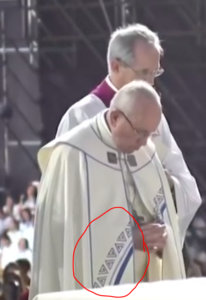
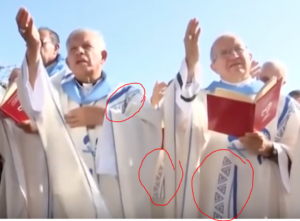
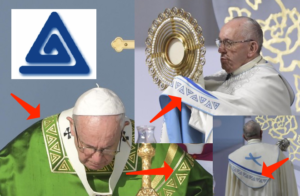
Before we talk about Sola Scriptura vs catholic tradition and catechism, please allow me to ask you to take a look with your own eyes at the pictures below: HOW can you possibly defend this? Isn’t it time you came to Jesus?
“Forbidding to marry” is the recipe for disaster in this scenario.
The Holy Spirit foresaw that the catholic church was coming and gave us specific warnings concerning this “Mother of harlots” described in detail in Revelation 17.
“Now the Spirit speaketh expressly, that in the latter times some shall depart from the faith, giving heed to seducing spirits, and doctrines of devils; 2 Speaking lies in hypocrisy; having their conscience seared with a hot iron; 3 Forbidding to marry, and commanding to abstain from meats, which God hath created to be received with thanksgiving of them which believe and know the truth.” 1 Timothy 4:1-3
The warning of the Holy Spirit, the 2 teachings to look for are:
- “Forbidding to marry”, and
- “commanding to abstain from meats”
Yet Peter, supposedly, laughably called “the first pope”, was married (Matthew 8:14).
Then, it’s the catholic church who “abstain from meats” during their annual cultic lent season.
There’s only one system this fits as is the case in Revelation 17 which describes “THE MOTHER OF HARLOTS AND ABOMINATIONS OF THE EARTH.”
“And upon her forehead was a name written, MYSTERY, BABYLON THE GREAT, THE MOTHER OF HARLOTS AND ABOMINATIONS OF THE EARTH.” Revelation 17:5
Jesus created you. Jesus died for your sins. Jesus Christ gave you every breath you’ve ever breathed and every morsel of food you’ve ever put in your mouth. What has the catholic church ever done for you except lie to you to send you to hell eternally, irrevocably?
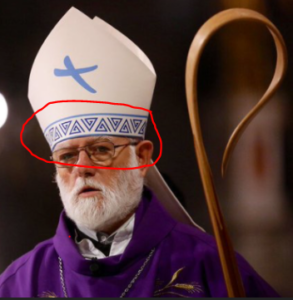
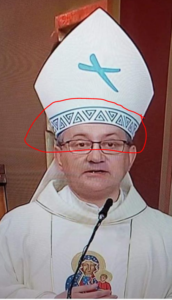
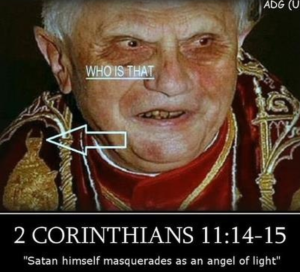
Sola Scriptura vs Catholic Teaching
The term Sola Scriptura simply means Scripture alone is the final divine authority. Yet the antichrist catholic church doesn’t like this very much because if God gave us His Word to establish truth, they they can’t teach their erroneous dogmas to the world and freely deceive them.
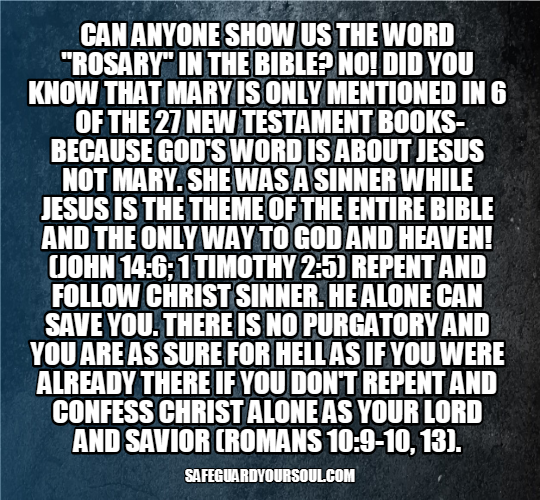
Any person whose been around a few catholics, knows that the fruit of their lives is strife, unrest, turmoil, and anything but God’s love. This alone reveals their doctrines to be false – because God does not bless the wicked, those who believe lies but rather only those who walk in His truth (Psalms 1, etc.).
“Great peace have they which love thy law (Word): and nothing shall offend them.” Psalms 119:165
Only those who live by the Word of God are possessed by the peace of God.
It’s laughable to think that mere sinful religious men can make up any fabled lie they can concoct in their depraved minds and say it’s of God. But Jesus told us exactly who is “of God” and who is “NOT of God.”
“He that is of God heareth God’s words: ye therefore hear them not, because ye are not of God.” John 8:47
As is clearly witnessed in the lives of catholics, those who follow tradition are full of turmoil. Those who follow Bible truth are full of divine peace.
“And Jesus answered him, saying, It is written, That man shall not live by bread alone, but by every word of God.” Luke 4:4
Notice above that Jesus pointed no man to religion. In fact His greatest enemy was and still is – false religionists (Matthew 23; Mark 7:6-10, etc.).
Friends, God gave us His Word in tangible, written form in order to protect us from the “MANY false prophets” He promised would “deceive MANY” in these finals days before the return of our LORD (Matthew 24:11).
Those who choose to love God will seek Him in His own Word and nowhere else. They alone will be protected by Him.
“Every word of God is pure: he is a shield (protector) unto them that put their trust in him. 6 Add thou not unto his words, lest he reprove thee, and thou be found a liar.” Proverbs 30:5-6
The moment I prayed in repentance to receive Jesus Christ into my life, He washed me of all my sins. The ensuing days brought about a clear conscience, a sound mind, a peace, love and joy that made it clear to me that I’d been lied to by the cult of Rome my whole life. Needless to say, I never return to the catholic church.
Catholic deceivers have to constantly combat the many followers of Jesus who expose the heresy of catholic tradition being equal to the Bible. These pawns fight to perpetrate this tradition lie in order to be able to continue to perpetuate some of the vilest and strangest heresies known to mankind.
Many Christians believe that the Christian tradition of communion is the same as the Catholic tradition of the Eucharist. But this is not so. The Eucharist (i.e., Transubstantiation) is a Catholic term for communion when the bread and the wine supposedly become the very, the actual body and blood of Jesus Christ; thus when taken, the partaker is said to experience the presence of Jesus. These transformed elements are placed in what is called a monstrance and can then be worshipped as if worshipping Jesus Himself. The implications are tied in with salvation. In the catholic system, with the Eucharist, salvation becomes sacramental (participation in a ritual) as opposed to justification by faith in Christ alone. The mystical experience called the Eucharist is clearly a form of gross idolatry (as well as the very heart of Catholicism).
CATHOLIC TEACHING ON TRANSUBSTANTIATION is a complete theological statement and the name of a doctrine, out of which springs the most astounding set of beliefs and practices that have ever been taught in the name of religion. Yet few people know what the Catholic Church actually believes and teaches concerning this subject.
TRANS-SUBSTANTIATION CHALLENGE: PLEASE PROVIDE “EMPIRICAL EVIDENCE” – If the wheat wafer and wine TRULY become the actual and literal body and blood of Jesus Christ, as the catholic church teaches, then let’s do a DNA test to see what the composition of the elements truly are. That fair? Clue: Do they taste like flesh and blood, or bread and wine?
CATHOLIC MASS IS CLEARLY A MOCKERY and BLASPHEMY AGAINST CHRIST’S FINISHED WORK – it supposes to re-sacrifice Christ who paid ONCE for all sins on the cross according to God’s Word.
DID YOU KNOW THAT drinking blood is forbidden by God? Lev 7:27 “Whatsoever soul it be that eateth any manner of blood, even that soul shall be cut off from his people” BOTH TESTAMENTS CONDEMN DRINKING BLOOD – ACTS 15:28. So, why would the Son of God instruct us to do such (transubstantiation)??
Only a rebel rejects the divine truth that God gave us His Word so we’d not be misled by false prophet religions like this antichrist cult of Rome. The RCC teaches that tradition is equal to the Bible. Nonsense. They do so in order to be able to teach the myriad of heresies peddled by the antichrist roman cult which diametrically contradict the Word of God.
I grew up catholic, altar boy, catholic school, etc…. yet when Jesus saved me, immediately I knew that I’d been lied to my whole life. Instantly all my sins were forgiven and conscience cleared. What a blessing. Salvation is a personal relationship with Jesus, not a religion and this happens when we surrender, when we admit the reality that we’ve sinned against our Maker, are 100% guilty, and ask then ask Jesus to take over our lives from that moment forward. | Making Peace with God – Receiving His Forgiveness and Salvation
Recently I saw a catholic video titled “Sola Scriptura and Catholic Questions for Protestants.” The description said “This video is about Sola Scriptura and Catholic questions for Protestants, and why the teaching of the Bible alone is itself unbiblical.” Then he poses 5 questions. My replies are in blue.
**Catholic Questions for Protestants:** (from a catholic)
Note: 2 Timothy 3:16 is the Bible answer to each of these foolish questions from this catholic heretic.
#1. Where in the Bible does it say the bible is all you need?
The more pertinent question is: Where does the Bible say you need anything else but the Word of God, which it is? Where does the Bible say that tradition is all you need? Where does the Bible say the Word of God can be mixed with tradition? Where does God’s Word say that tradition is equal to Holy Scripture?
“ALL scripture (not tradition) is given by inspiration of God, and is profitable for DOCTRINE, for reproof, for correction, for instruction in righteousness:” (2 Timothy 3:16)
#2. Where does Scripture teach that the Bible is the ONLY or FINAL authority?
Where does the Bible say that there is authority anywhere else but in itself, as the very Word of God. Friends, the only ones who want you to look away from the Bible, God’s Word, are those who have lies to teach you.
First off, only a biblically illiterate person could ask such a question.
Jesus told the false religionists of His day and today “Ye do err, not knowing the scriptures, nor the power of God.” (Matthew 22:29) Those who don’t know God’s Word go into error. “My people are destroyed for lack of knowledge: because thou hast rejected knowledge, I will also reject thee, that thou shalt be no priest to me: seeing thou hast forgotten the law (Word) of thy God, I will also forget thy children.” (Hosea 4:6) Those who choose to look elsewhere, who do not seek God in His own Word, will be destroyed and rejected in the end. Satan’s religions exists for this very, this express purpose – to lead you away from the LORD and His truth. Beware.
God’s Word is Going to Judge Us, Not Sinful Man’s Traditions
“He that rejecteth me, and receiveth not my words, hath one that judgeth him: the word that I have spoken, the same shall judge him in the last day.” John 12:48
“In the day when God shall judge the secrets of men by Jesus Christ according to my gospel.” Romans 2:16
Is tradition or is Holy Scripture given to us for “doctrine”? “ALL scripture (not tradition) is given by inspiration of God, and is profitable for DOCTRINE, for reproof, for correction, for instruction in righteousness:” (2 Timothy 3:16) This would clearly reveal that any tradition or teaching that contradicts “scripture” is heresy.
Any person following the roman catholic religion instead of Holy Scripture has made a decision to reject the LORD.
“He that is of God heareth God’s words: ye therefore hear them not, because ye are not of God.” John 8:47
“Heaven and earth shall pass away: but my words (not catechism or tradition) shall not pass away.” Mark 13:31
“Thy word (not catechism or tradition) is a lamp unto my feet, and a light unto my path. Psalms 119:105
The longest chapter in the Bible is 176 verses of which each and every verse speaks of the written Word of God, not tradition or the catechism of some self-proclaimed religion of sinful men. Read Psalms 119.
#3. How do we know, according to the Bible alone, know that the books in the Bible are inspired Scripture? Where in the Bible does it give a list of inspired Scripture and how do we know what is inspired and what is not? – Where does it say in the Bible that the Book of Hebrews is inspired Scripture? – Where does it say in the Bible that Matthew is inspired? Or Philemon?
To even ask these questions reveals that this man is demon possessed. It was and is Satan who casts doubt on what God has said – “Hath God said?” (Genesis 3:1)
“ALL scripture (not tradition) is given by inspiration of God, and is profitable for DOCTRINE, for reproof, for correction, for instruction in righteousness:” (2 Timothy 3:16)
The Bible never once hints or says that truth is found in tradition or the teachings of man’s religions. In fact, we are often warned against this specifically (Colossians 2:8, etc.).
#4. According to the Bible alone, how do we even know Matthew wrote Matthew? How do we know who wrote the Book of Hebrews?
It doesn’t matter if we know exactly who the mere human author it. We know God intended it to be in His Word, part of “ALL scripture.” (2 Timothy 3:16) Not being able to ascertain the exact human author in no way diminishes the truth, the reality of divine inspiration.
How do we know catholic traditions are not of God? Answer: They clearly contradict Holy Scripture.
The LORD told the man in hell that his brothers, who were still on the earth, had the Word of God – “Moses and the prophets” – and that’s all they need. And, if they won’t hear and obey them, they are going to hell also (Luke 16:27-30) This clearly demonstrates that any person who will not hear and obey God’s Word is going to hell. “Whoso despiseth the word shall be destroyed: but he that feareth the commandment shall be rewarded.” (Proverbs 13:13)
The following Bible verse makes is clear that anyone who puts away, rejects, does not obey it as being from God, is “unworthy of everlasting life.”
“Then Paul and Barnabas waxed bold, and said, It was necessary that the word of God should first have been spoken to you: but seeing ye put it from you, and judge yourselves unworthy of everlasting life, lo, we turn to the Gentiles.” Acts 13:46
#5. Where in the Bible does it say the Bible alone is the Word of God?
Where does the Bible say that there is truth outside of it that God’s true people are to trust in? Nowhere. Where in the Bible does it say that tradition is equal with Scripture? Where does the Bible say that the tradition of the antichrist catholic cult is to be mixed with Scripture?
God’s Word states:
“All scripture (not tradition) is given by inspiration of God, and is profitable for doctrine, for reproof, for correction, for instruction in righteousness: 17 That the man of God may be perfect, throughly furnished unto all good works.” 2 Timothy 3:16-17
Case closed. Oh, and where’s tradition in that? What did the Bible say is profitable for “doctrine, for reproof, for correction, for instruction in righteousness”? “Scripture.” Actually when Paul spoke of “tradition”, he was speaking of the Word of God he had taught and not making any ole pagan cult’s traditions equal the the Word of God (2 Thessalonians 3:6).
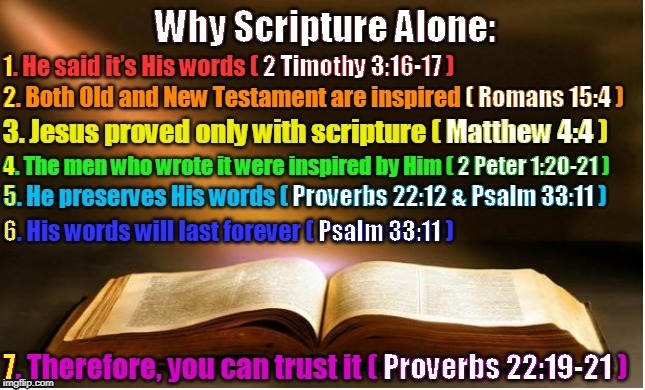
In fact, the vast majority of times that we find the word “tradition(s)” in the New Testament canon, it’s a warning against the false religionists… of which the catholic church fits the description distinctly.
“Why do ye also transgress the commandment (Word of God) of God by your TRADITION?” Matthew 15:3
“Thus have ye made the commandment (Word) of God of none effect by your TRADITION.” Matthew 15:6
“And he said unto them, Full well ye reject the commandment (Word) of God, that ye may keep your own TRADITION.” Mark 7:9
“Making the word of God of none effect through your TRADITION, which ye have delivered: and many such like things do ye.” Mark 7:13
“Beware lest any man spoil (ruin) you through philosophy and vain deceit, after the TRADITION of men, after the rudiments of the world, and not after Christ.” Colossians 2:8
The very reason God gave us His Word in written form was so that cults like the roman catholic church would not mislead His true people – so that we’d not be deceived by false prophet religions like “MYSTERY, BABYLON THE GREAT, THE MOTHER OF HARLOTS AND ABOMINATIONS OF THE EARTH.” (Revelation 17:5)
Read chapters 17 and 18 of the book of Revelation.
Is the catholic system based on God’s Word? No.
Catholics claim they go through the whole Bible yearly in their weekly mass. Is that true or is it just another lie? A lie. There are 1,189 chapters in the Bible. Catholics don’t read 52 chapters a year in their masses. Think about it: If they read just 1 chapter each Sunday, which they don’t, that would only be 52 chapters. Far short of 1,189 chapters. That would 1,137 chapters short of reading the whole Bible yearly.
Did the Catholic Church Give us the Bible, as they Claim?
Catholics will even dare say that the Bible came from the catholic church. Is this true? No.
THE CATHOLIC CHURCH WASN’T EVEN FORMED TILL THE 3RD OR 4TH CENTURY A.D. THE BOOKS OF THE BIBLE WERE COMPLETED ABOUT 90 A.D. BY JEWISH MEN WHO WERE INSPIRED BY THE HOLY SPIRIT (2 Peter 1:20-21; 2 Timothy 3:16)
So-Called “AUTHORITY” THAT VIOLATES UNCHANGING DIVINE TRUTH IS SIMPLY ILLEGITIMATE – REGARDLESS OF ITS CLAIMS. JESUS SAID HIS WORD IS FINAL AUTHORITY. Jesus says:
“Heaven and earth shall pass away: but my words shall not pass away.” Mark 13:31
Catholics do not believe the Bible is final authority – they are taught that catholic tradition and early church fathers are on the same level – this is strategically taught them, in order that the catholic religion might have open game to deceive them – by making up their own religion of mere sinful men.
“We have also a more sure word of prophecy; whereunto ye do well that ye take heed, as unto a light that shineth in a dark place, until the day dawn, and the day star arise in your hearts: 20 Knowing this first, that no prophecy of the scripture is of any private interpretation. 21 For the prophecy came not in old time by the will of man: but holy men of God spake as they were moved by the Holy Ghost.” 2 Peter 1:19-21
Personally, I waste no time on early church fathers or church history. They weren’t ordained, sanctioned by God exclusively to pen the words of Holy Writ, the Bible, which is God’s Word and the highest divine authority (2 Peter 1:19-21; 2 Timothy 2:15; 3:16-17). What’s it matter if you know what they said? The LORD didn’t ordain them to communicate His truth to the world. This does nothing but create confusion (1 Corinthians 14:33). Many would rather listen to what mere men had to say about God and the Bible than to learn for themselves what God said in His own Word. The LORD has always instructed His people to study and learn and attend to HIS words (Deuteronomy 4, 6, 11, Isaiah 34:16, etc.).
“Study to shew thyself approved unto God, a workman that needeth not to be ashamed, rightly dividing the word of truth.” 2 Timothy 2:15
The Catholic Council of Trent declares that: “It is lawful to have images in the church and to give honour and worship to them … Images are put in churches that they may be worshipped.” The Oxford dictionary defines an idol as: “An image used as an object of worship. A person or thing that is the object of excessive devotion.” An Idolater is a devoted admirer of idols.
IF THE BIBLE IS A CATHOLIC BOOK, THEN:
- Why does it condemn clerical dress? (Matt. 23:5-6; Luke 20:46).
- Why does the Bible teach against the adoration of Mary if the Bible is catholic? (Luke 11:27-28).
- Why does it show that all Christians are priests? (1 Pet. 2:5,9).
- Why does God’s Word condemn the observance of special days if it’s catholic? (Gal. 4:9-11).
- Why does the Bible teach that all Christians are saints if it’s catholic? (1 Cor. 1:2).
- If the Bible were truly catholic, WHY does it condemn the making and adoration of objects of worship, of graven images? (Ex. 20:4-5).
- Why does the Bible teach that baptism is immersion instead of sprinkling or pouring if the Bible is catholic? (Col. 2:12).
- If the Bible is truly catholic, WHY does it forbid us to address religious leaders as “father”? (Matt. 23:9)
- If the Bible is truly catholic, why does it teach that Christ is the only foundation and not the apostle Peter? (1 Cor. 3:11).
- Why does it address only God Himself as the “Holy Father”? (John 17:11)
- If the Bible is catholic, why does it teach that there is one mediator instead of many? (1 Tim. 2:5).
- If the Bible is catholic, why is the Bible completely silent about infant baptism, indulgence$, purgatory, confession to priests, the rosary, the mass, and many other things taught by the Catholic Church?
- If the Bible is catholic, why then did the Pope put the Bible on the Index of forbidden books in the 12th century?
EVERY breath and morsel of food you’ve ever received was from GOD, not your stupid religion. WHO died on that cross for you? Jesus Christ did. Repent and follow Jesus – and not the devil’s religion which exists for one purpose – to lead you to hell.
Support | STORE | Podcasts | The Catholic church | “MYSTERY, BABYLON THE GREAT, THE MOTHER OF HARLOTS AND ABOMINATIONS OF THE EARTH” [podcast] | Did Mary Die for Our Sins? [podcast] | SATAN IN THE VATICAN | The Chosen and Jonathan Roumie Exposed [podcast] | Peace with God


Apostasy
Beware of “Private Interpretation” [podcast]
NO MAN GAVE THE TRUTH AND NO MAN CONTROLS IT
ANY person who doesn’t uphold God’s Word as final divine authority on all matters of faith, is 100% “NOT of God” according to the Son of God (John 8:47).
“Let God be true and EVERY man a liar.” Romans 3:4
Is God or are mere men confused?
“For God is not the author of confusion, but of peace, as in all churches of the saints.” 1 Corinthians 14:33
Beware of those who violate, who speak contradictory to other parts of God’s Word in order to sell you on their “revelation.” Known truth, biblically stated truth must never be contradicted. The LORD is not confused and so we conclude that anyone upholding what they believe to be truth that contradicts known biblical truth, is confused at best. Beware of what the Holy Spirit calls “private interpretation.” (2 Peter 1:19-21) More in a moment on this.
Many seek to use commentaries, historians and the like to paint the picture, the outcome they desire because they do not love the LORD and therefore His truth. If God wanted us to have more it’d be in His Word…. I am not opposed to background information but that’s not divinely inspired Holy Scripture and many people try to change the outcome of biblical truth by using extra-biblical sources. Beware. They attempt to create a path to an unbiblical conclusion because they are “not valiant for the truth.” (Jeremiah 9:3)
It’s convoluted theology to speak against, contrary to the whole of the Word of God which among other things says “ALL scripture is given by inspiration of God.” (2 Timothy 3:16) Ignoring known, clearly stated Bible truth to perpetrate a certain view is bearing false witness against the LORD, is confusion, and is violence against the Holy Scriptures and the picture painted by the WHOLE of God’s Word. This is also a refusal to rightly divide the Word of truth but instead a deliberate, subjective ignoring of divine truth in order to perpetrate an agenda (1 Corinthians 2:13; 2 Timothy 2:15).
Many today interpret the Bible for their own self-serving purpose or liking, based on being predisposed to certain traditions, philosophies, and clichés. This is exactly what Jesus cited the false religionists of His day for doing (Mark 7:6-9).
God gave His Word to us and will reveal Himself and His will to each of His saints as they seek Him, studying His words thoroughly, diligently, daily.
“Search the scriptures; for in them ye think ye have eternal life: and they are they which testify of me. 40 And ye will not come to me, that ye might have life.” John 5:39-40
God gave us the Holy Scriptures to reveal to us who He is and yet, the individual must come to Jesus personally to know Him and understand His Precepts, His kingdom truths. Like the religionists Jesus is addressing above, many who think they know God are not known of God at all because they refuse to truly repent and seek His holy face.
Exactly as Jesus warned, there are “many false prophets” today to accommodate counterfeits, tares (Matthew 7:15; 24:11).
 Many times we hear men stand up to speak, claiming they’ve been studying a topic in the Bible extensively – and insinuating that on the basis of THEIR study, you should just buy wholesale everything they’re about the say. There are “many deceivers” operating today (2 John 7-11). Out of the pride of their hearts we hear men preface their message this way, boasting of their study, to set up and snare the unlearned, the gullible when in reality many of them have simply borrowed the errors of other men. Yet we must judge all that is taught against our own personal, diligent study of the whole of God’s Word and never buy the subjective claims of mere men. This is the very reason so many are deceived today. Following man’s supposed revelation, interpretations, instead of getting God’s revelation for ourselves, firsthand, is the recipe to be deceived. There are no shortcuts to personally, thoroughly studying the whole counsel of God’s Word for ourselves. | The Importance of Personal, Organic Bible Study
This scenario often plays out when someone is teaching on the end times, claiming or insinuating that they have come up with special revelation. At times they will claim to definitely know and have figured out who the antichrist is, the specifics and timing of end time events, and secrets about these last days. Yet, at least some of those things they claim to have special knowledge of are not specifically, expressly written in the Bible. Beware of the “private interpretation” of mere men.
“We have also a more sure word of prophecy; whereunto ye do well that ye take heed, as unto a light that shineth in a dark place, until the day dawn, and the day star arise in your hearts: 20 Knowing this first, that no prophecy of the scripture is of any private interpretation. 21 For the prophecy came not in old time by the will of man: but holy men of God spake as they were moved by the Holy Ghost.” 2 Peter 1:19-21
God’s Word, the words of God recorded in Holy Writ, were inspired by the Holy Spirit and were not written from any mere man’s “private interpretation”, nor are the words of God to be twisted and done violence to by anyone today for their own “private interpretation” to promulgate their own view, doctrine, or agenda.
Notice in this passage above that through Peter, the Holy Spirit puts the personal responsibility upon the individual disciple to “take heed” to the Word of God, to study it daily, diligently as the revelation of Christ and His will rises in our hearts, dawns on us – “ye do well that ye take heed, as unto a light that shineth in a dark place, until the day dawn, and the day star arise in your hearts.”
God expects His people to study thoroughly and to know His Word for themselves.
“Study to shew thyself approved unto God, a workman that needeth not to be ashamed, rightly dividing the word of truth.” 2 Timothy 2:15
No man controls the truth nor does he control the interpretation of divine truth which is self-evident and to be first and foremost studied and understood by individual disciples. Yes, God calls elders out to teach HIS Word, to let God’s Word dwell richly among His people, and yet the LORD alone teaches the individual believers heart His truth (Colossians 3:16). This is the individual priesthood of each and every blood bought saint of Christ. Jesus saves the individual sinner first and foremost who is then and only then an individual member of His one body (Ephesians 4; 1 Corinthians 12).
“But ye have an unction from the Holy One, and ye know all things. 21 I have not written unto you because ye know not the truth, but because ye know it, and that no lie is of the truth. …26 These things have I written unto you concerning them that seduce you. 27 But the anointing which ye have received of him abideth in you, and ye need not that any man teach you: but as the same anointing teacheth you of all things, and is truth, and is no lie, and even as it hath taught you, ye shall abide in him.” 1 John 2:20-27
Ultimately, and most importantly, God teaches each and every one of His individual saints – “My sheep hear my voice, and I know them, and they follow me:” (John 10:27)
Those who aren’t objective with the whole counsel of Scripture clearly prove their hearts are not honest, not authentic, and sincere before the LORD (Luke 8:15; John 7:16; 2 Corinthians 2:17; 2 Peter 3:16, etc.).
Beware of Being a “Back it Up” Bubba
Personally studying God’s Word from Genesis to Revelation, organically, is ultra-important. | The Importance of Personal, Organic Bible Study
To “back up” a belief with Scripture seems to really mean: “I believe ABC doctrine and I’m hell bent on finding Bible verses to prove it!” In other words someone like this doesn’t really care what the whole of Scripture teaches as much as they care to hold on to some pet doctrine (it’s usually something to justify their sin such as the falsehood of eternal security).
Some put forth their subjective beliefs and defend those beliefs by saying “I can back everything up with scripture.” Satan can too as we see him do when tempting Jesus (Luke 4). The devil used Scripture out of context as many today do. Are we merely backing up what WE say and what WE currently believe with Scripture or are we simply reading and diligently studying the whole counsel of Holy Scripture and letting GOD speak for Himself as we “compare spiritual things (Scripture, known truth) with spiritual things”? (1 Corinthians 2:13; 2 Timothy 2:15) Big difference. Think about that. Men and devils can deceitfully make the Bible say anything THEY want it to say but that doesn’t make it biblically sound and true. We must beware of our own tendency to espouse and hold on to philosophies, notions, and doctrines that do not line up with the whole counsel of God’s Word and we must be corrected (2 Timothy 3:16-17).
“All scripture is given by inspiration of God, and is profitable for doctrine, for reproof, for correction, for instruction in righteousness: 17 That the man of God may be perfect, throughly furnished unto all good works.” 2 Timothy 3:16-17
The disciple of Jesus, without exception, will be ever more rooted and grounded in the final divine authority of the written Word of God.
Jesus told us exactly who is “of God” and who is “NOT of God.”
“He that is OF GOD heareth God’s words: ye therefore hear them not, because ye are NOT OF GOD.” John 8:47
ALL who are “of God” uphold His Word as final divine authority, with no exception.
When discussing any matter, specifically spiritually, the main issue is what God’s Word says, which is His “truth” and when one is valiant for His truth, such a man will not rely on anything except God’s Word (Jeremiah 9:3; John 17:17). God says we can be CERTAIN about what He says concerning any topic revealed in His Word – “Have not I written to thee excellent things in counsels and knowledge, 21 That I might make thee KNOW the CERTAINTY of the words of truth; that thou mightest answer the words of truth to them that send unto thee?” (Proverbs 22:20-21)
We must honestly examine our own selves to see WHY we believe WHAT we currently believe. Discernment, “rightly dividing the word of truth” seem to be concretely connected to searching the Scriptures as we see with the Bereans who tested Paul and all that he taught, right? (2 Timothy 2:15; Acts 17:10-11) Lots of people who talk about discernment trust their own subjective discernment instead of letting the written WORD be their two edged sword of discernment (Hebrews 4:12). Many believe they are discerning correctly and yet aren’t daily, diligently being grounded in the written Word, which God will never contradict (2 Timothy 3:16-17; 2 Peter 1:19-21).
The Berean Saints are a Great Example to us Today
“And the brethren immediately sent away Paul and Silas by night unto Berea: who coming thither went into the synagogue of the Jews. 11 These were more noble than those in Thessalonica, in that they received the word with all readiness of mind, and searched the scriptures daily, whether those things were so.” Acts 17:10-11
May the reader be exhorted to become intimately familiar with the above passage, noticing that the Bereans didn’t even take Christ’s apostle Paul at his word. No, they “searched the scriptures daily” for themselves to see “whether those thing were so” that Paul was preaching.
As was the case with the Berean disciples who listened to Paul preach, God intends for us to partake in, to hear preaching and yet, all must be cross examined against our own personal searching of His Word for ourselves (2 Timothy 2:15; 3:16-17). On that note, do you remember when the LORD Jesus spoke to the woman at the well and how when He revealed Himself to her as the Messiah she ran out and told everyone? Yet, those men didn’t fully embrace Christ till they personally went to see Him for themselves.
“The woman then left her waterpot, and went her way into the city, and saith to the men, 29 Come, see a man, which told me all things that ever I did: is not this the Christ? 30 Then they went out of the city, and came unto him. … 42 And said unto the woman, Now we believe, not because of thy saying: for we have heard him ourselves, and know that this is indeed the Christ, the Saviour of the world.” Acts 4:28-30, 42
No Greek or Hebrew is needed and is certainly not the main rule of interpretation. We must take God’s preserved Word for what it clearly states in our own language, as we compile, compound, put together Scripture with Scripture (Isaiah 28:16; 1 Corinthians 2:13). This is the method of priority in apprehending truth, the highest, stated rule of interpreting truth. A thorough gathering of all Scripture pertaining to the given study, is essential.
“TAUGHT OF GOD”
“It is written in the prophets, And they shall be all TAUGHT OF GOD. Every man therefore that hath heard, and hath learned of the Father, cometh unto me.” John 6:45
“But as touching brotherly love ye need not that I write unto you: for ye yourselves are TAUGHT OF GOD to love one another.” 1 Thessalonians 4:9
The LORD alone is “the truth”, gave us His truth – His written Word – and presides over it, teaching it to His people (John 14:6; Psalms 146:6, etc.). His written Word is final divine authority and taught by Him to His people in abiding relationship (John 14:26; 16:13-14).
Beware of “Private Interpretation”
Being crucified with Christ means one is emptied of self, self-will, self-agenda, and abandoned to God’s will. This means that such a person searches out and embraces the biblical truth, no matter where it leads. He never bends the truth to try to fit a tradition or doctrine but rather reject any previous believed notion when the Word says differently (Romans 3:4; 2 Timothy 2:15; 3:15-17, etc.).
Those who engage in the sinful activity of privately interpreting Scripture, do so because …
- They themselves are un-repentant, not denying self, taking up the cross, and following Jesus (Luke 9:23-24; 2 Timothy 4:2-4)
- They refuse to let God be true and every man a liar – beginning with their own wicked hearts (Romans 3:4)
- They value tradition about divine truth (Mark 7:6-9)
- They do no hold God’s Word as final divine authority though they claim to (John 8:47)
- They refuse to be honest with the whole counsel of Holy Scripture (2 Timothy 2:15; 3:15-17)
Beware of those who seek to control the interpretation of God’s Word – those who impose their own notions and doctrine onto God’s truth. There are many who read things into Scripture which are not in the Scriptures. Let’s read again our central passage:
“We have also a more sure word of prophecy; whereunto ye do well that ye take heed, as unto a light that shineth in a dark place, until the day dawn, and the day star arise in your hearts: 20 Knowing this first, that NO PROPHECY OF THE SCRIPTURE IS OF ANY PRIVATE INTERPRETATION. 21 For the prophecy came not in old time by the will of man: but holy men of God spake as they were moved by the Holy Ghost.” 2 Peter 1:19-21
“Private interpretation” seems to point to the agenda and act of self application based on tradition or preconceived notions. Not allowing God to speak for Himself via a thorough study of the whole counsel of His written Word. Application or interpretation based on self desires or that which conforms to some extra-biblical notion or doctrine of men.
Here’s the Greek word for “private”
G2398
ἴδιος
idios
id’-ee-os
Of uncertain affinity; pertaining to self, that is, one’s own (agenda); by implication private or separate: – X his acquaintance, when they were alone, apart, aside, due, his (own, proper, several), home, (her, our, thine, your) own (business), private (-ly), proper, severally, their (own).
Greek word for “interpretation”
G1955
ἐπίλυσις
epilusis
ep-il’-oo-sis
From G1956; explanation, that is, application: – interpretation.
Total KJV occurrences: 1
Not only did the Holy Ghost give us God’s written Word, but also it’s the Holy Ghost that teaches individual saints. Here’s how:
“Which things also we speak, not in the words which man’s wisdom teacheth, but which THE HOLY GHOST TEACHETH; comparing spiritual things with spiritual.” 1 Corinthians 2:13
Believers are “taught of God” as they study and collate Scripture. This is never to be infringed upon or controlled by elders. That’s one reason for the plurality of elders in the local expressions, the gatherings of Christ’s body. There’s safety in a plurality of elders who should thereby be held accountable and rebuked when needed (Titus 1:5, etc.).
As Christ’s saints continue “stedfastly in the apostles’ doctrine and fellowship, and in breaking of bread, and in prayers”, they compare, put together, collate line upon line, Bible verse upon Bible verse, in ordain to be “taught of God” His truth (Acts 2:42; Colossians 3:16).
“Reprove, rebuke, exhort with all longsuffering and doctrine”
RED FLAG: When you witness a man, an elder, who dodges or doesn’t want certain BIBLE verses read, due to that truth contradicting his tradition/heresy, you know you have a man who is in need of repentance (Mark 7:6-9). Such a man’s heart is not captive to the Word of God. He has his own evil agenda. Such a wolf will seek to impose his doctrine of men and devils on others and must be rebuked.
“Against an elder receive not an accusation, but before two or three witnesses. 20 Them that sin rebuke before all, that others also may fear.” 1 Timothy 5:19-20
“Preach the word; be instant in season, out of season; reprove, rebuke, exhort with all longsuffering and doctrine.” 2 Timothy 4:2
The root reason people choose the lie of OSAS is that they simply refuse to truly repent and lay down their lives in this fleeting world. So they are willing to wax over and avoid mountains of biblical truths and warnings. They have their own agenda they hold in reserve. They are not given over to Christ. They believed and were saved and yet didn’t continue in the truth – which Jesus says is essential.
Many times, the ones who cry “context, context, context” are those taking God’s Word out of context in order to perpetrate their heresy. They don’t want the real context because though they pose as Christians, they are not men of truth and so don’t honestly follow the Word of God honestly, no matter where it may lead. They don’t like the context of Holy Scripture – because it simply doesn’t say what they want it to say. They have a predetermined outcome, a doctrinal goal they want to reach and are willing to bait and switch, do acrobats, and ignore Scripture that doesn’t agree with their heresy. These are not honest people. Their goal is to reach their predetermined conclusion.
The Bible reveals that un-repentant people migrate to false teachers, false doctrines (2 Timothy 4:3-4).
“For the time will come when they will not endure sound doctrine; but after their own lusts shall they heap to themselves teachers, having itching ears; 4 And they shall turn away their ears from the truth, and shall be turned unto fables.” 2 Timothy 4:3-4
Counterfeits invent ways to excuse themselves from accountability to Scripture. Though they regularly and selectively refer to and read the Old Testament Scriptures, when you quote or read them Holy Scripture from the Old Testament to expose OSAS, they will scream “but that’s Old Testament!” Nice try. But “ALL scripture” is given to New Testament saints and we are told that we are taught by those very Scriptures (2 Timothy 3:17; Romans 15;4; 1 Corinthians 10:11). Also, this same truth as is taught in the passage below, is also taught and confirmed all over the New Testament and from Genesis to Revelation.
“Say unto them, As I live, saith the Lord GOD, I have no pleasure in the death of the wicked; but that the wicked turn from his way and live: turn ye, turn ye from your evil ways; for why will ye die, O house of Israel? 12 Therefore, thou son of man, say unto the children of thy people, The righteousness of the righteous shall not deliver him in the day of his transgression: as for the wickedness of the wicked, he shall not fall thereby in the day that he turneth from his wickedness; neither shall the righteous be able to live for his righteousness in the day that he sinneth. 13 When I shall say to the righteous, that he shall surely live; if he trust to his own righteousness, and commit iniquity, all his righteousnesses shall not be remembered; but for his iniquity that he hath committed, he shall die for it.” Ezekiel 33:11-13
Eternal Security is a Lie from Hell.
The Ultimate Teacher is Divine
“But the Comforter, which is the Holy Ghost, whom the Father will send in my name, he shall teach you all things, and bring all things to your remembrance, whatsoever I have said unto you.” John 14:26
“Howbeit when he, the Spirit of truth, is come, he will guide you into all truth: for he shall not speak of himself; but whatsoever he shall hear, that shall he speak: and he will shew you things to come. 14 He shall glorify me: for he shall receive of mine, and shall shew it unto you.” John 16:13-14
GOD alone “keepeth truth”, is the Divine Source and Steward of His Truth
“…the LORD his God: 6 Which made heaven, and earth, the sea, and all that therein is: which keepeth truth for ever:” Psalms 146:6
Notice the Hebrew word for “keepeth” here….
H8104
שָׁמַר
shâmar
shaw-mar’
A primitive root; properly to hedge about (as with thorns), that is, guard; generally to protect, attend to, etc.: – beware, be circumspect, take heed (to self), keep (-er, self), mark, look narrowly, observe, preserve, regard, reserve, save (self), sure, (that lay) wait (for), watch (-man).
Total KJV occurrences: 468
Support | STORE | Podcasts | Jail/Prison Ministry | Mexico Mission here | All Ministry Updates | Making Peace with God | It is Finished! | Discipleship | The Gospel Centers Upon Christ’s Blood | Christology | The Gospel: What is It? | H.O.T. Bible Study [podcast]
Abiding
Cons and Crooks who Do Not Preach the Cross [podcast]
“For the preaching of the cross is to them that perish foolishness; but unto us which are saved it is the power of God.” 1 Corinthians 1:18
Those who do not preach the cross prove that they believe the cross is “foolishness.”
The know that many will leave if they were to preach the crucified life. And they are in it for the money, the acceptance of mere men, not Christ. Make no mistake, the Holy Ghost through Paul warned us specifically about this generation of counterfeits, these “evil men and seducers” who “wax worse and worse.” (2 Timothy 3:13) They’ve raised up a generation of self-love counterfeits who have a mere “form of godliness” and are “denying the power (authority of Jesus) thereof: from such turn away.” (2 Timothy 3:1-13)
The con men who commandeer today’s apostate church world want you “in church” so they get paid and yet where did the apostle Paul or any of the apostles instruct anyone to go find a good church or “attend church every Sunday”? Chapters and verses please
Why is lack of attending a local fellowship listed as a sin in the New Testament canon?
What qualifies a man to be an elder? certainly not seminary which are wolf factories invaded by the jesuits in 50’s and 60’s. All seminarians are vatican indoctrinated. The first they the jesuits did was replace the real Bible, the KJB with fake vatican corrupted new version “bibles.”
In His Great Commission command, did Jesus ever command “Go ye into all the world and find a church and be a fruitless, lukewarm, good church member?” OR …. Go teach and preach my Word? (Matthew 28:18-20; Mark 16:15)
In the early days of the Gospel, when persecution hit Jerusalem, God’s Word records this: “Therefore they that were scattered abroad went every where preaching the word.” (Acts 8:4) This clearly reveals that they were equipped by the apostles “for the work of the ministry, for the edifying of the body of Christ:” (Ephesians 4:11-12) Jesus and apostles never trained anyone to become good church members or attenders.
IF YOU ARE ARGUING TO PUSH THE IDEA THAT ALL DISCIPLES OF JESUS MUST GO TO A SUPPOSED “OFFICIAL” CHURCH BUILDING ON SUNDAY MORNINGS AND YET YOUR OWN PASTOR ISN’T CONSTANTLY PREACHING THE CRUCIFIED LIFE AS AN ABSOLUTE ORIGINAL GOSPEL ESSENTIAL….. THIS IS CLEAR PROOF YOU ARE SITTING UNDER WOLVES AND NOW DEFENDING THEM AND WILL BE JUDGED WITH THEM (2 John 9-11).
Isn’t it interesting that those who push the “go to church” agenda are the ones who stand to profit from such? Are you being made merchandise of? (2 Peter 2:1-3)
Christ’s true disciples do what HE did – direct you to the cross, the crucified life – and not some apostate modern church run by a fake pastor, using a fake “bible”, and preaching a fake “Jesus.” WHAT did Jesus teach was necessary to follow Him – going to church or taking up the cross, living the crucified life, daily?
“And he said to them all, If any man will come after me, let him deny himself, and take up his cross daily, and follow me. 24 For whosoever will save his life shall lose it: but whosoever will lose his life for my sake, the same shall save it.” Luke 9:23-24
“Many try to crucify their flesh in their own strength. This is impossible. It takes a complete and total surrender to Jesus first. Then the Holy Spirit will show you all the ways you are not like God. Then it is not a struggle. You let Jesus have control. Your job is to obey and take your flesh to the cross to be nailed there. Dead and buried. This is how the fruits of the Spirit are born in us! If we are saved by the blood of Jesus, we will not let sin reign in our mortal bodies. We now have the power of Christ to resist sin. It should never have dominion over us. We are now servants of righteousness and holiness. We are to walk in the newness of life that we have in Christ. Do not serve sin! Serve Jesus!” Karen Cochran
Is the cross, the crucified daily life essential to following Jesus? Yes or no?
“And whosoever doth not bear his cross, and come after me, cannot be my disciple.” Luke 14:27
 Memorize Galatians 2:20 today. Meditate upon and live it daily.
“But those mine enemies, which would not that I should reign over them, bring hither, and slay them before me.” Luke 19:27
“Behold, the days come, saith the Lord GOD, that I will send a famine in the land, not a famine of bread, nor a thirst for water, but of hearing the words of the LORD:” Amos 8:11
Fellowship with other saints is vital and yet we have to navigate these times of apostasy.
MESSAGE RECEIVED:
“Not forsaking the assembling of ourselves together” is a Biblical command (Hebrews 10:24-25). It was also demonstrated and practiced in the early church (Acts 4:31, Acts 11:26, Acts 15:25, Acts 20:7, Romans 12:3-8, 1 Corinthians 11:17-34, 1 Corinthians 14:23-26, 1 Corinthians 16:1-2) . Missionaries may not always be able to attend the local church that sent them out but their heart is there and a big part of the mission should be establishing new local churches, like Paul did. All believers should desire to meet with fellow like minded Scriptural believers for fellowship, labor, and worship together unto God. Those without a body mentality are self centered.”
REPLY:
As Jesus commanded, the earliest followers of Jesus cross-walked with Jesus “daily” and fellowshipped “daily.” (Luke 9:23-24; Acts 2:46; 5:42). Today we have people who are impressed with themselves for meeting weekly in a setting that is called “church” that is not even biblical. Churchianity vs Christianity.
Acts 2:42 – “And they continued stedfastly in the apostles’ doctrine and fellowship, and in breaking of bread, and in prayers.” This is the true model of simple, Christ-centered fellowship. Regrettably the bureaucracy mob of wolves infiltrated long ago. Most local “churches” are commandeered by seminarian wolves (Ezekiel 22:25-27). In the first decades after Christ was raised from the dead, the apostle Paul wept bitterly over the hoards of wolves who would come and make a busine$$ out of the church, who would devour the sheep of Christ, for whom He came and died (Acts 20:20-32). Jesus had already cleansed the temple in divine fury over this very thing (Matthew 21; John 2). They the apostle Peter warned us of those who would “make merchandise of you.” (2 Peter 2:1-3)
“Evil men and seducers shall wax worse and worse.” 2 Timothy 3:13
 Missionaries and others who are truly born again and find Biblical fellowship even daily, instead of weekly, are no less assembling than those who meet in a designated building once weekly.
We still do not see Jesus or the apostles operating rigidly or perhaps much at all with a regimented Sunday morning meeting, nor their insistence that all Christians the world over do such. It was more of a lifestyle, not a Sunday morning visit to a country club as is mostly what we see today. Telling new Christians to go “find a church” in their area is a dangerous proposition especially in this late hour where Jesus promised, foretold that “MANY false prophets shall arise and shall deceive MANY.” (Matthew 24:11) Most “church” organizations are 501(C)(3) which alone means they sold out to the state, rejecting the rulership of the Savior…. and now the state dictates what, when, and where they can preach. The covid scamdemic exposed this – how over 90% of these state owned “churches” are utterly false. Those wolves took orders from the State, not the Savior who commands us to fellowship and if they have true fellowship, why didn’t they continue? They are compromised.
WHAT fruit has the modern church produced? Can we count on more than 1 hand the amount of people we know who are ardent church members (unbiblical) who are also in the Word daily, deny self and taking up the cross daily, and who are evangelizing. There are very few. Jesus says His people are a “little flock.” (Luke 12:32) The modern church wolves who pretend to represent Christ have produced a generation of counterfeits.
WHO did God tell us are His?
“And they that are Christ’s have crucified the flesh with the affections and lusts.” Galatians 5:24
When’s the last time you heard, outside of a “church” building. a faithful church goer laud and celebrate Jesus Christ, testifying of His precious blood and glorious resurrection? Churchianity isn’t Christianity. So many counterfeit modern church goers brag about and are proud of their church and pastor and yet few if any of those same people testify from their own mouths and lives the glories of the bless-ed nail scarred risen Savior. They are not upholding Christ, the Head (Colossians 2:18-19).
Many modern church assemblies do not equal true Bible fellowship, assembling which will always exalt Jesus Christ, not the elders, the organization, or the church.
YOUR PRAYER: Holy Father I come to You now in the name of Jesus, knowing what you said my life should be and yet not knowing how this is to come about. Please increase my faith. I love You LORD. Here and now I turn to You in repentance, asking You to forgive my many sins of not being thankful to You, of selfishness, self-idolatry, rebellion, and unbelief. Please wash me clean, afresh, in the precious blood of my LORD Jesus. Change me dear LORD. Conform me to the image of Christ. Please fill me with Your Holy Ghost and use me to win the lost and help Your people as we eagerly anticipate Your soon return. In Jesus’ name. Amen.
Each of us is blessed with good ministries we are surrounded by. They feed us and they are winning souls (street preachers, God called Bible teachers, etc). Please pray for and support them saints (Galatians 6:6; Philippians 1:19, etc.). This way we are all, each member of Christ’s body, participating in the Great Commission mandate He gave us – and is coming back to take account of the stewardship of our lives – time, talent, treasure, etc. (Ephesians 4:11-16, etc.). Let’s roll saints. Jesus is coming.
Support | STORE | Podcasts | Jail/Prison Ministry | Mexico Mission here | All Ministry Updates | THE BLOOD OF JESUS | Blood Atonement | PEACE with GOD | Christology (the study of Christ) | Christ Crucified | Was Jesus the “One and Only Son”? [podcast] | The Remission of Sins | | Prayer | Making Peace with God – Before it’s too late | The Return of Christ








Sola Scriptura vs the Catholic Church and its Traditions [podcast]

“Pastors According to Mine Heart” [podcast]

Ridiculous King James Bible Corrections

Darwin’s Demise: What they don’t want You to know about Charles Darwin! [podcast]

Beware of “Private Interpretation” [podcast]

The Benefits of Knowing and Delighting in the LORD [podcast]

Cons and Crooks who Do Not Preach the Cross [podcast]

NET New English Translation Fake “bible” Exposed

Doubt Casting Wolves Exposed

Thank You for Declaring that the Mexican People Matter to Jesus! Mission Mexico Part 50

John Wesley on Calvinism, Once Saved Always Saved, and Conditional Security

Arrogant Bible Correctors Rebuked

In a Small Prison Cell, Justin was about to Commit Suicide … [podcast]

“A Land Flowing with Milk and Honey” [podcast]

Nicolaitan Nightmare [podcast]
John Wesley on Calvinism, Once Saved Always Saved, and Conditional Security

Why Did God Give Us His Word? [podcast]
Beware of “Private Interpretation” [podcast]

Beware of the Hebrew Roots Judaizing Snakes! [podcast]

The Highest Form of His Creation

The Flesh will Never be Reformed it Must be Crucified [podcast]

The High Treason of False Leaders [podcast]

Direction in God’s Word? [podcast]

Can and Will God Use You? [podcast]

A PLACE CALLED HELL [podcast]
Arrogant Bible Correctors Rebuked
“Pastors According to Mine Heart” [podcast]
Nicolaitan Nightmare [podcast]

The Daily Cross in Prayer [podcast]
Sola Scriptura vs the Catholic Church and its Traditions [podcast]
Sola Scriptura vs the Catholic Church and its Traditions [podcast]
“Pastors According to Mine Heart” [podcast]
Ridiculous King James Bible Corrections


 America2 years ago
The Drugging of America: The Pharmakeia Sorcery Deception [podcast]
- Articles3 years ago
Children being Rescued in Tunnels: Happening Now – UPDATE!
- Articles9 years ago
Self-Examination in Preparation for the Lord’s Return
- Apostasy3 years ago
SHOCKING List of False Prophets Most Believe are True