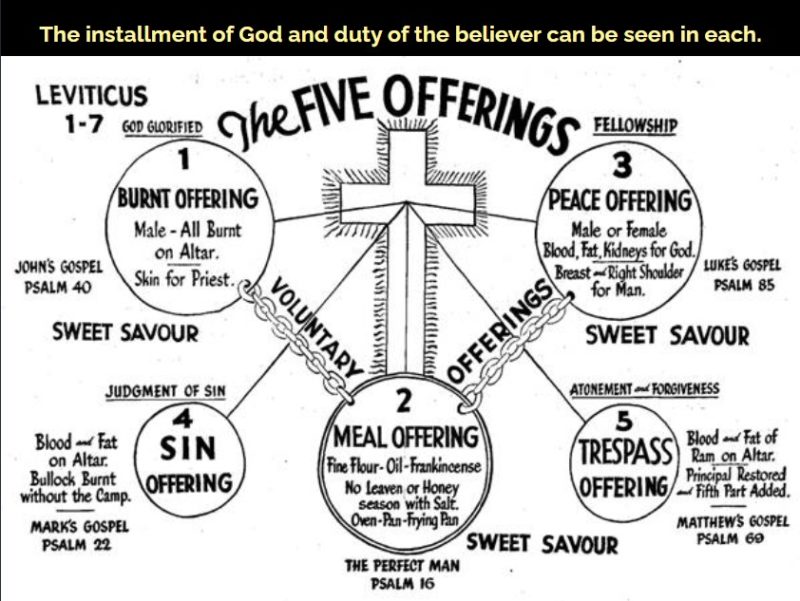
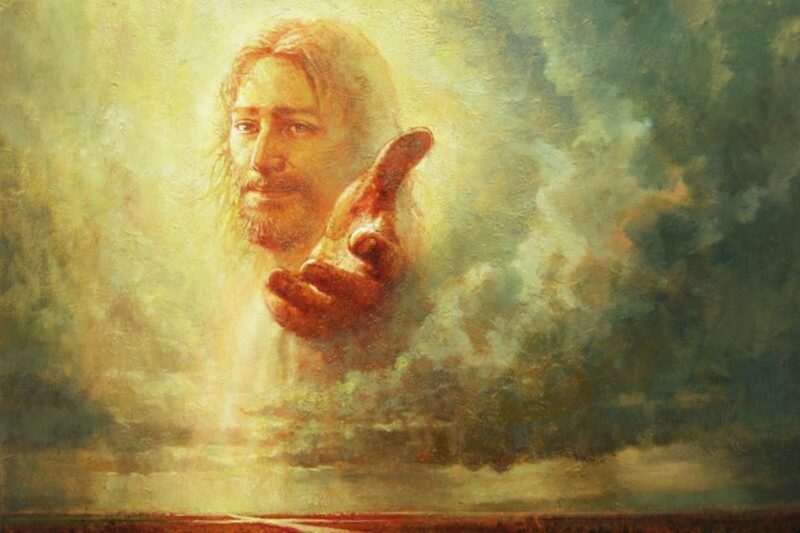
The burnt offering means a complete consumption. What did God illustrate to us when He required His people under the Old Covenant to offer burnt offering sacrifices?
His coming Messiah’s perfect sacrifice for the sins of mankind.
The ordained way He requires that His people serve Him.
Jesus was the ultimate burnt offering. He gave all of Himself freely in obedience to His Father and to redeem mankind.
“I beseech you therefore, brethren, by the mercies of God, that ye present your bodies a living sacrifice, holy, acceptable unto God, which is your reasonable service.” Romans 12:1
In His earthly days, our LORD came and resolved to do the will of His Father.
“And he said unto them, How is it that ye sought me? wist (knew) ye not that I must be about my Father’s business?” Luke 2:49
What was ultimately the “Father’s business”?
“And the Word was made flesh, and dwelt among us, (and we beheld his glory, the glory as of the only begotten of the Father,) full of grace and truth.” John 1:14
Mankind fell in the Garden and is separated from God due to his sin (Genesis 3; Isaiah 59:1; Ezekiel 18:4; Romans 6:23). Ultimately, Jesus came to die for the sins of the world (Matthew 1:21; John 1:29; 2 Corinthians 5:19, 21). “The Word was made flesh and dwelt among us” to ultimately die a sacrificial death for our sins – “that he might bring us (back) to God” (John 1:14).
“For Christ also hath once suffered for sins, the just for the unjust, that he might bring us to God, being put to death in the flesh, but quickened by the Spirit:” 1 Peter 3:18
Jesus, who is God “manifest in the flesh,” a living man was crucified as the burnt offering sacrifice “for the sins of the whole world” (1 Timothy 3:16; 1 John 2:1-2). This is in fulfillment of what the burnt offering represented, prefigured under the sacrificial system of the Old Covenant as it pointed to the coming Messiah and to the cross He instructed us to take up in following Him (Luke 9:23-24; Romans 6; 12:1, etc.).
“How shall we escape, if we neglect so great salvation; which at the first began to be spoken by the Lord, and was confirmed unto us by them that heard him;” Hebrews 2:3
There were 5 types of sacrificial offerings that God required of His people under the Old Covenant to atone for their sins. Each of these offerings depicted this “so great salvation” of Christ (Hebrews 2:3). They were prophetic of what our LORD Jesus, the Messiah, would do when He came, and we know He has come. What is merely represented in these offerings to God were a foreshadowing of the perfect, one-time sacrifice Jesus was coming to offer. Book of Hebrews. Jesus is the fulfillment of each of these offerings which were a mere prefiguring of His perfect offering to come. He is the embodiment of them. His perfect sacrifice is what was represented in these 5 offerings to God. His sacrifice, His blood, is the basis for every and any kind of sin that has ever been committed. God covered all bases for fallen man’s sin!
“How much more shall the blood of Christ, who through the eternal Spirit offered himself without spot to God, purge your conscience from dead works to serve the living God?” Hebrews 9:14
Jesus “offered himself without spot to God” – Not only was Jesus the perfect, spotless sacrifice, He offered Himself wholly, unreservedly, unconditionally to the Father and therefore to the cross which was the ordained will of the Father. Jesus was “the Lamb slain from the foundation of the world” (Revelation 13:8).
“I can of mine own self do nothing: as I hear, I judge: and my judgment is just; because I seek not mine own will, but the will of the Father which hath sent me.” John 5:30
The Old Covenant concept of the burnt offering was a complete giving up of self, of self-will, self-interests, and selfish ambition, and an unreserved giving of self to God.
As Jesus gave Himself wholly, so should Christ’s disciples, allowing the cross to vanquish us, to consume us, that Christ might raise us upward for His glory.
The burnt offering depicted the coming Messiah’s complete giving over of Himself to the will of His Father to be the atoning sacrifice to buy back His fallen race, mankind.
One observer of Scripture writes:
“During the First Temple and Second Temple periods, the burnt offering was a twice-daily animal sacrifice offered on the altar in the temple in Jerusalem that was completely consumed by fire. The skin of the animal, however, was not burnt but given to the priests respective of their priestly division.”
Our LORD Jesus gave Himself unreservedly to the Father, in fulfillment of the Old Covenant sacrificial system of burnt offerings. This now obsolete sacrificial requirement merely foreshadowed the atoning death of the Messiah who was to come and now has come. In the same way, Christ’s New Testament saints are called to offer their “bodies a living sacrifice” to the LORD (Romans 12:1). We are here for Him who died and rose again for us, to do His will. So, just as did our LORD, so we must yield ourselves to God and His will and work, without reserve, holding nothing back.
In the Garden of Gethsemane, Jesus prayed, declared:
“Father, if thou be willing, remove this cup from me: nevertheless not my will, but thine, be done.” Luke 22:42
This exemplifies the unreserved giving of Himself to the Father for the sins of the world (2 Corinthians 5:19).
One commentator notes:
“The biggest difference between the burnt offering and other offerings is that to make a burnt offering the entire animal was burned on the altar, symbolizing total commitment or surrender to God. As you read, think about different ways the burnt offering can teach us about the Atonement of Jesus Christ and how it reminded the Israelites of their duty to God.”
There was no other way for Jesus but the cross and there’s no other way for you than the cross (Luke 22:41-44). And you will not make it without the cross He commanded you to take up daily (Luke 9:23-24). It’s only when we worshipfully, obediently resign ourselves in the death and burial of Christ – when we are “crucified with Christ” – that He raises us upward in His victory! (2 Corinthians 4:10-12; Galatians 2:20) In the divine economy the resurrection is the victory and it of necessity, must be preceded with our own death and burial (John 12:23-25; Romans 6).
“Forasmuch then as Christ hath suffered for us in the flesh, arm yourselves likewise with the same mind: for he that hath suffered in the flesh hath ceased from sin; 2 That he no longer should live the rest of his time in the flesh to the lusts of men, but to the will of God.” 1 Peter 4:1-2
Jesus Christ is our LORD, Savior, and example, and He is unique in all of history. Christ perfectly and exclusively satisfied the claims of the Father’s justice to buy back (re-deem) mankind from sin to the Father.
“For the love of Christ constraineth (compels) us; because we thus judge, that if one died for all, then were all dead: 15 And that he died for all, that they which live should not henceforth live unto themselves, but unto him which died for them, and rose again.” 2 Corinthians 5:14-15
As Jesus gave Himself over wholly to the Father, so we must do the same and such is done daily as we are crucified with Christ.
“I am crucified with Christ: nevertheless I live; yet not I, but Christ liveth in me: and the life which I now live in the flesh I live by the faith of the Son of God, who loved me, and gave himself for me.” Galatians 2:20
“The burnt offering is in one sense the most “complete” of all the sacrifices offered to God. In every other type of offering, only a small portion is burnt on the altar. The rest is consumed by the priests, sometimes shared with those who brought the offering. But the burnt offering is to be entirely consumed by flame, as a “sweet aroma to the Lord” (Leviticus 1:9, 13, 17).” S. Aaron Osborne
From Forerunner Commentary
“‘And he took unto him all these (animals to sacrifice), and divided them in the midst, and laid each piece one against another: but the birds divided he not.’ Genesis 15:10
Genesis 15:10 and 17 show us a small portion of the ancient practice of making serious covenants. Those making the covenant prepared a sacrifice by dividing animals or fowl in two, then both parties passed between the divided carcasses. This symbolized the seriousness of their intentions in that the divided carcasses represented what would happen to them if they did not keep their oath! They placed their lives at risk. The carcasses were then burned, symbolizing their acceptance.
The smoking oven and burning torch symbolize God. In many instances in the Bible, God represents Himself through the image of fire (i.e., the burning bush and the pillar of fire). The sacrifice in Genesis 15 is interesting in that only God passes between the divided carcasses because, in reality, this is an oath of only one party, God, to keep His promise. In this specific case, Abraham has agreed to nothing, but God has bound Himself with utmost seriousness to meet the requirements of His promise in full. This promise will be fulfilled only because of God’s character and grace.
The 14th thus signifies the ratification of the promise by sacrifice, and the 15th, what it accomplishes by providing visible evidence of God’s faithfulness (e.g., the Israelites go free).”
Adam Clarke on Romans 12:1
“That ye present your bodies – A metaphor taken from bringing sacrifices to the altar of God. The person offering picked out the choicest of his flock, brought it to the altar, and presented it there as an atonement for his sin. They are exhorted to give themselves up in the spirit of sacrifice; to be as wholly the Lord’s property as the whole burnt-offering was, no part being devoted to any other use.
A living sacrifice – In opposition to those dead sacrifices which they were in the habit of offering while in their Jewish state; and that they should have the lusts of the flesh mortified, that they might live to God.
Holy – Without spot or blemish; referring still to the sacrifice required by the law.
Acceptable unto God – Ευαρεστον· The sacrifice being perfect in its kind, and the intention of the offerer being such that both can be acceptable and well pleasing to God, who searches the heart. All these phrases are sacrificial, and show that there must be a complete surrender of the person – the body, the whole man, mind and flesh, to be given to God; and that he is to consider himself no more his own, but the entire property of hisMaker.”
FB Meyer on Romans 12:1-8
“DEVOTING SELF AND USING GIFTS Therefore links this practical appeal to the whole of the sublime argument, which reaches its climax in the previous chapter. It is easier to die once for God than to live always the surrendered life. But nothing so pleases God as daily surrender, the sacrificed and yielded will tied by cords to His altar. Such an attitude is the only reasonable one we can assume. If God be all we profess to believe, He is worthy of all we are. But we are reminded that the world is ever seeking to mold us to its will, and we need the renewing grace of the Holy Spirit, that we may withstand its baleful influence. We need to be transformed-that is, transfigured-by the renewing of our mind. Please God, and you will be pleased with the will of God.”
William MacDonald writes:
“Romans 12:1-2 III. DUTIFUL: THE GOSPEL LIVED OUT (Chaps. 12-16) The rest of Romans answers the question: How should those who have been justified by grace respond in their everyday lives? Paul takes up our duties toward other believers, toward the community, toward our enemies, toward the government, and toward our weaker brothers.
A. In Personal Consecration (12:1, 2) 12:1 Serious and devout consideration of the mercies of God, as they have been set forth in chapters 1-11, leads to only one conclusion—we should present our bodies as a living sacrifice, holy, acceptable to God. Our bodies stand for all our members and, by extension, our entire lives.
Total commitment is our reasonable service. It is our reasonable service in this sense: if the Son of God has died for me, then the least I can do is live for Him. “If Jesus Christ be God and died for me,” said the great British athlete C. T. Studd, “then no sacrifice can be too great for me to make for him.” Isaac Watts’ great hymn says the same thing: “Love so amazing, so divine, demands my heart, my life, my all.”
Reasonable service may also be translated “spiritual worship.” As believer-priests, we do not come to God with the bodies of slain animals but with the spiritual sacrifice of yielded lives. We also offer to Him our service (Rom_15:16), our praise (Heb_13:15), and our possessions (Heb_13:16).” Believer’s Bible Commentary
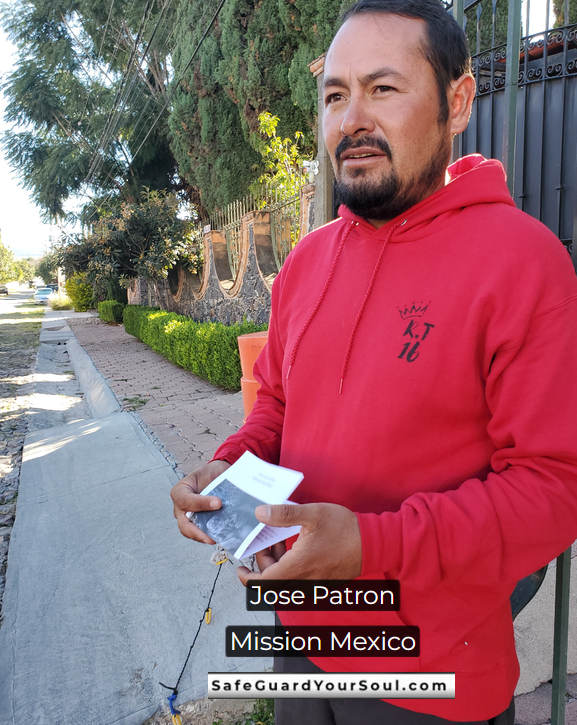
THIS MORNING: Brother Mark brought brother Juan to meet our new brother Jose Patron!
Jose was given a stack of JESUS tracts after he said he wanted to evangelize.
Brother Juan passes by where Jose works for work daily and so that connection and fellowship is being put in place.
“WE are labourers TOGETHER with God” (1 Corinthians 3:9) – and what God has us doing is supporting His beloved “labourers” who are “few”! (Matthew 9:35-38)
A FEW DAYS AGO: Sister Maria called for more JESUS tracts. She ran out as she is distributing hundreds per day. So our dear sister, thanks to you who are praying and supply…. was given a new jacket to keep her warm (pictured), food and drink to bring home for her living quarters, a fresh supply of JESUS tracts, some cash (Mexican pesos), and some Scripture that she as usual read out loud and devoured as I brought them up on my cell phone from the Spanish Bible (Reina Valera). God is good saints. May He be glorified in all you are doing to see the beloved people of Mexico reached with His bless-ed Gospel! You are refreshing His beloved saints.
LORD willing, I will be meeting again with our dear brother Juan this week to refresh him in fellowship etc.
“Pure religion and undefiled before God and the Father is this, To visit the fatherless and widows in their affliction, and to keep himself unspotted from the world.” James 1:27
Mexico: The Land where the Gospel of Jesus is Freely Received
“Freely ye have received, freely give.” Matthew 10:8
As we truly follow Jesus He makes us fishers of men.
“And Jesus said unto them, Come ye after me, and I will make you to become fishers of men.” Mark 1:17
This was the sweetest couple ever as you can tell by the picture. They were overjoyed to receive the preaching of our LORD’s Gospel and were told how to be saved – repentance and faith in Christ, and showed the prayer on the back, etc. They were directed to the prayer on the back and exhorted to pray in repentance and faith and receive eternal life. When asked they said they’d welcome your prayers for them.
On the streets today in Mexico ministering our LORD Jesus’ Gospel to many. As usual the name of Jesus was preached in Christ’s love and it was readily, eagerly received by most who thanked us for giving them the Gospel. SMH. It’s no even fair!
A man name Jose was ministered to, received the Word, and prayed in repentance and faith to be saved! Would you like to lift our new brother in Christ in prayer? Jose Patron is his name and we are connected and he’s already been given more Scripture and added to the Spanish WA group.
Jose just sent me a voice recording saying Thank you to Mark and I for ministering Jesus’ Gospel to him and that he wants to do the same thing we are doing, minister to others our LORD’s Gospel.
“So mightily grew the word of God and prevailed.” Acts 19:20
“The food looks healthy. Just this morning I was thinking that it is unfathomable, in my mind, to comprehend what the Lord is doing in Mexico. I watched the video of Mark passing out Jesus tracts and everyone was so receptive. That stuck in my mind, because I recently watched a video of a man preaching the gospel on a train. Zero response! Everyone kept looking at their phones and never once looked up. This is the true state of America. We have need of nothing and especially not Jesus. Rev 3:17. As opposed to the precious people of Mexico who know they are poor in spirit and are in need of the Lord to save them. They know something is missing in their lives. When Mark was passing out those Jesus tracts people were very happy and joyful to receive them, here they are rejecting the Savior.” Karen Cochran
We went to a colonia, to a street where no one was outside at the moment, Brother Mark said “God sent us this way for a reason, for someone.” 30 seconds later we came upon Jose! Boom.
Then came the Gospel explosion!
Upon ministering Christ’s Gospel to him, Jose Patron excitedly shared with brother Mark and I about how God had saved him from dying. He simply needed the opportunity to repent and be saved – and that’s exactly what JESUS did. Thank you for lifting our beloved brother Jose in prayer.
Jose just sent me a voice recording saying Thank you to Mark and I for ministering Jesus’ Gospel to him and that he wants to do the same thing we are doing, minister to others our LORD’s Gospel.
“So mightily grew the word of God and prevailed.” Acts 19:20
Gospel blessings abounded on the streets in Mexico ministering our LORD Jesus’ Gospel to many. As always the name of Jesus was preached in Christ’s love and it was readily, eagerly received by most who thanked us for giving them the Gospel.
It’s no even fair to have the privilege to minister to the beloved Mexicans! SMH.
A man name Jose was ministered to. He received the Word, and prayed in repentance and faith to be saved! Would you like to lift our new brother in Christ in prayer? Jose Patron is his name and we are connected and he’s already been given more Scripture and added to the Spanish WA group.
Jose just sent me a voice recording saying Thank you to Mark and I for ministering Jesus’ Gospel to him and that he wants to do the same thing we are doing, minister to others our LORD’s Gospel.
Thank you for lifting the salvation of the people of Mexico in your prayers. | Mexico Mission
“I love this brother! May God continue to provide and increase his fruit in the lives of the disciples in Mexico, in the Philippines, in Pakistan, in Kenya, in all his earth for his glory! Amen.
I was reading Psalm 8 and John 10. Beautiful beyond understanding is God’s love poured out in Christ Jesus toward us who hear his voice!
Much love to the body of Christ in Mexico and throughout the whole world. Jesus is coming!
“EVERY person you meet, or stand next to in line, is an opportunity to share the Good News. Do not miss the opportunity to bring another into the Kingdom.
I thank God everyday that this happened to me 5 years ago.” Targeted Christian Girl, RN
Let us be blessed to preach Christ’s Gospel this day.
Upon having the Gospel of Jesus preached to her, beloved Laura informed me that she is a born again saint!!! After fellowshipping she took a stash of JESUS tracts. Would you like to pray for sister Laura?
After receiving the ministry of God’s Word, Antonio was asked if he wanted you to lift him in prayer. He eagerly accepted and is glad you will pause to lift his life to the LORD in prayer. | Mexico Mission
ON THE TOPIC OF MEXICO
The Mexican people never handed their country over to the government so that the government can take it away the government cannot take it away because
Historically and presently the Mexican people find a way to circumvent the government. They never let the government have control and therefore the government can’t take their freedom away – because the people recognize their freedom coming from God.
The tax money of the people is a large way that the government controls the people they are empowered by the riches of the people through taxes in order to control and exploit them endlessly. Your tax money fuels your slavery….
Mexican people have a very healthy dis-trust for government. This is unlike many Americans. Many Americans it seems, haven’t learned that the promises candidates make before an election, will nearly never carry them out when elected. It seems the “We’re going to release the epstein files” was a mere ruse to cover those secret files. “It’s all a big club, and you’re not in it.” George Carlin
Thank you for praying for this man, Juan. He received ministry today and is in need of being saved.
The concept of a “daily cross life” with Jesus is the way of living that involves submitting ourselves to Christ daily, perpetually, and living in sacrificial service to God and His kingdom (Matthew 6:33). This is based on the Bible verse Luke 9:23, which says, “And he said to them all, If any man will come after me, let him deny himself, and take up his cross daily, and follow me. 24 For whosoever will save his life shall lose it: but whosoever will lose his life for my sake, the same shall save it” (Luke 9:23-24).
In short, the cross gets you, me, out of the way so Christ can reign. Selah.
“But thanks be to God, which giveth us the victory through our Lord Jesus Christ.” 1 Corinthians 15:57
How do we walk in victory after Jesus saves us? By participating in the daily cross life.
“And he said to them all, If any man will come after me, let him deny himself, and take up his cross daily, and follow me. 24 For whosoever will save his life shall lose it: but whosoever will lose his life for my sake, the same shall save it.” Luke 9:23-24
HOW could we possibly, vainly believe we are going to overcome the sins that prevent us from eternal glory without the daily crucified life? Not going to happen.
The cross is essential—the crucified life. Read Romans 6 in prayer each morning.
Death and burial must precede resurrection. There will be no resurrection in your personal life—no divine raising you up out of sin and into victory—until you lay down your life, until you die.
The Bible says we have been FOOLS:
“Thou fool, that which thou sowest(plant)is not quickened(made alive), except it die:” 1 Corinthians 15:36
How could we have ever believed that God is going to raise us upward into His victory, out of sin, until we died? I can tell you why—it’s because we weren’t honestly studying and obeying His Word for ourself but rather following false teachers (Philippians 3:18-19).
“Always bearing about in the body the dying of the Lord Jesus, that the life also of Jesus might be made manifest in our body. 11 For we which live are alway delivered unto death for Jesus’ sake, that the life also of Jesus might be made manifest in our mortal flesh. 2 Corinthians 4:10-11
“But if the Spirit of him that raised up Jesus from the dead dwell in you, he that raised up Christ from the dead shall also quicken your mortal bodies by his Spirit that dwelleth in you.
12 Therefore, brethren, we are debtors, not to the flesh, to live after the flesh. 13 For if ye live after the flesh, ye shall die: but if ye through the Spirit do mortify the deeds of the body, ye shall live.” Romans 8:11-13
The original Gospel is a cross Gospel. Any gospel that does not have the cross front and center, is “another gospel,” a false gospel (Galatians 1:6-9). Reading Romans 6 prayerfully each morning is a blessing.
YOUR PRAYER: Holy Father, I love You and thank You for sending Your only begotten Son to die for my sins and the sins of the whole world. We are not worthy but You bought us with the very life blood of Christ, back to Yourself from a life of sin, to be Your sons and daughters. Please forgive all my sins afresh LORD. Into Your holy, mighty hands I now submit my spirit. Bless this life to be crucified with You dear LORD. In Jesus’ name, amen.
NOTHING – NO MAN, NO DEVIL CAN STOP THIS! Just as no man, no devil could possibly stop the resurrection of Christ, no entity or army can stop the resurrection life of Christ in His saints, as they submit to their own death and burial. Resurrection follows! “Always bearing about in the body the dying of the Lord Jesus, that the life also of Jesus might be made manifest in our body. 11 For we which live are alway delivered unto death for Jesus’ sake, that the life also of Jesus might be made manifest in our mortal flesh. 12 […]
Victory Over the Iniquities that Currently Drive You [podcast]
“Too many Christians blame their flesh on Satan and try casting it out. Never works. That’s why they don’t grow! Must crucify the flesh!” Karen Cochran Recently, a brother in Christ was pushing the fact that Genesis 6:5, 12, use the phrase “only evil continually” pertaining to mankind, all men. REPLY: Ask for yourself the important question: WHY did Jesus come to the earth? And from this moment forward, allow the Bible to answer that question …. Look for the Bible answer…… Why Jesus came to die for us and make us new creatures in Christ whereby OLD THINGS ARE […]
Cons and Crooks who Do Not Preach the Cross [podcast]
“For the preaching of the cross is to them that perish foolishness; but unto us which are saved it is the power of God.” 1 Corinthians 1:18 Those who do not preach the cross prove that they believe the cross is “foolishness.” The know that many will leave if they were to preach the crucified life. And they are in it for the money, the acceptance of mere men, not Christ. Make no mistake, the Holy Ghost through Paul warned us specifically about this generation of counterfeits, these “evil men and seducers” who “wax worse and worse.” (2 Timothy 3:13) […]
Recently a dear brother in Christ related this testimony to me of our LORD’s work in his life:
“I had a ‘back to Jesus’ moment after the election. As I was horribly disappointed in our country and the dividing of even my own friends, I was praying: ‘I’ve lost faith in my country, I’ve lost faith in my friends…’ then it hit me… I had put my faith in the wrong things. It’s so easy to depend on others. But now I am trusting only in my Lord and Savior.”
“For he looked for a city which hath foundations, whose builder and maker is God.” Hebrews 11:10
“For here have we no continuing city, but we seek one to come.” Hebrews 13:14
Satan seeks to seduce God’s people with counterfeit causes – causes outside of that which is clearly defined by Holy Scripture as Christ’s Gospel cause! A moral cause is not necessarily the work of the Messiah. Loving the LORD with all of our being and doing His work, the work of the Gospel is His will as we are “new creature(s)” in Christ and His “ambassadors,” sent forth by Him to teach His Word (Matthew 28:18-20; 2 Corinthians 5:20).
HAVE WE EXALTED FREEDOM ABOVE CHRIST – THE ONLY ONE WHO CAN GIVE IT? “Thou shalt have no other gods before me” (Exodus 20:3-5) and “No man can serve two masters” right? (Matthew 6:24)
Do we love Jesus more than freedom? Do we love His Great Commission more than the cause of getting our country back?
In fact we have no freedom if we are not born again and presently walking with and abiding in Jesus on HIS stated terms (John 8:31-32; 15:1-16). Jesus came to save, heal, and grant freedom in the Spirit, from Satan, and freedom from sin to those who are His (Matthew 1:21; Luke 4:18; John 1:29; Acts 26:18; Titus 2:11-14; 1 John 3:1-10, etc.). Here, listen to the Son of God ….
“As he spake these words, many believed on him. 31 Then said Jesus to those Jews which believed on him, IF ye continue in my word, then are ye my disciples indeed; 32 And ye shall know the truth, and the truth shall make you free.” John 8:30-32
The LORD makes free those whom He saves, those who continue in an abiding relationship with Him (John 15).
You must “desire the sincere milk of the word” and feed your spirit the Word of God daily or you will grow weak very quickly and fall away (1 Peter 2:2). Jesus calls us to be “Nourished up in the words of faith and of good doctrine” (1 Timothy 4:6).
A Good Servant of Christ Jesus
Jesus is KING and kingdom living is all about exalting KING Jesus – not mere men or organizations or ministries! It’s only then that His divine “nourishment” is going to flow down into His beloved body!
“Let no man beguile you of your reward in a voluntary humility and worshipping of angels, intruding into those things which he hath not seen, vainly puffed up by his fleshly mind, 19 And not holding the Head, from which all the body by joints and bands having nourishment ministered, and knit together, increaseth with the increase of God.” Colossians 2:18-19
Heaven’s “nourishment” only transpires when KING Jesus is truly exalted.
“I am the LORD: that is my name: and my glory will I not give to another, neither my praise to graven images.” Isaiah 42:8
Modern church pawns want you to become enamored with THEM, not CHRIST. It’s a sales job! Beware. Read Colossians 2:18-19 closely.
“If thou put the brethren in remembrance of these things, thou shalt be a good minister of Jesus Christ, nourished up in the words of faith and of good doctrine, whereunto thou hast attained.” 1 Timothy 4:6
Feed. Feast. Fuel. Those who choose not to feast upon and fuel their hearts and minds with God’s Word daily, are not going to make it. They will walk weak, empty, and malnourished, just as the 5 foolish virgins did and were shut out of the kingdom (Matthew 25:1-13). They have freely chosen not to be “nourished up in the words of faith and of good doctrine” (1 Timothy 4:6).
“As newborn babes, desire the sincere milk of the word, that ye may grow thereby:” 1 Peter 2:2
Daily drinking the healing oil of God’s Word assures divine nourishment and wholeness in your spirit. God’s Word gets in us only when we get into it – and seek Him in it daily. Memorize Jeremiah 15:16 now.
“Thy words were found, and I did eat them; and thy word was unto me the joy and rejoicing of mine heart: for I am called by thy name, O LORD God of hosts.” Jeremiah 15:16
JUST as none of us understand but know the blessing of food nourishing our physical bodies, so the Word of God nourishes our spirit man, our hearts. It’s a daily must. Feeding and being nourished by the words of God is an imperative (Job 12:23; Jeremiah 15:16; Hebrews 5:11-14; 1 Peter 2:2, etc.). His Word cannot get into us and nourish us until we get into it! Let the nourishment begin!
“Let the word of Christ dwell in you richly (abundantly)…” Colossians 3:16
Note here in the above passage, we see Christ instructing those who believed upon Him to “continue in my word.” This was Jesus’ perfect opportunity to tell these new believers that they were “eternally secure” but He didn’t because He’s the Son of God and not a false prophet!
Jesus says that it’s only “IF ye continue in my word” that you will know the truth, be made free and walk in the liberty, the freedom He alone can grant from sin! See John 8:31-32, 36. YOU GOT SAVED? GOOD – NOW STAY SAVED!
“Sow to yourselves in righteousness, reap in mercy; break up your fallow ground: for it is time to seek the LORD, till he come and rain righteousness upon you.” Hosea 10:12
You must turn your heart to the LORD – in true worship – in order to walk in the liberty that He alone can give!
“Nevertheless when it (your heart) shall turn to the Lord, the vail (that blinds) shall be taken away. 17 Now the Lord is that Spirit: and where the Spirit of the Lord is, there is liberty.” 2 Corinthians 3:16-17
Fake “bibles” such as the NIV teach that “It is for freedom that Christ has set us free” (Galatians 5:1). Read that again. In the context of the whole of Scripture, we must ask: Did Jesus come to set us free for freedom’s sake or to be set free from sin in order to serve Him as new creatures? (2 Corinthians 5:17-18). Any student of God’s Word knows that this NIV rendering of Galatians 5:1 is a contradiction, a lie. | Fake “bibles” Exposed!
“For, brethren, ye have been called unto liberty; only use not liberty for an occasion to the flesh, but by love serve one another.” Galatians 5:13
“As free, and not using your liberty for a cloke of maliciousness, but as the servants of God.” 1 Peter 2:16
As was foretold, we are seeing that some are departing from the faith, listening to devils and their doctrines from the fake “bibles” and false prophets of today, instead of being daily nourished up in the pure words of God and helping feed Christ’s flock. Get a King James Bible.
“Now the Spirit speaketh expressly, that in the latter times some shall depart from the faith, giving heed to seducing spirits, and doctrines of devils; 2 Speaking lies in hypocrisy; having their conscience seared with a hot iron; … 6 If thou put the brethren in remembrance of these things, thou shalt be a good minister of Jesus Christ, nourished up in the words of faith and of good doctrine, whereunto thou hast attained. … 16 Take heed unto thyself, and unto the doctrine; continue in them: for in doing this thou shalt both save thyself, and them that hear thee.” 1 Timothy 4:1-2, 6, 16
Any person who is teaching that it’s impossible to “depart from the faith”(to leave Christ) after being saved, is a false teacher (Luke 8:13).
“Take heed, brethren, lest there be in any of you an evil heart of unbelief, in departing from the living God. 13 But exhort one another daily, while it is called To day; lest any of you be hardened through the deceitfulness of sin. 14 For we are made partakers of Christ, if we hold the beginning of our confidence stedfast unto the end; 15 While it is said, To day if ye will hear his voice, harden not your hearts, as in the provocation.” Hebrews 3:12-15
“For ye had compassion of me in my bonds, and took joyfully the spoiling of your goods, knowing in yourselves that ye have in heaven a better and an enduring substance. 35 Cast not away therefore your confidence, which hath great recompence of reward. 36 For ye have need of patience, that, after ye have done the will of God, ye might receive the promise. 37 For yet a little while, and he that shall come will come, and will not tarry. 38 Now the just shall live by faith: but if any man draw back, my soul shall have no pleasure in him. 39 But we are not of them who draw back unto perdition; but of them that believe to the saving of the soul.” Hebrews 10:34-39
“And let us not be weary in well doing: for in due season we shall reap, if we faint not.” Galatians 6:9
Be not deceived: You cannot sustain a life with Christ without daily fellowship with Him!
“In your patience possess ye your souls.” Luke 21:19
“And ye shall be hated of all men for my name’s sake: but he that endureth to the end shall be saved.” Matthew 10:22
So many today who claim Christ view salvation as something they did in the past and not a present relationship with Christ on His stated terms (John 15; Titus 1:16).
Okay so think about the last time you heard this passage read in a “church” gathering. Well, have you ever heard it read? These are the warning words of the very and soon coming LORD and Savior.
“All these are the beginning of sorrows. 9 Then shall they deliver you up to be afflicted, and shall kill you: and ye shall be hated of all nations for my name’s sake. 10 And then shall many be offended, and shall betray one another, and shall hate one another. 11 And many false prophets shall rise, and shall deceive many. 12 And because iniquity shall abound, the love of many shall wax cold. 13 But he that shall endure unto the end, the same shall be saved.” Matthew 24:10-13
“And these are they by the way side, where the word is sown; but when they have heard, Satan cometh immediately, and taketh away the word that was sown in their hearts. 16 And these are they likewise which are sown on stony ground; who, when they have heard the word, immediately receive it with gladness; 17 And have no root in themselves, and so endure but for a time: afterward, when affliction or persecution ariseth for the word’s sake, immediately they are offended. 18 And these are they which are sown among thorns; such as hear the word, 19 And the cares of this world, and the deceitfulness of riches, and the lusts of other things entering in, choke the word, and it becometh unfruitful. 20 And these are they which are sown on good ground; such as hear the word, and receive it, and bring forth fruit, some thirtyfold, some sixty, and some an hundred.” Mark 4:15-19
“WHEN IT (the heart) SHALL TURN TO THE LORD, THE VAIL SHALL BE TAKEN AWAY” How the veil that blinds us, that hinders our understanding, is removed. “But even unto this day, when Moses is read, the vail is upon their heart. 16 Nevertheless when it (the heart) shall turn to the Lord, the vail shall be taken away. 17 Now the Lord is that Spirit: and where the Spirit of the Lord is, there is liberty. 18 But we all, with open face beholding as in a glass the glory of the Lord, are changed into the same […]
The Reign of Christ! [podcast]
God counteracts death by the promise of resurrection – now and in eternity! (1 Corinthians 15; 2 Corinthians 4:10-12). Three Dimensions of the Reign of Jesus Christ: 1. Christ Reigning Over His Creation, 2. Christ Reigning in Your Life, and, 3. Christ Reigning Over the Wicked. Christ Reigning Over His Creation “For unto us a child is born, unto us a son is given: and the government shall be upon his shoulder: and his name shall be called Wonderful, Counsellor, The mighty God, The everlasting Father, The Prince of Peace. 7 Of the increase of his government and peace there […]
“This Hope” of Christ’s Return [podcast]
The Hope of Nations [podcast] Jesus Is Coming – Ready or Not “Even so, come, LORD Jesus” (Revelation 22:20). Psalm 2 is the real PEACE plan when the one and only “Prince of peace” arrives to destroy all the kingdoms of the antichrist and to crush in judgment the antichrist’s rebels who have refused His exclusive, blessed offer of salvation (Isaiah 9:6-7; Revelation 19:11-15). For now the KING is actually laughing at them … don’t believe me? Go read Psalm 2 and throw your hands up high in praise to our soon coming KING! Oh and notice that vs. 12 […]
Returning to Christ as Our "First Love" [podcast]
“Thou shalt have no other gods before me.” Exodus 20:3 The LORD is a “Jealous” God. “For thou shalt worship no other god: for the Lord, whose name is Jealous, is a jealous God:” Exodus 34:14 If Jesus Christ is not genuinely the first love of our hearts, our lives, we are committing spiritual adultery on the Son of God. “Jesus said unto him, Thou shalt love the Lord thy God with all thy heart, and with all thy soul, and with all thy mind. 38 This is the first and great commandment. 39 And the second is like unto it, Thou shalt love thy neighbour as thyself. 40 On these two […]
Heaven’s Nourishment! [podcast]
Nourished Up and Enduring to the End [podcast] Just How and When is Heaven’s “Nourishment Ministered” to Christ’s Body? “If thou put the brethren in remembrance of these things, thou shalt be a good minister of Jesus Christ, nourished up in the words of faith and of good doctrine, whereunto thou hast attained.” 1 Timothy 4:6 The GOAL and aim of most messages today heard coming from “Christian” leaders does not have Christ as it’s Grand Subject. This makes it more than obvious that God’s Word is not being preached and that the numerous prophetic warnings from Christ and His […]