





by Martin Bobgan, PhD.
Do children and adults really need self-esteem? Does low self-esteem lead to serious life problems? Should parents attempt to build self-esteem in their children? Does the Bible encourage self-esteem? Many Christians have assumptions about self-esteem. But, what does the Bible say? What does research say?
The Genesis of Self-Esteem
The self-esteem movement has its most recent roots in clinical psychology, namely in the personality theories of such men as William James, Alfred Adler, Erich Fromm, Abraham Maslow, and Carl Rogers. It became further popularized by their many followers. Nevertheless, the roots of the self-esteem movement reach further back into human history.
What is the LIE of the Ages? Find out in this revolutionary new book.
The self-esteem movement began in the third chapter of Genesis. Initially Adam and Eve were God-conscious and aware of one another and their surroundings rather than being self-conscious. Their awareness of themselves was incidental and peripheral to their focus on God and one another. Adam realized that Eve was bone of his bone and flesh of his flesh, but he was not self-aware in the same sense that his descendants would be. Self was not the issue until the Fall.
Partaking of the tree of the knowledge of good and evil did not bring godly wisdom. It brought guilt, fear, and separation from God. Thus, when Adam and Eve heard God approaching, they hid in the bushes. But God saw them and asked, “Who told thee that thou wast naked? Hast thou eaten of the tree, whereof I commanded thee that thou shouldest not eat?” (Genesis 3:11).
Sinful Self
Adam and Eve answered with the first example of self-justification. First Adam blamed Eve and God, and then Eve blamed the serpent. The fruit of the knowledge of good and evil spawned the sinful self with all of its self-love, self-esteem, self-acceptance, self-justification, self-righteousness, self-actualization, self-denigration, self-pity and other forms of self-focus and self-centeredness.
The present Self-Etc. movement is thus rooted in Adam and Eve’s sin. Through the centuries mankind has continued to feast at the tree of the knowledge of good and evil, which has spread its branches of worldly wisdom. It has branched out into the vain philosophies of men and, more recently, the “scientized” philosophies and metaphysics of modern psychology.
Religious incantations for self-worth, self-love, and self-acceptance ooze out of the TV tube, drift across radio waves, and entice through advertising. From the cradle to the grave, self-promoters promise to cure all of society’s ills through doses of self-esteem, self-worth, self-acceptance, and self-love. And everyone, or nearly everyone echoes the refrain: “You just need to love and accept yourself the way you are. You just need to forgive yourself” and “I just have to accept myself the way I am. I’m worth it. I am a lovable, valuable, forgivable person.”
Christian Response to the World
How is the Christian to combat the thinking of the world, which glorifies the self and places self at the center as the be-all and end-all of existence? How is the Christian to be faithful to our Lord’s command to be in the world, but not of the world? Can he adopt and adapt the popular philosophy/psychology of his culture, or must he stand apart as one who has been set apart by God and view his culture by the light of the Word? Jesus said:
Come unto me, all ye that labour and are heavy laden, and I will give you rest. Take my yoke upon you, and learn of me; for I am meek and lowly in heart: and ye shall find rest unto your souls. For my yoke is easy, and my burden is light (Matthew 11:28-30).
Here is a call to give up one’s own way and to come under the yoke of humility and service – an emphasis on yoking – on a teaching and living relationship. Jesus described His call for followers in different words, but to the same relationship and with the same intent, when He said:
If any man will come after me, let him deny himself, and take up his cross, and follow me. For whosoever will save his life shall lose it: and whosoever will lose his life for my sake shall find it (Matthew 16:24-25).
No Self-Love Commandment
Jesus does not command self-love, but rather love for God and love for one another. The Bible presents an entirely different basis for love than humanistic psychology preaches. Rather than promoting self-love as the basis for loving others, the Bible says that God’s love is the true source. Human love is mixed with self-love and may be ultimately self-serving. But God’s love is self-giving. Therefore, when Jesus calls His disciples to deny self and to take up His yoke and His cross, He is calling them to a self-giving love, not a self-satisfying love. Until the advent of humanistic psychology and its heavy influence in the church, Christians generally thought of self-esteem as a sinful attitude.
In Part Two of this series, we will look at what the Bible says about self-love, particularly the Second Great Commandment, and what research says about self-esteem.
Part Two
Even though the Bible does not teach self-love, self-esteem, self-worth, or self-actualization as virtues, helps, or goals, a vast number of present-day Christians have been deceived by the self-teachings of humanistic psychology. Rather than resisting the enticement of the world they become culture-bound. Not only do they not resist the tidal wave of selfism; they are riding the crest of self-esteem, self- acceptance, and self-love. One can hardly tell the difference between the Christian and the non-Christian in the area of the self, except that the Christian adds God as the main source for his self-esteem, self-acceptance, self-worth, and self-love.
Through slogans, one-liners, and twisted Scripture, many Christians jump on the existential bandwagon of humanistic psychology and set up their own cheering section. Thus, any criticism voiced against the teachings of self-worth, self-love, and self-esteem is regarded as ipso facto proof that the speaker wants people to be miserable. Moreover, any criticism against the self-esteem movement is seen as dangerous to society, since self-esteem is considered to be the panacea for its ills. Then, in the church, if one does not wholly endorse a self-esteem theology, he is accused of promoting worm theology.
If there is one thing the world and many in the church have in common these days, it’s the psychology of self-esteem. Although Christians may disagree about some of the nuances of self-esteem, self-worth, and self-acceptance, and even on some of the finer points of definition and how it is attained, too many have joined forces against what they believe is a formidable enemy – low self-esteem. Yet, even the world cannot justify promoting high self-esteem through its own methods of research.
No Research Justification for Self-Esteem
A few years ago the California legislature passed a bill creating the California Task Force to Promote Self-Esteem and Personal and Social Responsibility. The legislature funded the bill with $245,000 a year for three years, for a total of $735,000. The twofold title of the Task Force was quite an assumption. No one has ever demonstrated that promoting self-esteem is in any way related to personal and social responsibility. Nor has anyone proved that all those who exhibit personal and social responsibility have high self-esteem. Self-esteem and social and personal responsibility actually appear to be negatively rather than positively related.
The Mission Statement of the Task Force is as follows:
- Seek to determine whether self-esteem, and personal and social responsibility are the keys to unlocking the secrets of healthy human development so that we can get to the roots of and develop effective solutions for major social problems and to develop and provide for every Californian the latest knowledge and practices regarding the significance of self-esteem, and personal and social responsibility.1
The Task Force believed that esteeming oneself and growing in self-esteem would reduce “dramatically the epidemic levels of social problems we currently face.”2
Is There a Positive Relationship Between High or Low Self-Esteem and Personal and Social Responsibility?
In order to investigate this relationship the state Task Force hired eight professors from the University of California to look at the research on self-esteem as it relates to the six following areas:
1. Crime, violence and recidivism.
2. Alcohol and drug abuse.
3. Welfare dependency.
4. Teenage pregnancy.
5. Child and spousal abuse.
6. Children failing to learn in school.
Seven of the professors researched the above areas and the eighth professor summarized the results. The results were then published in a book titled The Social Importance of Self-Esteem.3 Has the relationship been established between self-esteem and social problems? David L. Kirk, syndicated writer for the San Francisco Examiner,4 said it bluntly:
- That . . . scholarly tome, The Social Importance of Self-Esteem, summarizes all the research on the subject in the stultifyingly boring prose of wannabe scientists. Save yourself the 40 bucks the book costs and head straight for the conclusion: There is precious little evidence that self-esteem is the cause of our social ills.
Even though they searched for a connection between low self-esteem and problematic behavior, they could not find a cause and effect link. However, more recent studies indicate a definite relationship between violent behavior and high self-esteem. Nevertheless, faith in self-esteem dies hard and schools continue to work on building high self-esteem.
Worse than the continuance of self-esteem teachings in the world is the faith that Christians continue to place in self-esteem and self-worth teachings. Thus, the secular self-esteem movement is not a frontal attack against the Bible with the battle-lines clearly displayed. Instead it is skillfully subversive and is truly the work, not of flesh and blood, but of principalities, powers, the rulers of darkness of this world, and spiritual wickedness in high places, just as delineated by Paul near the end of Ephesians. The sad thing is that many Christians are not alert to the dangers. More than we can number are being subtly deceived into another gospel: the gospel of self.
Biblical Love
Jesus calls His own into a love relationship with Himself and with one another. Their joy is to be found in Him, not in self. Their love comes from His love for them. Thus, their love for one another does not come from self-love or self-esteem, nor does it enhance self-esteem. The emphasis is on relationship, fruitfulness, and readiness to be rejected by the world. A believer’s identification is in Jesus to the point of suffering and following Him to the cross. Only through strained semantics, labored logic and exploited exegesis can one even attempt to demonstrate that self-esteem is biblical or even a part of the church tradition or teaching.
The focus of love in the Bible is upward and outward instead of inward. Love is both an attitude and action to one another. And while love may include sentiment and emotional affection, it is primarily volitional action for the glory of God and the good of others. Thus when Jesus said, “Thou shalt love the Lord thy God with all thy heart, and with all thy soul, and with all thy mind, and with all thy strength” (Mark 12:30), He was saying that all of our being is to be committed to loving and, therefore, pleasing God. Love for God is expressed with a thankful heart committed to doing what pleases God according to what has been revealed in the Bible. It is not a grudging kind of obedience, but an eagerness to conform to His gracious will and to agree with God that He is the source and standard for all that is right and good.
The Second commandment is an extension or expression of the First Commandment: “Thou shalt love thy neighbor as thyself” (Mark 12:31). John elaborates on this. He describes the sequence of love. In contrast to the teachers of self-love, who say that people cannot love God and others until they love themselves, John says that love originates with God and then extends to others:
- We love Him because He first loved us. If a man say, I love God, and hateth his brother, he is a liar: for he that loveth not his brother whom he hath seen, how can he love God whom he hath not seen? And this commandment have we from Him, that he who loveth God love his brother also (1 John 4:19-21).
God loved us first, which enables us to love Him, which then expresses itself in love for one another.
From Adam’s first breath, mankind was designed to live in relationship with God, not as autonomous selves. The entire Bible rests on that relationship, for after Jesus answered the Pharisee by saying that the Greatest Commandment is to love God and the second is to love neighbor as oneself, He said: “On these two commandments hang all the law and the prophets” (Matthew 22:40). Jesus came to save us from self and to reestablish that love relationship for which we were created. Through the centuries books have been written about loving God and loving one another. However, today the church is increasingly inundated with books telling us how to love ourselves better, esteem ourselves more, accept ourselves no matter what, and build our own self-worth.
Sign up here to receive the Moments with My Master email sent out for the edification of Jesus’ body.
End Notes
1 California Task Force to Promote Self-Esteem and Personal and Social Responsibility. “1987 Annual Report to the Governor and the Legislature,” p. V.
2 Andrew M. Mecca, “Chairman’s Report.” Esteem, Vol. 2, No. 1, February 1988, p. 1.
3 Andrew M. Mecca, Neil J. Smelser, and John Vasconcellos, eds. The Social Importance of Self-Esteem. Berkeley: University of California Press, 1989.
4 David L. Kirk, “Lack of Self Esteem is Not the Root of All Ills.” Santa Barbara News-Press, 15 January 1990.
More on PsychoHeresy here.
Support | STORE | Podcasts | Jail/Prison Ministry | Mexico Mission here | All Ministry Updates | Fresh Start with God | “Fear hath Torment” – 100% Deliverance from all Fear! [podcast] | Resurrection Grace [podcast] | G.O.D. = Game Over Devil [podcast] | Justification | Grace and Good Works [podcast] | More on Assurance here | Eternal Security Debunked | The Cross Life | 100’s of Christ-centered, Scripture-rich podcasts for your edification in Christ.



Apostasy
Favorite Eternal Security “Proof” Text? [podcast]

Excerpt from the book Lie of the Ages
Does John 10:27-29 Prove “Eternal Security”?
WHO are Jesus’ Sheep? Defined by, in God’s Word.
John 10:27-29
“My sheep hear my voice, and I know them, and they follow me: And I give unto them eternal life; and they shall never perish, neither shall any man pluck them out of my hand. My Father, which gave them me, is greater than all; and no man is able to pluck them out of my Father’s hand.” ~ John 10:27-29
Verse 27 is the condition necessary to appropriate the promises of verses 28-29.
Those who believe that a man can never lose his salvation, use this John 10:28-29 text but ignore the prerequisite, the divinely given condition – v27. Watch this:
 Firstly, in this passage Jesus identifies those sheep whom He makes the security promise to. He says, “My sheep hear my voice, and I know them, and they follow me.” In this we see one part divine and two parts the responsibility of the individual:
- “I know them”—the divine part toward those who are truly in Christ, presently abiding (v. 27)
- Those who are His sheep “hear” His “voice” and “follow” Him—the individual’s responsibility (v. 27)
The promise to be kept is a conditional promise which requires that we choose to continue to hear His voice and follow Him (John 10:27-29). Many today wrongly detach our LORD’s words in verse 27 from verses 28-29. In doing so, they perpetrate their “eternal security” mythology.
The problem for the eternal securists is that v27 has been intentionally been ignored…. It’s the actual condition Jesus gives for receiving the assurance promises He then gives in v28-29.
Those who seek to spread the “once saved always saved” heresy use John 10:28-29 to their advantage and conveniently ignore the preceding words of Christ in verse 27. Verses 28-29 are promises of security to those who have been genuinely born again and are currently abiding in Christ – hearing His voice and following Him (John 15:1-6). Many ignore the previous qualifying words (v. 27) of Jesus where Christ tells us that only those who are hearing His voice and following Him are promised that they are secure and will never perish. There is a condition to being secure in Christ—knowing Him—which requires continuing to abide in Him, hear His voice and follow Him (see also John 15).
“Jesus will neither leave us nor forsake us, but we can leave and forsake Him by choosing our sins OVER His love, grace and mercy!” Dino Filardo
Eternal securists have been taught to selectively interpret Scripture while ignoring mountains of Bible truth, in order to come to a predetermined conclusion.
Many a false teacher has built his own ministry empire dishonestly peddling this passage. Take a closer look. Anchor the promise to be kept in verses 28-29 on verse 27 where Jesus identifies who His sheep are – those who hear and continue to hear His voice and continue to follow Him (present tense). The promise to be kept is a glorious and yet conditional promise which requires that the individual recipient of the salvation gift of God chooses to continue to hear His voice and follow Him (John 10:27-29). Many today wrongly detach our LORD’s words in verse 27 from verses 28-29 of John 10. In doing so, they perpetrate their “eternal security” or otherwise called “once saved always saved” mythology. Beware as this was the first lie Satan told mankind, which led to the fall (Genesis 2:17; 3:4).
Instead of synthesizing the whole of Scripture, false teachers isolate certain verses for their own self-serving agenda and purpose (2 Corinthians 2:17, etc.).
The sheep Jesus’ promises are going to be kept are those who endure to the end, abide (remain) with Him (John 15:1-6). The Great Shepherd defines His sheep as those who are presently hearing His voice and following Him (present tense). John 10:27-29
It’s not difficult to mislead people in the direction of the sinful nature of their hearts – because then they can evade truly repenting which is a major life change and necessity for salvation. This is why Paul foretold of this hour and how men would “heap to themselves (false) teachers having itching ears.” (2 Timothy 4:3) “Itching ears” here represents unrepentant hearts.
OSAS people make a vain attempt at redefining the words of Scripture to fit their own self-serving agenda of lukewarmness, cross-less rebellion. For example they hyper-focus on “eternal” in the term “eternal life” while intentionally refusing to synthesize the whole of what Scripture states. They hyper-focus on the word “gift” and teach that a gift could never be lost which the rest of Scripture does not agree with. They then take the word “sealed” and make it to be permanent which it cannot possibly be because the same Greek word for “sealed” is used of Jesus’ tomb which we all know was NOT permanently sealed (Matthew 27:66). In this they bear false witness against the LORD and act like some Scriptures are more divinely inspired than others. This practice reveals the evil and deceit of their own hearts. Not just some Scripture in the Bible but rather “ALL scripture is given by inspiration of God…” (2 Timothy 3:16-17) It must all be synthesized, put together, compared (1 Corinthians 2:13). Error will result in the hearts and lives of those who do not search, study, and revere “ALL scripture” in God’s Word.
Eternal security deceivers don’t want to talk about Bible verses that contradict and expose their proof texts. You see, they don’t want to get awaken by the truth to the scam they’ve bought into. The wolves who they gullibly believe instead of God’s Word, taught them to cry “context, context” all while THEY are the beguilers who are taking Scripture out of context. Just like the demonic democrats in America, they accuse their adversaries of the exact thing THEY themselves are guilty of (Romans 2:1-3).
YOU are defending OSAS and yet you gave no Bible verses? Self-deception. If “once saved always saved” were true, WHY O WHY didn’t God tell us? Such a term, phrase, or concept appear no where in Scripture and the verses you use to “prove” it are taken out of their context. OSAS is undeniably the very first lie Satan ever told and it led to the fall of mankind from a HOLY God (Genesis 2:17; 3:4). If OSAS isn’t a doctrine of devils, nothing is! (1 Timothy 4:1-2)
Is the unchanging, Almighty God no longer “Holy, holy, holy” now that He sent His only begotten Son? (Isaiah 6:3; Revelation 4:8) If He’s still holy, no unrepentant person with sin will enter His holy Heaven (Revelation 21:8, 27, etc.).
“Follow peace with all men, and holiness, without which no man shall see the Lord:” Hebrews 12:14
HOW is it that so many treat the words of JESUS recorded in John 10 more divinely authoritative than the words of JESUS recorded in John 15? False teachers.
Most of the dupes who cite John 10:28-29 to “prove” they can never lose their salvation, 1. Don’t even know what the preceding verse says (v27), and 2. Have no clue what JESUS says in John 15:6.
“If a man abide (remain) not in me, he is cast forth as a branch, and is withered; and men gather them, and cast them into the fire, and they are burned.” John 15:6
In this John 10 passage used by the unconditional eternal security crew to peddle their wares, some neglect to look closely at verse 27 to see who Jesus was specifically speaking to when He promised “they shall never perish.” “They” refers to those who “hear my voice” and “follow me.” According to verse 27 the promise of eternal security is conditional. Assurance of salvation is only to those who are presently following Christ. In verse 27 we learn that protection from judgment to come is only to those who are currently 1) hearing His voice, 2) known by Him, and 3) following Him. This is consistent with the message seen in the whole of Holy Writ.
“For if AFTER they have escaped the pollutions of the world through the knowledge of the Lord and Saviour Jesus Christ, they are AGAIN entangled therein, and overcome, the latter end is worse with them than the beginning. 21 For it had been better for them not to have known the way of righteousness, than, AFTER they have known it, to turn from the holy commandment delivered unto them. 22 But it is happened unto them according to the true proverb, The dog is turned to his own vomit AGAIN; and the sow that was washed to her wallowing in the mire.” 2 Peter 2:20-22
WHO did Jesus say His true sheep are?
“My sheep hear my voice, and I know them, and they follow me” (Jn. 10:27). According to these words of Christ, those who “know” Jesus and “follow” Him are given the promise that they will “never perish.” As long as the follower hears His voice and follows Him, they are assured “eternal life.” This is exactly what the Son of God taught just a few chapters later in John 15 where He says that if a branch that is in Him does not remain or abide in Him, that person will be cut off and cast into the fire (hell).
Those who abide or remain under the shadow of His holy and protective wing shall remain secure in Him (Ps. 91:1). The Good Shepherd here said: “Neither shall any man pluck them out of my hand.” No man can pluck us out of His protection except ourselves by our own decisions. We who are abiding are protected from the snare of other men drawing us away as we remain walking with the Son of God. If you’re tucked, you won’t get plucked. If you’re not tucked under the wing of intimacy with Jesus, you will, can, and are likely to be plucked out of His holy hand by your own sinful unbelief. The LORD told us “Behold, I come quickly: hold that fast which thou hast, that no man take thy crown” (Rev. 3:11).
It’s also notable that those who emphasize John 10 to convince themselves and others that they are “eternally secure”, don’t even know much less acknowledge the words of the Savior in John 15:1-6.
Telling.
“If a man abide (remain) not in me, he is cast forth as a branch, and is withered; and men gather them, and cast them into the fire, and they are burned.” John 15:6
 Jesus taught repeatedly that some would not continue to follow Him (“abide”) and hear His voice and would consequently “fall away.” There is record of some who once believed and then stopped believing (Lk. 8:13; 13:23-30; Jn. 6:66; Acts 8:14-23).
WHY do eternal securists get all upset when their fairy tale is exposed? Well, they are hiding behind the thin veneer of this heresy, feeling all secure, emboldened to live as they please, feeling assured in their lukewarmness and sin … denying Jesus instead of self, refusing to take up the cross that Jesus commanded all who would follow Him truly (Luke 9:23-24). Christ’s apostle Paul speaks of self-serving “enemies of the cross of Christ.” (Philippians 3:18-19) What’s behind this myth? The Psychology of Eternal Security [book]
Another Example of the Twisting of Scripture
The eternal securists seek to justify their OSAS heresy by misusing the following passage…. but in this Paul is speaking of those who go to Heaven, the judgment of saints, and not those who fell away and won’t be there because they will be in hell. They will not be present when this happens….
“Every man’s work shall be made manifest: for the day shall declare it, because it shall be revealed by fire; and the fire shall try every man’s work of what sort it is. 14 If any man’s work abide which he hath built thereupon, he shall receive a reward. 15 If any man’s work shall be burned, he shall suffer loss: but he himself shall be saved; yet so as by fire.” 1 Corinthians 3:13-15
One More….
Common Objection to Conditional Eternal Security….
“What about Romans 8:38-39 where it says nothing can separate us from the love of God?”
REPLY:
Simple: Notice the word LOVE not life. God will love us all the way into hell if we choose not to repent. His soul will even “weep in secret places for your pride” which comes before destruction (Jeremiah 13:17). The LORD is “Holy, holy, holy,” He’s just, and He will not ever coexist with sin. See the fall of lucifer (Isaiah 14:12-15; Ezekiel 28:13-19; Luke 10:18). The wages of sin is still death and the LORD will damn every soul that dies in sin, with no exception (Psalms 5:4; Habakkuk 1:13; Isaiah 6:3; Romans 6:23; Revelation 4:8; 21:8; 22:11, etc.). Read Jesus’s parable of the prodigal son Lk 15. Did the father love and miss his son? Yes. Did the father (represents God) go chase him down? No. The son who departed had to choose to return. Much truth there. Speaking of Romans, read 11:20-22. Now read 2 Peter 2:20-22 and the book of Hebrews.
1 John 2:19 is often also utilized to “prove” eternal security. Not.
“They went out from us, but they were not of us; for if they had been of us, they would no doubt have continued with us: but they went out, that they might be made manifest that they were not all of us.” 1 John 2:19
Interestingly, the word “never” does not appear in this verse above which is so often used to “prove” OSAS. Let’s read it again with an objective mind. And, also remember what Jesus says about the primary importance of His teaching of the seed and the soil, the sower and the Word:
“And he said unto them, Know ye not this parable? and how then will ye know all parables?” Mark 4:13
The honest student of the whole Counsel of God’s Word knows that numerous clear Bible truths reveal that a saved person can turn away from the LORD, so we know that the apostle John could not possibly be saying that a saved person could never depart from the LORD. In my opinion, this verse is the best argument the eternal security proponent has, yet it’s not enough. There must be two or three witnesses and not just one (2 Cor. 13:1). After a closer examination of this text, one will find that verse 19 does not teach or justify “once saved always saved.” When any one verse is taken to the exclusion of the whole Word of God, one will certainly misunderstand the doctrine of the LORD which can only be apprehended by “study.” (2 Tim. 2:15) This verse is like any other verse of Scripture – it must be taken in light of the entire Counsel of God. The context to be considered is 1 John 2:18-29).
In examining the context in which 1 John 2:19 is set, we see that false teachers whom John calls “many antichrists,” had come and were telling these believers that Jesus was not the Christ (v22).
Let’s look at verses 18 and 19 together:
“Little children, it is the last time: and as ye have heard that antichrist shall come, even now are there many antichrists; whereby we know that it is the last time. They went out from us, but they were not of us; for if they had been of us, they would no doubt have continued with us: but they went out, that they might be made manifest that they were not all of us.” 1 John 2:18-19
Note here that it is specifically of these “antichrists” that John speaks and says that “if they had been of us, they would no doubt have continued with us: but they went out, that they might be made manifest that they were not all of us.”
John was speaking of those who were once saved but then departed from the faith (1 Tim 4:1), they believed and then fell away (Luke 8:12-13) …. then departed from the believers in that fellowship.
Teddy Caldwell writes:
“OSAS insists that those are professing believers, but 1 John 2:18 says such people are antichrists. 1 John 2:22 says an antichrist is one who denies that Jesus is the Christ. Anyone who does that isn’t a believer and isn’t even trying to look like one.”
Concerning 1 John 2:19, Donald Stamps, in the Life in the Spirit Study Bible, writes:
“‘THEY WENT OUT FROM US.’ When the antichrists departed from their fellowship with true believers, they were not in a saving relationship with Christ. This allows for two possibilities: (1) They were never true believers to begin with, or (2) they had once been in a saving relationship with Christ but afterward abandoned their faith in Christ.”
Right here in verse 24 of this passage we see the doctrine of personal responsibility to “remain” in faithful obedience to the LORD or lose one’s place with God (1 Cor. 15:2; Gal. 6:9; Col. 1:23). This is a teaching found throughout Holy Writ – the divine requirement to stay saved or lose all in eternity, “suffering the vengeance of eternal fire.” (Jude 7)
“Let that therefore abide (remain) in you, which ye have heard from the beginning. IF (denotes condition) that which ye have heard from the beginning shall remain in you, ye also shall continue in the Son, and in the Father. And this is the promise that he hath promised us, even eternal life.” 1 John 2:24-25
Verse 24 alone tells us that we cannot think that verse 19 means that someone who is at some point in right standing with God can never depart from Him and lose out. Also, verse 25 tells us that “eternal life” (not just rewards) is at stake and the promise contingent upon the believer abiding or remaining in that “which ye have heard from the beginning” which is the Gospel. “Eternal life” is assured as long as one is remaining rooted in Jesus Christ. This is the overwhelmingly consistent message of God’s Word.
In verse 26 John says “These things have I written unto you concerning them that seduce you.” Verse 19 is written about the deceivers who sought to “seduce” these disciples John was addressing and not of true believers.
With all of Scripture in consideration, we can conclude that 1 John 2:19 is a specific example and not a rule of doctrine.
If you truly wish to search out this matter, let me encourage you to closely examine, break down and study this entire text (1 Jn. 2:18-29). In order to ascertain truth, one must compare the verse in question with all other related Scriptures, beginning with the context in which the verse is set (Isa. 28:9-10; 1 Cor. 2:13).
Go here for more on the misuse of 1 John 2:19.
Eternal Security / OSAS Exploded
Support | STORE | Podcasts | Peace with God | Soul-Damning Sins (book) | Hell’s Menu | Where Do We Go When We Die (audio) | Voices of Conviction Who Warn of Hell’s Horror




Articles
Laboring Fervently for Christ’s Body [podcast]
“Epaphras, who is one of you, a servant of Christ, saluteth you, always labouring fervently for you in prayers, that ye may stand perfect and complete in all the will of God. 13 For I bear him record, that he hath a great zeal for you, and them that are in Laodicea, and them in Hierapolis.” Colossians 4:12-13
One source notes:
“Epaphras’ prayer is a powerful New Testament model of intercession found in Colossians 4:12. As the founder of the church in Colossae, Epaphras is described by the Apostle Paul as ‘wrestling’ or ‘laboring earnestly’ in prayer so that his congregation would stand mature, firm, and fully assured in the will of God.”
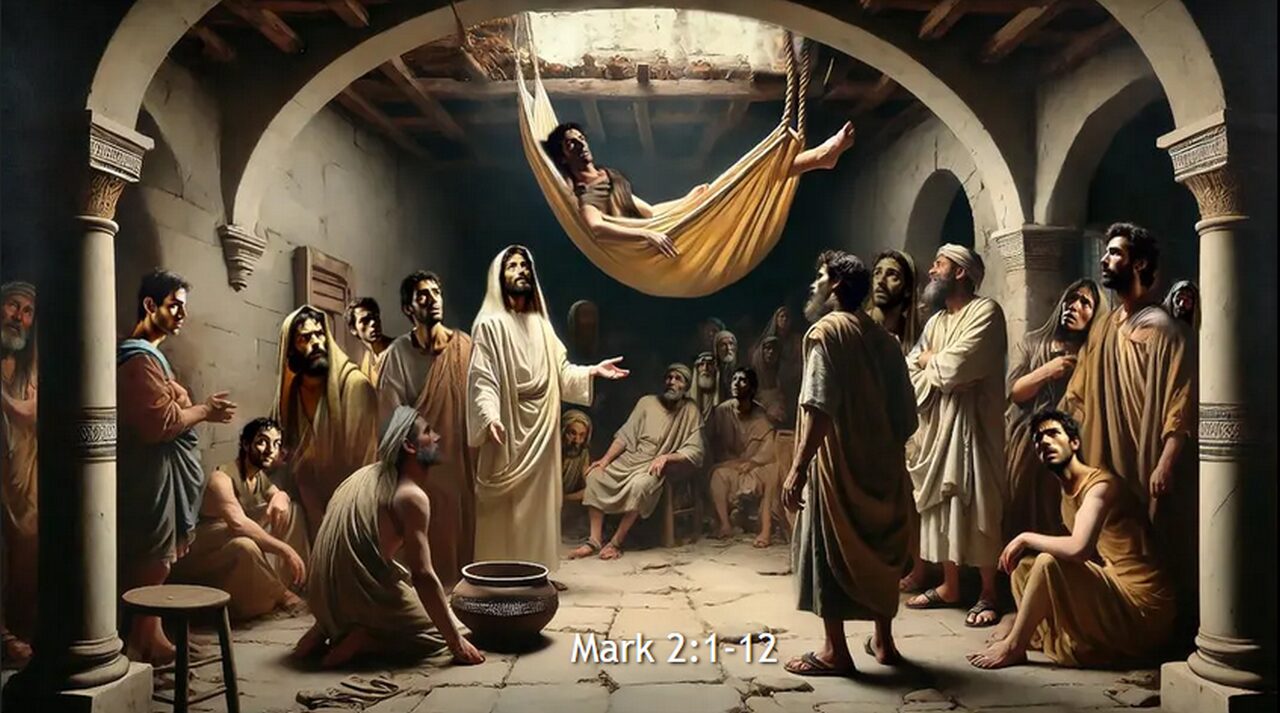
Jesus Heals the Paralytic Man who was Dropped Down to Him from the Roof
Mark 2
“1 And again he entered into Capernaum after some days; and it was noised that he was in the house.
2 And straightway many were gathered together, insomuch that there was no room to receive them, no, not so much as about the door: and he preached the word unto them.
3 And they come unto him, bringing one sick of the palsy, which was borne of four.
4 And when they could not come nigh unto him for the press, they uncovered the roof where he was: and when they had broken it up, they let down the bed wherein the sick of the palsy lay.
5 When Jesus saw their faith, he said unto the sick of the palsy, Son, thy sins be forgiven thee.
6 But there were certain of the scribes sitting there, and reasoning in their hearts,
7 Why doth this man thus speak blasphemies? who can forgive sins but God only?
8 And immediately when Jesus perceived in his spirit that they so reasoned within themselves, he said unto them, Why reason ye these things in your hearts?
9 Whether is it easier to say to the sick of the palsy, Thy sins be forgiven thee; or to say, Arise, and take up thy bed, and walk?
10 But that ye may know that the Son of man hath power on earth to forgive sins, (he saith to the sick of the palsy,)
11 I say unto thee, Arise, and take up thy bed, and go thy way into thine house.
12 And immediately he arose, took up the bed, and went forth before them all; insomuch that they were all amazed, and glorified God, saying, We never saw it on this fashion.” Mark 2:1-12
Support | STORE | Podcasts | Jail/Prison Ministry | Mexico Mission here | All Ministry Updates | Fresh Start with God | “Fear hath Torment” – 100% Deliverance from all Fear! [podcast] | Resurrection Grace [podcast] | G.O.D. = Game Over Devil [podcast] | Justification | Grace and Good Works [podcast] | More on Assurance here | Eternal Security Debunked | The Cross Life | 100’s of Christ-centered, Scripture-rich podcasts for your edification in Christ.


Abiding
Abiding Under the Shadow of the Almighty [podcast]

“O Lord, thou knowest: remember me, and visit me, and revenge me of my persecutors; take me not away in thy longsuffering: know that for thy sake I have suffered rebuke. 16 Thy words were found, and I did eat them; and thy word was unto me the joy and rejoicing of mine heart: Jeremiah 15:15-16
Dwelling “in the secret place of the most High”
“He that dwelleth in the secret place of the most High shall abide under the shadow of the Almighty. 2 I will say of the LORD, He is my refuge and my fortress: my God; in him will I trust.” Psalms 91:1-2
“In the secret place of the Most High – Spoken probably in reference to the Holy of holies. He who enters legitimately there shall be covered with the cloud of God’s glory – the protection of the all-sufficient God. This was the privilege of the high priest only, under the law: but under the new covenant all believers in Christ have boldness to enter into the holiest by the blood of Jesus; and those who thus enter are safe from every evil.” Adam Clarke
“[Psalms] 91:1, 2 Jesus is the One who in a preeminent way dwelt in the secret place of the Most High, and abode under the shadow of the Almighty. There never was a life like His. He lived in absolute, unbroken fellowship with God, His Father. He never acted in self-will but did only those things that the Father directed. Though He was perfect God, He was also perfect Man, and He lived His life on earth in utter and complete dependence on God. Without equivocation He could look up and say, “My refuge and my fortress, my God, in Him I will trust.” Believer’s Bible Commentary
Support | STORE | Podcasts | Jail/Prison Ministry | Mexico Mission here | All Ministry Updates | The Return of Christ | Stewardship | Apostate Modern Church Exposed | Beware of the BUZZ WORD Bandits [podcast] | Preach the Word | Wolves Exposed | Giving | Fellowship | Christology = the Study of Christ








Favorite Eternal Security “Proof” Text? [podcast]

Laboring Fervently for Christ’s Body [podcast]

Abiding Under the Shadow of the Almighty [podcast]

The Warnings of the Book of Jude [podcast]

Attend to My Words [podcast]

Gathering Fruit for Christ’s Eternal Glory [podcast]

Acquaint now thyself with him, and be at peace: thereby good shall come unto thee [podcast]

Dwelling in the Secret Place of the Most High [podcast]

The Over Population Delusion Exposed [video]

Are You Bless-able? English and Spanish [podcast]

Mexico Mission Momentum Part 41

“Cursed be the Man that Trusteth in Man” [podcast]

Modern Day Cult of Personality Exposed [podcast]

The Cross and the Throne of Grace [podcast]

“I Will Uphold Thee with the Right Hand of My Righteousness” [podcast]

The Damning Myth of Unconditional Eternal Security! [podcast]

Calvinism’s Origins and Historical Roots [podcast]

Name Cult Warning: Beware of the Yahweh, Yahushua, Yahuah Cults!
Favorite Eternal Security “Proof” Text? [podcast]

The FORGOTTEN Sins of Sodom [podcast]
Dwelling in the Secret Place of the Most High [podcast]
Acquaint now thyself with him, and be at peace: thereby good shall come unto thee [podcast]
The Warnings of the Book of Jude [podcast]

Hell’s Menu

“You Who are Troubled Rest with Us” [podcast]

Penknife Sacrilege [podcast]
Attend to My Words [podcast]
The Over Population Delusion Exposed [video]

Diminishing Returns or Divine Blessings? [podcast]

Be Not Moved Away from the Hope of the Gospel [podcast]
Favorite Eternal Security “Proof” Text? [podcast]
Laboring Fervently for Christ’s Body [podcast]
Abiding Under the Shadow of the Almighty [podcast]


 America1 year ago
The Drugging of America: The Pharmakeia Sorcery Deception [podcast]
- Articles2 years ago
Children being Rescued in Tunnels: Happening Now – UPDATE!
- Articles8 years ago
Self-Examination in Preparation for the Lord’s Return
- Apostasy2 years ago
SHOCKING List of False Prophets Most Believe are True