Real Spiritual Maturity Must Become the Christian’s Priority







This Last Days church will never survive without it.
The power of the gospel to save is as real today as it ever was. Its power to heal our hurts, to comfort our hearts, and to do all kinds of tangible miracles is still available, too.
But what about the power of the gospel to actually mature believers, particularly to bring spiritual maturity to the collective members of a local body so that we are led to measure up to the stature that belongs to Jesus Christ? Is that power still available? Yes! It is still available, too! But it must be believed and appropriated in order to be realized in the same way that the gospel’s power to save, heal, comfort, and do miracles must be.
We are so far from understanding the theme of spiritual maturity that many believers do not even know that it is a part of the gospel message. This is true even among many who believe in spiritual gifts. Only a tiny percentage of Christians really have a vision for the fullness of Jesus Christ in the body, or even see it as a part of the gospel message. But the gospel is a whole life message. It brings change immediately, it saves ultimately, and between the two it grows us up.
How We Got Here
There are several contributing factors which have led to our present spiritual dilemma. The primary one is that for the last 500 years we have prioritized preaching for saving over teaching for spiritual maturity. Another one is that it is much easier to preach the saving part of the gospel than it is to submit to the maturing part of the gospel. And finally, the natural man likes things that can be measured and boasted about, and preaching for saving usually yields a headcount. But there are no immediate grand results from submitting to the power of the gospel for spiritual maturity. They come over time.
Even though Christianity today is accustomed to prioritizing salvation over spiritual maturity, this does not change the fact that we are spiritual creatures, born after God Himself. As spiritual creatures, whether we feel like it or not, our new default is to be spiritual. But the natural man fights the spiritual man for all he is worth (which is not very much, by the way). As born-again believers, we are reprogrammed away from the natural man altogether, but we are all too familiar with how difficult it is to keep him in check. Nonetheless, our new spiritually advanced DNA leads us to preach not only the gospel that saves, but also the gospel that grows us up into the full measure of the stature that belongs to Jesus Christ. I do not discount the great importance of preaching the gospel that saves, but only advocate that we also teach and practice spiritual growth by it, too; and it is through our growing up spiritually that we will see more people saved, anyway.
Reformation but Not Spiritual Maturity
I mentioned earlier that a major contributing factor to our lack of spiritual fitness is that for nearly 500 years we have prioritized numerical growth, giving very little attention to spiritual maturity. Allow me to give an overview to show you what I mean.
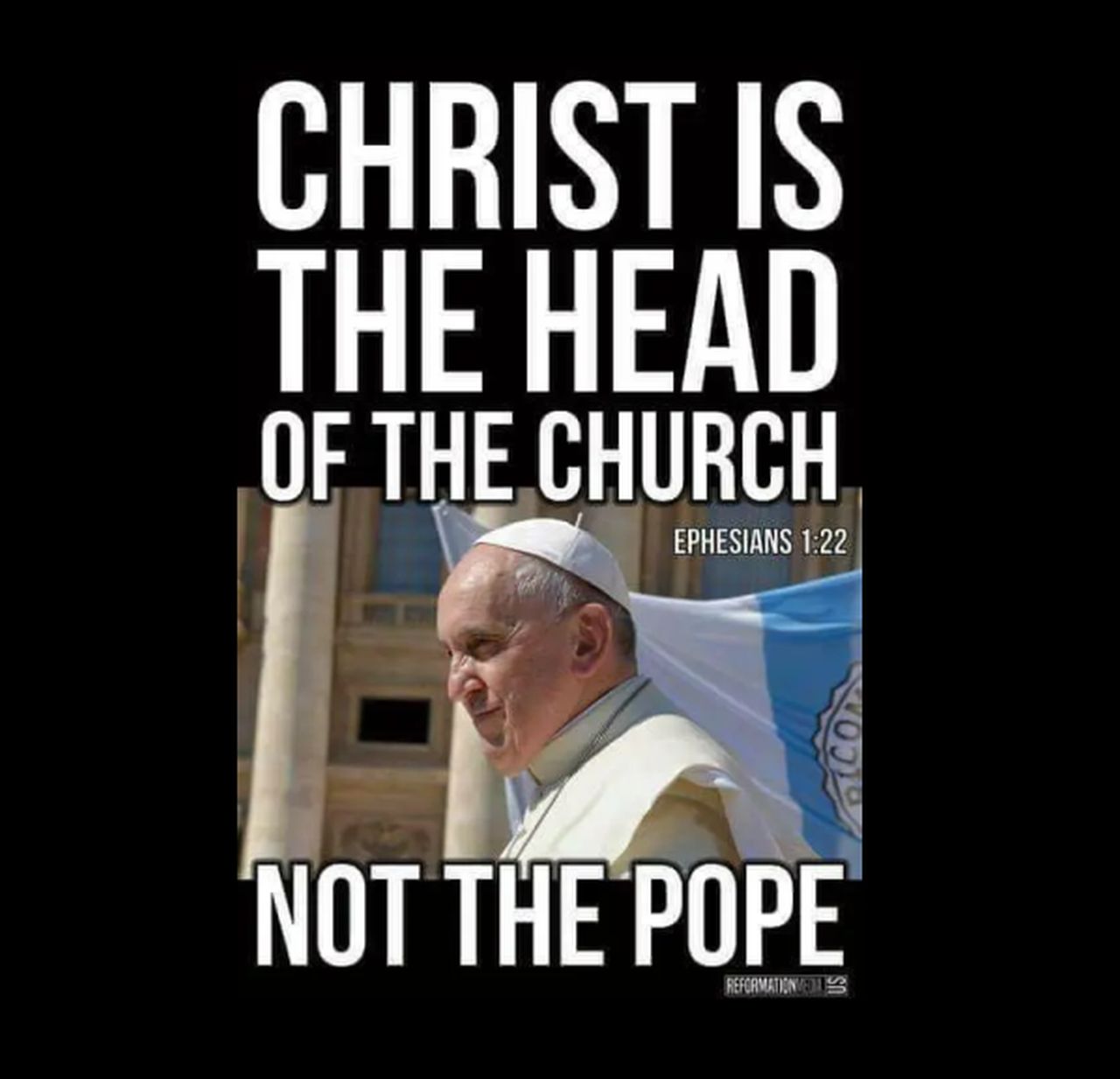
By the time of the death of the beloved apostle John, the center for the church for all practical purposes had moved to Rome, under the leadership of Clement of Rome, who was later named the bishop of Rome. Within just a few short generations, succeeding church leaders began dominating Christian thought and doctrine entirely. Having left the Spirit’s leadership and fallen captive to Satan’s religious bondage, the early church evolved into a damning religious institution. Roman Catholicism purposefully set out to bring all people everywhere under its thumb. Its leaders interpreted the scriptures to say that all souls who wanted to claim Christ would have to come under the established church. Thus they taught that any hope of salvation had to come from the Catholic Church; and their dogma reigned supreme throughout much of the world for nearly 1400 years.
Amazingly, it still enslaves more than a billion souls today!
Then, about 500 years ago, God loosed Truth that resulted in the freeing of countless souls throughout the institution’s horrid domain around the world. Whole families and even nations had been under the Roman religious system for generations, but finally God raised up Christian reformers who, in the face of papal authority, established soundly through the scriptures that anyone could be saved by grace through faith in Christ alone – apart from the Catholic Church or any other institution. And with that, the battle for proclaiming Christ alone through open evangelism had begun!
A dozen years or so later, after Martin Luther openly challenged papal supremacy, new authority was assumed by King Henry VIII over the Church of England, and he continued the fight against any unbridled Christian who preached that souls are saved by faith alone. But the cat was already out of the bag; and by the grace of God, within just a few decades, multitudes of people who had lived in the darkest dungeon of humanity’s existence for centuries burst into the glorious light of the gospel! Countless numbers of people were set free to read the Bible for themselves for the first time (at least as quickly as they became available) and to evangelize. And for the first time in more than 1000 years, the world discovered that any and every man, woman, and child was a priest in his or her own right through faith in Jesus Christ. Surely the heavens shouted in delight when, after so many centuries of hellish religious bondage, earthly humanity realized that it was not in Jerusalem, or “in this mountain” (John 4:20-24), or under Rome’s Catholicism, or the Church of England, or anywhere else that they would have to worship! But as wonderful as that was for the gospel to have been loosed, the road to spiritual maturity had only just begun. At this point, the deeper understanding of the believer as a new creation and his enablement by the Spirit to actually grow up into Christ’s image was not even known, much less pursued on a large scale. And since so much of our modern-era evangelical doctrine finds its base in Reformation theology, I dare say that, in spite of great spiritual awakenings around the world over more recent centuries, today’s most vocal voices in Christianity are more influenced by John Calvin from 500 years ago than by the Spirit of God of eternity past! Authentic spiritual understanding for authentic spiritual maturity is provided for by Christ in us, the hope of the glory of God on earth; but mainstream evangelicalism is still in the dark ages on this truth.
The apostle Paul knew this revelation was deep and easy to overlook. He prayed earnestly that believers everywhere would come to an understanding of all that had been accomplished through the work of Jesus Christ for His glory to be revealed in us here and now, as well as for our eternal glory (Ephesians 1:15-23)! It is in knowing and appropriating those benefits which we have received for this age that we are made a truly spiritual people in this age – something that only segments of Christianity have touched in recent centuries.
Is there any wonder why we are not growing up into the image of Christ? And what about taking on the demonic battles that are lurking at our doorstep? How many among the Christian community are ready to take on Satan’s spiritual forces as he marches against this Last Days church? Can you not hear the Spirit of the Lord crying out to you and me that we MUST become a spiritually mature church if we expect to endure victoriously the times in which we live? Let us look at more evidence of why we are still spiritual babies, not ready for this late hour.
Great Awakenings but Not Spiritual Maturity
The Great Awakenings of the 1700s and 1800s boosted preaching for salvation and renewal for those already saved – and it was very effectual. God used a few inspired men to call the world to attention. Men such as Jonathan Edwards, George Whitefield, and John Wesley started, followed in the next century by Charles Finney, James McCready, Barton Stone, and others. These led tens of thousands into repentance from sin and faith toward God. Their preaching set on fire hundreds of other fiery preachers, then thousands. From England to America, makeshift pulpits popped up on busy streets and in the open fields, wherever there were people. And this was wonderful! Oh, how many of us would love to see this kind of revival preaching now! But it would have to happen on the streets and in the fields, since the churches far and wide, large and small, are in their own Dark Age and will NOT let God in! And many do not even realize it! Again our point is made that, as wonderful as this power preaching for salvation was then, there was still no knowledge of or emphasis given to spiritual maturity as it relates to the whole body coming into the image of Christ.
In the same way, there is lack in that area today. In the largest denomination in America, in fact, the call for salvation (watered down though it usually is) is still the focus of preaching every Sunday – even to those who are already saved! Is there any wonder why the body of Christ is so spiritually immature? Oh, what a spiritual awakening we need to get us out of the nursery! Limiting ourselves to the traditions and priorities of revivals past will not allow God’s people to come into lasting spiritual maturity – which was God’s goal from the beginning, and which is an absolute MUST if we are to endure these last chapters of these Last Days, not to mention our need to become His spotless, glorious bride!
Sunday School / Bible Studies but Not Spiritual Maturity
In the continuing evolution of evangelical Christianity, Bible study was first given emphasis through what came to be known as Sunday School. Most historians attribute its origin to Sunday Bible-reading lessons for children that took place in England, starting in the 1780s. As a part of the industrial revolution, thousands of young children were forced to work in awful conditions and for unthinkable hours six days a week, making it impossible for them to attend school; so God raised up a man named Robert Raikes, an Anglican evangelical, to start teaching these underprivileged children to read the Bible on Sundays, their only day off. From that was born Sunday School, which eventually spread to America. From that humble beginning, Bible study became a regular part of early elementary education. Then approximately 100 years later, when the state began to take over the responsibility of educating children, Bible training began to be moved out to the churches for Sunday study only, where it became a mainstay for the next 100 years. More recently, evangelicalism has largely turned from authentic Bible study in Sunday School to opinion-based discussions about God, with perhaps an accompanying Bible reference or two to support free thinking. Even so, the early Sunday School program set the pattern for regimented Bible study among 20th century evangelicals. Of course, there have been many other outstanding programs for Bible study that have contributed to excellent Bible training as well. But the point is that even 200 years of consistent Bible study has not solved the believer’s handicap of Spirit-life underdevelopment. Again, this is primarily due to our unwillingness to progress beyond doctrines and traditions established in centuries past.
There are those believers who, in their earnest pursuit to walk with the Lord, have returned to the land where He and His apostles walked. They have gone to Israel, as well as to the lands of Paul’s missionary journeys. Other believers have pursued a closer walk with Him by going back to get seminary training, and some have even learned a little Greek and/or Hebrew, so they can read the Bible in its own language; but few have come away from any of those things having grown deeper in their spiritual understanding of all that has been accomplished through Christ for us in real time. To truly walk as Jesus walked still seems far away; and to pursue the fullness of Christ in the body is, for all practical purposes, foreign. Once again, Christianity as a religious practice has failed to actually yield Spirit-filled Christ-likeness on a large scale. Millions and millions of genuine believers today have been kept in the state of the natural man by traditional thinking and doing which can be traced back to early religious ideas since the Reformation. Oh, if only we could break out of the nursery and enter into Bible study and fellowship with spiritual understanding that would lead us all to spiritual maturity! Indeed, the world is waiting!
Pentecostal Denominationalism but Not Spiritual Maturity
Consider the Pentecostal denominations. Their origins can usually be traced back to truly authentic spiritual awakenings at the turn of the 1700s, 1800s, and 1900s. Some churches that considered themselves Pentecostal genuinely sought to allow the Spirit to have His way. Their meetings were obviously accompanied by the Spirit’s presence, evidenced by the activity of spiritual gifts just as was the case with the church of Corinth. The opportunity was certainly there for believers to develop into spiritual maturity and deep Christ-likeness. In the end, however, they followed in the footsteps of the church at Corinth, too. They had all the gifts but never reached spiritual maturity. Eventually they gave in to a religious form, and the Spirit’s power faded; but they continued to duplicate the habits and practices of their early stages, nonetheless, not knowing that the Spirit had moved out.
The largest Pentecostal denominations in the world have become nothing more than giant religious institutions. Just like their more spiritually conservative brothers and sisters in Christ have done, their system is tiered, weighty, and burdensome on local churches. They have long snuffed out any hope for true spiritual development. Here again, the effort of the Spirit to bring about deep spiritual understanding that leads to a deep spiritual walk was overwhelmed by Christianity becoming religious.
The Charismatic Movement but Not Spiritual Maturity
I should not neglect to mention a genuine move of the Holy Spirit that started in America in the 1950s and spread around the world, called the Charismatic Movement. The Spirit of the Lord moved afresh on God’s people of every denomination. Tens of thousands of churches were started in America alone by believers who came out of traditional churches which refused to allow the Spirit His liberty in their meetings. Many of those newly organized churches sought to mature spiritually – not only in their worship meetings, but also as corporate bodies growing up into the measure of the stature of Christ. But they experienced burnout when too many became so emotionally driven that they moved away from a truly Biblical foundation. Today, theology among the remnants of the Charismatic Movement, for the most part, is about as emotionally exaggerated and theologically twisted as it could ever be. Yet when evaluating that movement along with all the others, we must separate what men have done from what God was trying to do through men. If we discern between God’s way and men’s results, we can take the good and grow while leaving the bad behind.
Even though God’s work in that season of spiritual awakening did not lead to widespread spiritual maturity, it was certainly an authentic work which impacted the body of Christ around the world on a scale that no previous move had done. Yet we still groan within ourselves to become more like Him. God has not failed; we have. And even though we know there is something missing, and we read the scriptures spelling it out, we have yet to make the connection for the long-term. Oh, that God would take us to the fullness of Christ’s measure soon!
But Jesus Said: “I will build My church.”
Regardless of the tremendous spiritual warfare that keeps the body of Christ as spiritual babies, our Lord said that He would build His church. Any true believer who honestly evaluates the general spiritual condition of Christianity today would have to concede that the Lord is not the one who put this mess together. He has built the church indeed, in that He is the author of our salvation individually; but we have built ourselves together corporately. Nonetheless, based upon His promise, He will build His corporate body His way; and just like many of you, I can hardly wait to see it come together!
We have all the ingredients. The scriptures declaring what we should become are clearly seen in the Bible. The example of how we are to follow the Father’s perfect way was set by His Son. His aid and guidance are freely offered by the grace of His Spirit within. And His promise is sure.
We need only to ask Him to show us every area in our thought and practice that should be removed, and then remove it, or allow Him to do so. We should seek a continuing infilling of His Spirit and provide a place that is wholly hospitable for Him within. We should abide in His Word and believe it completely. We should come together when He calls us to. We should wait patiently on Him and be sensitive to obey. We should not lose hope but instead take heart. We can appropriate and facilitate His work by doing these things, but only HE can do the work itself. Let us not frustrate His Spirit but yield. This Last Days church will never survive without Him!
Do you want to get deeper into God’s Word? If so, send a reply requesting the “Moments with My Master” email that is sent out to edify the body of Christ.
Articles
Why We Have Civil Authorities [podcast]
What should be our view of and responsibility to God-ordained civil authorities?
In light of these truths, it seems wise to remove oneself and family from the country, state, or local jurisdiction that is not punishing evildoers as God has ordained.
CRUSHING AND SEPARATING EVIL DOERS FROM THE GOOD PEOPLE IS GOD’S ORDAINED DUTY AND WILL FOR CIVIL AUTHORITIES TO CARRY OUT.
“A wise king scattereth the wicked, and bringeth the wheel over them.” Proverbs 20:26
A king or civil servant, ruler will destroy the wicked, he will truck them, he will crush them! Read the above verse again.
“The phrase ‘bringeth the wheel over them’ comes from Proverbs 20:26. It refers to the act of a wise king punishing or dealing with the wicked, particularly through the process of threshing (separating the good from the bad). The ‘wheel’ imagery suggests a thorough and often harsh application of this punishment.”
“Proverbs 20:26: Bringeth the wheel over them – He threshes them in his anger, as the wheel does the grain on the threshing-floor. Every one knows that grain was separated from its husks, in Palestine, by the feet of the oxen trampling among the sheaves, or bringing a rough-shod wheel over them. Asiatic kings often threshed their people, to bring out their property; but this is not what is intended here.” Adam Clarke
God ordained civil authorities to punish EVIL DOERS and not the good people! Any civil authority, whether an individual or the whole governmental system that punishes the good people, that weaponizes the system to destroy lawful, law abiding citizens, should be replaced. The framers of our Constitution actually set that in place.
God bless our Constitutionally abiding law enforcement which God ordains in order to punish evil doers. “Submit yourselves to every ordinance of man for the Lord’s sake: whether it be to the king, as supreme; 14 Or unto governors, as unto them that are sent by him FOR THE PUNISHMENT OF EVILDOERS, and for the praise of them that do well.” (1 Peter 2:13-14)
“He that justifieth the wicked, and he that condemneth the just, even they both are abomination to the LORD.” Proverbs 17:15
Read Romans 13 and notice…. Civil Rulers, including the Police, are ordained of God to punish those who do evil. They are His “ministers.” A few bad cops doesn’t change this fact. Oh, and notice how criminals all go to hell—“damnation.”
Romans 13 and 1 Peter 2:12-14 …. whenever government isn’t punishing evil doers, and instead, turns and punishes well doers, that government is the antitheses, the opposite of what God ordained civil government for and should be abolished.
Submission to the Authorities
1 Let every soul be subject unto the higher powers. For there is no power but of God: the powers that be are ordained of God. 2 Whosoever therefore resisteth the power, resisteth the ordinance of God: and they that resist shall receive to themselves damnation. 3 For rulers are not a terror to good works, but to the evil. Wilt thou then not be afraid of the power? do that which is good, and thou shalt have praise of the same: 4 For he is the minister of God to thee for good. But if thou do that which is evil, be afraid; for he beareth not the sword in vain: for he is the minister of God, a revenger to execute wrath upon him that doeth evil. 5 Wherefore ye must needs be subject, not only for wrath, but also for conscience sake. 6 For for this cause pay ye tribute also: for they are God’s ministers, attending continually upon this very thing. 7 Render therefore to all their dues: tribute to whom tribute is due; custom to whom custom; fear to whom fear; honour to whom honour. Fulfilling the Law Through Love 8 Owe no man any thing, but to love one another: for he that loveth another hath fulfilled the law. 9 For this, Thou shalt not commit adultery, Thou shalt not kill, Thou shalt not steal, Thou shalt not bear false witness, Thou shalt not covet; and if there be any other commandment, it is briefly comprehended in this saying, namely, Thou shalt love thy neighbour as thyself. 10 Love worketh no ill to his neighbour: therefore love is the fulfilling of the law. 11 And that, knowing the time, that now it is high time to awake out of sleep: for now is our salvation nearer than when we believed. 12 The night is far spent, the day is at hand: let us therefore cast off the works of darkness, and let us put on the armour of light. 13 Let us walk honestly, as in the day; not in rioting and drunkenness, not in chambering and wantonness, not in strife and envying. 14 But put ye on the Lord Jesus Christ, and make not provision for the flesh, to fulfil the lusts thereof.” Romans 13
Truth: This priesthood of fake pastors bowed to Satan long ago. They are antichrists who bought into and even defend Satan’s fake “bibles” and teach heresies such as eternal security, etc.
Submission to civil authority has its limits and is contingent upon those authorities who are punishing evil doers and not having become the evil doers who then turn and punish the righteous.
Submission to Authority
“Submit yourselves to every ordinance of man for the Lord’s sake: whether it be to the king, as supreme; 14 Or unto governors, as unto them that are sent by him for the punishment of evildoers, and for the praise of them that do well.” 1 Peter 2:13-14
Jesus died. He shed His precious blood to redeem His people “out of every kindred, and tongue, and people, and nation;”
“And they sung a new song, saying, Thou art worthy to take the book, and to open the seals thereof: for thou wast slain, and hast redeemed us to God by thy blood out of every kindred, and tongue, and people, and nation;” Revelation 5:9
“He hath shewed thee, O man, what is good; and what doth the LORD require of thee, but to do justly, and to love mercy, and to walk humbly with thy God?” Micah 6:8
Let’s Grow Together! Sign up here to begin receiving the Moments with Our Master email devotional that is sure to help you grow in His grace and in the knowledge of our LORD and Savior Jesus Christ (2 Pet. 1:2; 3:18). It’s sent out for the edification of the body of Christ. Sign Up HERE.
Support | STORE | Podcasts | Jail/Prison Ministry | Mexico Mission here | All Ministry Updates | More on Assurance here | Because You Care Page | The Greatest of these is Charity | Be Ready in the Morning [podcast] | The Sure Mercies of David [podcast] | That Repentance and Remission of Sins should be Preached [podcast] | At His Feet | Knowing God | The Cross Life | 100’s of Christ-centered Scripture-rich Podcasts | Christology = the Study of Christ | Government


Apostasy
Billy Graham Promoted and Sent People to Go Join the Catholic Church
“One of the most troubling problems within the church today is the unwavering loyalty to a ‘christian’ personality rather than to Christ and His Word. The unwillingness to test every man’s teaching with God’s Word, coupled with a stubborn lack of discernment, produces fertile ground for deception to flourish.” Evangeline DiChristi
from Chick Publications
Billy Graham Still Sending Converts Back to the Pope
Billy Graham. We know that his messages are solid gospel. Few in or out of the Christian World have not heard of him. Since 1949 he has held the spotlight as the most prominent evangelist in Christendom. He has just finished his 416th crusade in Pasadena, California that drew over 300,000 people in four days. 13,000+ responded to his altar calls. Graham is now 86 years old and has one more crusade scheduled in New York City next year, health permitting.
The Pasadena crusade was on the anniversary of his first Los Angeles revival 55 years ago. It was after that meeting that Graham was “kissed by William Randolph Hearst” according to Dr Cathy Burns in her book, Billy Graham and His Friends. This meant that Hearst had decided to promote Graham’s ministry in his nationwide chain of newspapers.
Immediately, reporters and photographers were crawling all over the Graham meetings. Front page articles began to appear in the leading local papers wherever Graham held meetings. One reporter was assigned full time to travel with Graham’s team.
In 1991, Graham claimed that this sudden attention remained a mystery. Burns describes a more complex scenario. Regardless, the publicity propelled Graham into the national, if not international, limelight.
Jesus warned, “Woe unto you, when all men shall speak well of you.” Over the years, Graham became the friend of presidents and kings, a beloved “America’s Pastor.”
But the fame came with a price. In his book, Smokescreens, written in 1983, Jack Chick describes how Roman Catholic leaders viewed and used Graham as a key player in their ecumenical plans. As early as 1965, he was a guest speaker at Catholic Belmont Abbey College in North Carolina where he received an honorary doctor’s degree. A college official’s letter describes Graham’s address as “theologically sound” as may have been given by “any other Catholic preacher.” The letter further states, “I would state that he could bring Catholics and Protestants together in a healthy ecumenic spirit.” Graham was also speaking at several other Catholic colleges at that time.
This prediction was fully realized. In Smokescreens, Chick shows various illustrations. In 1971 Graham is shown meeting with Oakland, California, Catholic Bishop Floyd Begin who lauded Graham’s ministry. In 1972 he received a Franciscan Friars’ award for true ecumenism. In 1979 Graham praised the pope as a “moral and spiritual leader that believes in something.”
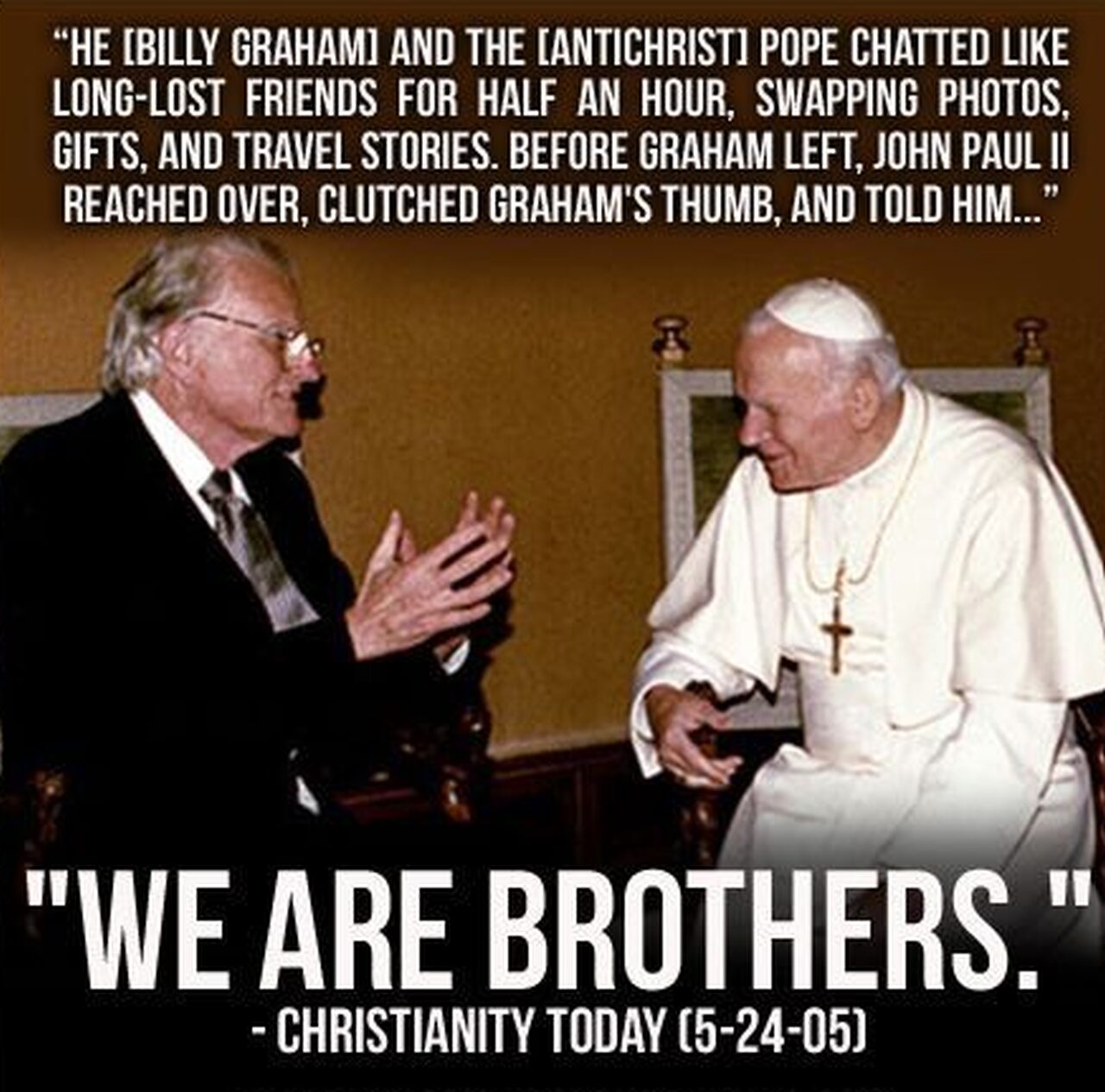
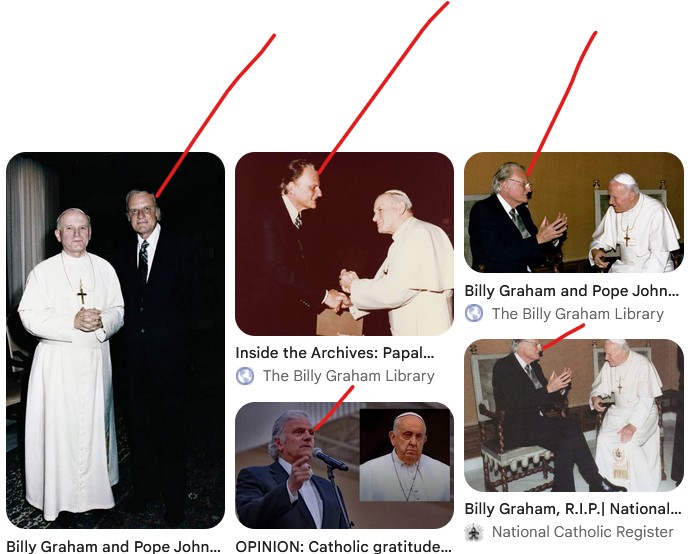
In 1981 he was closeted for almost two hours with Pope John Paul II. After the 1982 New England crusade, thousands of those who went forward for salvation were turned over to Catholic clergy for follow-up.
And this hasn’t changed. Before the Pasadena crusade this year, The Tidings, official newspaper for the Los Angeles diocese, reported that Cardinal Mahony had written to parish priests to encourage their members to attend the crusade.
Crusade officials bragged that they had “a marvelous agreement” with Graham to give all registration cards to the diocese, of the inquirers who identified themselves as Catholic. The object was to “reincorporate Catholic Crusade participants back into full sacramental life in the Catholic Church.” “This is ecumenicity at it finest,” said Alexei Smith, Ecumenical and Interreligious Officer for the archdiocese.
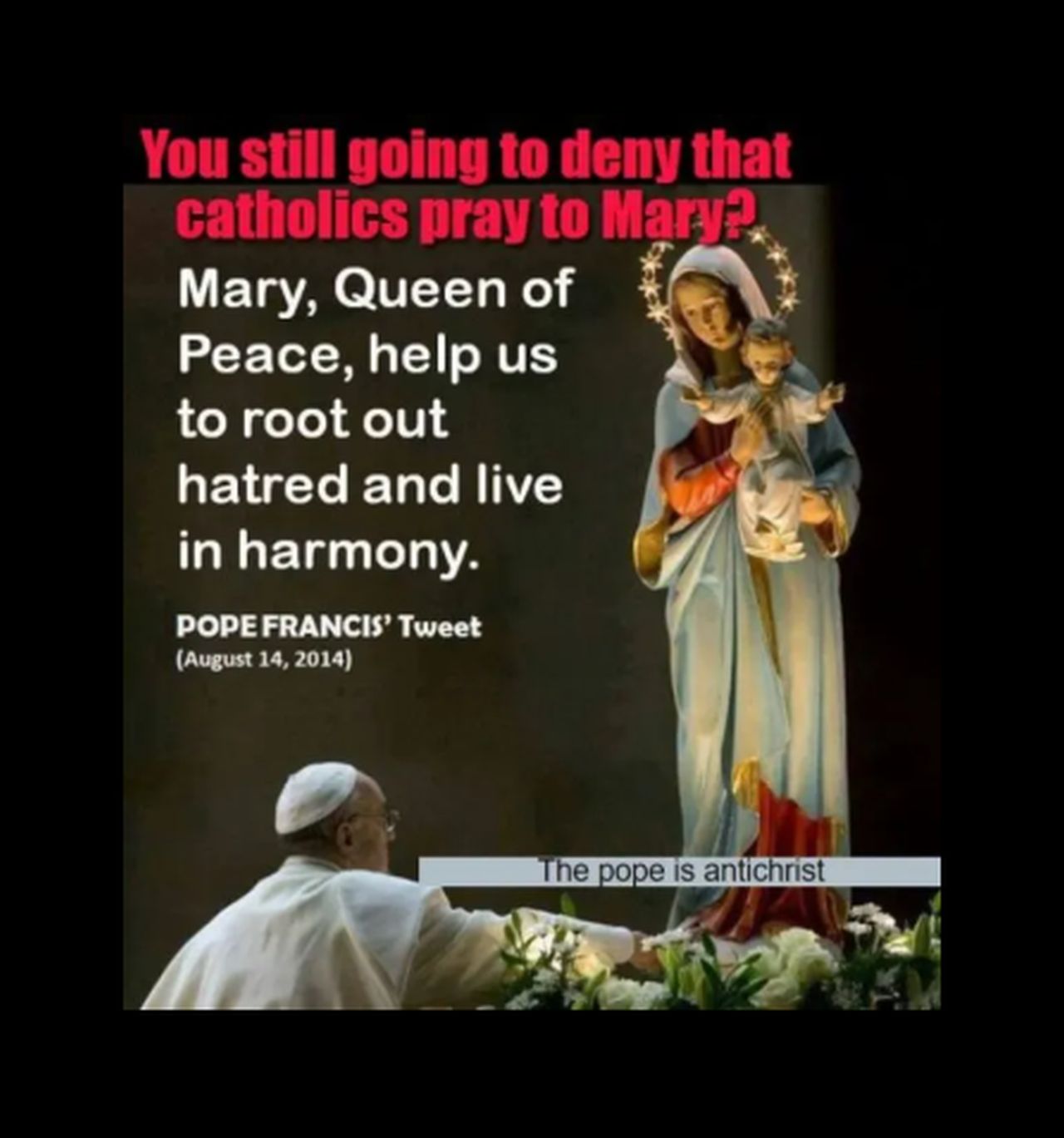
There is no doubt that hundreds of thousands have been swept into the kingdom during the Graham crusades. But how tragic that so many who responded to Graham’s call to salvation were then sent back to the spiritual bondage and pagan rituals of the pope’s prostitute church?
Jack Chick concludes the Smokescreens chapter: “Yes, beloved. Billy Graham, as much as I love him and hate to say it, I believe was cleverly used as a smokescreen and as a pied piper for the whore of Revelation.”
In Graham’s 1952 Pittsburgh crusade, the Pittsburgh Sun-Telegraph reported that Graham said:
“Many of the people who reach a decision for Christ at our meetings have joined the Catholic Church and we have received commendations from Catholic publications for the revived interest in their Church following our campaigns. This happened both in Boston and Washington. After all, one of our prime purposes is to help the churches in a community. If after we move on, the local (sic) churches do not feel the efforts of these meetings in increased membership and attendance, then our crusade would have to be considered a failure.” [Emphasis in the original.]
Did you notice that Graham was only interested in a church’s increased membership-but nothing was said about a person receiving Christ as his or her personal Lord and Savior. This is what is important-not church membership! Church membership could increase a 1000-fold but if people are not being saved, then all is in vain.
Graham also gave a boost to the Catholic Church (in 1952) when he added that he “hoped to hear Bishop Fulton J. Sheen at one of the masses at St. Paul’s Cathedral tomorrow. ” [Emphasis in the original.]
“In 1968, Graham was in a meeting in San Antonio, Texas. He said that the Roman Church had given ‘tremendous cooperation’ in areas where he had held crusades. He added, ‘A great part of our support today comes from Catholics. We never hold a crusade without priests and nuns being much in evidence in the audience.”
By 1973 nuns were singing in the choir at Graham’s crusades.
Continuing on with Graham’s ecumenical outlook, the June 10, 1966 issue of Time said that volunteers “will tactfully receive those stepping forward to make a decision for Christ, [and] steer them to the nearest church of their chosen denomination….”
In Poland in 1978, “Graham taught nuns and priests how to evangelize. A picture taken at the famous Polish Shrine of the Black Madonna shows Graham welcoming pilgrims to the worship of their Virgin.”
Support | STORE | Podcasts | Jail/Prison Ministry | Mexico Mission here | All Ministry Updates | Because You Care Page | Conspiracy is Reality [podcast] | The Prophesied End Times Conspiracy of False Leaders [podcast] | Billy Graham, Paul Washer, James Robison, Jonathan Roumie, Sean Feucht | Catholicism/Ecumenism category | The Dangerous Threat of False Leaders | Antichrists Among Us | Masonic Lodge Exposed | Knowing God | Christology = the Study of Christ
Abiding
“David Encouraged Himself in the LORD his God” [podcast]
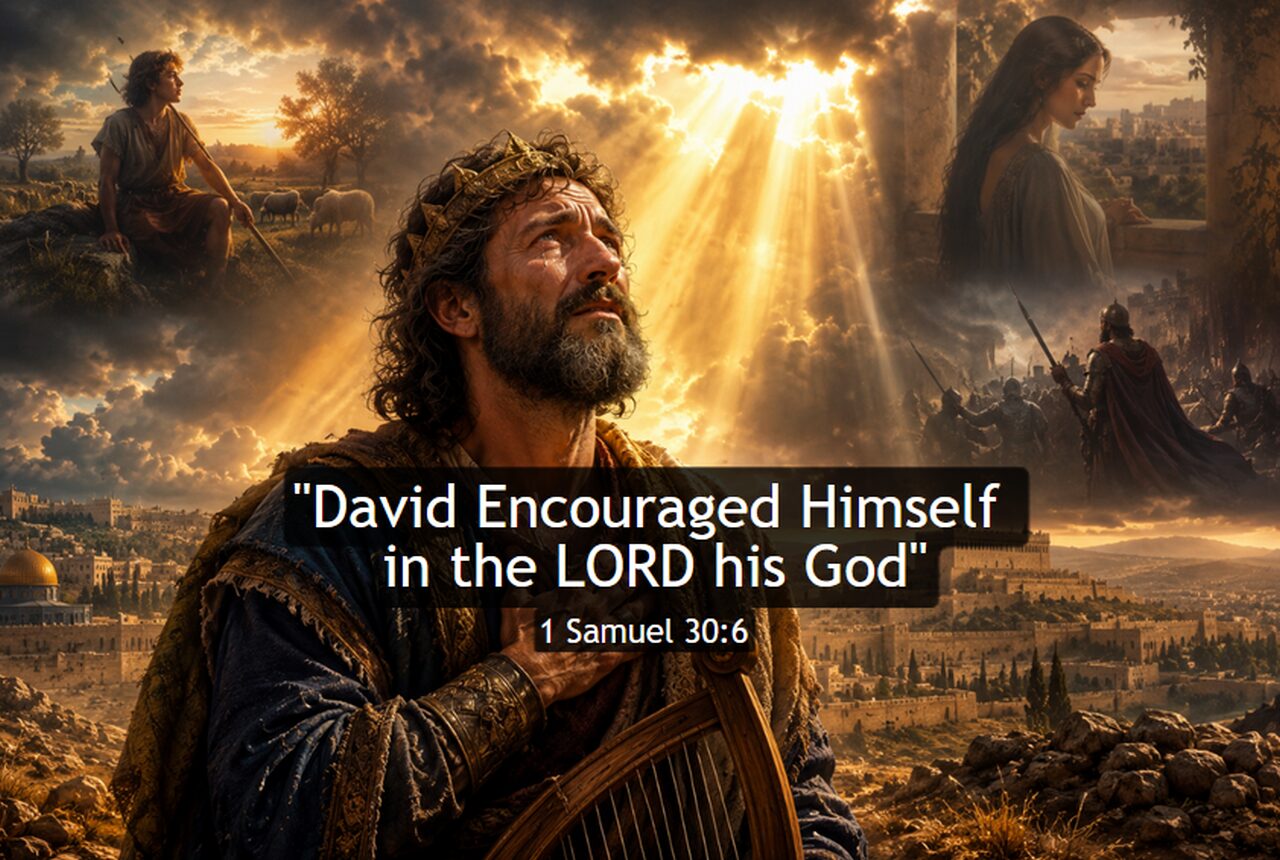
“And David was greatly distressed; for the people spake of stoning him, … but David encouraged himself in the LORD his God.” 1 Samuel 30:6
Gathering from several commentaries on this passage, one source notes the following:
“Faced with the devastating loss of Ziklag and a mutinous army threatening to stone him, David found supernatural resilience. Rather than yielding to panic or despair, he actively turned his focus away from the overwhelming crisis and strengthened his faith directly in God.
Key Context and Lessons
- The Crisis: Amalekite raiders had burned the city and captured all the women and children, including David’s own wives.
- The Breaking Point: His loyal men were now grieving and broken, turning their deep anguish into violent anger against their leader.
- The Shift: David did not look to his men, his own strength, or his circumstances for hope. He preached truth to his own soul, drawing on his past history with God’s faithfulness and inquiring of the Lord for his next steps.
Practical Takeaways
- Self-Talk: When no one else is around to lift you up, you must learn to speak God’s promises to your own heart.
- Refocusing: Encouraging yourself in the Lord means anchoring your identity and security in His unchanging character rather than shifting public opinion.
- Actionable Faith: David’s inward strengthening immediately led to outward action—he sought God’s direction and pursued the enemy, resulting in complete victory and restoration.”
“Confirming the souls of the disciples, and exhorting them to continue in the faith, and that we must through much tribulation enter into the kingdom of God.” Acts 14:22
“In the world ye shall have tribulation”
“These things I have spoken unto you, that in me ye might have peace. In the world ye shall have tribulation: but be of good cheer; I have overcome the world.” John 16:33
During seasons of great stress, this man after God’s own heart sought the LORD. This time only served as a blessing, hastening David to the feet of Christ. Beloved David gave us the most amazing Scriptures concerning seeking God.
“My soul followeth hard after thee.” Psalms 63:8
“As the hart panteth after the water brooks, so panteth my soul after thee, O God. 2 My soul thirsteth for God, for the living God: when shall I come and appear before God?” Psalms 42:1-2
“One thing have I desired of the LORD, that will I seek after; that I may dwell in the house of the LORD all the days of my life, to behold the beauty of the LORD, and to enquire in his temple.” Psalms 27:4
“When thou saidst, Seek ye my face; my heart said unto thee, Thy face, LORD, will I seek.” Psalms 27:8
Prayer: Father in Heaven, in the name of Jesus, please grant me, Your mere servant, to be possessed with a heart after You dear LORD. I love You Jesus. In Jesus’ name. Amen.
Support | STORE | Podcasts | Jail/Prison Ministry | Mexico Mission here | All Ministry Updates | Because You Care Page | Bible/Word of God | The Greatest of these is Charity | Be Ready in the Morning [podcast] | The Sure Mercies of David [podcast] | That Repentance and Remission of Sins should be Preached [podcast] | At His Feet | Prepared to be Used of God | Grace and Truth Bible School [modules] | 7 Study Guides to a Greater Foundation in Christ | Knowing God | The Cross Life | Christology = the Study of Christ








Why We Have Civil Authorities [podcast]

Billy Graham Promoted and Sent People to Go Join the Catholic Church

“David Encouraged Himself in the LORD his God” [podcast]

10 Clues Your Love for God has Waxed Cold [podcast]

More Good News! Mission Mexico Part 42

Why the Apocrypha Isn’t in the Bible

What is the difference between a “Textus Receptus Man” and a “King James Man?”

David’s Farewell Prayer [podcast]

Water Baptism: Understanding It [study guide]

Favorite Eternal Security “Proof” Text? [podcast]

Laboring Fervently for Christ’s Body [podcast]

Abiding Under the Shadow of the Almighty [podcast]

The Warnings of the Book of Jude [podcast]

Attend to My Words [podcast]

Gathering Fruit for Christ’s Eternal Glory [podcast]
10 Clues Your Love for God has Waxed Cold [podcast]

The Damning Myth of Unconditional Eternal Security! [podcast]

Calvinism’s Origins and Historical Roots [podcast]

Name Cult Warning: Beware of the Yahweh, Yahushua, Yahuah Cults!
Favorite Eternal Security “Proof” Text? [podcast]
Water Baptism: Understanding It [study guide]

Dwelling in the Secret Place of the Most High [podcast]
Why the Apocrypha Isn’t in the Bible

Acquaint now thyself with him, and be at peace: thereby good shall come unto thee [podcast]
The Warnings of the Book of Jude [podcast]

Penknife Sacrilege [podcast]
Attend to My Words [podcast]

The Over Population Delusion Exposed [video]

Diminishing Returns or Divine Blessings? [podcast]

Be Not Moved Away from the Hope of the Gospel [podcast]
Why We Have Civil Authorities [podcast]
Billy Graham Promoted and Sent People to Go Join the Catholic Church
“David Encouraged Himself in the LORD his God” [podcast]


 America1 year ago
The Drugging of America: The Pharmakeia Sorcery Deception [podcast]
- Articles2 years ago
Children being Rescued in Tunnels: Happening Now – UPDATE!
- Articles8 years ago
Self-Examination in Preparation for the Lord’s Return
- Apostasy2 years ago
SHOCKING List of False Prophets Most Believe are True