






“This book has shocked me to the core. No wonder the writer warns that ‘if you are not willing to have your Christianity seriously examined do not read this book. Spare yourself the trouble of having your Christian life turned upside down!’ Wow. I think this book just took my Christianity to a whole new level of understanding! I am shell shocked that I did not know any of this. Every Christian should read this book. If they dare.” Karen Cochran
Pagan Christianity by Frank Viola and George Barna
“The Christian faith was born in believer’s homes, yet every Sunday morning, scores of Christians sit in a building with pagan origins that is based upon Pagan Philosophy”.
“We somehow have been taught to feel holier when we are in ‘the house of God’ and have inherited a pathological dependency upon edifice to carry out our worship to God”.
“We are doing great damage to the message of the New testament by calling man made buildings ‘churches’.
“The order of worship includes threefold structure: (1) singing, (2) the sermon, and (3) closing prayer or song. This order of worship is viewed as sacrosanct in the eyes of many present-day Christians. But why? Again, it is due simply to the titanic power of tradition. And that tradition has set the Sunday morning order of worship in concrete … never to be moved”.
“As Will Durant, author of The Story of Civilization put it, Pagan isles remained in the spreading Christian sea. This was a tragic shift from the primitive simplicity that the church of Jesus Christ first knew”.
“We so easily forget that the early Christians turned the world upside down without them”.
“Our study of the liturgical history of the Lutheran (sixteenth century), Reformed (sixteenth century), Puritans (sixteenth century), Methodists (eighteenth century), Frontier-Revivalists (eighteenth to nineteenth centuries), and Pentecostals (twentieth century) uncovers one inescapable point: For the last five hundred years, the Protestant order of worship has undergone minimal change”. Pg.73 .
“As one author put it, ‘The Reformers accepted in substance the ancient Catholic pattern of worship…the basic structures of their services were almost universally taken from the late medieval orders of various sorts'”. pg 74
“In the end, then, the Reformers reformed the Catholic liturgy only slightly. Their main contribution was in changing the central focus. In the words of one scholar, ‘Catholicism increasingly followed the path of the (pagan) cults in making a rite the center of its activities, and Protestantism followed the path of the synagogue in placing the book at the center of it’s services’. Unfortunately, neither Catholics nor Protestants were successful in allowing Jesus Christ to be the center and head of their gatherings. Nor were they successful at liberating and unleashing the body of Christ to minister one to another in the gathering, as the New Testament envisions”. pg 74
“Because of the Reformation the Bible replaced the Eucharist and the Pastor replaced the priest. But there is still a directing of God’s people, rendering them as silent spectators. The centrality of the Author of the book was never restored. Hence, the Reformers dramatically failed to put their finger on the nerve of the original problem: a clergy-led worship service attended by a passive laity. It is not surprising, then, that the Reformers viewed themselves as reformed Catholics”. pg. 74
“Not only is the traditional order of service unscriptural and heavily influenced by paganism (which runs contrary to what is often preached from the pulpit), it does not lead to the spiritual growth God intended”. pg 75
“The Protestant order of worship represses mutual participation and growth of Christian community. It puts a choke hold on the functioning of the body of Christ by silencing its members. There is absolutely no room for anyone to give a word of exhortation, share an insight, start or introduce a song, or spontaneously lead a prayer. You are forced to be a muted, staid pew holder! You are prevented from being enriched by the other members of the body as well as being able to enrich them yourself”. pg 75
The Protestant order of worship strangles the headship of Jesus Christ. The entire service is directed by one person. You are limited to the knowledge, gifting, and experience of one member of the body- the Pastor. Where is the freedom for our Lord Jesus to speak through his body at will? Where in the liturgy may God give a brother or sister a word to share with the whole congregation? The order of worship allows for no such thing. Jesus Christ has no freedom to express Himself through His body at his discretion. He too is rendered a passive spectator”. pg 76
“Every Sunday you attend the service to be bandaged and recharged like all the other wounded soldiers. Far to often, however, the bandaging and the recharging never takes place. The reason is quite simple. The New Testament never links sitting through an ossified ritual that we mislabel “church” as having anything to do with spiritual transformation. We grow by functioning, not by passively watching and listening”. pg 77
“Let’s face it. The Protestant order of worship is largely unscriptural, impractical, and unspiritual. It has no analog in the New Testament. Rather, it finds its roots in the culture of fallen man. It rips at the heart of primitive Christianity, which was informal and free of ritual. Five centuries after the Reformation, the Protestant order of worship still varies little from Catholic Mass-a Religious ritual that is a fusion of pagan and Judaistic elements” pg. 77
“In fact, when the church functions as she should, she is the greatest evangelism known to humankind. When God’s people are living in authentic community, their lives together are a sign to the world of God’s coming reign”. pg. 82
“Remove the sermon and you have eliminated the most important source of spiritual nourishment for countless numbers of believers (so it is thought). Yet the stunning reality is that today’s sermon has no root in Scripture. Rather, it was borrowed from pagan culture, nursed and adopted into the Christian faith”. pg. 86
“The New Testament letters show that ministry of God’s Word came from the entire church in their regular gatherings. From Romans 12: 6-8, 15: 14, 1 Corinthians 14:26, and Colossians 3:16, we see that it included teaching, exhortation, prophecy, singing, and admonishment. This “every-member” functioning was also conversational (1 Corinthians 14:29) and marked by interruptions (1 14:30). Equally so, the exhortation of the local elders were normally impromptu.
In Short, the contemporary sermon delivered for Christians consumption is foreign to both Old and New Testaments. There is nothing in Scripture to indicate it’s existence in the early Christian gatherings”. pg. 88
“The Christian sermon was borrowed from the pagan pool of Greek culture”! pg. 89
“The sermon was conceived in the womb of Greek rhetoric. It was born into the Christian community when pagans-turned-Christians began to bring their oratorical styles of speaking into the church. By the third century, it became common for Christian leaders to deliver a sermon. By the fourth century it became the norm”. pg.101
“Nevertheless, despite the fact that the contemporary sermon does not have a shred of biblical merit to support it’s existence, it continues to be uncritically admired in the eyes of most present-day Christians. It has become so entrenched in the Christian mind that most Bible-believing pastors and Laymen fail to see that they are affirming and perpetuating an unscriptural practice out of sheer tradition. The sermon has become permanently embedded in a complex organizational structure that is far removed from the first-century church life”. pg. 102
“The first-century church planters had a deep and profound revelation(or insight) of Jesus Christ. They knew him, and they knew him well. He was their life, their breath, and their reason for living. They, in turn, imparted that same revelation to the churches they planted. John 1: 1-3 is a good example of this dynamic .
Paul of Tarsus preached a message of Christ that was so profound that it caused immoral, blood-drinking pagans to become full-fledged Christians in love with Jesus Christ in just a few short months. (These new believers made up the churches of Pisidian, Antioch, Iconium, Lystra, Derbe, Philippi, Thessalonica, and Berea (Acts13-17). Paul shared the depths of Christ with them in such a way that they knew that they were holy in His eyes and that they could know Him internally, for Christ indwelt them. This profound, personal understanding of the indwelling Christ affected how they gathered together and what they did in those gatherings.
Furthermore, Paul typically spent several months with these new converts then left them on their own for long periods of time, sometimes years. And when he returned, they were still gathering together, still loving one another, and still following their Lord.
What kind of gospel did he preach to cause this kind of remarkable effect? He called it “the unsearchable riches of Christ” (Ephesians 3:8) To put it another way, he submerged them in a revelation of Jesus Christ”. pg.103
“THE PASTOR. He is the fundamental figure of the Protestant faith. So prevailing is the pastor in the minds of most Christians that he is often better known, more highly praised, and more heavily relied upon than Jesus Christ himself!
Remove the pastor and most Protestant churches would be thrown into a panic. Remove the pastor, and Protestantism as we know it would die. The pastor is the dominating focal point, mainstay, and centerpiece of the contemporary church. He is the embodiment of Protestant Christianity”. pg. 106
“With the fall came an implicit desire in people to have a physical leader to bring them to God. For this reason, human societies throughout history have consistently created a special caste of revered Religious leaders. The medicine man, the shaman, the rhapsodist, the miracle worker, the witch doctor, the soothsayer, the wise man, and the priest have all been with us since Adam’s blunder. And this person is always marked by special training, special garb, a special vocabulary, and special way of life”. pg.108
“Up until the second century, the church has no official leadership. That it had leaders is without dispute. But leadership was unofficial in the sense that there were no religious “offices” or sociological slots to fill. New Testament scholarship makes this abundantly clear.
In this regard, the first-century churches were an oddity indeed. They were religious groups without priests, temple, or sacrifice. The Christians themselves led the church under Christ’s direct headship. Leaders were organic, untitled, and were recognized by their service and spiritual maturity rather than by a title or an office.
Among the flock were the elders(shepherds or overseers). These men all had equal standing. There was no hierarchy among them. Also present were extra-local workers who planted churches. These were called the “sent ones” or apostles. But they did not take up residency in the churches for which they cared. Nor did they control them. The vocabulary of the New Testament leadership allows no pyramidal structures. It is rather a language of horizontal relationships that includes exemplary action”. pg.110
“Because the presbyters were the ones administering the Lord’s Supper, they began to be called priests. More startling, the bishop came to be regarded as the high priest who could forgive sins! All of these trends obscured the New Testament reality that all believers are priests unto God.
By the fourth century, this graded hierarchy dominated the Christian faith. The clergy caste was now cemented. At the head of the church stood the bishop. Under him was the college of presbyters. Under them stood the deacons. And under all of them were the Laymen. One-bishop rule became the accepted form of church government throughout the Roman Empire. (During this time, certain churches began to exercise authority over other churches-thus broadening the hierarchical structure)”. pg.115
“Strikingly, only three passages in the New Testament tell us that elders were publicly recognized. Elders were acknowledged in the churches in Galatia (Acts 14: 23). Paul had Timothy acknowledge elders in Ephesus (1 Timothy 3:1ff). He also told Titus to recognize them in the churches in Crete (Titus 1:5ff).
The word ordain (KJV) in these passages does not mean to place into office. It rather carries the idea of endorsing, affirming, and showing forth what has already been happening. It also conveys the thought of blessing. Public recognition of elders and ministries was typically accompanied by the laying on of hands by apostolic workers. (In the case of workers being sent out, this was done by the church or the elders).
In the first century, the laying on of hands merely meant the endorsement or affirmation of function, not the installment into an office or the giving of special status. Regrettably, it came to mean the latter in the late second and early third centuries.
During the third century, ordination took on an entirely different meaning. It was a formalized Christian rite. By the fourth century, the ceremony of ordination was embellished by the symbolic garments and solemn ritual. Ordination produced an ecclesiastical caste that usurped the believing priesthood.
From where did Christians get their pattern of ordination? They patterned their ordination ceremony after the Roman custom of appointing men to civil office. The entire process, down to the very words, came straight from the Roman civic world”. pgs.124-125
“The contemporary practice of ordination creates a special caste of Christian. Whether it be the priest in Catholicism or the pastor in the Protestantism, the result is still the same: The most important ministry is restricted to a few”special” believers.
Such an idea is as damaging as it is nonscriptural. The New Testament nowhere limits preaching, baptizing, or distributing the Lord’s Supper to the “ordained”. Eminent scholar James D. G. Dunn put it best when he said that the clergy-laity tradition has done more to undermine New Testament authority than most heresies.
Since church office could only be hold through the rite of ordination, the power to ordain became the crucial issue in holding religious authority. The biblical content was lost. And proof-texting methods were used to justify the clergy/laity hierarchy. Perhaps the best-known example is the early Catholics’ use of Matthew 16 to justify the creation of a papal system and the doctrine of apostolic succession. The result: Ordinary believers, generally uneducated and ignorant, were at the mercy of a professional clergy”. pg.127
“The New Testament word for minister is diakonos. It means ‘servant’. But this word has been distorted because men have professionalized the ministry. We have taken the word minister and equated it with the pastor, with no scriptural justification whatsoever. In like manner, we have mistakenly equated preaching and ministry with pulpit, sermon, again without biblical justification”. pg.136
“The unscriptural clergy/laity distinction has done untold harm to the body of Christ. It has divided the believing community into first and second-class Christians. The clergy/laity dichotomy perpetuates an awful falsehood-namley, that some Christians are more privileged than others to serve the Lord.
The one-man ministry is entirely foreign to the New Testament, yet we embrace it while it suffocates our functioning. We are living stones, not dead ones. However, the pastoral office has transformed us into stones that do not breathe.
Permit us to get personal. We believe the pastoral office has stolen your right to function as a full member of Christ’s body. It has distorted the reality of the body, making the pastor a giant mouth and transforming you into a tiny ear. It has rendered you a mute spectator who is proficient at taking sermon notes and passing an offering plate.
But that is not all. The modern-day pastoral office has overthrown the main thrust of the letter to the Hebrews-the ending of old priesthood. It has made ineffectual the teaching of 1 Corinthians 12-14, that every member has both the right and the privilege to minister in a church meeting. It has voided the message of 1 Peter 2 that every brother and sister is a functioning priest”. pg. 136
“But there is something more. The contemporary pastorate rivals the functioning headship of Christ in his church. It illegitimately holds the unique place of centrality and headship among God’s people, a place that is reserved for only one Person-the Lord Jesus. Jesus Christ is the only head over a church and the final word to it. By his office, the pastor displaces and supplants Christ’s headship by setting himself up as the church’s human head”. pg. 137
“The contemporary pastor is the most unquestioned fixture in the twenty-first century Christianity. Yet not a strand of Scripture supports the existence of this office.
Rather, the present-day pastor was born out of the single-bishop rule first spawned by the Ignatius and Cyprian. The bishop evolved into the local presbyter. In the Middle Ages, the presbyter grew into the the Catholic priest. During the Reformation, he was transformed into the “preacher”, “the minister”, and finally “the pastor”-the person upon whom all of the Protestantism hangs. To boil it down to one sentence: The Protestant pastor is nothing more than a slightly reformed Catholic priest. (Again, we are speaking of the office and not the individual.)
Catholic priests had seven duties at the time of the Reformation: preaching; the sacraments; prayers for the flock; a disciplined, godly life; church rites; supporting the poor; and visiting the sick. The Protestant pastor takes upon himself all of these responsibilities-plus he sometimes blesses civic events.
The famed poet John Milton put it best when he said, “New presbyter is but old priest writ large!” In other words, the contemporary pastor is but an old priest written in large letters! ” pg. 141
“Leading up to the sermon, those who “lead worship” select the songs that are to be sung. They begin those songs. They decide how those songs are to be sung. And they decide when those songs are over. Those sitting in the audience in no way, shape, or form lead the singing. They are led by someone else who is often part of the clerical staff-or who has similar stature.
This is in stark contrast to the first-century way. In the early church, worship and singing were in the hands of all of God’s people. The church herself led her own songs. Singing and leading songs was a corporate affair, not a professional event led by specialists”. pg. 158
“In 1962, a group of dissatisfied British church musicians in Dunblane, Scotland, tried to revitalize traditional Christian songs. Led by Congregational minister Erik Routley, these artists were influenced by Bob Dylan and Sydney Carter. George Shorney Jr.of Hope Publishing Company brought their new style to the United States. These new Christian hymns were a reform, but not a revolution. The revolution came when rock and roll was adapted into Christian music with the coming of the Jesus movement. This reform set the stage for the revolutionary musical changes to take root in the Christian church through Calvay Chapel and the Vineyard.
The origin of the worship team goes back to the founding Calvary Chapel in 1965. Chuck Smith, the founder of the denomination, started a ministry for hippies and surfers. Smith welcomed the newly converted hippies to retune their guitars and play their now redeemed music in church. He gave the counterculture a stage for their music in church .He gave the counterculture a stage for their music-allowing them to play Sunday night performances and concerts. The new musical forms began to be called “praise and worship”. As the Jesus movement began to flourish, Smith founded the record company Maranatha Music in the early 1970s. It’s goal was to distribute the songs of these young artists.
In due time, the guitar replaced the organ as the central instrument that led worship in the Protestant church. Although patterned after the rock concert of secular culture, the worship team has become as common as the pulpit”. pg. 166
“I (Frank) am no theoretician. For almost twenty years I have gathered with churches where every member has been trained to start a song spontaneously. Imagine: Every brother and sister free to lead songs under the headship of Jesus Christ-even to write his or her own songs and bring them to the meeting for all to learn. I have met with numerous churches that have experienced this glorious dynamic. Someone starts a song and everyone joins in. Then someone else begins another song, and so worship continues without long pauses and with no visible leader present.
This is exactly how the first-century Christians worshipped, by the way. Yet it is a rare experience in the modern-day institutional church. The good news is that it is possible and available for all who wish to experience Christ’s headship through song in a church meeting. The singing in such churches is intensely corporate rather than individualistic and subjective”. pg 167
“Tithing is mentioned only four times in the New Testament. But none of these instances apply to Christians. Tithing belonged to the Old Testament era where a taxation system was needed to support the poor and a special priesthood that had been set apart to minister to the Lord. With the coming of Jesus Christ, there has been a “change of the law”-the old has been “set aside” and rendered obsolete by the new (Hebrews 7:12-18, 8:13
We are all priests now-free to function in God’s house. The law, the old priesthood, and the tithe have all been crucified. There is now no Temple curtain, no Temple tax and no special priesthood that stands between God and man. You have been set free from the bondage of tithing and from the obligation to support the umbilical clergy system. May you, like the first-century Macedonian Christians, give freely, out of a cheerful heart, without guilt, religious obligation, or manipulation… generously helping those in need (2 Corinthians 8:1-4; 9:6-7)”. pg. 183
“In the early church, converts were baptized immediately upon believing. One scholar says of baptism and conversion, “They belong together. Those who repented and believed the Word were baptized. That was the invariable pattern, so far as we know.” Another writes “At the birth of the church, converts were baptized with little or no delay.”
In the first century, water baptism was the outward confession of a person’s faith. But more than that, it was the way someone came to the Lord. For this reason, the confession of baptism is vitally linked to the exercise of saving faith. So much so that the New Testament writers often use baptism in place of the word faith and link it to being “saved”. This is because baptism was the early Christian’s initial confession of faith in Christ.
Baptism accompanied the acceptance of the gospel. For example, when Lydia heard Paul preach the gospel, she believed and was immediately baptized with her household (Acts 16:14-15). In the same way, when Paul led the Philippian jailor and his household to the Lord, they were immediately baptized (Acts 16:30-33). This was the New Testament pattern (see Acts 2:41, 8:12, 35-37). Baptism marked a complete break with the past and full entrance into Christ and His church. Baptism was simultaneously an act of faith as well as an expression of faith.” pgs. 188-189.
“Through our tradition, we have evacuated the true meaning and power behind water baptism. Properly conceived and practiced, water baptism is the believer’s initial confession of faith before men, demons, angels, and God. Baptism is a visible sign that depicts our separation from the world, our death with Christ, the burial of our old man, the death of the old creation, and the washing of the Word of God.
Water baptism is the New Testament form of conversion-initiation. It is God’s idea. To replace it with the human-invented sinners prayer is to deplete baptism of its God-given testimony.
In the same vein , the Lord’s Supper, when separated from its proper context of full meal, turns into a strange, pagan-like rite.The supper has become an empty ritual officiated by a clergyman, rather than a shared-life experience enjoyed by the church. It has become a morbid religious exercise, rather than a joyous festival-a stale individualistic ceremony, rather than a meaningful cooperate event.
As one scholar put it, “It is not in doubt that the Lord’s Supper began as a family meal or meal of friends in a private house… the Lord’s Supper moved from being a real meal into being a symbolic meal…the Lord’s Supper moved from bare simplicity to elaborate slender…the celebration of the Lord’s Supper moved from being a lay function to a priestly function. In the New Testament itself, there is no indication that it was the special privilege or duty of anyone to lead the worshipping fellowship in the Lord’s Supper”. pgs 196-197
“In the minds of most Christians, formal Christians education qualifies a person to do the Lord’s work. Unless a Christian has graduated from Bible College or seminary, he or she is viewed as being a “para”-minister. A pseudo Christian worker. Such a person cannot preach, teach, baptize, or administer the Lord’s Supper since he or she has not been formally trained to do such things…right?
The idea that a Christian worker must attend Bible college or seminary to be legitimate is deeply ingrained-so much so that when people feel a “call” of God on their lives, they are conditioned to begin hunting for a Bible College or seminary to attend
Such thinking fits poorly with the early Christian mind-set. Bible colleges, seminaries, and even Sunday Schools were utterly absent from the early church. All are human innovations that came hundreds of years after the Apostles’ death.
How, then, were Christian workers trained in the first century if they did not go to a religious school? Unlike today’s ministerial training, first-century training was hands-on, rather than academic. It was a matter of apprenticeship, rather than of intellectual learning. It was aimed primarily at the spirit, rather than at the frontal lobe.
In the first century, those called to the Lord’s work were trained in two ways:(1) They learned the essentials lessons of Christian ministry by living a shared life with a group of Christians. In other words, they were trained by experiencing body life as nonleaders. (2) They learned the Lord’s work under the tutelage of an older, seasoned worker.” pgs.199-200
“The teaching of the New Testament is that God is Spirit, and as such, He is known by revelation ( spiritual insight) to one’s human spirit. Reason and intellect can cause us to know about God. And they help us to communicate what we know. But they fall short in giving us spiritual revelation. The intellect is not the gateway for knowing the Lord deeply. Neither are emotions. In the words of A.W.Tozer: “Divine truth is of the nature of the spirit and for that reason can be only by spiritual revelation…God’s thoughts belong to the world of spirit, man’s to the world of intellect, and while spirit can embrace intellect, the human intellect can never comprehend spirit.
…Man by reason cannot know God; he can only know about God.
… Man’s reason is a fine instrument and useful within its field. It was not given as an organ by which to know God.” pg. 206
“Instead of offering the cure to the ills of the church, our theological schools worsen them by assuming ( and even defending) all of the unscriptural practices that produce them.
The words of one pastor sum up the problem nicely: “I came through the whole system with the best education that evangelicalism had to offer-yet I really didn’t receive the training that I needed… seven years years of higher education in top-rated evangelical schools didn’t prepare me to (1) do ministry and (2) be a leader. I began to analyze why I could preach a great sermon and people afterwards would shake my hand and say, ‘Great Sermon, Pastor.’ But these were the very people who were struggling with self-esteem, beating their spouses, struggling as workaholics, succumbing to their addictions. Their lives weren’t changing. I had to ask myself why this great knowledge I was presenting didn’t move from their
heads to their hearts and their lives. And I began to realize that breakdown in the church was actually based on what we learned in seminary. We were taught that if you just give people information, that’s enough!” pg. 218
“WHY IS IT THAT WE CHRISTIANS can follow the same rituals every Sunday without ever noticing that they are at odds with the New Testament? The incredible power of tradition has something to do with it As we have seen, the church has often been influenced by the surrounding culture, seemingly unaware of it’s negative effects. At other times, it has, quite properly, recognized overt threats- such as heretical teachings about the person and divinity of Jesus Christ. But in an effort to combat those threats, it has moved away from the organic structure that God wrote into the church’s DNA .
But there is something else- something more fundamental that most Christians are completely unaware of. It concerns our New Testament. The problem is not in what the New Testament says. The problem is in how we approach it.
The approach most commonly used among contemporary Christians when studying the Bible is called “proof texting”. The origin of proof texting goes back to the 1590s. A group of men called Protestant scholastics took the teachings of the Reformers and systematized them according to the rules of Aristotelian logic.
The Protestant scholastics held that not only is the Scripture the Word of God, but every part of it is the Word of God in and of itself-irrespective of context. This set the stage for the idea that if we lift a verse out of the bible, it is true in it’s own right and can be used to prove a doctrine or a practice.
When John Darby emerged in the mid-1800s, he built a theology based on this approach. Darby raised proof texting to an art form. In fact, it was Darby who gave fundamentalist and evangelical Christians a good deal of their presently accepted teachings. All of them are built on the proof-texting method. Proof texting, then, became the common way that we contemporary Christians approach the Bible.
As a result, we Christians rarely, if ever, get to see the New Testament as a whole. Rather, we are served up a dish of fragmented thoughts that are drawn together by means of fallen human logic. The fruit of this approach is that we have strayed far afield from the practice of the New Testament church. Yet we still believe we are being biblical”. pgs 222-223
“Seminaries and Bible college students alike are rarely if ever given a panoramic view of the free-flowing story of the early church with the New Testament books arranged in chronological order. As a result, most Christians are completely out of touch with the social and historical events that lay behind each of the New Testament letters Instead, they have turned the New Testament into a manual that can be wielded to prove any point. Chopping the Bible up into fragments makes this relatively easy to pull off.
.We Christians have been taught to approach the Bible in one of eight ways. See how many that apply to you, you can tick off with a pencil:
.You look for verses that inspire you. Upon finding such verses, you either highlight, memorize, meditate upon, or put them on your refrigerator door.
.You look for verses that tell you what God has promised so that you can confess it in faith and thereby obligate the Lord to do what you want.
.You look for verses that tell you what God commands you to do
.You look for verses that you can quote to scare the devil out of his wits or resist him in the hour of temptation..
.You look for verses that will prove your particular doctrine so that you can slice and dice your theological sparring partner into biblical ribbons. (Because of the proof-texting method, a vast wasteland of Christianity behaves as if the mere citation of some random, decontextualized verses of Scripture ends all discussion on virtually any subject).
.You look for verses in the bible to control and /or correct others.
. You look for verses that “preach” well and make good sermon material. (This is an ongoing addiction for many who preach and teach).
.You somethimes close your eyes, flip open the bible randomly, stick your finger on a page, read what the text says, and then take what you have read as a personal “word” from the Lord.
Now look at the list again.Which of these approaches have you used? Look again: Notice how each is highly individualistic. All of them put you, the individual Christian, at the center. Each approach ignores the fact that most of the New Testament was written to corporate bodies of people (churches), not to individuals.
But that’s not all. Each of those approaches is built on isolated proof texting. Each treats the New Testament like a manual and blinds us to its real message. It is no wonder that we can approvingly nod our heads at paid pastors, the Sunday morning order of worship, sermons, church buildings, religious dress, choirs, worship teams, seminaries, and a passive priesthood all without wincing.
We have been taught to approach the Bible like a jigsaw puzzle. Most of us have never been told the entire story that lies behind the letters that Paul, Peter, James, John, and Jude wrote. We have been taught chapters and verses, not the historical context.
For instance, have you ever been given the story behind Paul’s letter to the Galatians? Before nodding, see if you can answer these questions off the top of your head: Who were the Galatians? What were their issues? When and why did Paul write to them? What happened just before Paul penned his Galatian treatise? Where was he when he wrote it? What provoked him to write the letter? And where in Acts do you find the historical context for his letter? All of these background matters are indispensable for understanding what our New Testament is about. Without them, we simply cannot understand the Bible clearly or properly”. pgs. 229-231
“What do we mean by first-century styled church? It is group of people who know how to experience Jesus Christ and express Him in a meeting without any human officiation. Such a group of people can function organically together as a body when they are left on their own after the church planter leaves them. ( This does not mean that church planters never return. There are many times when they are needed to help the church. But after planting a church, church planters should be absent more than they are present.)
The one who plants a first-century styled church leaves that church without a pastor, elders, a music leader, a Bible facilitator, or a Bible teacher. If that church is planted well, those believers will know how to sense and follow the living, breathing headship of Jesus Christ in a meeting. They will know how to let Him invisibly lead their gatherings. They will bring their own songs, they will write their own songs, they minister out of what Christ has shown them-with no human leader present! What is described here is not an armchair philosophy. I (Frank) have worked with churches that fit this bill.
To equip people to do that takes a lot more than opening up your house and saying, “Come, let’s have Bible study”. pg. 234
“Unlike Christians today, the early Christians did not share Christ out of guilt, command, or duty. They shared Him because He was pouring out of them, and they could not help it! It was a spontaneous, organic thing-born out of life, not guilt.” pg.237
“We do well to pay attention to the way that churches were raised up in the first century. I believe that scripture holds for us enduring principles on this score. If you count all the churches mentioned in the New Testament, you’ll find about thirty-five. Everyone of them was planted or aided by a traveling church planter who preached only Christ. There were no exceptions. The church was raised up as a result of the apostolic presentation of Jesus Christ.” pg. 238
“Jesus was never a rabble-rouser nor a ranting rebel (Matthew 12:19-20). Yet He constantly defied the traditions of the scribes and Pharisees. And He did not do so by accident, but with great deliberation. The Pharisees were those who, for the sake of the “truth” as they saw I, tried to extinguish the truth they could not see. This explains why there was always a blizzard of controversy between the ‘tradition of the elders’ and the acts of Jesus.
Someone once said that ‘a rebel attempts to change the past; a revolutionary attempts to change the future’. Jesus Christ brought drastic change to the world. Change to man’s view of God …. Change to men’s view of women. Our Lord came to bring radical change to the old order of things, replacing it with a new order. He came to bring forth a new covenant – a new Kingdom – a new birth – a new race – a new species – a new new culture – and a new civilization.
As you read through the Gospels, behold your Lord, the Revolutionary. Watch him throw the Pharisees into a panic by intentionally flaunting their conventions. Numerous times Jesus healed on the Sabbath day, flatly breaking their cherished traditions. If the Lord wanted to placate His enemies, He could have waited until Sunday or Monday to heal some of these people. Instead, he deliberately healed on the Sabbath, knowing full well it would make His opponents livid.
This pattern runs deep. In one instance, Jesus healed a blind man by mixing clay with spittle and putting it in the man’s eyes. Such an act was in direct defiance of the Jewish ordinance that prohibited healing on the Sabbath by mixing mud with Spittle! Yet your Lord intentionally shattered this tradition publicly and with absolute resolve .Watch Him eat food with unwashed hands under the judgmental gaze of the Pharisees, again intentionally defying their fossilized tradition.
In Jesus we have a man who refused to bow to the pressures of religious conformity. A man who preached a revolution. A man who would not tolerate hypocrisy. A man who was not afraid to provoke those who suppressed the liberating gospel He brought to set men free. A man who did not mind evoking anger in His enemies, causing them to gird their thighs for battle”. pgs 244- 246
“For most Christians, this is a side of Jesus Christ they have never known before. Yet we believe it explains why exposing what is wrong with the contemporary church so that Christ’s body can fulfill God’s ultimate intention is so critical. It is simply an expression of our Lord’s revolutionary nature. The dominating aim of the nature is to put you and me at the center of the beating heart of God. To put you and me in the core of His eternal purpose – a purpose for which everything was created.
The early church understood that purpose. They not only understood God’s passion for His Church, they lived it out. And what did such body life look like?
- The early Christians were intensely Christ-centered. Jesus Christ was their pulse beat. He was their life, their breath, and their central point of reference. He was the object of their worship, the subject of their songs, and the content of their discussion and vocabulary. The New Testament church made the Lord Jesus Christ Central and supreme in all things.
- The New Testament church had no fixed order of worship. The early Christians gathered in open-participatory meetings where all believers shared their experience of Christ, exercised their gifts, and sought to edify one another. No one was a spectator. All were given the privilege and the responsibility to participate. The purpose of these church meetings was twofold. It was for the mutual edification of the body. It was also to make visible the Lord Jesus Christ through the every-member functioning of His body. The early church meetings were not religious “services”. They were informal gatherings that were permeated with an atmosphere of freedom, spontaneity, and joy. The meetings belonged to Jesus Christ and to the church; they did not serve as platform for any particular ministry or gifted person.
- The New Testament church lived as a face-to-face community. While the early Christians gathered for corporate worship and mutual edification, the church did not exist to merely meet once or twice a week. The New Testament believers lived a shared life. They cared for one another outside of scheduled meetings. They were, in the very real sense of the word, family.
- Christianity was the first and only religion the world has ever known that was void of ritual, clergy, and sacred buildings. For the first 300 years of the Church’s existence, Christians gathered in homes. On special occasions, Christian workers would sometimes make use of larger facilities (like Solomon’s Porch) {John 10:23, Acts 3:11} and the Hall of Tyrannus {Acts 19:9}. But they had no concept of a scared edifice nor of a spending large amounts of money on buildings. Nor would they ever call a building a “church” or the “house of God.” The only sacred building the early Christians knew was the one not made with human hands.
- The New Testament church did not have a clergy. The Catholic priest and the Protestant pastor were completely unknown. The church had traveling apostolic workers who planted and nurtured churches. But these workers were not viewed as being part of the a special clergy caste. They were part of the body of Christ, and they served the churches (not the other way around). Every Christian possessed different gifts and different functions, but only Jesus Christ had the exclusive right to exercise authority over his people. No man had that right. Eldering and Shepherding were just two of those gifts. Elders and Shepherds were ordinary Christians with certain gifts. They were not special offices. And they did not monopolize the ministry of the church meetings. They were simply seasoned Christians who naturally cared for the members of the church during times of crisis and provided oversight for the whole assembly.
- Decision making in the New Testament church fell upon the shoulders of the whole assembly. Traveling church planters would sometimes give input and direction. But ultimately, the whole church made decisions under the lordship of Jesus Christ. It was the church’s responsibility to find the Lord’s mind together and act accordingly.
- The New Testament church was organic, not organizational. It was not welded together by putting people into offices, creating programs, constructing rituals, and developing a top-down hierarchy or chain-of-command structure. The church was a living, breathing organism. It was born, it would grow, and it naturally produced all of what was in its DNA. That would include all the gifts, ministries, and functions of the body of Christ. In the eyes of God, the church is a beautiful woman. The bride of Christ. She was a colony from heaven, not a man-made organization from earth.
- Tithing was not a practice of the New Testament church. The early Christians used their funds to support the poor among them, as well as the poor in the world. They also supported traveling itinerant church planters so that the gospel could be spread and churches could be raised up in other lands. They gave according to their ability, not out of guilt, duty, or compulsion. Pastor/clergy salaries were unheard of. Every Christian in the church was a priest, a minister, and a functioning member of the body. (elders who labour in the word and doctrine to feed and equip Christ’s sheep are to be thought worthy of “double honour” which means sufficient financial compensation – 1 Timothy 5:17-18; 1 Corinthians 9:1-14, etc.)
- Baptism was the outward expression of Christian conversion. When the early Christians led people to the Lord, they immediately baptized them in water as a testimony to their new position. The Lord’s Supper was an ongoing expression whereby the early Christians reaffirmed their faith in Jesus Christ and their oneness with His body. The Supper was a full meal which the church enjoyed together in the spirit and atmosphere of joy and celebration. It was fellowship of the body of Christ, not a token ritual or a religious rite. And it was never officiated by a clergy or special priesthood.
- The early Christians did not build Bible schools or seminars to train young workers. Christians workers were educated and trained by older workers in the context of church life. They learned “on the job.” Jesus provided the initial model for this “on-the-job” training when He mentioned the Twelve. Paul duplicated it when he trained young Gentile workers Ephesus.
- The early Christians did not divide themselves into various denominations. They understood their oneness in Christ and expressed it visibly in every city. To their minds, there was only one church per city ( even though it may have met in many different homes throughout the locale). If you were a Christian in the first century, you belonged to that one Church. The unity of the spirit was well guarded. Denominating themselves ( “I am of Paul,” ‘I am of Peter,’ ‘I am of Apollos’) was regarded as sectarian and divisive (see 1 Corinthians 1:12).
We believe this is God’s vision for every church. In fact, we have written this book for one reason: to make room for the absolute centrality, supremacy, and headship of Christ in His church. Fortunately, more and more Revolutionaries today are catching that vision. They recognize that what is needed is a revolution within the Christian faith-a complete upheaval of those Christian practices that are contrary to biblical principles. We must begun all over again, on the right foundation. Anything less will prove defective.
And so our hope as you finish this book is threefold. First, we hope that you will begin asking questions about the church as you presently know it. How much of it is truly biblical? How much of it expresses the absolute headship of Jesus Christ? How much of it allows the members of His body the freedom to function? Second, we hope you will share this book with ever Christian you know so they too can be challenged by its message. And third, we hope you will pray seriously about what your response should be to that message.
If you are a disciple of the Revolutionary from Nazareth… the radical Messiah who lays His axe to the root…you must eventually ask a specific question. It is the same question that was asked of our Lord’s disciples while He walked the earth. That question is: “Why do your disciples break the tradition of the elders?” (Matt 15:2)”. pgs 246-250
Support | STORE | Podcasts | Jail/Prison Ministry | Mexico Mission here | All Ministry Updates | Because You Care Page | Bible/Word of God | Gifts | Prophetic or Pathetic? | Christology | Final Divine Authority | Knowing God

Abiding
Cons and Crooks who Do Not Preach the Cross [podcast]
“For the preaching of the cross is to them that perish foolishness; but unto us which are saved it is the power of God.” 1 Corinthians 1:18
Those who do not preach the cross prove that they believe the cross is “foolishness.”
The know that many will leave if they were to preach the crucified life. And they are in it for the money, the acceptance of mere men, not Christ. Make no mistake, the Holy Ghost through Paul warned us specifically about this generation of counterfeits, these “evil men and seducers” who “wax worse and worse.” (2 Timothy 3:13) They’ve raised up a generation of self-love counterfeits who have a mere “form of godliness” and are “denying the power (authority of Jesus) thereof: from such turn away.” (2 Timothy 3:1-13)
The con men who commandeer today’s apostate church world want you “in church” so they get paid and yet where did the apostle Paul or any of the apostles instruct anyone to go find a good church or “attend church every Sunday”? Chapters and verses please
Why is lack of attending a local fellowship listed as a sin in the New Testament canon?
What qualifies a man to be an elder? certainly not seminary which are wolf factories invaded by the jesuits in 50’s and 60’s. All seminarians are vatican indoctrinated. The first they the jesuits did was replace the real Bible, the KJB with fake vatican corrupted new version “bibles.”
In His Great Commission command, did Jesus ever command “Go ye into all the world and find a church and be a fruitless, lukewarm, good church member?” OR …. Go teach and preach my Word? (Matthew 28:18-20; Mark 16:15)
In the early days of the Gospel, when persecution hit Jerusalem, God’s Word records this: “Therefore they that were scattered abroad went every where preaching the word.” (Acts 8:4) This clearly reveals that they were equipped by the apostles “for the work of the ministry, for the edifying of the body of Christ:” (Ephesians 4:11-12) Jesus and apostles never trained anyone to become good church members or attenders.
IF YOU ARE ARGUING TO PUSH THE IDEA THAT ALL DISCIPLES OF JESUS MUST GO TO A SUPPOSED “OFFICIAL” CHURCH BUILDING ON SUNDAY MORNINGS AND YET YOUR OWN PASTOR ISN’T CONSTANTLY PREACHING THE CRUCIFIED LIFE AS AN ABSOLUTE ORIGINAL GOSPEL ESSENTIAL….. THIS IS CLEAR PROOF YOU ARE SITTING UNDER WOLVES AND NOW DEFENDING THEM AND WILL BE JUDGED WITH THEM (2 John 9-11).
Isn’t it interesting that those who push the “go to church” agenda are the ones who stand to profit from such? Are you being made merchandise of? (2 Peter 2:1-3)
Christ’s true disciples do what HE did – direct you to the cross, the crucified life – and not some apostate modern church run by a fake pastor, using a fake “bible”, and preaching a fake “Jesus.” WHAT did Jesus teach was necessary to follow Him – going to church or taking up the cross, living the crucified life, daily?
“And he said to them all, If any man will come after me, let him deny himself, and take up his cross daily, and follow me. 24 For whosoever will save his life shall lose it: but whosoever will lose his life for my sake, the same shall save it.” Luke 9:23-24
“Many try to crucify their flesh in their own strength. This is impossible. It takes a complete and total surrender to Jesus first. Then the Holy Spirit will show you all the ways you are not like God. Then it is not a struggle. You let Jesus have control. Your job is to obey and take your flesh to the cross to be nailed there. Dead and buried. This is how the fruits of the Spirit are born in us! If we are saved by the blood of Jesus, we will not let sin reign in our mortal bodies. We now have the power of Christ to resist sin. It should never have dominion over us. We are now servants of righteousness and holiness. We are to walk in the newness of life that we have in Christ. Do not serve sin! Serve Jesus!” Karen Cochran
Is the cross, the crucified daily life essential to following Jesus? Yes or no?
“And whosoever doth not bear his cross, and come after me, cannot be my disciple.” Luke 14:27
 Memorize Galatians 2:20 today. Meditate upon and live it daily.
“But those mine enemies, which would not that I should reign over them, bring hither, and slay them before me.” Luke 19:27
“Behold, the days come, saith the Lord GOD, that I will send a famine in the land, not a famine of bread, nor a thirst for water, but of hearing the words of the LORD:” Amos 8:11
Fellowship with other saints is vital and yet we have to navigate these times of apostasy.
MESSAGE RECEIVED:
“Not forsaking the assembling of ourselves together” is a Biblical command (Hebrews 10:24-25). It was also demonstrated and practiced in the early church (Acts 4:31, Acts 11:26, Acts 15:25, Acts 20:7, Romans 12:3-8, 1 Corinthians 11:17-34, 1 Corinthians 14:23-26, 1 Corinthians 16:1-2) . Missionaries may not always be able to attend the local church that sent them out but their heart is there and a big part of the mission should be establishing new local churches, like Paul did. All believers should desire to meet with fellow like minded Scriptural believers for fellowship, labor, and worship together unto God. Those without a body mentality are self centered.”
REPLY:
As Jesus commanded, the earliest followers of Jesus cross-walked with Jesus “daily” and fellowshipped “daily.” (Luke 9:23-24; Acts 2:46; 5:42). Today we have people who are impressed with themselves for meeting weekly in a setting that is called “church” that is not even biblical. Churchianity vs Christianity.
Acts 2:42 – “And they continued stedfastly in the apostles’ doctrine and fellowship, and in breaking of bread, and in prayers.” This is the true model of simple, Christ-centered fellowship. Regrettably the bureaucracy mob of wolves infiltrated long ago. Most local “churches” are commandeered by seminarian wolves (Ezekiel 22:25-27). In the first decades after Christ was raised from the dead, the apostle Paul wept bitterly over the hoards of wolves who would come and make a busine$$ out of the church, who would devour the sheep of Christ, for whom He came and died (Acts 20:20-32). Jesus had already cleansed the temple in divine fury over this very thing (Matthew 21; John 2). They the apostle Peter warned us of those who would “make merchandise of you.” (2 Peter 2:1-3)
“Evil men and seducers shall wax worse and worse.” 2 Timothy 3:13
 Missionaries and others who are truly born again and find Biblical fellowship even daily, instead of weekly, are no less assembling than those who meet in a designated building once weekly.
We still do not see Jesus or the apostles operating rigidly or perhaps much at all with a regimented Sunday morning meeting, nor their insistence that all Christians the world over do such. It was more of a lifestyle, not a Sunday morning visit to a country club as is mostly what we see today. Telling new Christians to go “find a church” in their area is a dangerous proposition especially in this late hour where Jesus promised, foretold that “MANY false prophets shall arise and shall deceive MANY.” (Matthew 24:11) Most “church” organizations are 501(C)(3) which alone means they sold out to the state, rejecting the rulership of the Savior…. and now the state dictates what, when, and where they can preach. The covid scamdemic exposed this – how over 90% of these state owned “churches” are utterly false. Those wolves took orders from the State, not the Savior who commands us to fellowship and if they have true fellowship, why didn’t they continue? They are compromised.
WHAT fruit has the modern church produced? Can we count on more than 1 hand the amount of people we know who are ardent church members (unbiblical) who are also in the Word daily, deny self and taking up the cross daily, and who are evangelizing. There are very few. Jesus says His people are a “little flock.” (Luke 12:32) The modern church wolves who pretend to represent Christ have produced a generation of counterfeits.
WHO did God tell us are His?
“And they that are Christ’s have crucified the flesh with the affections and lusts.” Galatians 5:24
When’s the last time you heard, outside of a “church” building. a faithful church goer laud and celebrate Jesus Christ, testifying of His precious blood and glorious resurrection? Churchianity isn’t Christianity. So many counterfeit modern church goers brag about and are proud of their church and pastor and yet few if any of those same people testify from their own mouths and lives the glories of the bless-ed nail scarred risen Savior. They are not upholding Christ, the Head (Colossians 2:18-19).
Many modern church assemblies do not equal true Bible fellowship, assembling which will always exalt Jesus Christ, not the elders, the organization, or the church.
YOUR PRAYER: Holy Father I come to You now in the name of Jesus, knowing what you said my life should be and yet not knowing how this is to come about. Please increase my faith. I love You LORD. Here and now I turn to You in repentance, asking You to forgive my many sins of not being thankful to You, of selfishness, self-idolatry, rebellion, and unbelief. Please wash me clean, afresh, in the precious blood of my LORD Jesus. Change me dear LORD. Conform me to the image of Christ. Please fill me with Your Holy Ghost and use me to win the lost and help Your people as we eagerly anticipate Your soon return. In Jesus’ name. Amen.
Each of us is blessed with good ministries we are surrounded by. They feed us and they are winning souls (street preachers, God called Bible teachers, etc). Please pray for and support them saints (Galatians 6:6; Philippians 1:19, etc.). This way we are all, each member of Christ’s body, participating in the Great Commission mandate He gave us – and is coming back to take account of the stewardship of our lives – time, talent, treasure, etc. (Ephesians 4:11-16, etc.). Let’s roll saints. Jesus is coming.
Support | STORE | Podcasts | Jail/Prison Ministry | Mexico Mission here | All Ministry Updates | THE BLOOD OF JESUS | Blood Atonement | PEACE with GOD | Christology (the study of Christ) | Christ Crucified | Was Jesus the “One and Only Son”? [podcast] | The Remission of Sins | | Prayer | Making Peace with God – Before it’s too late | The Return of Christ



Apostasy
Doubt Casting Wolves Exposed

Beware of this New Fad of Uncertainty
“Lest Satan should get an advantage of us: for we are not ignorant of his devices.” 2 Corinthians 2:11
Satan was the first to cast doubt on God’s Word, on what God had said. This led to the fall of mankind. It seems to be the first play in his playbook – in order to deceive mankind.
“Now the serpent was more subtil than any beast of the field which the LORD God had made. And he said unto the woman, Yea, hath God said, Ye shall not eat of every tree of the garden?” Genesis 3:1
Beware: Satan is the very father of all lies and the one who casts doubt upon the Word of his arch-enemy – the LORD. Did you notice that in the above verse, God’s Word describes our enemy as the creature that is “more subtil than any beast”? Then it shows us just exactly who he operates as we see this “subtil … beast” cast a question mark on the LORD and what He stated to the man and woman just previously (Genesis 2:17).
To “endure to the end,” we must be aware of this significant tripping tool, this pitfall of the enemy of all souls (2 Corinthians 2:11).
There are many ways and vehicles through which Satan casts doubt on what God has said in His Word – what He has spoken to us, mankind. In this message, we are merely touching on a few of those ways, in hopes of assisting the reader of being aware of the way our enemy works.
It has actually become fashionable to question the Almighty in the things He has non-negotiably stated to us in His Word. Is this not a fulfillment of many prophetic Scriptures warning us of apostasy?
“Woe unto them that call evil good, and good evil; that put darkness for light, and light for darkness; that put bitter for sweet, and sweet for bitter! 21 Woe unto them that are wise in their own eyes, and prudent in their own sight!” Isaiah 5:20-21
Satan is in the Seminaries
Casting doubt on God’s Word is an ancient tactic of Satan and we must be aware of it and on guard against it. There are no boundaries to it – where ever the enemy works, this tactic will be seen and it’s most “subtil.” In fact, the place we think this evil scheming to be least likely to be found is the very place it can be most prevalently found – Bible colleges and seminaries! Personally, I have attended two Bible colleges and have dialogued with hundreds of seminarians. It doesn’t take long at all to see just where their faith and trust is and how they have allowed themselves to have “an evil heart of unbelief,” refusing to take God at His very Word (Hebrews 3:12-14). Rather, they are “subverted” as they have been taught not to believe God for what He says in His Word (Titus 3:9-11). Instead, they have systems in place to cast doubt upon the Most High which is treason and betrayal of Christ! See Satan’s Seminaries!
 Doubt-Casting in the Margins of Perverted Versions of the English Bible
Have you ever noticed that in the margin of the new, corrupt versions of the English Bible, where the godless translators have rebelliously and brazenly removed portions of Holy Scripture, they have a note casting doubt on whether or not that portion they removed should have been there in God’s Word in the first place? The lie in the margin is that “many earlier manuscripts didn’t contain this portion of Scripture.” This is an outright lie. Satan is busy people (1 Peter 5:8). Jesus warned us that the enemy has come to steal, kill, and destroy and that “Satan cometh immediately, and taketh away the word.” (Mark 4:15; John 10:10)
Of a new diabolical fad that is arising, Jim Clark notes:
“It seems that the latest apostate fad is ‘uncertainty’, also referred to as the certainty vs. assurance debate. They say that you can only have ‘assurance’ (something less than 100% certainty — like it’s something that you can scientifically measure) and only omniscient God has certainty. This is eisegesis (opposite of exegesis) — inserting human philosophy into Scripture. 1 John 5:13 says ‘These things have I written unto you that believe on the name of the Son of God; that ye may KNOW that ye have eternal life, and that ye may believe on the name of the Son of God.’ KJV”
In the divine economy and the heart of every true disciple of Jesus, salvation is a definitive certainty. Jesus made it certain because His blessed miracle of salvation in the hearts of men is certain. How can the most powerful experience (regeneration) in this life happen to a person and they not know it? The Son of God says:
Those who are truly saved, KNOW they are truly saved. Any person who is only 99% “sure” they are saved, is not saved. Huh?! Yes! Read these words of Holy Scripture:
“Verily, verily, I say unto you, He that heareth my word, and believeth on him that sent me, HATH everlasting life, and shall not come into condemnation; but is passed from death unto life.” John 5:24
“Verily, verily, I say unto you, He that believeth on me hath everlasting life.” John 6:47
1 John 3:14 says: “We KNOW that we have passed from death unto life, because we love the brethren. He that loveth not his brother abideth in death.”
This doubt is purely diabolical. Satan has not changed and that he is limited to the same tricks he had in the beginning (1 Corinthians 10:13). In the Garden of creation he cast doubt on God’s Word when he said to the woman: “Yea, hath God said?” (Genesis 3:1)
Of these doubt-casters, a brother named Preston notes:
“I think this stems from a philosophy embraced by many Calvinists. Christian Existentialism was started by Soren Kierkegaard and is where we get the idea of “blind leap of faith”. That is, the more obscure a belief can be the more “faith” one must exhibit or have to believe in it. This is a satanically-inspired, man-made philosophy and is not of God. God has given us overwhelming evidence not only of his existence, but also salvation as well. These men are preachers of confusion and are enamored with their so called intellect. In fact they are nothing more than fools!”
“Being b orn again, not of corruptible seed, but of incorruptible, by the word of God, which liveth and abideth for ever.” 1 Peter 1:23
Beware of the wolf who would cast doubt on the “certainty” of knowing God (Proverbs 22:17-21). Along with the divine Person of the Holy Spirit who indwells every believer, His “words of truth” are His “incorruptible” seed and make evident within every true born again and abiding saint that he is saved!
“For as many as are led by the Spirit of God, they are the sons of God. 15 For ye have not received the spirit of bondage again to fear; but ye have received the Spirit of adoption, whereby we cry, Abba, Father. 16 The Spirit itself beareth witness with our spirit, that we are the children of God.” Romans 8:14-16
Among other evils, this doubt that Satan’s ministers are introducing and casting, stifles witnessing and fulfilling the Great Commission our LORD gave us (2 Corinthians 11:12-15).
“Bow down thine ear, and hear the words of the wise, and apply thine heart unto my knowledge. 18 For it is a pleasant thing if thou keep them within thee; they shall withal be fitted in thy lips. 19 That thy trust may be in the Lord, I have made known to thee this day, even to thee. 20 Have not I written to thee excellent things in counsels and knowledge, 21 That I might make thee know the CERTAINTY of the words of truth; that thou mightest answer the words of truth to them that send unto thee?” Proverbs 22:17-21
Now that these smooth talking animalistic wolves have enormous masses of gullible audiences following their cultic personalities, they are beginning to cast doubt on the salvation of their constituents. Beware and be rooted and grounded in Christ!
“As ye have therefore received Christ Jesus the Lord, so walk ye in him: 7 Rooted and built up in him, and stablished in the faith, as ye have been taught, abounding therein with thanksgiving. 8 Beware lest any man spoil you through philosophy and vain deceit, after the tradition of men, after the rudiments of the world, and not after Christ.” Colossians 2:6-8
Seek, love, and obey Jesus Christ and cease following men! Repent of this idolatry and spiritual adultery!
The LORD’s holy truth is divine, eternal, and non-negotiable, amen. “FOREVER O LORD, they word is settled in heaven.” Psalms 119:89
Concerning Satan’s process through the modern church of deceiving and damning the souls of millions, one commenter writes:
“Those of us who keep our nose in the crack of the Holy Word of God and ignore the imaginations of men will be glad we did! Whew, denominations and their doctrines have killed more people than Hitler could have imagined! No denominations, no politics, no electorate process, no opinions in Heaven! God IS. That is enough to know!”
“Cease ye from man, whose breath is in his nostrils: for wherein is he to be accounted of?” Isaiah 2:22
Remedy for the sins of lies and doubt:
- Repent/surrender afresh
- Cling to Christ
- Repent of spiritual idolatry and adultery
- Denounce your human idols – all of them (Ezek. 14:3)
- Stop trusting mere men
- Get into God’s Word with reckless abandon
- Memorize Scripture by writing them on index cards – KJB
Sign up for free email devotional HERE... The Moments with My Master email devotional is sent out for the edification of the body of Christ.
Feedback:
“Excellent word! Sharing! I must admit I have been caught in Satan’s trap on this one in my life! But got right back up again, repented and know that I am His!” Darlene T.
Support | STORE | Podcasts | Jail/Prison Ministry | Mexico Mission here | All Ministry Updates | Christology | Be Ready in the Morning [podcast] | Fresh Start with God | Making Peace with God | 100’s of Christ-Centered, Scripture-Rich Podcasts | Rooted and Grounded in Christ


Apostasy
John Wesley on Calvinism, Once Saved Always Saved, and Conditional Security
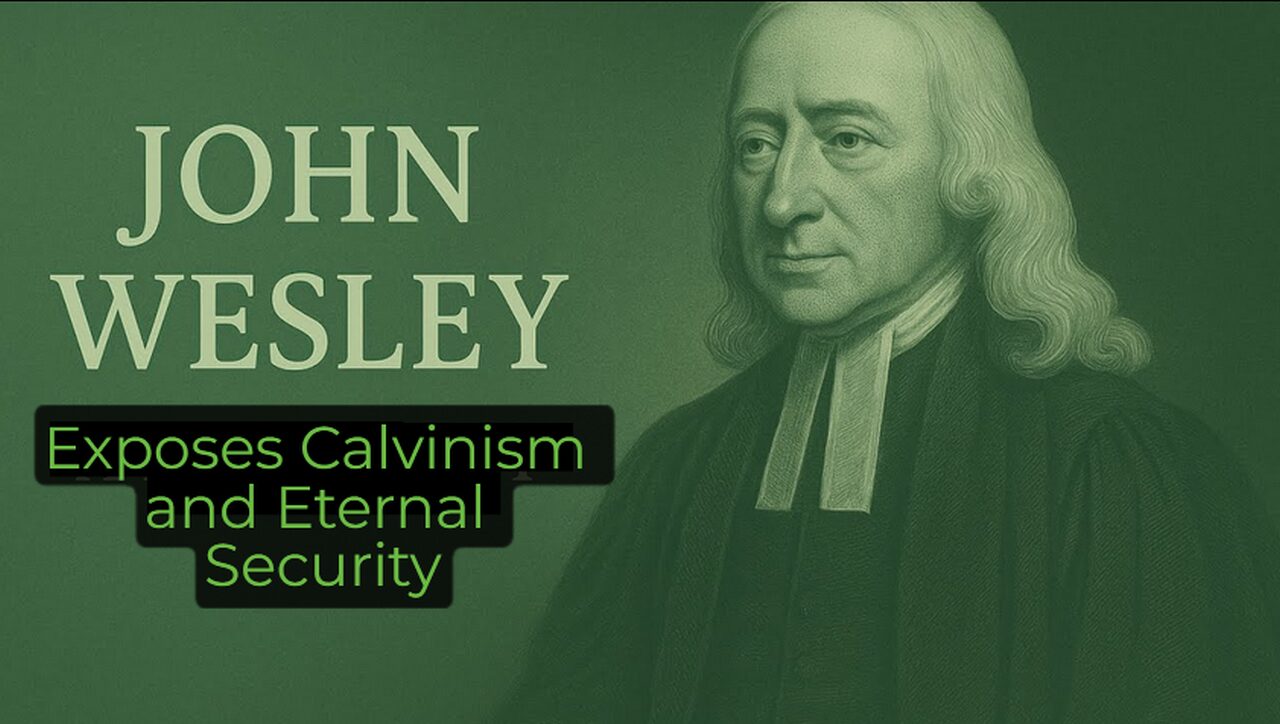
John Wesley on Calvinism, Once Saved Always Saved, and Conditional Security
“Calvinists, who deny that salvation can ever be lost, reason on the subject in a marvelous way. They tell us, that no virgin’s lamp can go out; no promising harvest be choked with thorns; no branch in Christ can ever be cut off from unfruitfulness; no pardon can ever be forfeited, and no name blotted out of God’s book! They insist that no salt can ever lose its savor; nobody can ever ‘receive the grace of God in vain’; ‘bury his talents’; ‘neglect such great salvation’; trifle away ‘a day of grace’; ‘look back’ after putting his hand to the gospel plow. Nobody can ‘grieve the Spirit’ till He is ‘quenched,’ and strives no more, nor ‘deny the Lord that bought them’; nor ‘bring upon themselves swift destruction.’ Nobody, or body of believers, can ever get so lukewarm that Jesus will spew them out of His mouth. They use reams of paper to argue that if one ever got lost he was never found (John 17:12); that if one falls, he never stood (Rom. 11:16-22 and Heb. 6:4-6); if one was ever ‘cast forth,’ he was never in, and ‘if one ever withered,’ he was never green (John 15:1-6); and that ‘if any man draws back,’ it proves that he never had anything to draw back from (Heb. 10:38,39); that if one ever ‘falls away into spiritual darkness,’ he was never enlightened (Heb 6:4-6); that if you ‘again get entangled in the pollutions of the world,’ it shows that you never escaped (2 Pet 2:20); that if you ‘put salvation away’ you never had it to put away, and if you make shipwreck of faith, there was no ship of faith there!! In short they say: If you get it, you can’t lose it; and if you lose it you never had it. May God save us from accepting a doctrine, that must be defended by such fallacious reasoning!” ~ John Wesley
OSAS people make a vain attempt at redefining the words of Scripture to fit their own self-serving agenda of lukewarmness, cross-less rebellion. For example they hyper-focus on “eternal” in the term “eternal life” while intentionally refusing to synthesize the whole of what Scripture states. Purposely, they do not distinguish between initial and final salvation and refuse to believe that after being saved, the recipient of His salvation must “endure to the end” to be “saved.” (Matthew 10:22; 24:13; John 15:6; Colossians 1:23; Hebrews 3:6, 12-14; 10:26-39; 2 Peter 2:20-21; Revelation 2-3, etc.) They hyper-focus on the word “gift” and teach that a gift could never be lost which the rest of Scripture does not agree with. They then take the word “sealed” and make it to be permanent which it cannot possibly be because the same Greek word for “sealed” is used of Jesus’ tomb which we all know was NOT permanently sealed – it was unsealed when Jesus came out of that grave! (Matthew 27:66) In this they bear false witness against the LORD and act like some Scriptures are more divinely inspired than others. This practice reveals the evil and deceit of their own hearts. While they scream, “context, context, context,” they themselves syphon things out of the immediate and overall context of Scripture. Not just some Scripture in the Bible but rather “ALL scripture is given by inspiration of God…” (2 Timothy 3:16-17) It must all be synthesized, put together, compared (1 Corinthians 2:13). Error will result in the hearts and lives of those who do not personally search, study, and revere “ALL scripture” in God’s Word.
The Cancer of Calvinism | Eternal Security/OSAS is a Scam
Support | STORE | Podcasts | Jail/Prison Ministry | Mexico Mission here | All Ministry Updates | Fresh Start with God | “Fear hath Torment” – 100% Deliverance from all Fear! [podcast] | Resurrection Grace [podcast] | G.O.D. = Game Over Devil [podcast] | Justification | Grace and Good Works [podcast] | More on Assurance here | Eternal Security Debunked | The Cross Life | 100’s of Christ-centered, Scripture-rich podcasts for your edification in Christ.







Cons and Crooks who Do Not Preach the Cross [podcast]

NET New English Translation Fake “bible” Exposed

Doubt Casting Wolves Exposed

Thank You for Declaring that the Mexican People Matter to Jesus! Mission Mexico Part 50

John Wesley on Calvinism, Once Saved Always Saved, and Conditional Security

Arrogant Bible Correctors Rebuked

In a Small Prison Cell, Justin was about to Commit Suicide … [podcast]

“A Land Flowing with Milk and Honey” [podcast]

Nicolaitan Nightmare [podcast]

A PLACE CALLED HELL [podcast]

Following the Faith of Abraham [podcast]

The Flesh will Never be Reformed it Must be Crucified [podcast]

Gospel Preached at Funeral of a Decorated United States Marine Officer in Mexico [podcast]

The High Treason of False Leaders [podcast]

Why Did God Give Us His Word? [podcast]
John Wesley on Calvinism, Once Saved Always Saved, and Conditional Security
Why Did God Give Us His Word? [podcast]

Beware of the Hebrew Roots Judaizing Snakes! [podcast]

False Apostles Exposed!

SINLESS PERFECTIONISM: WHOSE Righteousness are You Trusting? [podcast]

The Highest Form of His Creation
The Flesh will Never be Reformed it Must be Crucified [podcast]
The High Treason of False Leaders [podcast]

Direction in God’s Word? [podcast]

Addiction’s Only Solution [podcast]

Can and Will God Use You? [podcast]
A PLACE CALLED HELL [podcast]
Arrogant Bible Correctors Rebuked
Nicolaitan Nightmare [podcast]

The Golden Rule Life: What’s that Really Mean? [podcast]
Cons and Crooks who Do Not Preach the Cross [podcast]
NET New English Translation Fake “bible” Exposed
Doubt Casting Wolves Exposed


 America2 years ago
The Drugging of America: The Pharmakeia Sorcery Deception [podcast]
- Articles3 years ago
Children being Rescued in Tunnels: Happening Now – UPDATE!
- Articles9 years ago
Self-Examination in Preparation for the Lord’s Return
- Apostasy3 years ago
SHOCKING List of False Prophets Most Believe are True