A young mother laid her baby girl to sleep in her cradle. I’ll just go to the neighbors for a minute to visit, she thought to herself. I haven’t had time to talk to her for such a long time. But while she and the neighbor were chatting, the city fire alarm sent a chill through them both.
“Don’t worry,” said the neighbor. “Most likely it’s only a grass fire. There are lots of them at this time of year. I’m sure the fire isn’t anywhere near here.”
“But listen,” said the mother. “I think I hear the fire engine coming this way. Look! People are running down the street-running toward my house!”
Without another word she dashed into the street and ran with the gathering crowd. Then she saw it. Her own house was on fire! Smoke and flames were already pouring through the roof.
“My baby!” she cried frantically. “My baby!”
The crowd was thick around the house, but she pushed and shoved until she reached the door. A fireman stopped her and said, “You can’t go in there! You will be burned!”
But the mother cried, “Let me go! Let me go!” as she broke free and dashed into the flaming house.
She knew just where to go. Running through the smoke and flames, she seized her precious baby, then turned to make her way out. But by now the smoke made it very hard to see and breathe. Nearly overcome, she swayed and fell, and would not have made it out of the house safely if a fireman had not picked her up and carried her out.
What a cheer went up as they appeared! Baby Marjorie was not hurt at all! But the poor mother’s hands were terribly burned. Kind friends took care of the baby while the ambulance took her to the hospital. The doctors did their best, but her hands were terribly scarred.
Years later, when Marjorie had grown, she suddenly noticed something she had not noticed before. Her mother’s hands were so ugly! “Why are your hands so ugly?” she asked her mother when they were alone.
Tears filled her mother’s eyes as she remembered how frightened she was the day the house burned with Marjorie asleep and unaware of the danger.
“Have I said something wrong?” Marjorie asked when she saw the tears.
“No, my dear,” replied her mother. “But there’s a story I need to tell you.”
Then she told Marjorie the story of the fire. She told how the people tried to hold her back, how the fireman tried to stop her, how she battled the flames to rescue her, how she fell, and how they were rescued. Then she held out her scarred hands for Marjorie to see.
“They are ugly, in a way, aren’t they,” Mother said softly. “For me, the only thing that mattered was to save your life.”
Now it was Marjorie’s turn to shed a few tears. “Oh, Mother,” she cried, “You must love me so much! These are the most beautiful hands in all the world!”
Do you know there are hands that were hurt for you? The hands of Jesus. Soldiers drove great nails through His hands and hung Him on a cross to die so you could be forgiven of our sins and go to Heaven. Even when He comes again, the marks made by those nails will still be there. If you ask Him, He will show them to you. When you see them, you will know for sure how much Jesus loves you! You need to realize all Christ has done for you and cease being ashamed of Him. He suffered for you, in your place to save you from your sins and the fires of eternal damnation.
“Then saith he to Thomas, Reach hither thy finger, and behold my hands; and reach hither thy hand, and thrust it into my side: and be not faithless, but believing. 28 And Thomas answered and said unto him, My Lord and my God.” John 20:27-29
Mother’s Face
Calvin Miller reminds us of the little girl whose mother’s face was hideously scarred from an early injury. As the little girl grew, made friends, and gained her own identity, she became more and more ashamed of her mother’s horrid appearance. As she walked down the street with her mother, she noticed people moving over to the far side of the walk or even crossing the street to avoid them. Gradually, the girl found ways to avoid being with her mother in public. Eventually, the girl became an adult, married, and moved to another town. Her lonely mother suffered financial setbacks and faced basic hunger. Her daughter continued to ignore her, even in such destitute circumstances.
One day the daughter discovered an old diary of her mother’s. It described a horrible fire that swept through their home. The mother rushed into the burning house, scooped her daughter into her arms, and ran back out, burning herself beyond belief. The truth dawned on the girl. Her mother’s horrific scars came from saving the daughter’s life.
A new kind of shame raced through her heart and soul. She went to her mother and threw her arms around what now appeared to be a beautiful face. In tears she expressed her gratitude for all her mother had done. A new love relationship controlled their lives from then on (Miller, Until He Comes, p. 139).
So often we depend on outward appearances as we choose our leaders and friends. We do not look behind appearances to find the truth about a person, a program, or an organization and their abilities to help us. Israel kept looking beyond her boundaries to find a strong ally to deliver her from enemies. Time and again God sent word to trust Him and let Him alone be the ally they needed. What does it take to reveal the truth to us about who can really help us and meet our needs? Who has proved true and faithful in our times of deepest distress? Are we ready to turn to the Faithful One, or will we seek yet another earthly ally?
Another was Marred for Us
“As many were astonied(stunned, shocked)at thee; his visage(form, appearance, countenance)was so marred more than any man, and his form more than the sons of men:” Isaiah 52:14
“[visage] Hebrew: mar’eh (H4758), view; appearance; shape; visage. Generally translated “appearance,” referring to His outward form.”
“[marred] Hebrew: mishchath (H4893), to disfigure. Translated “marred” (Isa_52:14), and “corruption” (Lev_22:25). In His sufferings the Messiah was so bruised, beaten, and mutilated that His outward appearance was horrendous. He suffered so much that even wicked, hardhearted men were shocked at His treatment. He became so disfigured that men were disgusted at what they saw. The more perfect His body, the more marred He seemed in suffering.” Dake
“v1 Who hath believed our report? – The report of the prophets, of John the Baptist, and Christ’s own report of himself. The Jews did not receive the report, and for this reason he was not manifested to them as the promised Messiah. ‘He came unto his own, but his own received him not.’ Before the Father he grew up as a tender plant: but to the Jews he was as a root out of a dry ground. ‘He hath no form nor comeliness; and when we shall see him, there is no beauty that we should desire him.’” Adam Clarke
“v3 ‘Man of Sorrows,’ what a name For the Son of God who came Ruined sinners to reclaim! Hallelujah! what a Saviour! Bearing shame and scoffing rude, In my place condemned He stood; Sealed my pardon with His blood; Hallelujah! what a Saviour!”
—Philip P. Bliss
Isaiah 52:13 – 53:12
Prophetic Utterance of the Loving, Suffering Savior 700 Years Before He Came. He Was Pierced for Our Transgressions.
Isa 52:13 Behold, my servant shall deal prudently, he shall be exalted and extolled, and be very high. Isa 52:14 As many were astonied at thee; his visage was so marred more than any man, and his form more than the sons of men: Isa 52:15 So shall he sprinkle many nations; the kings shall shut their mouths at him: for that which had not been told them shall they see; and that which they had not heard shall they consider.
Isa 53:1 Who hath believed our report? and to whom is the arm of the LORD revealed? Isa 53:2 For he shall grow up before him as a tender plant, and as a root out of a dry ground: he hath no form nor comeliness; and when we shall see him, there is no beauty that we should desire him. Isa 53:3 He is despised and rejected of men; a man of sorrows, and acquainted with grief: and we hid as it were our faces from him; he was despised, and we esteemed him not. Isa 53:4 Surely he hath borne our griefs, and carried our sorrows: yet we did esteem him stricken, smitten of God, and afflicted. Isa 53:5 But he was wounded for our transgressions, he was bruised for our iniquities: the chastisement of our peace was upon him; and with his stripes we are healed. Isa 53:6 All we like sheep have gone astray; we have turned every one to his own way; and the LORD hath laid on him the iniquity of us all. Isa 53:7 He was oppressed, and he was afflicted, yet he opened not his mouth: he is brought as a lamb to the slaughter, and as a sheep before her shearers is dumb, so he openeth not his mouth. Isa 53:8 He was taken from prison and from judgment: and who shall declare his generation? for he was cut off out of the land of the living: for the transgression of my people was he stricken. Isa 53:9 And he made his grave with the wicked, and with the rich in his death; because he had done no violence, neither was any deceit in his mouth. Isa 53:10 Yet it pleased the LORD to bruise him; he hath put him to grief: when thou shalt make his soul an offering for sin, he shall see his seed, he shall prolong his days, and the pleasure of the LORD shall prosper in his hand. Isa 53:11 He shall see of the travail of his soul, and shall be satisfied: by his knowledge shall my righteous servant justify many; for he shall bear their iniquities. Isa 53:12 Therefore will I divide him a portion with the great, and he shall divide the spoil with the strong; because he hath poured out his soul unto death: and he was numbered with the transgressors; and he bare the sin of many, and made intercession for the transgressors.
Jesus’ hands were pierced. He was forsaken that we might be forgiven. He took the blow of death for us. We owe a debt we cannot pay. He paid a debt He did not owe, all to redeem us from the burning house of hell.
“To wit, that God was in Christ, reconciling the world unto himself, not imputing their trespasses unto them; and hath committed unto us the word of reconciliation. 20 Now then we are ambassadors for Christ, as though God did beseech you by us: we pray you in Christ’s stead, be ye reconciled to God. 21 For he hath made him to be sin for us, who knew no sin; that we might be made the righteousness of God in him.” 2 Corinthians 5:19-21
Jesus’ Scars
Like the loving mothers in these stories, Jesus loves us, too. He loves us enough that He carries scars from the day that He saved you and me and everyone in the world from the fire of sin. He has scars on His hands, His feet, and His side where the sword pierced Him. And likely He has scars on His back and on His head. Jesus could have gone back to His Father in heaven without dying for us, but He loves us so much that He could not bear the thought of spending eternity without us. He knew that if He did not die for us, we would all die without Him.
“For even hereunto were ye called: because Christ also suffered for us, leaving us an example, that ye should follow his steps: 22 Who did no sin, neither was guile found in his mouth: 23 Who, when he was reviled, reviled not again; when he suffered, he threatened not; but committed himself to him that judgeth righteously: 24 Who his own self bare our sins in his own body on the tree, that we, being dead to sins, should live unto righteousness: by whose stripes ye were healed. 25 For ye were as sheep going astray; but are now returned unto the Shepherd and Bishop of your souls.” 1 Peter 2:21-25
“For Christ also hath once suffered for sins, the just for the unjust, that he might bring us to God, being put to death in the flesh, but quickened by the Spirit:” 1 Peter 3:18
“For God so loved the world, that he gave his only begotten Son, that whosoever believeth in him should not perish, but have everlasting life. 17 For God sent not his Son into the world to condemn the world; but that the world through him might be saved.” John 3:16-17
“And about the ninth hour Jesus cried with a loud voice, saying, Eli, Eli, lama sabachthani? that is to say, My God, my God, why hast thou forsaken me?” Matthew 27:46
“27:46 At about 3:00 p.m., He cried out with a loud voice, saying, “My God, My God, why have You forsaken Me?” The answer is found in Psa_22:3, “ . . .You are holy, enthroned in the praises of Israel.” Because God is holy, He cannot overlook sin. On the contrary, He must punish it. The Lord Jesus had no sin of His own, but He took the guilt of our sins upon Himself. When God, as Judge, looked down and saw our sins upon the sinless Substitute, He withdrew from the Son of His love. It was this separation that wrung from the heart of Jesus what Mrs. Browning so beautifully called “Immanuel’s orphaned cry”:
Deserted! God could separate from His own essence rather;
And Adam’s sins have swept between the righteous Son and Father:
Yea, once, Immanuel’s orphaned cry His universe hath shaken—
It went up single, echoless, “My God, I am forsaken!”
—Elizabeth Barrett Browning
27:47, 48 When Jesus cried, “Eli, Eli … ,” some of those who stood by said He was calling for Elijah. Whether they actually confused the names or were simply mocking is not clear. One used a long reed to lift a sponge soaked with sour wine to His lips. Judging from Psa_69:21, this was not intended as an act of mercy but as an added form of suffering.” Believers Bible Commentary
“But this man, because he continueth ever, hath an unchangeable priesthood. 25 Wherefore he is able also to save them to the uttermost that come unto God by him, seeing he ever liveth to make intercession for them. 26 For such an high priest became us, who is holy, harmless, undefiled, separate from sinners, and made higher than the heavens;” Hebrews 7:24-26
YOUR PRAYER TO GOD: Heavenly Father, thank You for the life, death, and burial of my LORD and Savior. Thank You Jesus for loving me and demonstrating that great love by Your perfect sacrifice on the cross where Your feet and hands were pierced with nails. I know it was Your love that held You to that cross more than those nails. I’m forever grateful to You my LORD Jesus for Your ultimate sacrifice for me, and the sins of the whole world. I love You dear LORD Jesus and am fervently watching for Your soon return. Please fill me with Your Holy Spirit afresh right now and use me to help others to know You. In Jesus’ Name, amen.
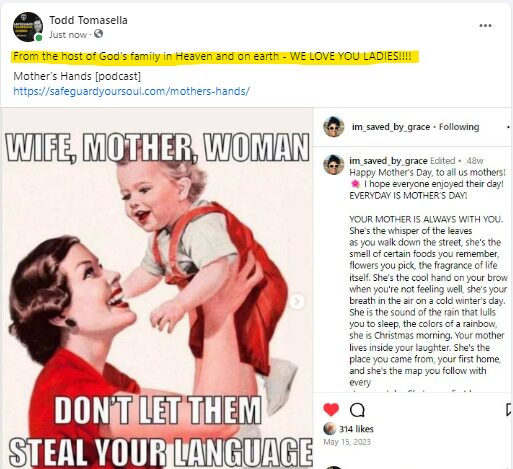
YOU are His BABY! You are the very JEWEL of God! [podcast]
He’s Crazy about You – Are You Crazy about Him? O if our children had the slightest clue as to how much we love them…. There’s no chance any parent could begin to explain how much they love their child(ren) …. What a gift from God! It’s a picture of how much He loves us! And, His love for us is far beyond our comprehension and description. “For ye have not received the spirit of bondage again to fear; but ye have received the Spirit of adoption, whereby we cry, Abba (Daddy), Father. 16 The Spirit itself beareth witness with our […]
WHAT'S On Jesus' Prayer List? [podcast]
What Did Jesus Pray for His People? John 17 – knowing Him. Being one with Him. Jesus’ prayer. Jesus prayed the highest priorities of the Father for His people as is recorded in John 17. Having offered His precious, sinless blood to the Father for the redemption of the fallen race, Jesus Christ is now seated at the right hand of the Father making intercession for all of His saints. “But this man, because he continueth ever, hath an unchangeable priesthood. 25 Wherefore he is able also to save them to the uttermost that come unto God by him, seeing he […]
Powerful Parenting
PRAYER OF A PARENT: Heavenly Father, thank You for the children You sovereignly gave their father and I. You entrusted them to us, to train up in Your ways – to teach them to know and follow You Jesus. We know they are first and foremost, YOURS. You have committed to my trust Your child(ren). Right this moment, I release each of my children back to You – to Your sovereign care. Please help me to be the parent You’ve ordained me to be, walking in Your love, truth, and wisdom – as I obey them by teaching them Your […]
God Himself personally sends a “strong delusion” to all who do not love His truth so that they WILL believe lies. He greases their pole to hell. That’s how personally He takes it when people call Him a liar by not believing His Word.
“Even him, whose coming is after the working of Satan with all power and signs and lying wonders, 10 and with all deceivableness of unrighteousness in them that perish; because they received not the love of the truth, that they might be saved. 11 And for this cause God shall send them strong delusion, that they should believe a lie: 12 that they all might be damned who believed not the truth, but had pleasure in unrighteousness.” 2 Thessalonians 2:9-12
“Beware lest any man spoil you through philosophy and vain deceit, after the tradition of men, after the rudiments of the world, and not after Christ.” Colossians 2:8
Notice “of God” and “NOT of God”
“He that is OF GOD heareth God’s words: ye therefore hear them not, because ye are NOT OF GOD.” John 8:47
How do We Know Who is "of God" and Who is "Not of God"? [podcast]
Scripture vs Subjectivity/Human Reasoning “Beware lest any man spoil you through philosophy and vain deceit, after the tradition of men, after the rudiments of the world, and not after Christ.” Colossians 2:8 There are many people pretending to be representing Christ. Many pretend to speak for God but how do we know who is truly “of God” and who is “not of God”? Jesus gave us the answer to this important question because He desires His people to be protected by proper discernment. He has warned us repeatedly to “Beware of false prophets, which come to you in sheep’s clothing, but […]
Return and Discern [podcast]
THE LORD IS DOING A WORK TODAY IN THE HEARTS OF HIS PEOPLE – BLESSING US TO BE POOR IN SPIRIT, HUNGERING FOR MORE OF HIM, AND PURE IN HEART (Matthew 5:3, 6, 8 ). It’s all in spite of our own failings and sin and because of His great mercies which are renewed every morning – GREAT is His faithfulness (Lamentation 3:22-23). Discernment is only granted by God when we truly repent which means we lay down our lives in this fleeting world and follow Jesus for real (2 Corinthians 3:16-18). WHEN we earnestly seek the face of the […]
The Essential Doctrine of Repentance
The Biblical Statement on the Essential Doctrine and Necessity of Repentance – in Life and in the Dispensing of the Original Gospel Message. Though nearly never heard in today’s apostate modern church world, according to Christ’s unchanging original Gospel, repentance is an absolute necessity. Karen Cochran observes: “It doesn’t seem the word repent is part of the Christian’s vocabulary! In the modern church, it’s all about God accepting you the way you are without any requirements to repent and die to self.” Note that in modern churches, “Christian” radio, media, books, the word “repent” is rarely if ever heard. Yet […]
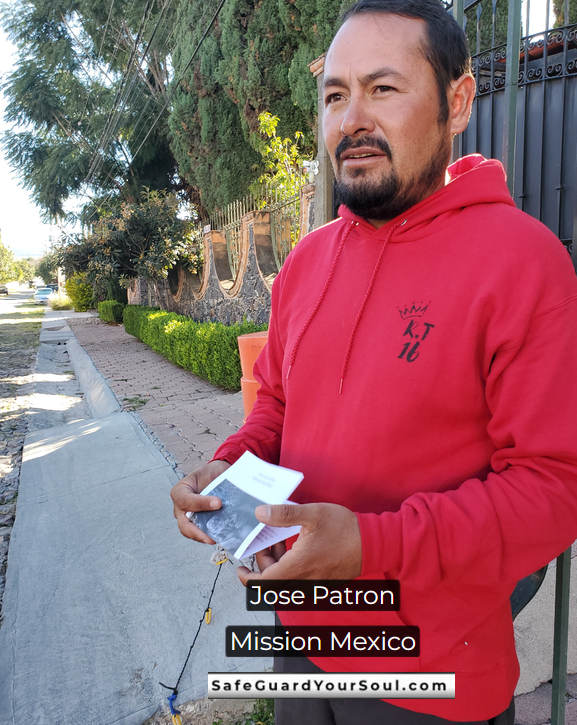
THIS MORNING: Brother Mark brought brother Juan to meet our new brother Jose Patron!
Jose was given a stack of JESUS tracts after he said he wanted to evangelize.
Brother Juan passes by where Jose works for work daily and so that connection and fellowship is being put in place.
“WE are labourers TOGETHER with God” (1 Corinthians 3:9) – and what God has us doing is supporting His beloved “labourers” who are “few”! (Matthew 9:35-38)
A FEW DAYS AGO: Sister Maria called for more JESUS tracts. She ran out as she is distributing hundreds per day. So our dear sister, thanks to you who are praying and supply…. was given a new jacket to keep her warm (pictured), food and drink to bring home for her living quarters, a fresh supply of JESUS tracts, some cash (Mexican pesos), and some Scripture that she as usual read out loud and devoured as I brought them up on my cell phone from the Spanish Bible (Reina Valera). God is good saints. May He be glorified in all you are doing to see the beloved people of Mexico reached with His bless-ed Gospel! You are refreshing His beloved saints.
LORD willing, I will be meeting again with our dear brother Juan this week to refresh him in fellowship etc.
“Pure religion and undefiled before God and the Father is this, To visit the fatherless and widows in their affliction, and to keep himself unspotted from the world.” James 1:27
Mexico: The Land where the Gospel of Jesus is Freely Received
“Freely ye have received, freely give.” Matthew 10:8
As we truly follow Jesus He makes us fishers of men.
“And Jesus said unto them, Come ye after me, and I will make you to become fishers of men.” Mark 1:17
This was the sweetest couple ever as you can tell by the picture. They were overjoyed to receive the preaching of our LORD’s Gospel and were told how to be saved – repentance and faith in Christ, and showed the prayer on the back, etc. They were directed to the prayer on the back and exhorted to pray in repentance and faith and receive eternal life. When asked they said they’d welcome your prayers for them.
On the streets today in Mexico ministering our LORD Jesus’ Gospel to many. As usual the name of Jesus was preached in Christ’s love and it was readily, eagerly received by most who thanked us for giving them the Gospel. SMH. It’s no even fair!
A man name Jose was ministered to, received the Word, and prayed in repentance and faith to be saved! Would you like to lift our new brother in Christ in prayer? Jose Patron is his name and we are connected and he’s already been given more Scripture and added to the Spanish WA group.
Jose just sent me a voice recording saying Thank you to Mark and I for ministering Jesus’ Gospel to him and that he wants to do the same thing we are doing, minister to others our LORD’s Gospel.
“So mightily grew the word of God and prevailed.” Acts 19:20
“The food looks healthy. Just this morning I was thinking that it is unfathomable, in my mind, to comprehend what the Lord is doing in Mexico. I watched the video of Mark passing out Jesus tracts and everyone was so receptive. That stuck in my mind, because I recently watched a video of a man preaching the gospel on a train. Zero response! Everyone kept looking at their phones and never once looked up. This is the true state of America. We have need of nothing and especially not Jesus. Rev 3:17. As opposed to the precious people of Mexico who know they are poor in spirit and are in need of the Lord to save them. They know something is missing in their lives. When Mark was passing out those Jesus tracts people were very happy and joyful to receive them, here they are rejecting the Savior.” Karen Cochran
We went to a colonia, to a street where no one was outside at the moment, Brother Mark said “God sent us this way for a reason, for someone.” 30 seconds later we came upon Jose! Boom.
Then came the Gospel explosion!
Upon ministering Christ’s Gospel to him, Jose Patron excitedly shared with brother Mark and I about how God had saved him from dying. He simply needed the opportunity to repent and be saved – and that’s exactly what JESUS did. Thank you for lifting our beloved brother Jose in prayer.
Jose just sent me a voice recording saying Thank you to Mark and I for ministering Jesus’ Gospel to him and that he wants to do the same thing we are doing, minister to others our LORD’s Gospel.
“So mightily grew the word of God and prevailed.” Acts 19:20
Gospel blessings abounded on the streets in Mexico ministering our LORD Jesus’ Gospel to many. As always the name of Jesus was preached in Christ’s love and it was readily, eagerly received by most who thanked us for giving them the Gospel.
It’s no even fair to have the privilege to minister to the beloved Mexicans! SMH.
A man name Jose was ministered to. He received the Word, and prayed in repentance and faith to be saved! Would you like to lift our new brother in Christ in prayer? Jose Patron is his name and we are connected and he’s already been given more Scripture and added to the Spanish WA group.
Jose just sent me a voice recording saying Thank you to Mark and I for ministering Jesus’ Gospel to him and that he wants to do the same thing we are doing, minister to others our LORD’s Gospel.
Thank you for lifting the salvation of the people of Mexico in your prayers. | Mexico Mission
“I love this brother! May God continue to provide and increase his fruit in the lives of the disciples in Mexico, in the Philippines, in Pakistan, in Kenya, in all his earth for his glory! Amen.
I was reading Psalm 8 and John 10. Beautiful beyond understanding is God’s love poured out in Christ Jesus toward us who hear his voice!
Much love to the body of Christ in Mexico and throughout the whole world. Jesus is coming!
“EVERY person you meet, or stand next to in line, is an opportunity to share the Good News. Do not miss the opportunity to bring another into the Kingdom.
I thank God everyday that this happened to me 5 years ago.” Targeted Christian Girl, RN
Let us be blessed to preach Christ’s Gospel this day.
Upon having the Gospel of Jesus preached to her, beloved Laura informed me that she is a born again saint!!! After fellowshipping she took a stash of JESUS tracts. Would you like to pray for sister Laura?
After receiving the ministry of God’s Word, Antonio was asked if he wanted you to lift him in prayer. He eagerly accepted and is glad you will pause to lift his life to the LORD in prayer. | Mexico Mission
ON THE TOPIC OF MEXICO
The Mexican people never handed their country over to the government so that the government can take it away the government cannot take it away because
Historically and presently the Mexican people find a way to circumvent the government. They never let the government have control and therefore the government can’t take their freedom away – because the people recognize their freedom coming from God.
The tax money of the people is a large way that the government controls the people they are empowered by the riches of the people through taxes in order to control and exploit them endlessly. Your tax money fuels your slavery….
Mexican people have a very healthy dis-trust for government. This is unlike many Americans. Many Americans it seems, haven’t learned that the promises candidates make before an election, will nearly never carry them out when elected. It seems the “We’re going to release the epstein files” was a mere ruse to cover those secret files. “It’s all a big club, and you’re not in it.” George Carlin
Thank you for praying for this man, Juan. He received ministry today and is in need of being saved.
The concept of a “daily cross life” with Jesus is the way of living that involves submitting ourselves to Christ daily, perpetually, and living in sacrificial service to God and His kingdom (Matthew 6:33). This is based on the Bible verse Luke 9:23, which says, “And he said to them all, If any man will come after me, let him deny himself, and take up his cross daily, and follow me. 24 For whosoever will save his life shall lose it: but whosoever will lose his life for my sake, the same shall save it” (Luke 9:23-24).
In short, the cross gets you, me, out of the way so Christ can reign. Selah.
“But thanks be to God, which giveth us the victory through our Lord Jesus Christ.” 1 Corinthians 15:57
How do we walk in victory after Jesus saves us? By participating in the daily cross life.
“And he said to them all, If any man will come after me, let him deny himself, and take up his cross daily, and follow me. 24 For whosoever will save his life shall lose it: but whosoever will lose his life for my sake, the same shall save it.” Luke 9:23-24
HOW could we possibly, vainly believe we are going to overcome the sins that prevent us from eternal glory without the daily crucified life? Not going to happen.
The cross is essential—the crucified life. Read Romans 6 in prayer each morning.
Death and burial must precede resurrection. There will be no resurrection in your personal life—no divine raising you up out of sin and into victory—until you lay down your life, until you die.
The Bible says we have been FOOLS:
“Thou fool, that which thou sowest(plant)is not quickened(made alive), except it die:” 1 Corinthians 15:36
How could we have ever believed that God is going to raise us upward into His victory, out of sin, until we died? I can tell you why—it’s because we weren’t honestly studying and obeying His Word for ourself but rather following false teachers (Philippians 3:18-19).
“Always bearing about in the body the dying of the Lord Jesus, that the life also of Jesus might be made manifest in our body. 11 For we which live are alway delivered unto death for Jesus’ sake, that the life also of Jesus might be made manifest in our mortal flesh. 2 Corinthians 4:10-11
“But if the Spirit of him that raised up Jesus from the dead dwell in you, he that raised up Christ from the dead shall also quicken your mortal bodies by his Spirit that dwelleth in you.
12 Therefore, brethren, we are debtors, not to the flesh, to live after the flesh. 13 For if ye live after the flesh, ye shall die: but if ye through the Spirit do mortify the deeds of the body, ye shall live.” Romans 8:11-13
The original Gospel is a cross Gospel. Any gospel that does not have the cross front and center, is “another gospel,” a false gospel (Galatians 1:6-9). Reading Romans 6 prayerfully each morning is a blessing.
YOUR PRAYER: Holy Father, I love You and thank You for sending Your only begotten Son to die for my sins and the sins of the whole world. We are not worthy but You bought us with the very life blood of Christ, back to Yourself from a life of sin, to be Your sons and daughters. Please forgive all my sins afresh LORD. Into Your holy, mighty hands I now submit my spirit. Bless this life to be crucified with You dear LORD. In Jesus’ name, amen.
NOTHING – NO MAN, NO DEVIL CAN STOP THIS! Just as no man, no devil could possibly stop the resurrection of Christ, no entity or army can stop the resurrection life of Christ in His saints, as they submit to their own death and burial. Resurrection follows! “Always bearing about in the body the dying of the Lord Jesus, that the life also of Jesus might be made manifest in our body. 11 For we which live are alway delivered unto death for Jesus’ sake, that the life also of Jesus might be made manifest in our mortal flesh. 12 […]
Victory Over the Iniquities that Currently Drive You [podcast]
“Too many Christians blame their flesh on Satan and try casting it out. Never works. That’s why they don’t grow! Must crucify the flesh!” Karen Cochran Recently, a brother in Christ was pushing the fact that Genesis 6:5, 12, use the phrase “only evil continually” pertaining to mankind, all men. REPLY: Ask for yourself the important question: WHY did Jesus come to the earth? And from this moment forward, allow the Bible to answer that question …. Look for the Bible answer…… Why Jesus came to die for us and make us new creatures in Christ whereby OLD THINGS ARE […]
Cons and Crooks who Do Not Preach the Cross [podcast]
“For the preaching of the cross is to them that perish foolishness; but unto us which are saved it is the power of God.” 1 Corinthians 1:18 Those who do not preach the cross prove that they believe the cross is “foolishness.” The know that many will leave if they were to preach the crucified life. And they are in it for the money, the acceptance of mere men, not Christ. Make no mistake, the Holy Ghost through Paul warned us specifically about this generation of counterfeits, these “evil men and seducers” who “wax worse and worse.” (2 Timothy 3:13) […]