







Martin Bobgan
Psychological counseling theories and therapies have given Americans a new way of thinking and have turned our country into a therapeutic culture of the self—where the self and how it feels about itself are at the center of meaning. People from coast to coast have embraced a psychological mindset that puts emotional deprivation and woundedness as the root cause of nearly every personal and social problem. This mindset has the potential to make everyone into a victim needing the services of the ever-expanding mental-health system. Fifteen years ago Charles Sykes wrote a book titled A Nation of Victims: The Decay of the American Character, in which he says:
The ethos of victimization has an endless capacity not only for exculpating one’s self from blame, washing away responsibility in a torrent of explanation—racism, sexism, rotten parents, addiction, and illness—but also for projecting guilt onto others.1
Sykes also says, “The impulse to flee from personal responsibility and blame others seems far more deeply embedded within the American culture.”2 In fact, he declares, “The National Anthem has become The Whine,” and explains, “Increasingly, Americans act as if they had received a lifelong indemnification from misfortune and a contractual release from personal responsibility.”3
Psychological Mindset
The psychological mindset evolved out of the fairly recent development of clinical psychology (including psychotherapy, counseling psychology, and marriage and family counseling), which was birthed in colleges and universities around 1950 and expanded through politics and money.4 Since that time, it has exploded to the extent that Dr. Ellen Herman describes psychology’s popularity and impact on the Western world this way in her book titled The Romance of American Psychology:
Psychological insight is the creed of our time. In the name of enlightenment, experts promise help and faith, knowledge and comfort. They devise confident formulas for happy living and ambitious plans for dissolving the knots of conflict. Psychology, according to its boosters, possesses worthwhile answers to our most difficult personal questions and practical solutions for our most intractable social problems
Herman also says:
In the late twentieth-century United States, we are likely to believe what psychological experts tell us. They speak with authority to a vast audience and have become familiar figures in most communities, in the media, and in virtually every corner of popular culture. Their advice is a big business.6
The kind of psychology that carries this power to turn people into victims is psychotherapy with its underlying psychologies, such as Sigmund Freud’s theory of the unconscious and Abraham Maslow’s hierarchy of needs, along with an estimated 500 different counseling systems and their theories. After all, who has a perfect life, certainly none of the theorists, all of whom developed their systems out of their own personal lives and creative imagination?7
In her book Manufacturing Victims: What the Psychology Industry Is Doing to People, Dr. Tana Dineen reveals what the so-called caring profession has become. She begins her book with the following words and the rest of her book proves her point:
Psychology presents itself as a concerned and caring profession working for the good of its clients. But behind the benevolent facade is a voracious, self-serving industry that proffers “facts” which are often unfounded, provides “therapy” which can be damaging, and exerts influence, which is having devastating effects on the social fabric.8
Dineen also says:
It is not news to say that psychology has become an influential cultural force or that society is becoming more and more filled with people who consider themselves victims who are psychologically needy in one way or another.
What is news is that psychology is manufacturing most of these victims; that it is doing this with motives based on power and profit (emphasis hers).9
While, indeed, there are real victims, the psychotherapeutic mindset has trivialized the horrors that some people have experienced by so expanding the meaning that now everyone qualifies if they want to. The role of victim can actually be quite enticing. Besides qualifying for sympathy from friends, engaging in endless psychological therapy centered on self, and gaining exoneration from responsibility and guilt, being a victim provides a new identity of being the hero or heroine in one’s own drama of overcoming horrendous obstacles in the grand quest for psychological healing. Rather than having to face the ugly fact of their own sin without excuse or reason or blame-shifting, they choose to be victims. Dr. Carol Tavris and Dr. Elliot Aronson describe the usefulness of victimhood that comes from recovered memory therapy in their book titled Mistakes Were Made (but not by me): Why We Justify Foolish Beliefs, Bad Decisions, and Hurtful Acts. They say:
Why would people claim to remember that they had suffered harrowing experiences if they hadn’t, especially when that belief causes rifts with families or friends? By distorting their memories, these people can “get what they want by revising what they had,” and what they want is to turn their present lives, no matter how bleak or mundane, into a dazzling victory over adversity. Memories of abuse also help them resolve the dissonance between “I am a smart, capable person” and “My life sure is a mess right now” with an explanation that makes them feel good and removes responsibility: “It’s not my fault my life is a mess. Look at the horrible things they did to me.”10
Psychological Mindset Christianized?
Yes, we are surrounded by a nation of victims with a therapeutic mindset, but wait—we are Christians! How does this affect those of us who have been given new life through faith in the finished work of Jesus Christ on the cross? What does this have to do with the Gospel and with living the Christian life? Plenty!
Almost as soon as the romance of psychology took hold of Americans, it was embraced by Christians who believed psychological counseling theories and therapies would be useful for helping Christians. These psychological counseling ideas were brought into pastoral counseling classes in numerous seminaries. Next came the “Christian psychologists” who devised a plan to integrate counseling psychologies theories and therapies with Christianity, both for counseling believers and for instructing the saints about how to live the Christian life. And now, what is the advice people hear when they are struggling with emotional distress and problems of living? “You need counseling.” And, what they mean is professional counseling, psychotherapy and its underlying theories of the self. Why? Because they believe a lie that, in essence, says that the cross of Christ, the Word of God, the work of the Holy Spirit, and the fellowship of believers are not enough for people with emotional or relational problems of living and that Christians need what only psychological theories and therapies can do. This is because of what Sykes calls:
The triumph of the therapeutic mentality … which insisted upon seeing the immemorial questions of human life as problems that required solutions. The therapeutic culture provided both in abundance: The therapists transformed age-old human dilemmas into psychological problems and claimed that they (and they alone) had the treatment.11
This lie about the Word of God, the work of the Holy Spirit, and the fellowship of the saints not being sufficient for dealing with so-called psychological problems of living is promoted by numerous leaders and believed throughout the church. One of them is Dr. Bruce Narramore, Distinguished Professor at Rosemead School of Psychology at Biola University, who says: “I think the critics [of psychology] need to ask, ‘Why are people so interested in psychology?’ The thought is that we ought to go back to the old way. But the old way wasn’t working.”12 Narramore says this without proof or evidence and thereby implies that for nearly 2000 years God failed to supply His children with the means of dealing with problems of living.
The integration of the theories and therapies of counseling psychology has succeeded in turning the body of Christ into a bunch of victims. If this were a book title, the subtitle could be “The Demise of Biblical Ministry.” In its eager embrace of this kind of psychology, the church has left its first love and fallen for the wisdom of man and “philosophy and vain deceit” (1 Cor. 2; Col. 2:8). That this kind of psychology is now regular fare in churches across America can be seen in the observation of Dr. Frank Furedi in his book Therapy Culture, in which he says: “A study of ‘seeker churches’ in the US argues that their ability to attract new recruits is based on their ability to tap into the therapeutic understanding of Americans.”13 He sees this as a preoccupation with the self, and, indeed, that is what it is all about—self!
All About Self
The focus of psychological therapy is on self and its problems from the perspective that the self is essentially good, but wounded emotionally by circumstances and other people. Therefore more and more Christians are seeing themselves as innocent victims with their “mistakes” and problems of living being due to other people and circumstances beyond their control. Worse yet, some, who have been convinced that the source of their problems is what happened to them as young children, spend months and years in therapy and/or in so-called inner healing. Some are trying to gain insight by remembering real events and some are searching for supposedly forgotten memories of abuse and neglect. Others are encouraged to see a figure of Jesus add something to the memory to heal or change it, but, since this is all in their imagination, they end up with a false Jesus. The idea in all of this kind of counseling and inner healing is that self has been harmed in some way and must be helped and healed.
Psychotherapy thus attempts to fix the self so that its so-called essential goodness can be experienced and expressed. The psychological mindset sees the problem as on the outside. The solution is found within the self, albeit with the help of those who have special psychological knowledge. Self is central and must be nurtured with self-love, self-esteem, and self-worth, all of which are supposed to lead to self-fulfillment, but which generally increase self-absorption, self-centeredness, and self-indulgence.
In contrast, the Word of God presents the truth about mankind, that we are sinners by nature and therefore not essentially good in ourselves. Romans 3:10 says: “There is none righteous, no not one” and verse 23 says, “All have sinned and come short of the glory of God.” The problem of sin comes from within and the solution comes from outside ourselves, from God Himself through the cross of Christ, who bore our sin, and purchased our new life, which is received by grace through faith and lived by grace through faith.
Victim or Sinner?
One of the main goals of much counseling psychology is to relieve guilt so that individuals can feel better about themselves and thereby supposedly handle their lives more effectively. Helping an individual see himself as needy, emotionally wounded, and having been harmed or disappointed by others is one convenient way to sidestep personal responsibility, sin, and guilt. This is the opposite of the Bible, which provides the true remedy for sin and the only remedy for the human condition through Jesus Christ and all He accomplished to rid one of sin and guilt.
The whole of Scripture points to the Lamb of God slain before the foundation of the world. Its focal point is Jesus Christ satisfying God’s wrath against sin and procuring forgiveness and new life for believers. Christianity is all about living the new life and reckoning oneself dead to the old life. Christianity is not about focusing on problems and on other people’s sins and shortcomings, and it is not about dredging up the past to fix the present. The Christian life is about confessing one’s own sin, walking according to the new life in Christ, and “forgetting those things which are behind, and reaching forth unto those things which are before” towards the goal of the “high calling of God in Christ Jesus” (Phil. 3:13,14).
The early church had the one remedy for everyone’s present problems and past circumstances: the cross of Christ! The magnitude of each person’s sin against God from the cradle to the grave is more than anyone could bear to imagine, but Jesus took it all upon Himself so that he could give every believer new life. He, who knew no sin, died in the place of those who were by nature sin. He did not just come to fix the flesh (the old nature). He came to put it on the cross so that believers, by identifying with Him, could reckon themselves dead to the old and alive to the new.
Everyone has been adversely affected by the sins of others to some degree, but the adverse effects or the sinful tendencies from parents or sinful ways learned from them reside in the flesh (old nature). Our flesh is therefore the problem, not something outside ourselves, either past or present. Therefore, the Bible does not teach people to nurture their so-called “inner child” or to develop self-esteem or to probe their early childhood years to look for ways that adults failed them in any way. The Bible does not advise anyone to remember and re-experience past pain, disappointments, or even abuse for the sake of personal or spiritual growth. The Bible does not suggest that people must be healed emotionally before they can believe God or before they can grow spiritually.
Considering the grievous circumstances and the childhoods of many of the Gentile Christians, the early church had plenty of potential “victims” (many born and raised in slavery with the accompanying sexual and physical abuse and being treated as less than human). But, did the church treat them as victims needing to heal their emotional wounds or to remember the pain of the past in order to know God and to grow spiritually? No! The Bible does not portray mankind as victims, but as sinners. Jesus died for sinners, not victims!
The Way of the Cross
The way of the cross is a totally different way of dealing with serious life issues and problems of living. Rather than trying to remember the past and somehow rework painful memories through therapy or so-called inner healing, Christians need to reckon themselves dead to the past by identifying with Christ’s death and to live according to their new life in Christ. Everything needs to be taken to the cross instead of relived and talked about. Nevertheless, many of the people who promote this senseless return to the past agree that Christ died for our sins, but insist that many Christians still need healing from the past. However, digging up old memories for the purpose of changing one’s present life is counterproductive to the cross and in effect denies the finished work of Christ.
Jesus said, “It is finished.” So we say to fellow Christians: Identify with those words when you bring sin to the cross, your own sin and the sins committed against you. Recognize that Jesus suffered the pain and eternal consequence of those sins. He felt the pain and agony of every sin you have committed and the pain of every sin committed against you. He took it all and said, “It is finished.” If a memory with its pain comes back, treat it as a temptation from the enemy, who wants to rob you of the truth of what Christ did and to undermine your identification with Him, both in His death and resurrection. Satan always works to keep Christians struggling in the flesh, because that is where they are the most vulnerable and because he hates the life of Christ in every believer. He is most pleased when Christians walk according to the flesh or their old nature. Therefore, the devil is pleased with all forms of psychological therapy and related forms of inner healing, including Theophostic Prayer Ministry.14
Think Biblically, Not Psychologically
Christians need to think biblically when they read books about how to live and deal with problems of living. They need to guard their thinking when watching or listening to believers or unbelievers talking about how to deal with the issues of life and about what it is to be a Christian. They need to be alert to such expressions as: felt needs, rejection, broken lives, repression, denial, defense mechanisms, inferiority complex, sublimation, projection, transference, maladjustment, low self-esteem, the unconscious, hidden reservoirs, hidden memories, emotional wounds, emotional healing, codependence, addiction, compulsion, trauma, stress, identity crisis. Every behavior imaginable has the possibility of a psychological maldescription.
Utilizing psychological therapies or inner healing blinds Christians to the glory of the cross and the great love that was poured out for them. Those who are willing to face their own depravity and the sins they continue to commit after they have received new life and who honestly look at what Jesus bore in their place have a greater realization of God’s love. Jesus said, “To whom little is forgiven, the same loveth little” (Luke 7:47). Thus, by seeing the magnitude of what Christ forgave them, believers know His love, and by knowing and receiving His love, are enabled to love Him back and His love in them flows out to others. The cross is the answer to all the pain of the past, and Jesus is the answer for every present problem of living. Here is the victory won by Christ and worked into the fabric of believers’ lives as they reckon themselves dead to their old life and alive unto Him. No wonder the enemy of our souls has invented such an enticing trap into victimhood!
Believers do not transform their lives through looking at the sins of others or by revisiting the past, but by confessing their own sin and believing that Jesus took it all. Believers need to leave their own sin and the sins committed against them on the cross and not try to remember, reconstruct, fix or transform the so-called inner child, which is actually the old nature or flesh. They are to live by the new life Jesus has procured for them, the new life that stretches forward into eternity. Colossians 2:6-10 says:
As ye have therefore received Christ Jesus the Lord, so walk ye in him: Rooted and built up in him, and stablished in the faith, as ye have been taught, abounding therein with thanksgiving. Beware lest any man spoil you through philosophy and vain deceit, after the tradition of men, after the rudiments of the world, and not after Christ. For in him dwelleth all the fulness of the Godhead bodily. And ye are complete in him, which is the head of all principality and power.
The Word of God continually calls believers back to their source of new life, back to faith in Christ and all he accomplished for living the new life. Believers are not called to be victims of their present circumstances or their past or of a powerful motivating unconscious supposedly formed during early life. They are to be walking by faith, growing in faith, and “abounding therein with thanksgiving.” That does not sound like the whine of the victims.
Furthermore, Paul warns believers not to be robbed of what they have in Christ through “philosophy and vain deceit” that turns them into victims. Psychological counseling theories are not science. They more aptly fall into Paul’s category of “philosophy and vain deceit.” Indeed, they resemble religion more than science. Dr. Thomas Szasz states the case very clearly in his book The Myth of Psychotherapy: “Herein lies one of the supreme ironies of modem psychotherapy: it is not merely a religion that pretends to be a science, it is actually a fake religion that seeks to destroy true religion.Ó15 Psychological counseling theories are collections of human opinions arranged in theoretical frameworks. They are human inventions based on the perception and personal experiences of the theorists themselves. They are “profane and vain babblings, and oppositions of science falsely so called: which some professing have erred concerning the faith”(1 Tim. 6:20-21).
Even when Paul was beaten and left for dead, he did not see himself as a victim, but as a recipient of the very life of Christ by grace through faith. Therefore he declared: “I am crucified with Christ: nevertheless I live; yet not I, but Christ liveth in me: and the life which I now live in the flesh I live by the faith of the Son of God, who loved me, and gave himself for me” (Galatians 2:20). Rather than victims forever seeking to be healed of emotional wounds, Christians are new creations in Christ (2 Cor. 5:17), fully equipped for challenges, trials, disappointments, dangers, and all sorts of calamities. Christ has won the victory and “ye are complete in him, which is the head of all principality and power.”
Victimization shifts the attention away from one’s own responsibility for what is thought, said, and done. Victimization shifts attention away from one’s own sin and onto the sins of others committed against them. Victimization diverts believers away from the cross of Christ. Victimization robs them of gratitude for God’s unspeakable gift and thereby robs them of a close walk with Him. Turning Christians into victims weakens their faith and stunts spiritual growth. Every choice to walk according to the Spirit by grace through faith brings spiritual maturity. The choice is up to every believer, whether to be a psychologically defined and created victim or to be a biblically defined sinner saved by grace and growing into the likeness of Christ.
(PsychoHeresy Awareness Letter, May-June 2008, Vol. 16, No. 3)
“Just read your article on victims (PsychoHeresy )…
I used to feel like everything that I went through was not my fault. I was angry at God. My mom had mental illness, I was raped by 3 men, abused in my first marriage, boyfriend killed in accident, and blah blah blah. But one day that outlook changed. What was it? I took responsibility. I put myself in bad situations. I made poor choices that led me to those circumstances. I ignored God’s voice. I…I..I….I was the reason. Not God. Once I realized that, God was able to come in and take care of business. My relationship with God was mended. God was merciful and he blessed me beyond what I deserve. He is in control. Not me. Being the victim puts you in the driving seat—I was driving around in circles. That’s all being a victim does. Gets u nowhere in a hurry. I want God to be my driver. I don’t want the control. Let Him take me where He will.
But there are sooo many people who can make anything an act of victimization! They twist innocent words or events to make themselves the victim. It’s toxic for the soul. It eats away at the victim and seeps into those around them. It’s all about the rush. The attention. People can be quick to feed these lions with the food they seek. Dangerous.” anonymous
Endnotes
1 Charles J. Sykes. A Nation of Victims: The Decay of the American Character. New York: St. MartinÕs Press, 1992, p. 11.
2 Ibid., pp. 14,15.
3 Ibid., p. 15.
4 Rogers H. Wright and Nicholas A. Cummings, eds. The Practice of Psychology: The Battle for Professionalism. Phoenix, AZ: Zeig, Tucker & Theisen, Inc., 2001.
5 Ellen Herman. The Romance of American Psychology. Berkeley, CA: University of California Press, 1195, 1996, p. 1.
6 Ibid.
7 Harvey Mindess. Makers of Psychology: The Personal Factor. New York: Insight Books, 1988; Linda Riebel, ÒTheory as Self-Portrait and the Ideal of Objectivity,Ó Journal of Humanistic Psychology, Spring 1982.
8 Tana Dineen. Manufacturing Victims: What the Psychology Industry is Doing to People. Montreal, QB: Robert Davies Multimedia Publishing, 1996, 1998, 2000, p. 15.
9 Ibid., pp. 17,18.
10 Carol Tavris and Elliot Aronson. Mistakes Were Made (but not by me): Why We Justify Foolish Beliefs, Bad Decisions, and Hurtful Acts. New York: Harcourt, Inc., 2007, p. 94.
11 Sykes, op. cit., p. 34.
12 Bruce Narramore, Christianity Today, May 17, 1993, p. 26.
13 Frank Furedi. Therapy Culture: Cultivating Vulnerability in an Uncertain Age. New York: Routledge, 2004, p. 18.
14 See Martin and Deidre Bobgan. Theophostic Counseling: Divine Revelation? Or PsychoHeresy? Santa Barbara, CA: EastGate Publishers, 1999.
15 Thomas Szasz. The Myth of Psychotherapy. Garden City: Anchor/Doubleday Press, 1978, p. 28.
PsychoHeresy Awareness Ministry (highly recommended free newsletter that is eye-opening. To get on list, call 800-216-4696)
Sign up for free email devotional HERE… The Moments with My Master email devotional is sent out for the edification of the body of Christ.
Support | STORE | Podcasts | Jail/Prison Ministry | Mexico Mission here | Because You Care Page | The Greatest of these is Charity | Be Ready in the Morning [podcast] | The Sure Mercies of David [podcast] | That Repentance and Remission of Sins should be Preached [podcast] | At His Feet | Prepared to be Used of God | The Damning Myth of Unconditional Eternal Security [podcast] | The Essential of Fearing God | The KING is Coming [podcast] | Lie of the Ages (Blockbuster book exposing OSAS and calvinism)


Abiding
Jesus Washes the Feet of His Own [podcast]

What was Jesus demonstrating and teaching us when He washed the feet of His disciples?
The Washed Way – begins with “the washing of regeneration and renewing of the Holy Ghost” – being born again (Titus 3:5-7; John 3:3, 7).
“On the way back from the public bath, a person’s feet would get dirty again. He didn’t need another bath but did need to have his feet washed. ‘He who is bathed needs only to wash his feet, but is completely clean.’ There is a difference between the bath and the basin. The bath speaks of the cleansing received at the time of one’s salvation. Cleansing from the penalty of sin through the blood of Christ takes place only once. The basin speaks of cleansing from the pollution of sin and must take place continually through the Word of God. There is one bath but many foot-washings.” Believer’s Bible Commentary
“If these last words of our Lord had any spiritual reference, it is not easy to say what it was. A common opinion is the following: He who is washed – who is justified through the blood of the Lamb, needeth only to wash his feet – to regulate all his affections and desires; and to get, by faith, his conscience cleansed from any fresh guilt, which he may have contracted since his justification.” Adam Clarke

Jesus Washes the Disciples’ Feet
“Now before the feast of the passover, when Jesus knew that his hour was come that he should depart out of this world unto the Father, having loved his own which were in the world, he loved them unto the end.
2 And supper being ended, the devil having now put into the heart of Judas Iscariot, Simon’s son, to betray him;
3 Jesus knowing that the Father had given all things into his hands, and that he was come from God, and went to God;
4 He riseth from supper, and laid aside his garments; and took a towel, and girded himself.
5 After that he poureth water into a bason, and began to wash the disciples’ feet, and to wipe them with the towel wherewith he was girded.
6 Then cometh he to Simon Peter: and Peter saith unto him, Lord, dost thou wash my feet?
7 Jesus answered and said unto him, What I do thou knowest not now; but thou shalt know hereafter.
8 Peter saith unto him, Thou shalt never wash my feet. Jesus answered him, If I wash thee not, thou hast no part with me.
9 Simon Peter saith unto him, Lord, not my feet only, but also my hands and my head.
10 Jesus saith to him, He that is washed needeth not save to wash his feet, but is clean every whit: and ye are clean, but not all.
11 For he knew who should betray him; therefore said he, Ye are not all clean.
12 So after he had washed their feet, and had taken his garments, and was set down again, he said unto them, Know ye what I have done to you?
13 Ye call me Master and Lord: and ye say well; for so I am.
14 If I then, your Lord and Master, have washed your feet; ye also ought to wash one another’s feet.
15 For I have given you an example, that ye should do as I have done to you.
16 Verily, verily, I say unto you, The servant is not greater than his lord; neither he that is sent greater than he that sent him.
17 If ye know these things, happy are ye if ye do them. – John 13:1-17
Those not happy prove they are not humble nor holy (John 13).
“If loving the person in front of you seems like too small of a ministry opportunity, you’ve forgotten the simplicity of the Gospel.” unknown
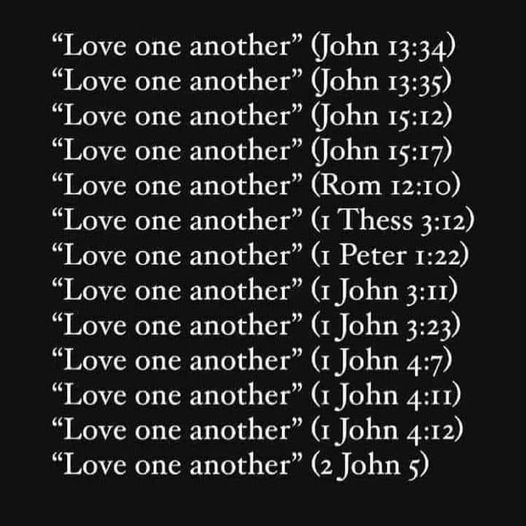
Jesus Washes the Disciples’ Feet as an Act of Final Sealing of His Mercy, His Will
“Now before the feast of the passover, when Jesus knew that his hour was come that he should depart out of this world unto the Father, having loved his own which were in the world, he loved them unto the end (to the end, to the utmost).” John 13:1
“Before the feast – Namely, on Wednesday, in the paschal week. Having loved his own – His apostles, he loved them to the end – Of his life.” John Wesley
Adam Clarke writes:
“He loved them unto the end – Continued his fervent affection towards them to his latest breath, and gave them that convincing proof of it which is mentioned Joh_13:5. That the disciples alone are meant here every man must see.”
Of these cornerstone verses of John 13, F.B. Meyer writes:
“John 13:1-11
JESUS GLORIFIES HUMBLE SERVICE
In the Temple the laver preceded the brazen altar. It was kept filled with pure water for the constant washing of the priests; Exo_30:18-21; Lev_16:4. We cannot have fellowship with Christ at Calvary or on Olivet unless we draw near with our hearts sprinkled from an evil conscience and our bodies washed with pure water.
The Synoptic Gospels tell us that on their way to the feast the disciples had yielded to contention and pride. It was needful that these should be put away, and our Lord’s love was equal to the occasion. He loved them to the end of His life and to the end of love. Only such love could have made saints and apostles out of such material.
Jesus began a work which has never ceased, and which will continue “till all the ransomed Church of God be saved to sin no more.” When we have contracted guilt, we have not to begin our whole life over again, but to go back to the place where we dropped the thread of obedience and begin there.”
May we never forget how merciful our LORD Jesus was to the woman at the well (John 4), the woman caught in the act of adultery (John 8), and the woman with the issue of blood (Luke 8).
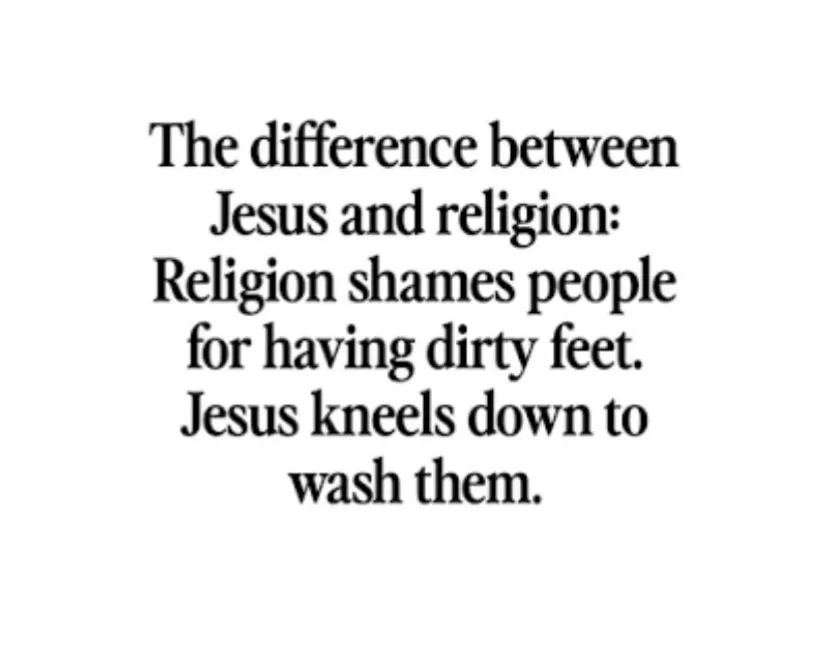
It’s of interest to note how this 13th chapter of the glorious Gospel of John begins with Christ’s love to His disciples and closes with His command for them to “love one another” as He taught and personally demonstrated to them:
“A new commandment I give unto you, That ye love one another; as I have loved you, that ye also love one another. 35 By this shall all men know that ye are my disciples, if ye have love one to another.” John 13:34-35
“When you fall in love don’t you want to shout it from the rooftops? He, the man you are in love with, is all you talk about! Should be the same with Jesus! You want to tell everyone about this man, the Savior who saved your life! Just as the woman at the well did! She told the whole city. ‘Come, and see a man, which told me all the things that ever I did: is this not the Christ?’ John 4: 28-29.” Karen Cochran
YOUR PRAYER: Father, in Jesus’ name, please reduce me to love.
Support | STORE | Podcasts | Jail/Prison Ministry | Mexico Mission here | Colossians | Upholding Jesus | H.O.T. Bible Study [podcast] | Divine Blessings | Exhort One Another Daily | The Return of Christ | The Joy of Fulfilling the Great Commission | The Love of Many Shall Wax Cold | Lie of the Ages (book) | Soul Damning Sins (small book) | Why We Need not Fear Death | Revelation Bombshell!


Antichrist
The Mission of the Spirit of Antichrist [podcast]

How do we discern the “many antichrists” operating in the church world today? (1 John 2:18)
The Antichrists are Multiplying [podcast]
Message from an Antichrist Refuted [podcast]
How the Spirit of Antichrist Works [podcast]
Our Glorious Inheritance in Christ vs Messianic Antichrists [podcast]
Antichrist or Christ? [podcast]
Antichrists Among Us [podcast]
“Woe to the inhabiters of the earth and of the sea! for the devil is come down unto you, having great wrath, because he knoweth that he hath but a short time.” Revelation 12:12
How is Satan bringing his great wrath on mankind in this last hour? Isn’t it the same way he’s always done it, yet now in an even more feverish, intensified way? Yes. His tools, his “devices” are the same—from the Garden to now! This is exactly what the Holy Ghost told us through Paul:
“There hath no temptation taken you but such as is common to man (it’s Satan’s same temptations/tactics): but God is faithful, who will not suffer you to be tempted above that ye are able; but will with the temptation also make a way to escape, that ye may be able to bear it.” 1 Corinthians 10:13
Knowing and walking in this divine knowledge will help us stop Satan from getting an advantage over our lives.
“Lest Satan should get an advantage of us: for we are not ignorant of his devices.” 2 Corinthians 2:11
In summation, “the spirit of antichrist” is Satan and exists to mislead people away from his arch enemy, the LORD Jesus Christ. This “spirit of antichrist” seeks to demote, to denigrate, and destroy the testimony of Holy Scriptures which reveal, which hold as their grand subject—Jesus Christ, born of a virgin, God Almighty, who was bodily crucified, buried, and raised again from the dead.
“The spirit of truth” vs “the spirit of error.”
“Beloved, believe not every spirit, but try the spirits whether they are of God: because many false prophets are gone out into the world.
2 Hereby know ye the Spirit of God: Every spirit that confesseth that Jesus Christ is come in the flesh is of God:
3 And every spirit that confesseth not that Jesus Christ is come in the flesh is not of God: and this is that spirit of antichrist, whereof ye have heard that it should come; and even now already is it in the world.
4 Ye are of God, little children, and have overcome them: because greater is he that is in you, than he that is in the world.
5 They are of the world: therefore speak they of the world, and the world heareth them.
6 We are of God: he that knoweth God heareth us; he that is not of God heareth not us. Hereby know we the spirit of truth, and the spirit of error.” 1 John 4:1-6
“That Spirit of Antichrist”
“Theological liberalism and religious cults (and cultists) betray themselves as ‘antichrist’ (v3) when they deny the full deity of Jesus Christ, His virgin birth, or His redemptive death and resurrection for our salvation (v 9-10; 2:2). Every departure from Biblical revelation concerning Christ opens itself up to demonic ‘spirits’ of deception (v1) because it sets aside the authority and complete trustworthiness of God’s Word.” Life in the Spirit Study Bible
“4:3 And every spirit that does not confess that Jesus Christ has come in the flesh is not of God. This is how you can detect the false teachers. They do not confess the Jesus who was described in the previous verse. This is the spirit of the Antichrist, which has been prophesied and which is now already in the world. There are many today who are willing to say acceptable things about Jesus, but they will not confess Him as God Incarnate. They will say that Christ is ‘divine,’ but not that He is God.” Believer’s Bible Commentary
“Spirit of antichrist – All the opponents of Christ’s incarnation, and consequently of his passion, death, and resurrection, and the benefits to be derived from them.” Adam Clarke
Seems to me that anyone who denies the essentials of the Messiah (virgin birth, divinity, etc.), is an “antichrist.”
Jesus told the antichrist pharisees:
“I said therefore unto you, that ye shall die in your sins: for if ye believe not that I am he, ye shall die in your sins.” John 8:24
“8:24 Jesus often used repetition for emphasis. Here He solemnly warned them again that they would die in their sins. If they steadfastly refused to believe on Him, there was no alternative. Apart from the Lord Jesus, there is no way to obtain forgiveness of sins, and those who die with sins unforgiven cannot possibly enter heaven at last. The word He is not found in this verse in the original, though it may be implied. It reads literally: ‘if ye believe not that I am he, ye shall die in your sins.’ We see in the words I am another claim to deity by the Lord Jesus.” Believer’s Bible Commentary
As was the case in the Garden, Satan’s mission is to misdirect, to remove Christ’s people from worshiping and upholding Him as the Head of His body, as the Captain of our salvation, who alone, who exclusively came as God the Word in the Flesh, Immanuel, and paid the full “It is finished” price for bringing us back to Himself and the Father from a life of sin (Matthew 1:21-3; John 1:1-4, 10, 14; 19:30). Holy Scripture informs us that “the devil is come down unto you, having great wrath, because he knoweth that he hath but a short time” (Revelation 12:12).
There are a myriad of facets, methods, mediums the prince of darkness is using in his full scale war against the Son of God. One of those methods is a changing of the words of God which is what Satan did in the very Garden of Eden which led to the fall of the first man and woman into sin. Satan cast doubt on God’s Word in order to lead the man and woman to doubt to, lose credibility in God and His Word, to weaken their resolve, and get them to not believe and obey what the LORD had stated to them in 2:17 (Genesis 3:1). Then the enemy altered what God had said (2:17) by adding a word (“not” — Genesis 3:4) This led to the fall of mankind into sin. New “bibles” equals/is apostasy and there could be no other spirit behind these corruptions of God’s words but “the spirit of antichrist” (1 John 4:3).
It’s interesting that the Bible uses the phrases “many antichrists” and also “many, which corrupt the word of God” (1 John 2:18; 2 Corinthians 2:17).
“For we are not as many, which corrupt the word of God: but as of sincerity, but as of God, in the sight of God speak we in Christ.” 2 Corinthians 2:17
There’s a direct connection between the snake in the Garden, animated by Satan, and those who question and pervert the words of God today.
“…ye have perverted the words of the living God, of the LORD of hosts our God.” Jeremiah 23:36
Perverting the words of God comes in many and various ways. His time is short and Satan is on an all-out offensive and many do not see it (1 Peter 5:8; Revelation 12:12).
How can anyone involved with, or agreeing with, or defending the changing of God’s Word be anything but an antichrist?
From our growing knowledge of God’s Word, just WHAT “spirit” do we think is behind the removal of the very “BLOOD” of Jesus from Colossians 1:14 in the new versions? Certainly we know this was “that spirit of antichrist” and surely we can conclude that is could only be “that spirit of antichrist” anointing, behind those who defend those who attack corruptions of God’s Word.
SO YOU agree with SATAN having removed the BLOOD of Jesus from Colossians 1:14? You are going to take sides with Satan himself against the Almighty you pretend to serve?
If your “bible” doesn’t have the BLOOD of Jesus in Colossians 1:14, you are now accountable. God knows you know!
The antichrists by Stacy Strother:
“I think it is worthy to mention that John is addressing the church in with this passage (1 John 4:1-3). He is warning the people, God‘s people, to be on the watch, and to be doctrinally ready to discern that antichrist spirit. I believe John is imploring the church that these antichrists are not just a bunch of people out in the world that noticeably hate God, but they are people who seem to appreciate God, who pretend to be saved. No, rather that they are coming from WITHIN the church body, serving a separate or different agenda and doctrine.
I believe the latest false doctrines that have emerged over the last 20 – 30 years are part of this antichrist spirit, which is basically a doctrine. WOF, the emergent church, IHOP, NAR and so on, all seep with the stench of this antichrist spirit.
John is telling them that they are living in the last hour and that the antichrist spirit is not just coming, it is abounding now, presently, within the professing church world.
A thought to glean from this might be that John was teaching his disciples that there would be certain doctrines come forth that might argue that Jesus left, and His kingdom is so distant that it doesn’t really affect our lives here and now. By doing this, it would leave room for the false teachers to implement a devised doctrine. Such doctrines would appear as authentic, but rather when the student of the Word peers into those false doctrines, he finds that it is actually another Jesus altogether. It is antichrist.”
Paul L. Freeman writes:
“Are we to believe the scholars when they tell us that no important doctrines are affected by the new Modern Versions? It is obvious that they are not correct. What they really mean to say is that when all the changes have been made the Bible Doctrines are still there somewhere else in the Bible. If there are ten verses showing the Virgin Birth of Christ, and they have removed two, there are still eight remaining to prove the doctrine. That may satisfy them, but the Fundamental believer sees that as a piece by piece destruction of the Word of God.
We would accuse them of taking away from the Word of God. They would accuse us of using a Bible which has many additions inserted by overzealous Christian copyists. The issue now becomes quite clear. We must either believe that overzealous heretics have corrupted the original Word of God or believe that overzealous believers have added to the original Word of God. I can understand why heretics would want to corrupt the original Word of God, but I cannot believe that Christians would add one word to the Word of God which they have been entrusted to copy and pass along. The Spirit of God within Christians would put a holy awe and reverence around the sacred word and guided by that same Spirit they would copy what God had given them. My conclusion is that the new Modern Versions are based on Greek manuscripts that have been corrupted by heretics who changed the Word of God to agree with their rejection of the Deity of Christ and their Humanism regarding salvation. The Greek Text underlying the King James Version is not filled with additions made by overzealous Christians. It is the Word of God preserved by the Spirit of God and it exalts the Lord Jesus Christ, giving him his proper place and the glory due unto his name.” | Bible Doctrines Affected by Modern Version (includes the deity of Christ maligned and attacked)
Anyone who participates in heretical doctrine or practices proves themselves to be under the control of “another spirit” which is the same devil as in the Garden of Eden, right? Read this, the Holy Spirit’s warning to us from Paul the apostles. Paul is seeing the body of Christ as Adam and Eve before they were beguiled by the serpent:
“For I am jealous over you with godly jealousy: for I have espoused you to one husband, that I may present you as a chaste virgin to Christ. 3 But I fear, lest by any means, as the serpent beguiled (deceived) Eve through his subtilty (cunning trickery), so your minds should be corrupted from the simplicity that is in Christ. 4 For if he that cometh preacheth another Jesus, whom we have not preached, or if ye receive another spirit, which ye have not received, or another gospel, which ye have not accepted, ye might well bear with him.” 2 Corinthians 11:2-4
“the simplicity that is in Christ” would be what is recorded about Christ the Messiah in God’s Word with nothing added or taken away.
- “another Jesus” – as in one that was not born of a virgin, was not God, did not die and rise bodily, etc.
- “another spirit” – that evil “spirit of antichrist” behind the denigration of Christ, the attempt to rob Him of His glory (Colossians 2:18-19).
- “another gospel” – a message, a false gospel that does not uphold Christ as that “the record” of Holy Scripture reveals Him.
Divine Commands Forbidding the Altering of God’s Words/Word
The obvious mission of Satan, “that spirit of antichrist” is to deceive and to destroy and to devour the saints of Christ. Adam and Eve were in perfect, sinless communion with God, right? Right. How did Satan derail them—get them removed from His holy presence? He simply questioned and changed the words of God.

If a person is not opposed to the desecration of “the RECORD that God gave of his Son”, such a person is against Christ. Such a person is not with but rather against the LORD—regardless of his mere profession (Matthew 12:30; Titus 1:16). Isn’t the very definition of antichrist to be opposed to or against Christ, right?
What do we call anyone pretending to be an American who “shreds the Constitution”? A traitor right? And traitors are worthy of death, right?
At this dark time in the history of Israel, the Scriptures had been lost and out of circulation among the people of God. Then they were found and read before the king, king Jehoiakim (the son of Josiah) and his servants. As a result, conviction of sin came and certain parts of God’s Word were rejected and thrown into the fire to burned and to be vanished out of their presence. Jehoiakim was a Bible burner. What he didn’t like, due to the darkness of his own heart, he thought in vain that he could just burn it and that it would go away. Not.
“My covenant will I not break, nor alter the thing that is gone out of my lips.” Psalms 89:34
This is a fascinating occurrence captured, recorded in Jeremiah 36 that is transpiring today in full scale, perpetrated by false leaders like king Jehoiakim (Ecclesiastes 1:9). Read Jeremiah 36. Remember that anyone participating in the altering of God’s words, is an antichrist.
“Whoso despiseth the word shall be destroyed: but he that feareth the commandment shall be rewarded.” Proverbs 13:13
Anyone defending the altering of God’s Word, which is what the new “bibles” have done, is under the control of a devil, the murderer who rebelled in eternity past, was cast to the earth, and began his war against God and His people by casting doubt upon and changing His words (Genesis 2:17; 3:1, 4).
If altering, changing God’s Word isn’t satanic, nothing is! See Genesis 2:17; 3:1, 4; 2 and Corinthians 2:1
New “bibles” are altered versions of God’s pure Word. They are the altering, the changing of “the RECORD that God gave of his Son”. The very premise of such is forbidden by the LORD (Deuteronomy 4:2; Jeremiah 26:2; Proverbs 30:5-6; Mark 13:31; Revelation 22:18-19). Read these carefully, prayerfully:
“Ye shall not add unto the word which I command you, neither shall ye diminish ought from it, that ye may keep the commandments of the LORD your God which I command you.” Deuteronomy 4:2
“Every word of God is pure: he is a shield unto them that put their trust in him. 6 Add thou not unto his words, lest he reprove thee, and thou be found a liar.” Proverbs 30:5-6
“… for ye have perverted the words of the living God, of the LORD of hosts our God.” Jeremiah 23:36
“Thus saith the LORD; Stand in the court of the LORD’S house, and speak unto all the cities of Judah, which come to worship in the LORD’S house, all the words that I command thee to speak unto them; diminish not a word:” Jeremiah 26:2
“Heaven and earth shall pass away: but my words shall not pass away.” Mark 13:31
“For I testify unto every man that heareth the words of the prophecy of this book, If any man shall add unto these things, God shall add unto him the plagues that are written in this book: 19 And if any man shall take away from the words of the book of this prophecy, God shall take away his part out of the book of life, and out of the holy city, and from the things which are written in this book.” Revelation 22:18-19
“Antichrist” simply means to oppose or more insidiously, to put something, anything in front of, in place of the Jesus Christ divinely testified to in “the record” of Holy Writ.
There are “many antichrists” and anyone opposing or putting something or someone (including self) in front of Christ is an idolater and in my opinion can be referred to as an antichrist.
“For many deceivers are entered into the world, who confess not that Jesus Christ is come in the flesh. This is a deceiver and an antichrist.” 2 John 1:7
Anyone defending these alterations of “the record that God gave of his Son” is under the control of “the spirit of antichrist” (1 John 4:1-3). In their allowing the very words of God to be perverted is the denial of “the record” or the recorded testimony that Jesus Christ is God.
It all goes back to what he did in the Garden (Genesis 3:1; 2:17>3:4): If you want to discern the work of Satan in this late hour and how he has “come down with great wrath,” look at the changing of God’s Word via the new versions (Revelation 12:12).
Support | STORE | Podcasts | H.O.T. Bible Study [podcast] | Bible Agnostics Exposed | How to Spot a Fake Bible [podcast] | WHAT ABOUT PEOPLE WHO CAN’T UNDERSTAND THE KJB? [podcast] | New American Standard Version “Bible” NASV Catastrophe Exposed | The Audacity of Defending the New Versions | Do We Have God’s Word or Do You Need to Know the Original Languages? [podcast] | Bible Versions Category |
Articles
Jesus Paid it All [podcast]
“by the sacrifice of himself“
“Now once in the end of the world hath he appeared to put away sin by the sacrifice of himself.” Hebrews 9:26
“ALL have sinned” against our God and so our own good works do not atone for our sins (Isaiah 64:6; Romans 3:10, 23; Ephesians 2:8-9, etc.). ONLY Jesus could and did do that for us – make the atonement that brings us back to God.

The LORD is “Holy, holy, holy” and therefore takes sin seriously (Isaiah 6:3; Revelation 4:8). The coming of Jesus to die on that cross reveals how loving God is and how personal He takes sin. The LORD therefore “appeared to put away sin by the sacrifice of himself.” The Son of God came in person to pay the full debt for the sin of mankind – “It is finished” which means paid in full (John 19:30).
Jesus “obtained eternal redemption for us” – “by his own blood.”
“Neither by the blood of goats and calves, but BY HIS OWN BLOOD he entered in once into the holy place, having obtained eternal redemption for us.” Hebrews 9:12
“And from Jesus Christ, who is the faithful witness, and the first begotten of the dead, and the prince of the kings of the earth. Unto him that loved us, and washed us from our sins IN HIS OWN BLOOD,” Revelation 1:5
“WHEN HE HAD BY HIMSELF purged our sins, sat down on the right hand of the Majesty on high.” Hebrews 1:3
ALL “BY HIMSELF” Jesus redeemed us, bought, brought us back to God by the shedding of His precious blood on that cross. Jesus needed no help: He alone was sufficient to propitiate, expiate, atone for the sins of mankind.
Jesus, I thank You for shedding Your precious blood for me and washing me afresh right now. I love You LORD Jesus!
The LORD desires to take His people “from glory to glory.” Think about that.
“But we all, with open face beholding as in a glass the glory of the Lord, are changed into the same image from glory to glory, even as by the Spirit of the Lord.” 2 Corinthians 3:18
As we seek and behold the face of our LORD, He will take us “from glory to glory” – deeper into the revelation of who He is, His eternal plan, and the inestimable blessings of the covenant He secured and ratified in His own precious blood (Matthew 26:28).
Jesus ALL “BY HIMSELF purged our sins” … Christ single handedly paid the sin debt with His perfect sacrifice on that cross – “It is finished” means paid in full (John 19:30).
“What the judiazers miss is that Jesus Fulfilled the Law at the Cross….Jesus being the perfect sacrifice was the Fulfilment.” Byron Wilson
“THE Lamb of God” has come and died, was buried, and raised again from the dead to fully justify His people, having redeemed them by the blood of his cross (Colossians 1:20)
“The next day John seeth Jesus coming unto him, and saith, Behold the Lamb of God, which taketh away the sin of the world.” John 1:29
Christ is our passover (1 Corinthians 5:7-8). The passover of the OT was a mere shadow of what Christ is the substance, the solution. The passover, the sprinkling of the blood of sacrificed lambs by the people of God was prophetic of the coming Messiah which merely prefigured what He has come and already did – shed His precious blood on that cross to redeem us from our sins (Exodus 12; 2 Corinthians 5:19-21; 1 Peter 1:15-16; 3:18). The doorposts were sprinkled/brushed with sacrificial animal blood in the shape of a cross which was a prophetic foreshadowing, prefiguring of our LORD Jesus Christ who was to come and has now come to die on that cross (Exodus 12:22-23). “It is finished” means paid in full (John 19:30). The price for your sins has been paid in full. Read Hebrews 8-10 several times prayerfully.
Why would anyone go to eternal damnation in hell when Jesus paid the full price for their sin, to bring them to Heaven? Unbelief.
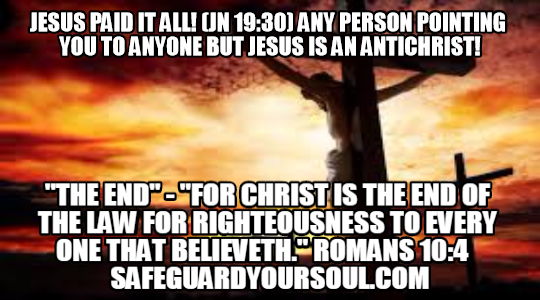
Anyone who gets saved and then doesn’t drill down into the doctrinal letters and epistles and get grounded in grace through faith justification and living, will be susceptible to being deceived by the antichrist judaizers in our midst. It will cost many of them their eternal souls. There will be not 1 law-keeping judaizing snake in Heaven. If you don’t know that, you are biblically illiterate. Romans. Galatians. Ephesians. Philippians. Colossians. Hebrews.
Dear law-keeper, Torah-keeper: Tell us all how NEW Testament saints are not justified by Christ’s sacrifice…. Tell us how we must help God out to justify us …. when the Bible declares that ALL of our own righteousnesses are as filthy rags (Isaiah 64:6).
ANY person who adds anything to salvation except Christ, is antichrist! Salvation is Jesus Christ plus nothing.
“God, who at sundry times and in divers manners spake in time past unto the fathers by the prophets, 2 Hath in these last days spoken unto us by his Son, whom he hath appointed heir of all things, by whom also he made the worlds; 3 Who being the brightness of his glory, and the express image of his person, and upholding all things by the word of his power, WHEN HE HAD BY HIMSELF purged our sins, sat down on the right hand of the Majesty on high;” Hebrews 1:1-3
Jesus sealed the New Covenant in His own blood when He died on the cross.
“For this is my blood of the new testament, which is shed for many for the remission of sins.” Matthew 26:28
Moses vs Jesus …. Every person must choose – John 1:17.
“For the law was given by Moses, but grace and truth came by Jesus Christ.” John 1:17
2 Corinthians 3 and Hebrews 8-10 contrast the infinitely superior NEW Covenant with the old covenant it replaced, superseded. Amazing! Now check out John 1:17. Moses = OLD. Jesus Christ = NEW!

Shall we be under Moses, the law, or Christ, the Gospel? Do you want the bondage of the law or the freedom of Christ, the only One to ever keep the whole law perfectly – before He nailed it to the cross and took is away?! (Colossians 2:14-19)
“Now therefore why tempt ye God, to put a yoke (the law) upon the neck of the disciples, which neither our fathers nor we were able to bear?” Acts 15:10
“Stand fast therefore in the liberty wherewith Christ hath made us free, and be not entangled again with the yoke of bondage (the law).” Galatians 5:1
Of this distinction between Moses and Jesus, law and grace, one disciple writes:
“The yoke of Moses’ law is heavy and oppressive. The yoke of the cross is easy and light. Matt 11:28-30. Why? The law cannot give one resurrection life. Rom 7:10. The cross, through faith, confers resurrection life and power on the recipient. The cross is on every page of the Bible either in type and shadow (OT) or reality (NT).
The cross and resurrection with Christ (grace) is totally antithetical to law/tradition/external observances/human effort. It astounding to see how much of the New Testament is devoted to teaching the difference in the two. Identifying Sin (behavioral management) and its consequences is addressed far far less.
Why? Because righteous living is a spontaneous byproduct of resurrection life and power. Without resurrection, the law multiplies the number of sins committed. Rom 5:20; 7:5″
If you will be planted deep into Christ, your Christology, your study of, your personal knowledge of Christ must be deep, not shallow (Colossians 2:6-10).
The Book of Hebrews!
Reading the book of Hebrews, pouring over it perhaps several times, will do wonders for your understanding and lay the foundation in New Covenant truth. In no other book of the Bible is the comparison, the contrast of the Old and New Covenants so poignantly displayed.
“But without faith it is impossible to please him: for he that cometh to God must believe that he is, and that he is a rewarder of them that diligently seek him.” Hebrews 11:6
GOD values our FAITH in HIM, most (Hebrews 11:6). Faith is a Gospel essential. It is rebellion to try to merit or do something GOD alone can and did do – paying the full, the whole, the entire, the perfect price for our sins! Christ! His cross! Faith connects us with God. Faith in Christ, His perfect sacrifice for us, appropriates His blessed salvation and all of His many benefits to those who are His. FAITH not works! (Ephesians 2:8-9)
“For by grace are ye saved through faith; and that not of yourselves: it is the gift of God: 9 Not of works, lest any man should boast. 10 For we are his workmanship, created in Christ Jesus unto good works, which God hath before ordained that we should walk in them.” Ephesians 2:8-10
Just because Jesus paid it all does not mean that Jesus doesn’t have stated conditions for receiving His gift of salvation. Repentance and faith are those conditions and true repentance and faith will be demonstrated, proved by who we love which is who we obey! (Matthew 3:7-10; Luke 9:23-24; 14:27, 33; 17:33; John 14:15; 15:14; Romans 6; James 2; 1 John 2:3-6, etc.). – “we are his workmanship, created in Christ Jesus unto good works…” (Ephesians 2:8-10)
“Now to him that worketh is the reward not reckoned of grace, but of debt. 5 But to him that worketh not, but believeth on him that justifieth the ungodly, his faith is counted for righteousness.” Romans 4:4-5
Was Christ’s sacrifice perfect? What it enough? Yes or no?
One MUST leave Christ, to depart from the only Savior, to go back to law-keeping. Such a person has denied Christ, has “fallen from grace” – is under a spirit of witchcraft, and is no longer saved (Galatians 3:3; 5:4).
The Galatia believers allowed themselves to be sucked in, to be seduced, and the result was that they fell from saving grace (Galatians 3:1-3; 5:4). They were drawn away from saving grace in Christ to law-keeping and then fell away.
Memory Verse
“Stand fast therefore in the liberty wherewith Christ hath made us free, and be not entangled again with the yoke of bondage.” Galatians 5:1
God desires that the hearts of His people be “with grace.”
“Be not carried about with divers and strange doctrines. For it is a good thing that the heart be established with grace; not with meats, which have not profited them that have been occupied therein.” Hebrews 13:9
Hebrews 8-10 contrasts the infinitely inferior Old Covenant with the infinitely superior New Covenant which was ratified in the very blood of Jesus Christ, which was merely foreshadowed under the Old Testament.
Redemption Through Christ’s Perfect Blood Sacrifice
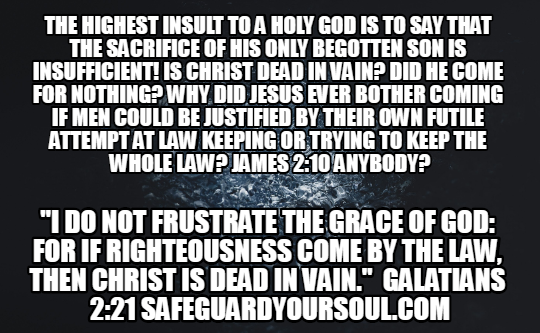
None of us is perfect. We have “ALL sinned” against our Maker (Romans 3:10, 23). And that makes us fully guilty of breaking the whole law and worthy of divine judgment (James 2:10). Only Jesus was perfect in keeping the whole law. He then nailed it to the cross and “took it out of the way.” (Colossians 2:14-19) This is the testimony, the message of Holy Scripture.
Read Romans 3-5 repeatedly.
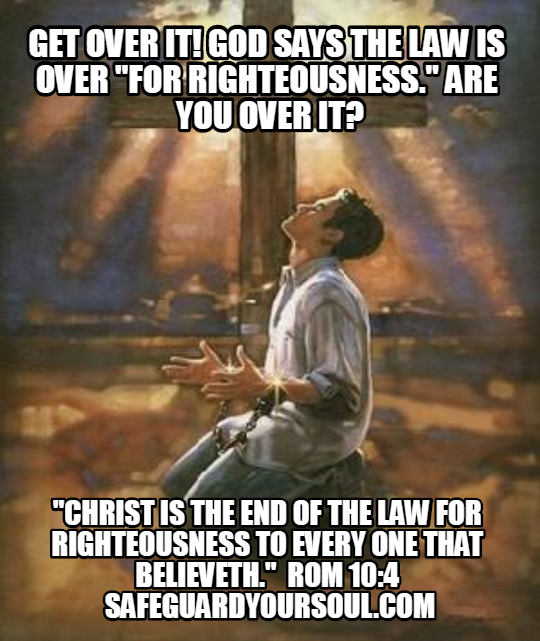
Romans 10:4 – the law is over for righteousness. “The end.”
“For Christ is the end of the law for righteousness to every one that believeth.” Romans 10:4
WHO is “the end of the law for righteousness”? “CHRIST”! (Romans 10:4)
1. The Ten commandments are the Old Covenant: Ex 34:27-28
2. The Old Covenant was abolished: Heb 8:13
3. The Ten Commandments are therefore abolished! “For righteousness” (Romans 10:4)
One disciple writes: “The law causes people to sin, people who would not otherwise have sinned without the law. Rom 5:20 (“causes transgressions to INCREASE, not decrease); 7:5 (the motions of sins which are caused by the law); all of Rom 7 which says the apart from the law sin is dead. The law revived sin in Paul’s life when it was formerly dormant. Moses’ law is a slavery and a curse which Jesus died to free us from. Rom 8:2; Gal 3:10-13. The law is the enemy of the Christian just as much as Sin and Satan are. The law kills. 2 Corinthians 3:4-7 and is a ministry of condemnation and death. 2 Cor 3. The law killed Jesus. Jn 19:7”

The keeping of a certain day, circumcision, or reenacting Jewish festivals that merely foreshadowed Him who has now come for all people, has no value. For the Jews (not NT Christians), those things were instituted and were mere “shadows” pointing to Christ Himself before He came, but now He has ALREADY COME. He completed His work perfectly and put away the law for righteousness and replaced that Old Covenant with His new covenant which is based upon better promises (Hebrew 7-10; Colossians 2:14-17; Galatians 4:1-10). This is a basic truth of New Testament Christianity and if the saint doesn’t get this in their heart, he can be vulnerable to be deceived by judaizers as we are so often specifically warned concerning.
YOU MUST CHOOSE: If you are going to be a law-keeper, you’d better not miss even one jot or tittle of the law or you are guilty of breaking it all.
“For whosoever shall keep the whole law, and yet offend in one point, he is guilty of all.” James 2:10
Or, you could repent and trust Christ who is the only One to perfectly keep the law. Then He nailed it to the cross and took it away for righteousness (Colossians 2:14-19).
DO you realize that if you are a law-keeper, you are an antichrist? You have openly denied Christ, denied His perfect sacrifice and are foolishly attempting to keep the law perfectly instead of repenting and trusting the only One who ever kept the law perfectly and then nailed it to the cross, taking it away for righteousness (Romans 10:4 Colossians 2:14-19).
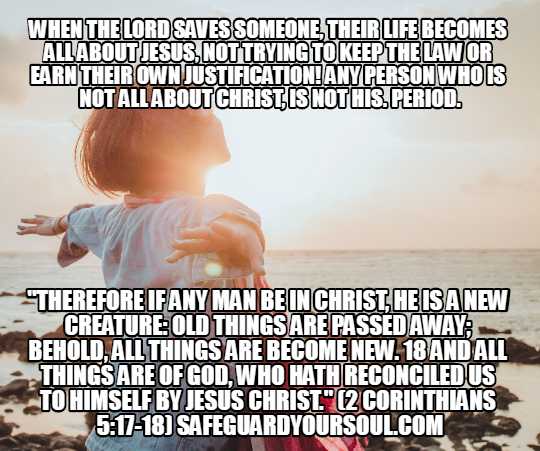
ANY person trying to keep the law to be justified in God’s eyes has no clue who the Son of God is nor why He came. They are lost. This includes all sabbath-keeping idolaters and Jewish feast keepers, etc.
Are you seeking to earn your salvation, your place with God? Or, are you trusting Christ, the only Mediator between you and God? (1 Timothy 2:5)
Obeying God after He saves us is the expression of our love for Him and not that which justifies us. HE alone justifies us. Only God Himself can justify a man and yet He set conditions. And yes, those who know Him will definitely obey Him and yet their obedience doesn’t justify them, God alone can do that. Memorize Romans 4:4-5 today.
Heather Hunter McKowen writes:
“Romans 7 says: ‘For sin, taking occasion by the commandment, deceived me, and by it slew me. 12 Wherefore the law is holy, and the commandment holy, and just, and good.”
The law reveals it is man who is full of sin, dead and in need of a Savior. The law is still a school master for those who have yet to come to the faith.
Galatians 3:
“Is the law then against the promises of God? God forbid: for if there had been a law given which could have given life, verily righteousness should have been by the law. 22 But the scripture hath concluded all under sin, that the promise by faith of Jesus Christ might be given to them that believe. 23 But before faith came, we were kept under the law, shut up unto the faith which should afterwards be revealed. 24 Wherefore the law was our schoolmaster to bring us unto Christ, that we might be justified by faith. 25 But after that faith is come, we are no longer under a schoolmaster.” Galatians 3:21-25
Support | STORE | Podcasts | Justification | “It is Finished”! | Law vs Grace |








Jesus Washes the Feet of His Own [podcast]

The Mission of the Spirit of Antichrist [podcast]

Jesus Paid it All [podcast]

“We’re Watching The Collapse of America in Real Time” [podcast]

Antichrist or Christ? [podcast]

How Has Women Leaving Their Homes Hurt Culture?

Was Jesus the “One and Only Son” OR the “Only Begotten Son”? [podcast]

“Fear hath Torment” – 100% Deliverance from all Fear! [podcast]

Jacob’s Ladder: What Does it Mean to Us? [podcast]

The Idiocy of Calvinism

Church History or the Scriptures? [podcast]

Mission Mexico Part 46 [podcast]

The Cross in the Book of Job [podcast]

Apostasy Dialogues

The Gracious LORD will Abundantly Pardon [podcast]
The Idiocy of Calvinism

The Communication of Thy Faith
Jesus Paid it All [podcast]
“Fear hath Torment” – 100% Deliverance from all Fear! [podcast]
Jacob’s Ladder: What Does it Mean to Us? [podcast]
Was Jesus the “One and Only Son” OR the “Only Begotten Son”? [podcast]

Exhort One Another Daily [podcast]

Overcoming that Old Serpent, Called the Devil, and Satan [podcast]
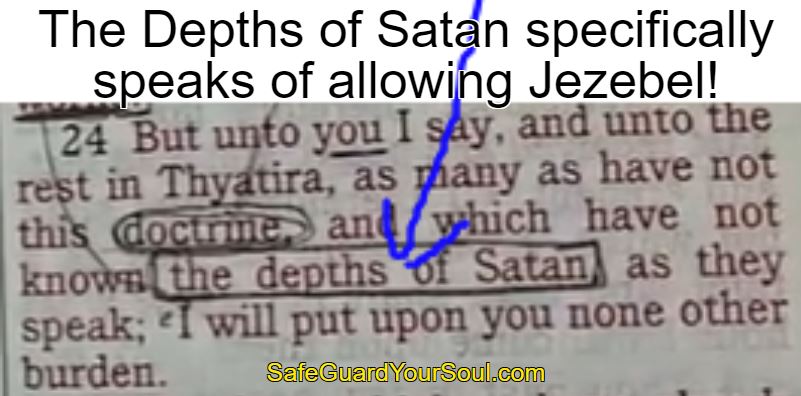
Jezebel The Depths of Satan [video]

“Seven Women shall take hold of One Man” [podcast]
Church History or the Scriptures? [podcast]

Redemption Through Christ’s Sacrifice [podcast]

“Warn them from Me”: The 3 Things Paul did to Protect God’s People [podcast]
Apostasy Dialogues
Antichrist or Christ? [podcast]
Jesus Washes the Feet of His Own [podcast]
The Mission of the Spirit of Antichrist [podcast]
Jesus Paid it All [podcast]


 America1 year ago
The Drugging of America: The Pharmakeia Sorcery Deception [podcast]
- Articles3 years ago
Children being Rescued in Tunnels: Happening Now – UPDATE!
- Articles8 years ago
Self-Examination in Preparation for the Lord’s Return
- Apostasy3 years ago
SHOCKING List of False Prophets Most Believe are True