






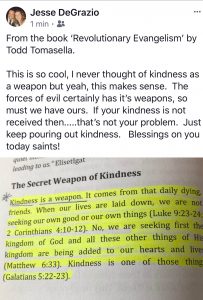
(excerpt from Revolutionary Evangelism)
“To open their eyes, and to turn them from darkness to light, and from the power of Satan unto God, that they may receive forgiveness of sins, and inheritance among them which are sanctified by faith that is in me.” Acts 26:18
 Ministry opportunities abound even as we do mundane, ordinary things. While at the laundromat, I met Derek. When he walked in the door, the LORD prompted my heart that He was going to minister to this man. As usual, I wondered how this would transpire and, yet, rested in the well-tested fact that God would arrange it if He was in it (John 3:29; 6:44).
Speaking of kindness being a soul winning weapon … about an hour had passed when Derek walked by me and I simply handed him a copy of the RIP (Rest In Peace) soul-winning Gospel tract and said, “It contains the message of the Gospel!” He stopped dead in his tracks, opened the Gospel tract and began reading. He seemed glued to it as the Holy Spirit was drawing His precious soul ‒ and obviously had been for some time.
Derek and I looked at Exodus 20. We trekked through several of the LORD’s Ten Commandments, each readily acknowledging our guilt before a holy God who is the Judge of our eternal souls (Romans 3). We discussed how our sin separates us from our “Holy, holy, holy,” Maker (Isaiah 6:3; 59:1-2; Revelation 4:8).
Other specifically named sins were discussed as we read together through lists of sins in the New Testament which clearly reveal that any person living in them is not in Christ and will not inherit the kingdom of God (1 Corinthians 6:9-10; Galatians 5:19-21).
Right in the middle of that laundromat this man and I bowed in sincere prayer to the Father and Derek laid down his life and gave it over to our LORD in faith! His life and walk with Christ had begun. On that rainy day at this local laundromat, the LORD ordained a collision between a precious 26-year-old man named Derek and one of His servants!
 Plowing the Soil of the Heart
Tilling the soil of the sinner’s heart deeply with the steel plow of the Law is an essential foundation to build upon in evangelizing lost souls. Turning up the soil of their heart is what cultivates a deep conviction which brings them to Christ (Galatians 3:24; 1 Timothy 1:7-11). The turning over of the heart soil makes for a deeply rooted seed that can germinate and produce a firmly entrenched tree. This is so very important in that the root determines the fruit.
So many will be in Hell due to the disservice done to them by Christians who did not communicate the Word of God as He told us to. Today there are millions of false converts who were misled by Christians to believe that if they uttered a magical type prayer that God was going to save their soul. Had the Law been administered to them, they’d have been deeply convicted and driven to their knees in true repentance, laying down their lives before the LORD.
We are all surrounded by false converts. There are so “many” in our midst as Jesus told us there were (Matthew 7:22-23). Sadly, they’ve been led to believe they are right with God and yet have never truly repented which Jesus says is essential to salvation (Luke 13:3, 5). In fact, over the last few years, by the grace of Christ, several precious souls have come to me to seek God in true repentance. They’d heard His Word through the ministry and realized after many years of thinking they were saved, that they simply were not born again. Remember, nothing pierces and convicts the human conscience with Holy Spirit-led conviction like the sharp edge of the Law. Please use it in God’s love. The results will be out of this world!
In His desire to bless us with the gift of repentance, the LORD has laboriously and specifically identified the sins which identify a violator’s separation from Him. This is a blessing and an essential beginning point to victory. In light of this, Derek and I read the following passages in the New Testament which name classes of sinners who will not inherit the kingdom of God.
“Know ye not that the unrighteous shall not inherit the kingdom of God? Be not deceived: neither fornicators, nor idolaters, nor adulterers, nor effeminate, nor abusers of themselves with mankind, 9 Nor thieves, nor covetous, nor drunkards, nor revilers, nor extortioners, shall inherit the kingdom of God.” 1 Corinthians 6:9-10
“Now the works of the flesh are manifest, which are these; Adultery, fornication, uncleanness, lasciviousness, 20 Idolatry, witchcraft, hatred, variance, emulations, wrath, strife, seditions, heresies, 21 Envyings, murders, drunkenness, revellings, and such like: of the which I tell you before, as I have also told you in time past, that they which do such things shall not inherit the kingdom of God.” Galatians 5:19-21
“For this ye know, that no whoremonger, nor unclean person, nor covetous man, who is an idolater, hath any inheritance in the kingdom of Christ and of God.” Ephesians 5:5
The reason it is important to list the sins that establish exactly and specifically violate divine holiness, is to lay the foundation for repentance in the heart of the person to whom we are ministering. Deep conviction of sin is essential to salvation and the deeper the conviction the more certain that person is going to receive Christ and truly lay down their life in authentic repentance. For this cause, I do not rush through this time of plowing the soil of their heart, which lays the foundation for their salvation. Many have been cheated out of this blessing by a false message of cheap grace, which does not include conviction of sin, the fear of God, or repentance.
When we see that so very many among us who profess to be saved but show no manifest fruit that is consistent with a born again, abiding in Christ, disciple of the LORD Jesus, we must wonder if they were given the Law to begin with to bring that deep conviction whereby a sincere repentance can ensue. Remember that true repentance always brings forth the fruit of a life that pleases the LORD. Listen:
“But when he saw many of the Pharisees and Sadducees come to his baptism, he said unto them, O generation of vipers, who hath warned you to flee from the wrath to come? 8 Bring forth therefore fruits meet for repentance: 9 And think not to say within yourselves, We have Abraham to our father: for I say unto you, that God is able of these stones to raise up children unto Abraham. 10 And now also the axe is laid unto the root of the trees: therefore every tree which bringeth not forth good fruit is hewn down, and cast into the fire.” Matthew 3:7-10
Derek’s Prayer of Repentance
Does the Law really work to bring about deep conviction in the hearts of sinners? As a follower of Jesus who sought extensively to bring people to Him by my own influence and even using Scripture, I must say “Yes” to this question. I have personally found that the Ten Commandments work wonders in the hearts of sinners. For the first 11 years of my being saved, even using Scripture, my efforts were fruitful and blessed and, yet, not to the degree they are now and have been since beginning to use the Law to make the way for the Gospel. Beloved Derek is no exception.
The Holy Spirit and God’s Word convicted Derek in his heart.
Many believers as well as I have found and can testify that using the Law first, then the Gospel, is the best order of administrating God’s Word. This is the biblical pattern and direction and makes for successful witnessing. The LORD works this way to bring lost souls to Himself.
After going through several of the Ten Commandments with Derek, he was asked if there was any reason he couldn’t repent and receive Jesus Christ and begin his walk with the LORD right now. Derek said, “No, there’s no good reason not to receive Christ right now.”
After he received Christ, we conversed about the goodness of God and thanked Him for saving Derek. At one point, he shook his head and said, “Man, there’s a deep peace and touching affect inside of me!”
We then began to build the foundation of Christ (1 Corinthians 3:11). Derek was given Scripture such as 1 Peter 3:15 and 2 Timothy 3:16 for the LORD to begin establishing in his heart the imperative of getting into the Word of God so the LORD’s Word could get into him.
We read several more foundation-building passages of Holy Scripture, such as:
“As ye have therefore received Christ Jesus the Lord, so walk ye in him: 7 Rooted and built up in him, and stablished in the faith, as ye have been taught, abounding therein with thanksgiving.” Colossians 2:6-7
“Therefore if any man be in Christ, he is a new creature: old things are passed away; behold, all things are become new. 18 And all things are of God, who hath reconciled us to himself by Jesus Christ, and hath given to us the ministry of reconciliation.” 2 Corinthians 5:17-18.
“As newborn babes, desire the sincere milk of the word that ye may grow thereby.” 1 Peter 2:2.
“Study to shew thyself approved unto God, a workman that needeth not to be ashamed, rightly dividing the word of truth.” 2 Timothy 2:15.
Then, I asked Derek to take my King James Bible and go read two chapters. Derek took the Bible and went and sat down, and began fervently reading Psalms 51 and Proverbs 3. Twenty-five minutes later, Derek was still pouring over the Holy Scriptures!
We exchanged phone numbers and Derek agreed to be added to the Moments with Our Master email list so he could be fed and taught our LORD’s Word (2 Peter 1:2; 3:18). Brother Derek and I have conversed and prayed for one another on many occasions since Jesus saved his precious soul! Often he tells me he’s praying for me which shows how our LORD is continuing that good work He began in Derek’s life (Philippians 1:6; 2:12-13). Amen, Jesus!
Derek took a few dozen Gospel tracts with him in order to distribute them. Oh, and he already asked how he could do ministry and be in the service of our LORD!
After this all happened, I called a brother in Christ who had given $60 to the ministry the day before without which there was no fuel to run on (literally). Every gift counts and the ministry outreach is fueled by the love offerings of individuals like yourself. No group or church organization supports this New Testament work and so the gifts are life giving and enable the work of Christ.
YOUR Prayer: Holy Father, thank You for finding, convicting and saving precious souls for whom You died! Thank You for continuing that good work You have begun in the lives of those You save until the day of Christ’s soon return. Now LORD, also, please continue to equip and to use me to reach out to lost souls for whom You died and rose again. Please fill me afresh, LORD Jesus, with Your Holy Spirit, and take over and empower me as You alone can do. I lay my life in Your holy hands afresh, right here and now. Thank You for finding and saving me, LORD, and for using me to bring glory to You. In Jesus’ name, amen.
Revolutionary Evangelism (book)
“THAT REPENTANCE AND REMISSION OF SINS SHOULD BE PREACHED” [podcast]
Abiding
Top 12 Missing Essential Doctrines in the Modern Church World! [podcast]
DOES THIS SOUND LIKE YOUR “CHURCH” OR FAVORITE PREACHER? It’s real simple… if they are not preaching the cardinal doctrines of the original Gospel given to us in the New Testament, they are preaching “another gospel” and are “accursed.” (Galatians 1:6-9).
 “For MANY DECEIVERS ARE ENTERED INTO THE WORLD, who confess not that Jesus Christ is come in the flesh. This is a deceiver and an antichrist. 8 Look to yourselves, that we lose not those things which we have wrought, but that we receive a full reward. 9 Whosoever transgresseth, and abideth not in the doctrine of Christ, hath not God. He that abideth in the doctrine of Christ, he hath both the Father and the Son. 10 If there come any unto you, and bring not this doctrine, receive him not into your house, neither bid him God speed: 11 For he that biddeth him God speed is partaker of his evil deeds.” 2 John 1:7-11
Modern church wolves refuse to preach the original Gospel of Jesus Christ from the pages of Holy Scripture and in the power of the Holy Ghost. No, instead they preach sermonettes that cater to the self-worshiping idolaters they entertain and collect money from (2 Timothy 3:1-7). They don’t even use the King James Bible but rather some cheap counterfeit. Their ear-tickling topics range from healing damaged emotions, 5 love languages, best life now, recovery, learning to love yourSELF, coping platitudes, loneliness, psychobabble band aids, law of attraction, being a successful single, purpose driven delusionment, etc.
LOTS of lying going on when we have counterfeits peddling affirmation without salvation, the “promise” of things “getting better” when their prey are heading straight to hell. Especially certain social media platforms are flooded with this false gospel coming out of “Christians.” There is no sin or repentance in their message which alone identifies it as a false gospel. You see, the things that are happening to the sinners around us are allowed by God in order to lead them to repentance and yet, the counterfeits among us are assuring those sinners it’s all going to get better and never giving them the 10 Commandments to show them they are sinners (Galatians 3:24) and then, leading them to Jesus (Romans 10:9-10, 13, etc.). 10 Commandments Evangelism
In the modern church world, there is …..
No cross. No Jesus. No blood. No judgment. No sin. No repentance. No hell. No readiness for the soon return of Jesus. No Heaven. No equipping preparation for ministry. No Scripture memory. No holiness. No Messianic prophecies and their fulfillment. No Christology. No fear of God. No repentance. etc., all of which are Bible doctrines essential to salvation and/or essential to sound foundation in Christ and are missing in the modern church world.
“Study to shew thyself approved unto God, a workman that needeth not to be ashamed, rightly dividing the word of truth.” 2 Timothy 2:15
THE TOP ESSENTIAL BIBLICAL DOCTRINES NEVER HEARD IN THE APOSTATE MODERN CHURCH WORLD!
- The divinity of Jesus Christ (John 1:1-4, 14; 1 Timothy 3:16). | Jesus Christ is God
- The virgin birth of the only begotten Son of God (Isaiah 7:14; Matthew 1:23). | The Virgin Birth of Jesus
- The essential precious blood of Jesus Christ (Matthew 26:28; Hebrews 9:22; 1 Peter 1:18-19). | The Blood
- The inherent fallen nature of mankind (Genesis 6:5, 12; Jeremiah 17:9; Romans 7:18). | Fallen, Sinful Man
- Worshipping God not idols (Exodus 20:3-5). | Idolatry
- The essential doctrine and necessity of repentance (Luke 13:3). | Repentance
- The Return of Christ and being ready for it (Luke 12:40; 21:34-36). | The Return
- Who Jesus is returning for and who will be shut out of His eternal kingdom (Matthew 25:1-13; Ephesians 5:25-27). | Ready for Christ’s Return
- The essential of enduring to the end to be with Christ eternally, initial and final salvation (Matthew 10:22; 24:13; Hebrews 3:6, 12-15; 10:26-30; Revelation 2:26). | Enduring to the End
- The essential daily cross, the crucified life, which Jesus required in following Him (Luke 9:23-24). | Living the Crucified Life
- Forgiving all others from the heart (Matthew 18:21-35). | Forgiveness
- Walking in God’s love (Ephesians 5:1). | The Love Walk
- Holiness – including the necessity of personal holiness (Hebrews 12:14; 1 Peter 1:15-16). | Holiness
- Judgment (Psalms 9:15-17). | Judgment
- Hell (Matthew 8:12; Mark 3:29; Luke 16:19-31). | Hell
- Fearing God (Psalms 2:11; Luke 12:4-5). | Fearing God
When’s the last time you heard verses like this in the modern church?
 “So likewise, whosoever he be of you that forsaketh not all that he hath, he cannot be my disciple.” Luke 14:33
“Whosoever shall seek to save his life shall lose it; and whosoever shall lose his life shall preserve it.” Luke 17:33
The modern church is going down in flames into the flames of hell. It cannot be reformed. Come out from it.
“And I heard another voice from heaven, saying, Come out of her, my people, that ye be not partakers of her sins, and that ye receive not of her plagues.” Revelation 18:4
In 2 Timothy 4:3 to “endure sound doctrine” means to hold oneself accountable to it. WHAT’s at the root of those who refuse to “endure sound doctrine”? – They simply do not love Jesus like He commanded them to (Matthew 22:37-39). They profess Christ as Savior and yet love self supremely and therefore serve the god of self. The Holy Ghost through Paul told us this of those who have a mere “form of godliness” in the last day resumé found in 2 Timothy 3:1-7.
Notice by divine design the very first thing he reveals is that “men shall be lovers of their own selves.” All the following evil comes out of self love, refusal to love God supremely and therefore repent, deny self, take up the cross and follow Jesus:
“This know also, that in the last days perilous times shall come. 2 For men shall be lovers of their own selves, covetous, boasters, proud, blasphemers, disobedient to parents, unthankful, unholy, 3 Without natural affection, trucebreakers, false accusers, incontinent, fierce, despisers of those that are good, 4 Traitors, heady, highminded, lovers of pleasures more than lovers of God; 5 Having a form of godliness, but denying the power thereof: from such turn away. 6 For of this sort are they which creep into houses, and lead captive silly women laden with sins, led away with divers lusts, 7 Ever learning, and never able to come to the knowledge of the truth.” 2 Timothy 3:1-7
God is toppling all the heart idols (Ezekiel 14:3)… because He’s Jealous and wants us looking to Him and not these mere men, these vile wolves, these celebrity sinners posing as His representatives (Exodus 34:14).
“For thou shalt worship no other god: for the LORD, whose name is Jealous, is a jealous God:” Exodus 34:14

Support | STORE | Podcasts | The Return of Christ | Stewardship | Apostate Modern Church Exposed | Beware of the BUZZ WORD Bandits [podcast] | Preach the Word | Wolves Exposed

Abiding
Fulfilling Your Calling [podcast]

“And say to Archippus, Take heed to the ministry which thou hast received in the Lord, that thou fulfil it.” Colossians 4:17
MINISTRY which pleases God is simply helping people know and grow in Christ for themselves – by the cross life and getting into HIS Word for themselves so they can follow HIM, not you! True ministry fosters in the hearers faith in God, not the preacher or local church organization! Read 1 Corinthians 2:1-5; 2 Corinthians 1:9; 3:5; 4:5.
Your communications and ministry are fed and fueled by your personal daily study and knowledge of God’s Word (Proverbs 22:17-21; 2 Timothy 2:15).
Ephesians 4:1-14
“I therefore, the prisoner of the Lord, beseech you that ye walk worthy of the vocation wherewith ye are called, 2 With all lowliness and meekness, with longsuffering, forbearing one another in love; 3 Endeavouring to keep the unity of the Spirit in the bond of peace. 4 There is one body, and one Spirit, even as ye are called in one hope of your calling; 5 One Lord, one faith, one baptism, 6 One God and Father of all, who is above all, and through all, and in you all. 7 But unto every one of us is given grace according to the measure of the gift of Christ. 8 Wherefore he saith, When he ascended up on high, he led captivity captive, and gave gifts unto men. 9 (Now that he ascended, what is it but that he also descended first into the lower parts of the earth? 10 He that descended is the same also that ascended up far above all heavens, that he might fill all things.) 11 And he gave some, apostles; and some, prophets; and some, evangelists; and some, pastors and teachers; 12 For the perfecting (equipping, maturing) of the saints, for the work of the ministry, for the edifying of the body of Christ: 13 Till we all come in the unity of the faith, and of the knowledge of the Son of God, unto a perfect man, unto the measure of the stature of the fulness of Christ: 14 That we henceforth be no more children, tossed to and fro, and carried about with every wind of doctrine, by the sleight of men, and cunning craftiness, whereby they lie in wait to deceive;” Ephesians 4:1-14
Ephesians | Galatians Outline | Grounded in Grace | 100’s of Christ-centered, Scripture-rich podcasts for your edification in Christ. |
Support | STORE | Podcasts | Colossians | Upholding Jesus | H.O.T. Bible Study [podcast] | Divine Blessings | Exhort One Another Daily | The Return of Christ | The Joy of Fulfilling the Great Commission | The Love of Many Shall Wax Cold | Lie of the Ages (book) | Soul Damning Sins (small book) | Why We Need not Fear Death | Revelation Bombshell!


Abiding
Swept Away in the “Strong Delusion” [podcast]

Recorded at a fellowship in Houston, Texas
God Himself personally sends a “strong delusion” to all who do not love His truth so that they WILL believe lies. He greases their pole to hell. That’s how personally He takes it when people call Him a liar by not believing His Word.
“Even him, whose coming is after the working of Satan with all power and signs and lying wonders, 10 and with all deceivableness of unrighteousness in them that perish; because they received not the love of the truth, that they might be saved. 11 And for this cause God shall send them strong delusion, that they should believe a lie: 12 that they all might be damned who believed not the truth, but had pleasure in unrighteousness.” 2 Thessalonians 2:9-12
“Beware lest any man spoil you through philosophy and vain deceit, after the tradition of men, after the rudiments of the world, and not after Christ.” Colossians 2:8
Notice “of God” and “NOT of God”
“He that is OF GOD heareth God’s words: ye therefore hear them not, because ye are NOT OF GOD.” John 8:47
Support | STORE | Podcasts | Because You Care Page | The Greatest of these is Charity | Be Ready in the Morning [podcast] | The Sure Mercies of David [podcast] | That Repentance and Remission of Sins should be Preached [podcast] | At His Feet | Prepared to be Used of God | Grace and Truth Bible School [modules] | 7 Study Guides to a Greater Foundation in Christ








Top 12 Missing Essential Doctrines in the Modern Church World! [podcast]

Fulfilling Your Calling [podcast]

Swept Away in the “Strong Delusion” [podcast]

Jesus Saved Jose! Mission Mexico Part 51

Dead, Buried, and Raised Up Daily [podcast]

Nourished Up and Enduring to the End [podcast]

Naming Names: Is It Biblical? [podcast]

Paul’s Prophetic Vision of Heretical Wolves Flooding the Church World During the Whole New Testament Era [podcast]

The Surrender of the Cross [podcast]

Sola Scriptura vs the Catholic Church and its Traditions [podcast]

“Pastors According to Mine Heart” [podcast]

Ridiculous King James Bible Corrections

Darwin’s Demise: What they don’t want You to know about Charles Darwin! [podcast]

Beware of “Private Interpretation” [podcast]

The Benefits of Knowing and Delighting in the LORD [podcast]

John Wesley on Calvinism, Once Saved Always Saved, and Conditional Security

Why Did God Give Us His Word? [podcast]
Paul’s Prophetic Vision of Heretical Wolves Flooding the Church World During the Whole New Testament Era [podcast]
Beware of “Private Interpretation” [podcast]
Naming Names: Is It Biblical? [podcast]
Top 12 Missing Essential Doctrines in the Modern Church World! [podcast]

The Flesh will Never be Reformed it Must be Crucified [podcast]

The High Treason of False Leaders [podcast]
Nourished Up and Enduring to the End [podcast]

A PLACE CALLED HELL [podcast]
“Pastors According to Mine Heart” [podcast]

Arrogant Bible Correctors Rebuked

Nicolaitan Nightmare [podcast]
Sola Scriptura vs the Catholic Church and its Traditions [podcast]

Doubt Casting Wolves Exposed
Top 12 Missing Essential Doctrines in the Modern Church World! [podcast]
Fulfilling Your Calling [podcast]
Swept Away in the “Strong Delusion” [podcast]


 America2 years ago
The Drugging of America: The Pharmakeia Sorcery Deception [podcast]
- Articles3 years ago
Children being Rescued in Tunnels: Happening Now – UPDATE!
- Articles9 years ago
Self-Examination in Preparation for the Lord’s Return
- Apostasy3 years ago
SHOCKING List of False Prophets Most Believe are True